








Binance Block 101 | Constance: How to Take Off at the Forefront of DeFi?
TechFlow Selected TechFlow Selected
Binance Block 101 | Constance: How to Take Off at the Forefront of DeFi?
"bubbles can't last forever. But you can't say DeFi is a bubble—DeFi is a very good concept."
 Navigating Web3 tides with focused insights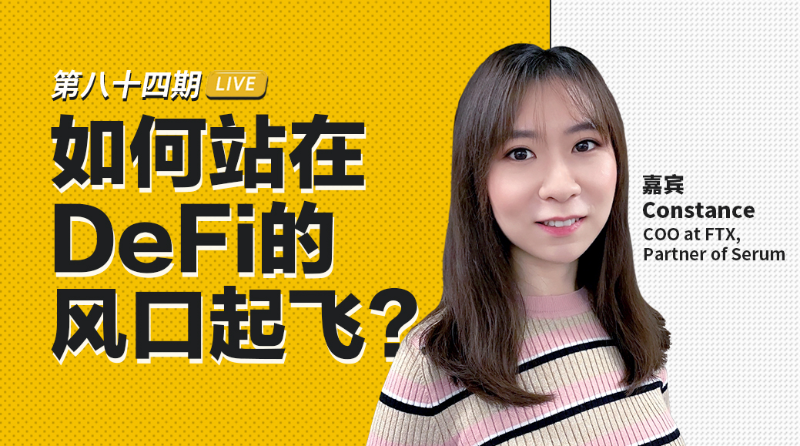
On August 20, 2020, Zora, head of Binance Taiwan community, held a live session with Constance, COO of FTX and Partner at Serum. During the livestream, Constance shared key considerations for navigating the DeFi boom and offered insights on how to identify reliable DeFi projects.
Constance believes the current DeFi surge is beneficial for technological advancement in the sector. First, it draws increasing attention to DeFi, driving industry growth. Second, more capital flows into DeFi, expanding opportunities for technical innovation. Finally, as public focus shifts toward DeFi, the entire ecosystem gains momentum. During this golden period, emphasis should be placed on real-world applications and promoting DeFi infrastructure. While DeFi may currently be in a bubble phase, once the bubble bursts and the market cools down, people will move past the allure of quick riches and begin seriously considering how DeFi can achieve real-world implementation through technology to advance the industry.
Key Insights from the Guest:
"Whether today's DeFi boom becomes a true golden era depends entirely on whether each practitioner uses this opportunity to build the industry. If we're all just here to make a quick profit and leave, there will never be any substantial, deployable products."
"We can see that today’s DeFi ecosystem generally falls into three categories: first, asset tokenization—bringing real-world assets onto the blockchain; second, decentralized exchanges; and third, lending platforms."
"Before investing, everyone must clearly understand what they’re investing in—what exactly does this project do? Are you seeking long-term or short-term returns? Every user needs to know precisely what they’re investing in—blind following should be strictly avoided."
"I believe the explosive DeFi tokens are definitely in a bubble right now. Any bubble will eventually burst—it cannot last forever. But that doesn't mean DeFi itself is a bubble. DeFi is an excellent concept."
"Centralized exchanges not only help DeFi projects grow, but DeFi projects also bring significant traffic and trading volume to centralized exchanges. More people come to centralized exchanges to trade due to the DeFi craze, generating higher trading fees and increased revenue—a symbiotic, mutually beneficial ecosystem."
"I think FOMO is psychological—people feel they’re missing out when others are making money. This emotion is easily exploited by the market. When overall market FOMO reaches a certain level, that coin takes off."
1
Binance Zora: Welcome to "Block 101." Today’s topic, the Serum project, is extremely hot. Many people in communities across Taiwan, both from primary and secondary markets, are closely watching this project. I’m personally very excited about today’s conversation with Kangkang. Hi, Kangkang.
Constance: Hi.
Binance Zora: We’ve started the livestream. Our special guest today is Constance, partner at Serum. Her background is impressive—she has financial experience in Singapore, worked in investment banking, and entered the crypto space in 2018. Please say hello to our audience and introduce yourself, Constance.
Constance: Hello everyone, I'm Constance. Many call me Kangkang or Xiao Kang.
I studied in Singapore and previously worked at Credit Suisse in risk management and legal compliance. In 2018, I joined Huobi, overseeing institutional business in the Asia-Pacific region. In 2019, I joined FTX, and in 2020, our team incubated the Serum DeFi project.
2
Binance Zora: We’ve invited Kangkang today mainly to discuss DeFi and the Serum project. Let’s start with DeFi.
On the 18th, many communities were buzzing because YFI surged in value, sparking speculation that 1 YFI might equal 1 BTC. That afternoon, YFI’s price shot up to $10,000, surpassing Bitcoin’s price.
As I mentioned, people are talking about YFI, yams, shrimps, bacon—all kinds of names, turning the market into a kind of "Happy Farm." Even Curve, an automated market maker, recently launched its token. Could you help us analyze, Kangkang, whether this DeFi frenzy is a sustainable trend or just a temporary cold-start bonus phase?
Constance: It is indeed a frenzy. From being largely ignored months ago to now having everyone acting as "farmers," this has become a popular joke within the industry.
Regarding this phenomenon, I personally believe that while these tokens have seen sharp rises and delivered outsized returns—drawing significant capital and investor attention—there are three crucial aspects to consider.
First, months ago, few paid attention to DeFi, and user numbers were minimal. Now, more people—both developers and retail traders—are focusing on DeFi projects and tokens, which is positive for industry development.
Second, large inflows of capital into DeFi are hard to judge as purely good or bad. But simply looking at where money flows reveals areas with untapped potential. The surge of funds into DeFi highlights the vast unexplored space in blockchain technology.
Third, where attention goes, the industry tends to follow. Last year, everyone focused on derivatives, leading to a rapid rise in derivative exchanges. After the dust settled, strong players remained, positively impacting the digital asset and trading industry. Similarly, with current attention on DeFi, the key question is whether it can drive broader technological and ecosystem progress.
While various "vegetables," yams, and shrimps are trending, what should we really care about? Price movements or underlying technology? Are we here for a quick profit or to advance the DeFi vision? This is something most market participants haven’t thought through. Everyone should reflect: are you chasing short-term gains or genuinely supporting the DeFi philosophy?
Regarding Zora’s question about whether this is a cold-start bonus phase—is it truly a golden opportunity? Possibly. Why? Because of the three factors I just mentioned: it brings users, capital, and attention.
Whether it becomes a golden era depends on whether practitioners seize this moment to build the industry. If everyone just aims to cash out quickly, no meaningful product will emerge.
Without real products, how can there be a cold start—or any start at all? You’d die before even beginning. The real issue is whether anyone uses this windfall—not to speculate short-term, but to realize DeFi’s vision, advance blockchain tech, and build viable, income-generating projects. That’s what matters now, not fixating on astronomical APYs.
Binance Zora: Exactly. Leveraging this initial boost to lock users into your project or technology is critical. Otherwise, companies like Didi or Meituan wouldn’t have built loyal user bases during their early subsidy phases.
We can see that today’s DeFi projects closely mirror traditional finance—whether derivatives, lending, prediction markets, insurance, stablecoins—all fall under DeFi, not just liquidity mining and lending.
Today’s DeFi ecosystem broadly breaks down into three models:
First, asset tokenization—moving real-world assets onto the blockchain;
Second, decentralized exchanges;
Third, lending platforms.
Most projects grabbing headlines today fall into exchange and lending categories—like liquidity mining, automated market makers (Uniswap), etc. Today, we’ve invited Kangkang from Serum, which approaches cryptocurrency derivatives (like SNX) and cross-chain solutions—technologies heavily focused on since 2018—spanning both asset and exchange categories.
I’m especially curious: why did you launch Serum? What are Serum’s future plans? Even if this is a cold-start golden period, the user base we target might be limited. Different projects compete for the same users. How can you effectively attract them and get them to stay?
Constance: Before answering, I want to clarify—I don’t see this as a zero-sum game.
For example, global DEX daily trading volume was around $3 million in March. A month ago, it reached about $200 million. Just before this AMA, I checked again—today’s 24-hour DEX volume is around $700 million, tripling in one month.
This shows it’s not zero-sum. DeFi still has massive room to grow. This leads to the next point: we’re not necessarily competing for the same users. As DeFi improves technically and offers better UX, new users may join DEXs and DeFi apps—becoming net additions. From this perspective, DeFi’s potential remains enormous.
Zora asked about Serum’s founding motivation. Simply put: on existing DEXs, a single trade may take 3–5 minutes and cost $2–3 in gas fees. Does your profit cover that fee? If not, what’s the purpose of the trade?
Current DEXs suffer from slow speeds and high costs—rooted in Ethereum’s limitations. Ethereum processes data slowly and charges high per-transaction fees. Building DEXs atop such infrastructure results in poor efficiency, cost, and speed.
We saw this unresolved market gap and aimed to break through with Serum.
Briefly, Serum is a DEX built on Solana. Solana processes data 10,000x faster than Ethereum, with transaction costs one-millionth as much. This allows us to build matching engines, risk engines, and order books directly on-chain.
We don’t rely on automated market makers. Market makers and users can place and cancel orders freely, just like on centralized exchanges—offering far greater flexibility than AMMs. We aim to deliver a CEX-like experience on a DEX.
While DEXs can’t yet match CEX speeds, I believe some users prefer CEXs while others favor DEXs.
With CEXs, users often ask: Is my money safe in your exchange? Is your hot wallet secure? Could your exchange be hacked? With DEXs, all assets are on-chain, order books are on-chain, every trade is recorded immutably, and users retain full control—true to blockchain’s spirit. I believe many users want to trade on such platforms.
But current platforms’ speed and cost limitations prevent efficient trading. Serum aims to push DeFi forward and improve DEX trading experiences—that’s our mission and long-term vision.
3
Binance Zora: Right. As Kangkang mentioned, Ethereum transaction fees are now around $20–30. Without sufficient capital, you’re forced to wait amid congestion. Serum is built on Solana, known for high performance and Ethereum compatibility.
We’ve seen Solana’s DeFi initiatives, like partnering with Chainlink, the decentralized oracle. I’m curious, Kangkang—why choose Solana over alternatives like EOS, TRON, or NEO, beyond high TPS, security, and compatibility?
Constance: This ties back to my earlier answer—TPS is crucial for trading. Why not EOS or TRON? Though they improve upon Ethereum, let me share some numbers.
Ethereum handles 10–20 TPS, EOS ~4,000, TRON ~2,000–3,000, Solana ~100,000. It’s like choosing between a narrow path, muddy trail, or highway—infrastructure drastically affects upper-layer products. Based on these properties, we chose Solana.
Additionally, when we first considered Serum, several partners recommended Solana. After deep discussions with the Solana team, we found their approach and mindset aligned closely with ours.
Most importantly, they clearly understood DeFi’s technical pain points and knew how to solve them. Collaborating with such a team felt like luck. Like investors who say they bet on the team, not just the product—we felt the same.
Binance Zora: Back in 2017 during the ICO craze, you often had no idea about a project’s quality—you didn’t know if it would deliver, sometimes not even seeing a prototype. All you could bet on was the team and their integrity.
Serum uses a dual-token model: SRM and MSRM. Could you explain why this structure exists, their respective roles, and how SRM’s incentive model differs from other DeFi tokens?
Constance: We split into two tokens—an unusual move, so let me explain. Think of them as big and small coins. The small one is SRM, tradable in the market. The big one is MegaSRM, abbreviated MSRM—hence “big coin.”
One MSRM equals one million SRM and inherits all SRM functionalities. Both can be staked. The key difference: only 1,000 MSRM will ever exist.
How to obtain MSRM? One way: early private sale—with 7-year lockups. Another: holding one million SRM lets you mint one MSRM. What’s MSRM’s main use? To become a Serum node, you need at least one MSRM. With only SRM, you cannot become a node.
Since only 1,000 MSRM exist, once all are created, acquiring more requires buying from the secondary market. If none are sold or all locked, you can’t get one—this scarcity is MSRM’s uniqueness.
Also, staking MSRM yields slightly higher rewards than staking SRM.
Binance Zora: Initially, one million SRM was pegged to one MSRM. Is this ratio permanently fixed? Even as SRM’s price rises, will it remain constant?
Constance: Yes, the ratio is fixed.
A few days ago, we ran a promotion: anyone staking SRM on FTX within three days of its listing would have a chance to win an MSRM. The winner was a user from Taiwan. At that time, one MSRM was worth about $2 million. I really wanted it too.
We designed this event early on. Honestly, we didn’t expect SRM to explode so fast. We wanted to reward supporters—but never imagined an MSRM would reach $2 million.
Regarding staking: whether locked or not, staking SRM or MSRM on exchanges now yields ~4% annual return.
Currently, staking happens on exchanges. Once Serum launches, the primary staking venue will shift to the Serum DEX itself.
4
Binance Zora: Returning to DeFi projects—despite recent hype, security issues are increasingly evident: smart contract vulnerabilities, price volatility of over-collateralized assets, frequent exploits in Ethereum-based DeFi. Most Ethereum DeFi protocols since 2019 operate like Lego blocks—lacking holistic integration and coordination.
To me, Serum feels like a complete Lego set—offering derivatives and cross-chain solutions in one integrated suite. Kangkang, how does Serum address systemic risks like the March 12 mass liquidation event?
Constance: Excellent question. Let me explain from an exchange perspective.
But before diving in, remember: comparing DEXs and CEXs directly isn’t fair. Compare CEX vs. CEX, DEX vs. DEX.
Within that context, let’s revisit security. On DEXs, all assets are on-chain—so theoretically, asset-related security incidents should be rarer than on CEXs.
But setting aside Serum, what are existing DEXs’ flaws? As I mentioned: slow transaction speeds and high costs.
Take the March 12 scenario. If using a current DEX, closing a position might take an hour. Watching your position near liquidation, unable to act for 60 minutes—that’s terrifying.
Even on CEXs, users panic if they can’t close positions in 5–10 seconds—imagine waiting an hour on a DEX.
This is also an asset security issue—caused by technical limits exposing users to market risks without recourse. Serum already improves significantly: our risk and matching engines process every second, vastly better than waiting 15 minutes to an hour for liquidation.
In volatile conditions, user assets are thus safer. Again, DEX speeds will never match CEXs due to on-chain decentralization. For speed-focused users, I recommend CEXs.
But if you deeply care about asset safety on CEXs, a DEX suits you better. Currently, apart from internal bugs, the main DEX issue is inadequate underlying tech—leaving users exposed during volatility without timely response options.
Thus, Serum effectively fills this market gap. We hope users try it post-launch. Our goal is continuous improvement—enhancing matching and risk engines to handle more orders per second—optimizing trading experiences during extreme market swings.
5
Binance Zora: DeFi faces systemic risks. We see claims of 100x annualized returns—“annualized” meaning tomorrow it could drop to 20%. It’s highly volatile and unstable.
Kangkang, among current DeFi projects—not just liquidity mining, but derivatives and other models—which ones do you find particularly risky? Many retail and institutional investors face unknown dangers. What should they watch out for?
Constance: If you’re a retail investor, always do thorough research before investing. Understand what the project actually does—don’t blindly follow others.
Same principle I’ve repeated since joining FTX: whether liquidity mining, altcoins, or meme coins—never invest in what you don’t understand. If you blindly jump in and lose money, don’t blame the project. Why didn’t you investigate before investing or buying?
It’s like stock trading—if you buy a stock without knowing what the company does, do you even know what you’re trading? Be responsible for your money—because it’s yours.
Whether investing long-term or short-term doesn’t matter. Some users trade frequently, in and out daily, or ride a project’s hype for weeks then exit. That’s fine—as long as you know what you’re doing.
I think the market is largely irrational, especially retail investors—drawn by outsized returns or free token drops, jumping in without thinking. I won’t judge if this is good or bad, but blind following creates opportunities for “wealth effect” scams. If everyone were rational, fewer fake coins and contracts would emerge.
Recall 2017’s ICO mania—everyone launching tokens, countless vaporware projects. Looking back, most had no value—just aiming to raise funds and disappear. Who truly benefited? So please stay清醒 and rational—the market is crazy.
Binance Zora: I recall a joke from late 2017 or early 2018: someone said, “I invested in two projects today—one I only knew the name, the other I didn’t even know the name.” I want to remind viewers: when I entered crypto, I learned an acronym—DYOR: “Do Your Own Research.”
I believe this applies not just to crypto, but any investment—stocks, real estate, anything. Always research thoroughly before investing. Only then can you take responsibility when losses occur.
Constance: A comment says, “She’s a storyteller.” Actually, my story: last year, I built exchange communities. I handled listings and community building for exchange tokens. I deeply understand retail investors’ feelings. This SRM launch is probably over 10x hotter than previous exchange token launches.
Join TechFlow official community to stay tuned
Telegram:https://t.me/TechFlowDaily
X (Twitter):https://x.com/TechFlowPost
X (Twitter) EN:https://x.com/BlockFlow_News






