








Another DeFi project has run into trouble—analysis of the BZRX IDO incident and prevention recommendations
TechFlow Selected TechFlow Selected
Another DeFi project has run into trouble—analysis of the BZRX IDO incident and prevention recommendations
This incident is neither a hacked DeFi project nor a vulnerability in a DeFi contract.
 Navigating Web3 tides with focused insights
Author | CertiK
Imagine you find out that a limited-edition pair of Jordan sneakers, the AJ series, will go on sale tonight at 6 PM. You've arrived early, set up your little stool, and secured a good spot in line, ready to grab your pair. But suddenly, you notice that several people ahead of you aren't genuine fans—they're scalpers.
These scalpers have pre-bought all remaining new AJ pairs from the store, so you quickly switch to online purchase. Unsurprisingly, just as before, without high-end hardware, specialized抢购 programs, or upgraded internet speed, you fail again—the online initial sale sells out instantly.
A pair originally priced at a few thousand RMB now resells online for over ten thousand RMB—not by official retailers, but by these scalpers.
Such scenarios may be all too familiar when you're shopping impulsively. Yet similar incidents keep happening in the blockchain space.
At 10:28 PM Beijing time on July 13, BZRX was listed on Uniswap. One user immediately used a smart contract to purchase over 1.9661 million BZRX tokens with 650 ETH—accounting for 39.3% of the BZRX in the liquidity pool. Two minutes later, the token price surged due to massive buying, and the user began a series of sell-offs, ultimately profiting 2,030 ETH and 300,000 BZRX tokens.
However, this action required the attacker to take significant cost risks (run out of gas). During the actual attack, the attacker had no certainty about which transactions would be mined and recorded into blocks by miners.
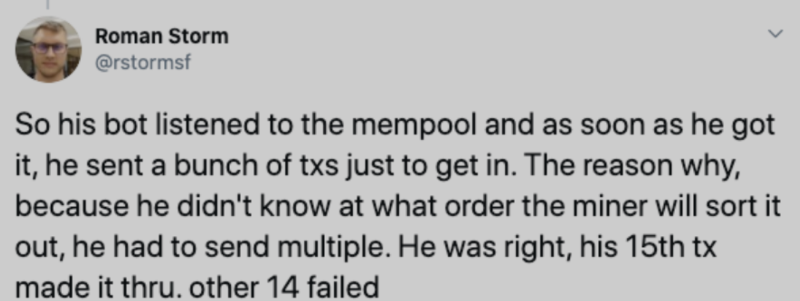
Screenshot from Roman Storm’s Twitter
According to security engineer Roman Storm's tweet, among all the BZRX sell-off transactions sent, 14 failed—and each failure incurred expensive gas fees. Of course, 15 transactions succeeded, meaning roughly a 50% success rate, indicating substantial risk during the attack.
If the attacker were buying limited AJ sneakers, every attempt would require a transaction fee deducted upfront. But not every purchase would succeed—once a purchase fails, the fee is lost.
From an operational perspective, this is more like an economic issue:
Monitor via program for BZRX listing announcement
Purchase large quantity of low-priced BZRX in single transaction
Sharply increase BZRX price
Sell BZRX multiple times
The attacker executed this sequence rapidly and profitably.
At the end of June this year, a similar event likely caught your attention: two liquidity pools on Balancer suffered flash loan attacks, resulting in $500,000 losses. After CertiK Skynet detected anomalies in the Balancer DeFi contract, we conducted analysis. For details, please refer to "Making Ether Out of Nothing: Balancer Attack Explained" and "Does DeFi Have a Future? Balancer Attacked Again".
Immediately after BZRX was added to Uniswap’s trading list, the attacker bought a large amount. Due to Uniswap’s market mechanism, heavy purchases drive up the token price. The attacker then conducted numerous trades, selling high-priced BZRX back for ETH (each sale slightly lowering BZRX price), eventually generating substantial profits. The attack cost and final gain are shown below:
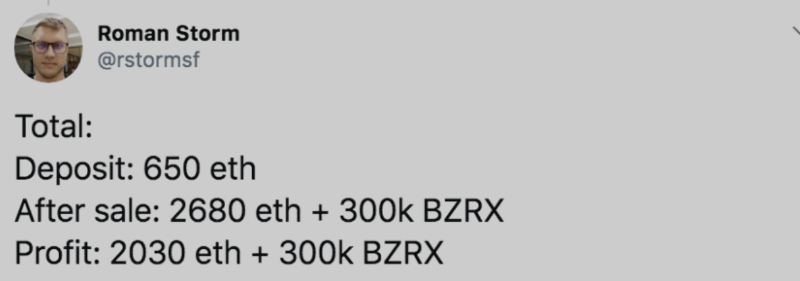
Screenshot from Roman Storm’s Twitter
Both incidents share a commonality: attackers exploited perceived "flaws" in DeFi financial models to conduct arbitrage through low-buy, high-sell strategies.
What differentiates this event from the Balancer attack is that in the latter, attackers maliciously manipulated token quantities to control prices. In contrast, here the attacker leveraged the brief window when BZRX was newly listed on Uniswap at a low price, purchasing through normal procedures to profit. Hence, Roman Storm later tweeted that the BZRX IDO incident was neither protocol exploitation nor hacking.
Yet unlike traditional smart contracts, DeFi smart contracts can suffer from financial model vulnerabilities.
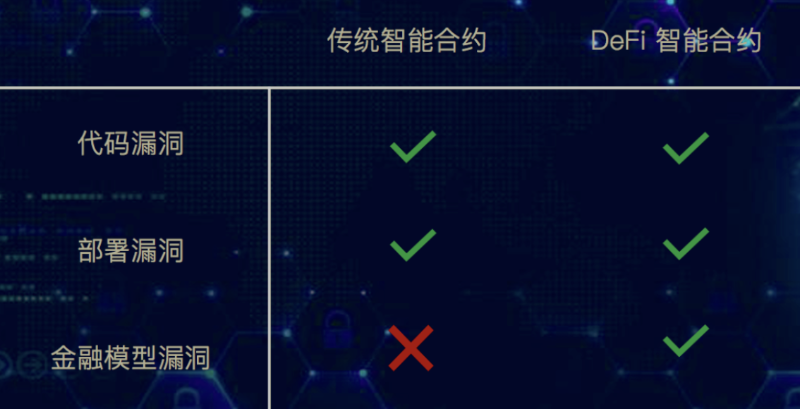
Even if code has no bugs and contract deployment is secure, issues may still arise from flaws in the financial model.
Sounds hard to defend against?
CertiK offers some basic measures to help DeFi projects prevent such issues:
When launching new tokens, reference exchange listing processes. Exchanges allocate purchase quotas based on certain metrics before public sale. Users can only buy within their quota post-launch, preventing any single user from snatching nearly 40% of new tokens and artificially inflating prices.
Adopt ring trading methods, setting trading intervals and batched releases.
Use batch auctions like dFusion or auction mechanisms such as Dutch auctions for token distribution.
This incident involved neither a hacked DeFi project nor a vulnerable contract. Yet it exposed major loopholes exploited by attackers, reflecting immaturity in DeFi’s financial design rather than technical implementation. As previously analyzed by CertiK experts, this is more of an economic issue.
Therefore, CertiK advises users to strengthen risk assessments for DeFi projects, continuously monitor for security vulnerabilities, and where necessary, engage third-party security firms to assist with penetration testing and comprehensive security defense deployment, helping identify issues arising from any cause.
Join TechFlow official community to stay tuned
Telegram:https://t.me/TechFlowDaily
X (Twitter):https://x.com/TechFlowPost
X (Twitter) EN:https://x.com/BlockFlow_News






