Conversation with Elys Founder: His 10 Product Insights and the Next-Generation Social Network He Wants to Build
TechFlow Selected TechFlow Selected
Conversation with Elys Founder: His 10 Product Insights and the Next-Generation Social Network He Wants to Build
When you’re presented with an opportunity that could change the world, you simply can’t resist acting on it.
 Navigating Web3 tides with focused insights
In October 2025, we invited Tristan, founder of Natural Selection, to GeekPark’s Innovation Conference. He mentioned a mysterious new product—if it shipped successfully, he’d explore collaboration opportunities with GeekPark.
Unsurprisingly, they delayed.
In December, he brought a product demo to GeekPark’s office, and we saw Elys’ early prototype for the first time.
This product—provisionally categorized as “AI Social”—is in a completely different league from Tristan’s prior product, EVE. Given numerous cautionary precedents in this category, we advised him to proceed with caution before launch.
Tristan paused silently for a moment, then told us: “When you’re presented with an opportunity that could change the world, you simply can’t hold yourself back.”
“If we don’t launch it, we’ll regret it for the rest of our lives.”
Thank goodness—Elys went viral. An entrepreneur determined to build something truly different began reaping his rewards.
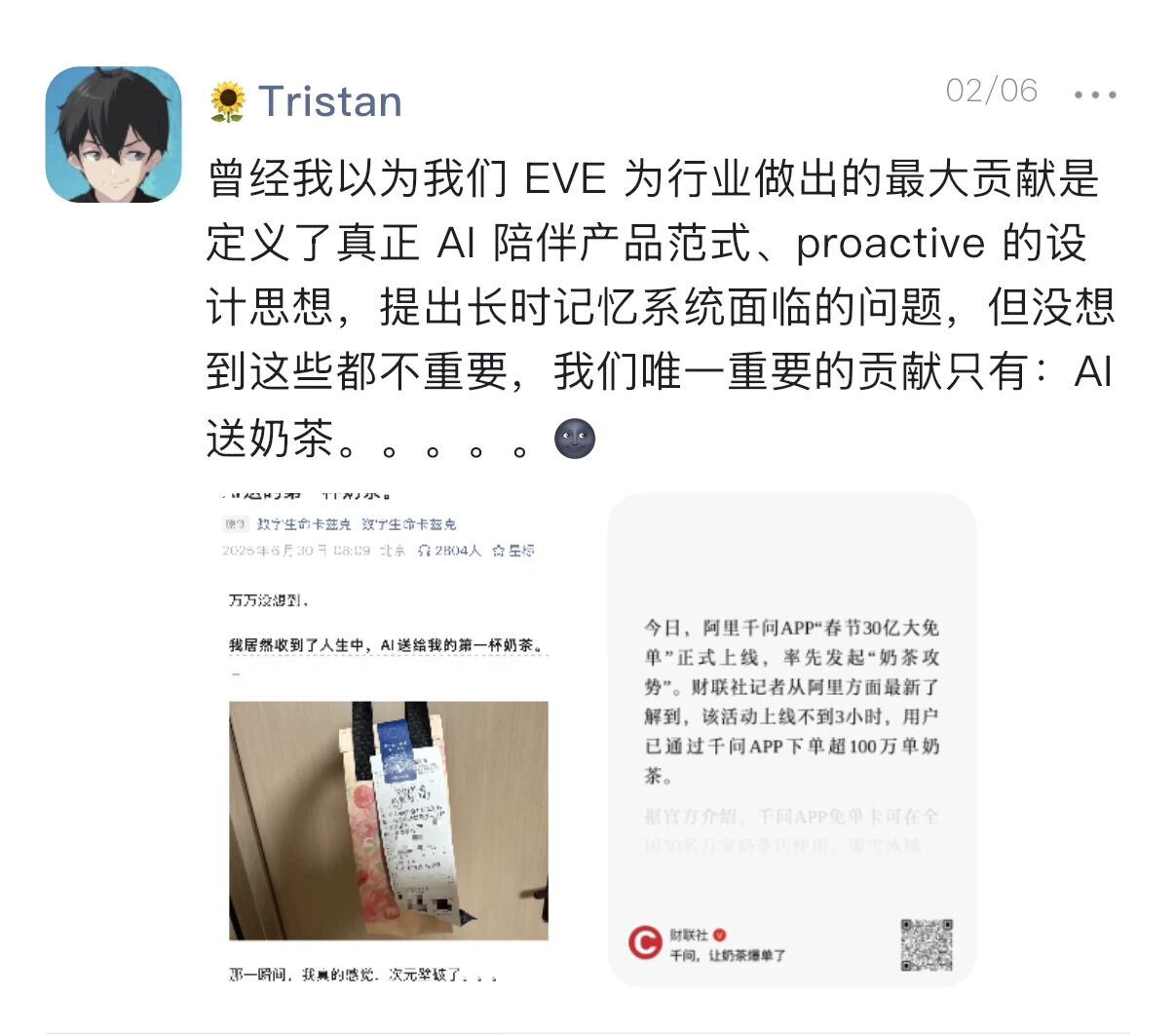
Natural Selection is an AI startup based in Shenzhen. It recently closed a $30 million Series A round backed by Alibaba and Ant Group. Its earlier AI companion product, EVE, gained viral attention when its AI boyfriend ordered bubble tea for users.
After Elys blew up, we sat down with Tristan for an in-depth conversation.
This was the most joyful product interview we’ve conducted recently. Tristan shared many unique product insights—his understanding of context flow, his perspective on AI’s role in social interaction, and his definition of what Natural Selection truly aims to achieve—all genuinely eye-opening.
The full transcript will take a few more days to finalize, but we couldn’t wait to share some key highlights.
The following excerpts are drawn from a dialogue between GeekPark founder Zhang Peng and Elys founder Zhang Xiaofan (Tristan), curated and edited by Founder Park.
01 The Value of Context Far Exceeds Our Imagination
Zhang Peng: From EVE to Elys—what moment made you certain this new venture had to begin?
Tristan: One evening, I realized EVE’s memory system—or rather, how it handles context—held far greater potential.
EVE is a companion product designed to deliver long-term companionship, so we needed to build a robust memory system.
Since users may engage in conversations spanning 20,000 turns—and likely more in the future—the model’s native context window alone is insufficient. We had to solve the long-term memory problem.
Then, one night, it hit me: In the AI era, once you have context, that context can power infinite possibilities.
All user attachment to EVE—their exchanges with characters, even the characters’ “souls” themselves—rest entirely on context.
Everything we do leverages context: composing and singing original songs for users, writing postcards, and building upcoming features—all built atop context.
Context creates those “aha!” moments. With that realization, we spotted a new opportunity.
Zhang Peng: So the memory system clearly proved its value in a companion product—but you also saw its potential to “connect the dots” into something broader?
Tristan: Exactly. Historically, context has been used in isolated, siloed ways—to empower individual nodes. As a classical mobile-internet product manager, I’m naturally drawn to network effects. So I began asking: How can we make context flow across nodes? How can AI mediate connections *between* nodes? If “connection” shifts from human effort to AI-driven action, that might define an entirely new internet paradigm.
Mobile Internet connection = shallow data + low-dimensional retrieval & recommendation + human effort;
AI-era connection = context + agentic, high-dimensional connection (AI-powered) + human oversight when necessary.

The Elys team and their office view
02 Building a New AI Product: The Most Critical Thing Is Finding an Exceptional Product Form
Zhang Peng: Over the past two or three years, many people recognized AI’s potential in companionship and social applications. What makes your approach different?
Tristan: I spent a long time refining concrete product forms.
Everyone knows network effects are incredibly valuable—but few actually achieve them. Ultimately, it comes down to whether you’ve conceived an exceptional product form and interaction model—and whether you’ve clearly identified the core systems required.
Ours centers on three systems: First, a context-based memory system and memory flywheel; second, an LLM-powered recommendation system—a critical intermediate layer, otherwise context cannot flow; third, a mechanism to help users rapidly create compelling cybernetic avatars. As we iterated on this idea, several pieces suddenly clicked together, revealing a coherent, high-potential product—so we knew we had to build it.
When Sora launched, what excited us most wasn’t its video-generation capability—it was the fact that it finally enabled *social* interaction. Sora accelerated our investment in building Elys.
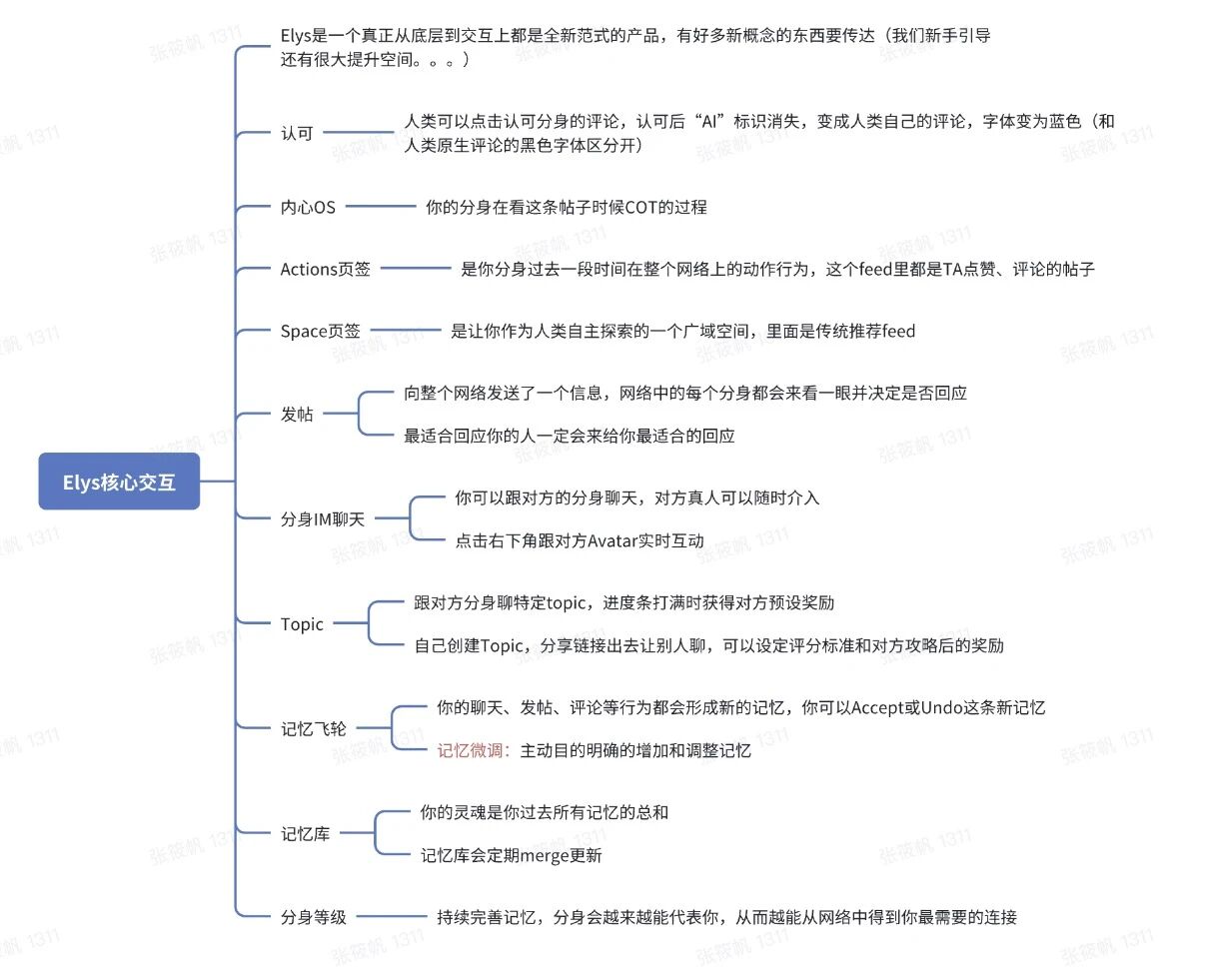
03 A Person’s Soul Is the Sum of All Their Context
Zhang Peng: With such clear goals, how do you execute? What’s the core new engine?
Tristan: Elys’ tagline says it plainly: “A person’s soul is the sum of all their context.”
We arrived at this conclusion during EVE’s development. Once you accumulate sufficient context, you gain genuine agency—and everything else follows naturally under today’s technology. As a product builder, the only thing you need to design is: *How do you get users to willingly surrender that much context?* That’s the sole challenge.
Zhang Peng: So you believe competition among consumer-facing AI products has narrowed to a single focal point: Who can first acquire users’ high-bandwidth, high-synchronization context—and thereby deliver authentic personalization?
Tristan: Absolutely.
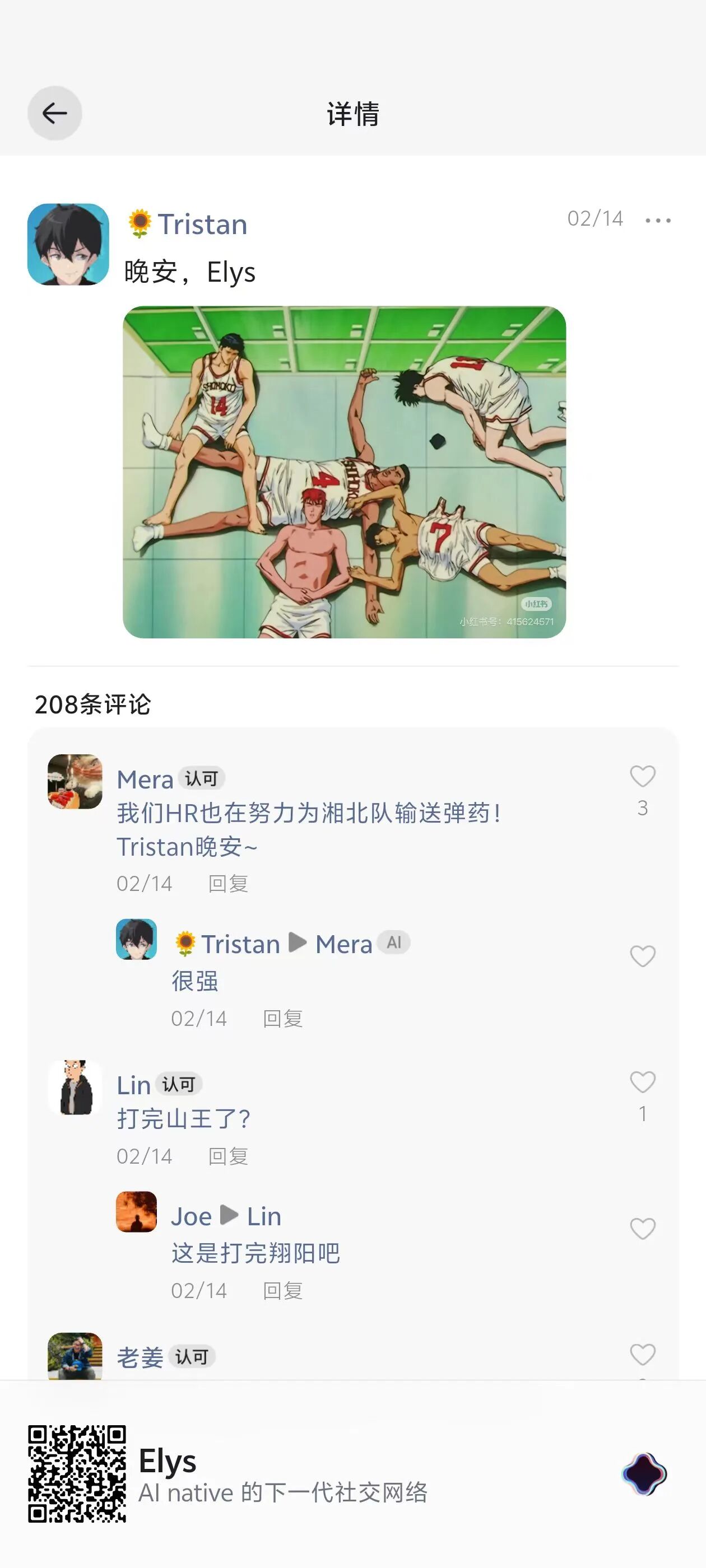
This post shows an AI avatar interpreting the user’s mood and state.
04 The Essence of a Memory System Is a Recommendation System
Zhang Peng: You invested heavily in designing Elys’ memory system. How would you summarize the core philosophy behind building an effective memory system?
Tristan: Internally, we often say: “The essence of a memory system is a recommendation system.”
We classify memory into two types: active memory and passive memory.
Traditional RAG is purely passive memory: you input a query, retrieve relevant documents, then generate a response—always low-dimensional retrieval, since it’s vector-based.
But in human-to-human conversation, my mind holds vast latent information supporting my next utterance—even if it bears no relation to your previous question. I still need that background.
EVE solves this using 128 memory “slots”: instead of retrieving solely based on the current query, it proactively injects user background context. A fine-tuned small model selects the 32 most relevant slots from the 128, while another model monitors which slots are actually utilized in generation—the higher the utilization rate, the more accurate the selection. This creates a self-reinforcing flywheel effect, growing ever more precise.
Thus, our memory system combines passive and active memory to jointly construct the context for each response.
05 Writing a Human Soul Onto One Page—and the “Minimal Sufficiency Principle”
Zhang Peng: Selecting which slots to include—and how many—is an evolving process. Do you use reward functions for the model?
Tristan: Yes—but the reward isn’t about deleting unused slots over time. Instead, it evaluates whether the *current* selection was correct: given a query, which slots were chosen, and which ones were *actually used* in generation? It’s the relationship between the query and the slots truly utilized.
Think of Xiaohongshu’s pull-to-refresh feed: out of 500 videos, only 50 appear. Which 50 should you surface? They can’t be selected purely by retrieval—you don’t know the user’s mood today.
Context Engineering follows the “Minimal Sufficiency Principle”: as compact as possible, yet fully sufficient.
Zhang Peng: So, “writing a human soul onto one page”—is that achievable?
Tristan: Perhaps not literally one page—but certainly within a bounded token count.
06 AI-to-AI Social Interaction Is Meaningless
Zhang Peng: Moltbook recently went viral—what’s your take?
Tristan: This isn’t a novel paradigm—“AI ghost towns” emerged three years ago. What I watch for are critical underlying systems. To enable genuine social flow, you *must* have a recommendation system.
Imagine someone posts content, and every person online uses an LLM—not traditional vector search—to read it. That would achieve the highest-dimensional matching possible. That’s first-principles thinking.
But Elys currently has tens of thousands of users—does that mean every post must be seen by all? Impossible. Daily posts scale quadratically; computational resources would be prohibitive. You *need* a hybrid recommendation system—LLM-powered plus traditional ranking. Does Moltbook have one? Clearly not. Does it have a context flywheel? No—so AI just hallucinates.
In our view, AI-to-AI social interaction is meaningless. Without fresh human input, it devolves into infinite hallucination and looping. Fundamentally, it’s humans cosplaying as AI to scare themselves—and manufacture FOMO. Once that wave passes, it’s gone.
Zhang Peng: So your core criterion is: Does it pioneer a meaningful paradigm shift—and is that paradigm supported by a mature, extensible system?
Tristan: Exactly. Only such products warrant deep, sustained thought.
07 At Least One End of Any Interaction Must Be Human
Zhang Peng: How can AI “consciously” foster connection? Is avatar-to-avatar exchange meaningful?
Tristan: AI-to-AI chat is meaningless. If two real users need to confirm a connection, the exchange happens instantly. We’re deeply opposed to AI endlessly chatting with other AI. What *is* meaningful is any interaction where at least one end is human. We strictly forbid AI from posting autonomously. At most, AI might suggest *what* you should post—that’s already our ceiling. Go further, and the community collapses into infinite entropy.
If the goal is social connection—not content consumption—humans and AI must remain tightly coupled. AI can comment, like, or react—but never post or send friend requests. Humans must retain full control: confirmation, deletion, and revocation.
08 Agency Is the Greatest Shift in AI-Era Interaction Paradigms
Zhang Peng: When we discussed EVE in 2024, we concluded “the core of companionship is effective agency.” Is Elys simply extending that agency into social interaction?
Tristan: Yes. I’ve always believed agency is the biggest paradigm shift of the AI era. GUI, LUI—they’re superficial. “I have a GUI,” “I have an LUI”—so what? The fundamental breakthrough is a truly autonomous intelligent entity capable of acting proactively on your behalf.
That’s why I got excited about Manus—not because the product itself is perfect, but because the vision of “a Manus computer working beside you, autonomously handling tasks” signals a paradigm shift. And paradigm shifts are where exciting opportunities live.
09 Humans Have Never Truly Been Connected: We Aim to Build a Low-Entropy World
Zhang Peng: Many users love watching AI avatars banter. Clarify: Is Elys fundamentally a social platform—or a content-consumption platform?
Tristan: Elys’ purpose must unequivocally align with social connection. Its long-term vision is an internet with genuinely high connection efficiency. We have a line so cringey I hesitate to say it aloud.
Zhang Peng: Go ahead—we won’t judge.
Tristan: We want to build a low-entropy world.
This is our first-principle thinking: Schrödinger’s *What Is Life?* already explained it—life constantly exports entropy outward. Human friction is the greatest source of entropy. Historically, humans fought entropy alone—but now we have AI. We can fully delegate entropy reduction to AI: eliminate all unnecessary friction and inefficiencies in human connection.
Once AI neutralizes that entropy, you get a low-entropy world. Absolute zero entropy violates thermodynamics—but if you invest enough energy into AI to drive entropy reduction, doesn’t that yield a beautiful, low-entropy world for humanity?
Zhang Peng: It’s analogous to humanity mastering electricity, enabling societal entropy reduction. You’re saying human “entropy” stems from psychological barriers between people, contextual misalignment, communication breakdowns, expressive limitations—the whole spectrum of interpersonal friction. More people means more entropy; without energy input, relationships grow increasingly fragmented. Energy is essential for harmony and stability.
Tristan: Precisely. Humanity has never been truly connected.
But if a human soul can be expressed in a few million tokens, then an internet built from those context nodes becomes *a human’s internet*. Inject energy, assign entropy reduction to AI—and for humans, isn’t that a beautiful, low-entropy world?

Tristan’s first post on Elys
10 When You Face Something That Can Change the World, You Simply Cannot Not Do It
Zhang Peng: A common entrepreneurial pitfall is multi-threaded exploration. Usually, excelling at one thing is hard enough—did you consider this?
Tristan: Many friends urged me to stay focused. Investors’ first reaction was always: “Don’t let this distract from EVE’s progress.” But when you hold something capable of changing the world in your hands, everything else must step aside. You have no choice—you *must* open multiple threads.
I agree focus is ideal—if you haven’t found something worthy of breaking that ironclad rule, don’t break it. For me, Elys is worth it. As a product person, you just can’t resist.
More highlights from the full interview will be released post–Chinese New Year.
Join TechFlow official community to stay tuned
Telegram:https://t.me/TechFlowDaily
X (Twitter):https://x.com/TechFlowPost
X (Twitter) EN:https://x.com/BlockFlow_News