Interview with Vitalik: Rejecting the Crypto Doomsday Scenario, Serving as the Last Line of Defense Against AI Authoritarianism
TechFlow Selected TechFlow Selected
Interview with Vitalik: Rejecting the Crypto Doomsday Scenario, Serving as the Last Line of Defense Against AI Authoritarianism
Beyond that decentralized kingdom worth hundreds of billions of dollars, he has always defended his freedom as an “ordinary person.”
 Navigating Web3 tides with focused insights
By Joe Zhou, Foresight News
“It’s been a year—Vitalik seems subtly different.”
That was the first thought that crossed my mind moments after concluding my second interview with him in Chiang Mai.
My memory flashes back to late 2024. Our first conversation took place indoors—quiet and enclosed—on Nimman Road in Chiang Mai. Back then, he was brimming with excitement about Web3 application-layer innovation, ranging from Farcaster and Polymarket to Solana and Base—a full 90-minute discussion.
This time, it’s late January 2026, a weekend in Chiang Mai, and the setting has shifted entirely to an open space.
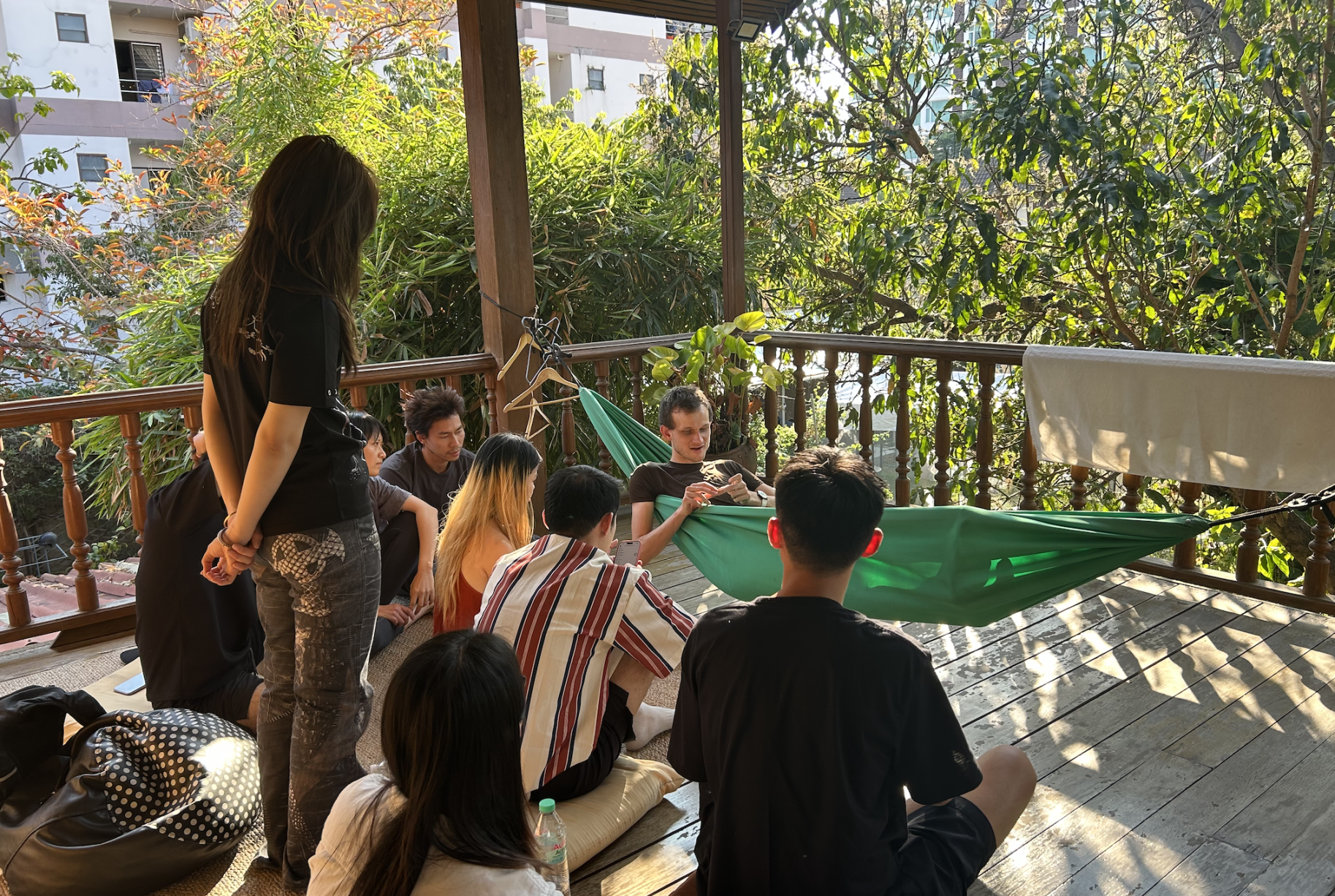
That afternoon, Vitalik strolled leisurely from the Sihai Community all the way to the 706 Community’s co-living space. On the second-floor balcony, he sat alone on a swing, swaying gently—utterly relaxed and completely at ease, indistinguishable from any other ordinary community member. I joined him on the swing, and as it rocked back and forth, I began asking him a series of questions.
Around us, community members went about their own business. There were no tight security details, no orchestrated fanfare. Soon, noticing our conversation, several curious members from the 706 Community naturally gathered around. We sat cross-legged on the floor, just like students casually chatting on a university lawn.
In the ensuing dialogue, I was struck by how substantially his thinking had evolved over the past year.
Whether on Web3 social, prediction markets, or AI, his perspective had grown sharper—and more concrete. He dissected his observations on leading projects including Polymarket, Farcaster, UMA, Chainlink, MetaDAO, and Base, and shared candid insights on Ethereum’s role in the AI era, decentralized stablecoins, and real-world assets (RWA).
Of course, much remains unchanged.
He still lives without a fixed address, never staying longer than two months in any single city; he still travels without bodyguards, happily queuing up with crowds for buffet meals in communal cafeterias; and he remains deeply passionate about decentralized communities, tirelessly moving between various hubs across Chiang Mai.
When our conversation wrapped up and night fell, the swing came to a stop. As usual, he dashed off down the street just before full darkness set in, hailing a ride-hailing car solo.
Beyond that multi-billion-dollar decentralized kingdom, he continues fiercely guarding his freedom—as an ordinary person.
Below is my latest conversation with Vitalik. At the end, we’ve also included selected questions from other 706 Community members present during the session.
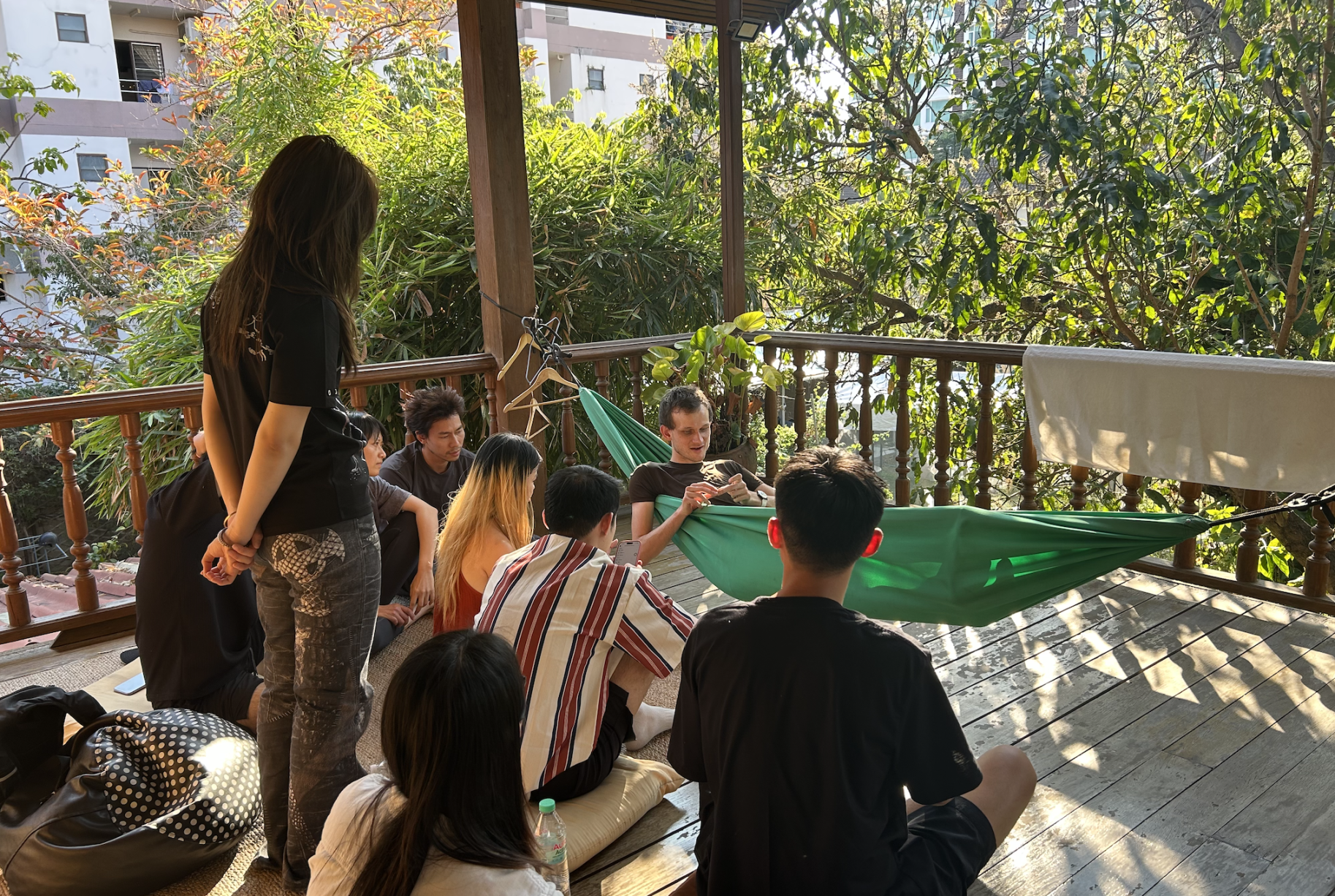
Image: Vitalik at the 706 Community in Chiang Mai
Vitalik’s Chiang Mai Reflection: Technical Mastery, Yet Applications Lost Their Way
Joe Zhou: A year ago, just before Devcon, I interviewed you in Chiang Mai for “Vitalik: Forty-Two Days in Chiang Mai.” Today, a year later, we meet again here. What new personal impressions has this return to Chiang Mai left on you?
Vitalik: I’ve seen some communities flourishing—like the Sihai Community—undergoing significant, meaningful changes. There are many events, many people—and most importantly—they haven’t become boring.
Joe Zhou: Environment and time often reshape thinking. A year apart—I’m curious: How have your frameworks for tackling crypto’s core questions evolved? Where do you anchor your attention now?
Vitalik: The biggest shift is recognizing the enormous gap between technology and applications.
Over the past year, Ethereum has made tremendous progress in scaling technology. Our gas limit rose from 30 million to 60 million, and this year’s target is 300 million. zkEVM has been successfully deployed, and wallet and other infrastructure user experiences have improved significantly—technically, progress has been highly successful.
But conversely, I see growing concerns at the application layer. Five or ten years ago, the community held diverse, ambitious visions for the entire ecosystem: building DAOs, creating genuinely decentralized applications that transform social coordination—like a “decentralized Uber.” Yet I feel many have since forgotten those original intentions.
Crypto succeeded financially—but lost its way in governance. For example, today’s DAO “token-voting” mechanisms suffer from inherent flaws. The recent explosion of memecoins exemplifies this: even Trump personally launched a meme coin early in 2025. But when he greedily issued a second token, MELANIA, his first token, TRUMP, effectively died.
Joe Zhou: Last year, we discussed SocialFi applications like Farcaster in depth. A year on, how do you assess their development from today’s vantage point?
Vitalik: SocialFi is currently in an awkward phase. Its biggest structural dilemma is this: if you tie social interaction too tightly to finance, financial incentives will inevitably overwhelm and corrode social incentives.
When users join not to access quality content but to make money, they’ll maximize returns by flooding the platform with low-quality noise. That’s a dangerous signal—the financial layer is eroding the essence of social interaction.
I admire Substack’s model. Look at Substack’s top ten authors—they’re thoughtful, high-caliber creators. But look at the top ten on certain crypto SocialFi platforms, and you’ll often find volume-chasers or hype-driven accounts. The difference? Substack invests heavily in curation and community-building—actively recruiting authors they deem high-quality and helping them migrate onto their platform—not merely offering a token-launch toolkit. That’s what crypto founders need to learn.
Joe Zhou: Does this explain Farcaster’s recent pivot—why they stopped pursuing pure social functionality and instead moved into wallets?
Vitalik: Yes. They couldn’t figure out how to scale it further. They weren’t satisfied with being “small but beautiful”—they aimed for millions, even hundreds of millions, of users. Under current trajectory analysis, they concluded the wallet space offers a more viable path toward mass adoption than pure social.
Joe Zhou: Several years ago, there was broad industry consensus that the application layer was about to explode—but that explosion never happened. Looking back four years, did you share that same optimistic expectation?
Vitalik: Yes, I did. My earlier thinking was: applications hadn’t taken off because of hard technical constraints—insufficient scalability, slow speeds, poor UX.
But by 2025, at least on L2s, these hard technical barriers have largely been resolved. Yet embarrassingly, we still haven’t seen high-quality applications achieve widespread adoption. The only sector that truly exploded in 2025 was prediction markets—but frankly, even they revealed serious shortcomings.
Joe Zhou: What specific “problems” did you refer to?
Vitalik: If you scan Twitter discussions, Polymarket’s most promoted markets lately are things like “Which team wins next week?” or “Will Bitcoin rise or fall in one hour?” In the long term, I don’t think such short-term bets carry much social significance. Prediction markets as tools work (they function), but we need more meaningful applications.
Mechanisms with longer-term incentives would be better. Take Robin Hanson’s concept of Futarchy—I find it fascinating. Traditional governance usually involves voting for people (presidents, legislators) or voting on methods (“Should we build this road?”). Hanson’s idea flips that: voters decide only on goals (“We want GDP growth” or “We want lower unemployment”), while prediction markets determine the means. Traders, motivated by profit, stake real money to surface the most truthful data. MetaDAO is already experimenting along these lines.
Behind $70,000 in Gains: Vitalik’s “Anti-Craze” Strategy and Oracle Concerns
Joe Zhou: Do you still use Polymarket? I remember you used it quite actively last year.
Vitalik: Yes—I earned $70,000 on Polymarket last year.
Joe Zhou: What was your initial capital?
Vitalik: $440,000.
Joe Zhou: Many people lose money—how did you profit?
Vitalik: My approach is simple: I seek markets that have fallen into “crazy mode,” then bet against the craziest outcomes. For instance, a market betting whether Trump will win the Nobel Peace Prize—or markets predicting the US dollar will hit zero next year amid extreme panic. When sentiment reaches irrational “crazy mode,” I bet the opposite—and that usually pays off.
Joe Zhou: Which Polymarket categories do you typically follow? Crypto? Politics? Entertainment? Economics?
Vitalik: Politics and tech. To profit, you go where people make wildly irrational predictions—that’s where opportunities lie.
Joe Zhou: You’re Ethereum’s founder—do you have insider information? When Venezuela’s conflict broke out, netizens noticed someone seemed to know insider news in advance. Have you ever encountered anything similar?
Vitalik: Let me highlight a critical case illustrating Oracle vulnerabilities. There was a Ukraine battlefield prediction market betting whether Russian forces would “control” a particular city. The contract defined “control” as holding the city’s most important railway station—and the Oracle source was ISW’s (Institute for the Study of War) Twitter feed and map.
Then something happened: An ISW employee—either by mistake or intentionally—hacked their own organization’s system, causing their map to suddenly update, falsely showing Russian control of the station. This instantly flipped a market outcome everyone believed had only a 5% chance (nearly impossible) to 100%. Though ISW retracted the update the next day, payouts may already have occurred.
This reveals a massive problem: Current Oracle data sources—like Web2 news sites or Twitter—have dangerously low security standards. They never imagined a single tweet could determine ownership of $1 million on-chain.
Joe Zhou: That does sound crazy. You’ve pointed out some Oracle issues—how should we solve them?
Vitalik: Currently, there are two main paths to solving Oracle problems.
The first is centralized: simply trust a single company—say, Bloomberg—to deliver accurate data.
The second is token-based voting—a decentralized model. Here, governance token holders vote to determine “what is true.” UMA exemplifies this model. (Note: UMA is an Ethereum-based decentralized oracle protocol relying on token-holder votes to adjudicate data authenticity.)
But recently, confidence in UMA has declined. Critics cite a game-theoretic flaw: if large holders (“whales”) collude to manipulate votes, ordinary participants can’t resist. Within this mechanism, even if you vote truthfully but oppose the majority, the system rules against you—and you lose money. This forces everyone to follow whales’ votes—not truth.
I believe trustworthy Oracles are vital—because every DeFi application depends on them. If you want to build real-world applications—like tokenizing real estate or predicting real elections—you need an Oracle. Today, most DeFi players default to trusting Chainlink. Yet Chainlink’s mechanism is complex—and relatively centralized.
I’ve always hoped we’d eventually find a better solution.
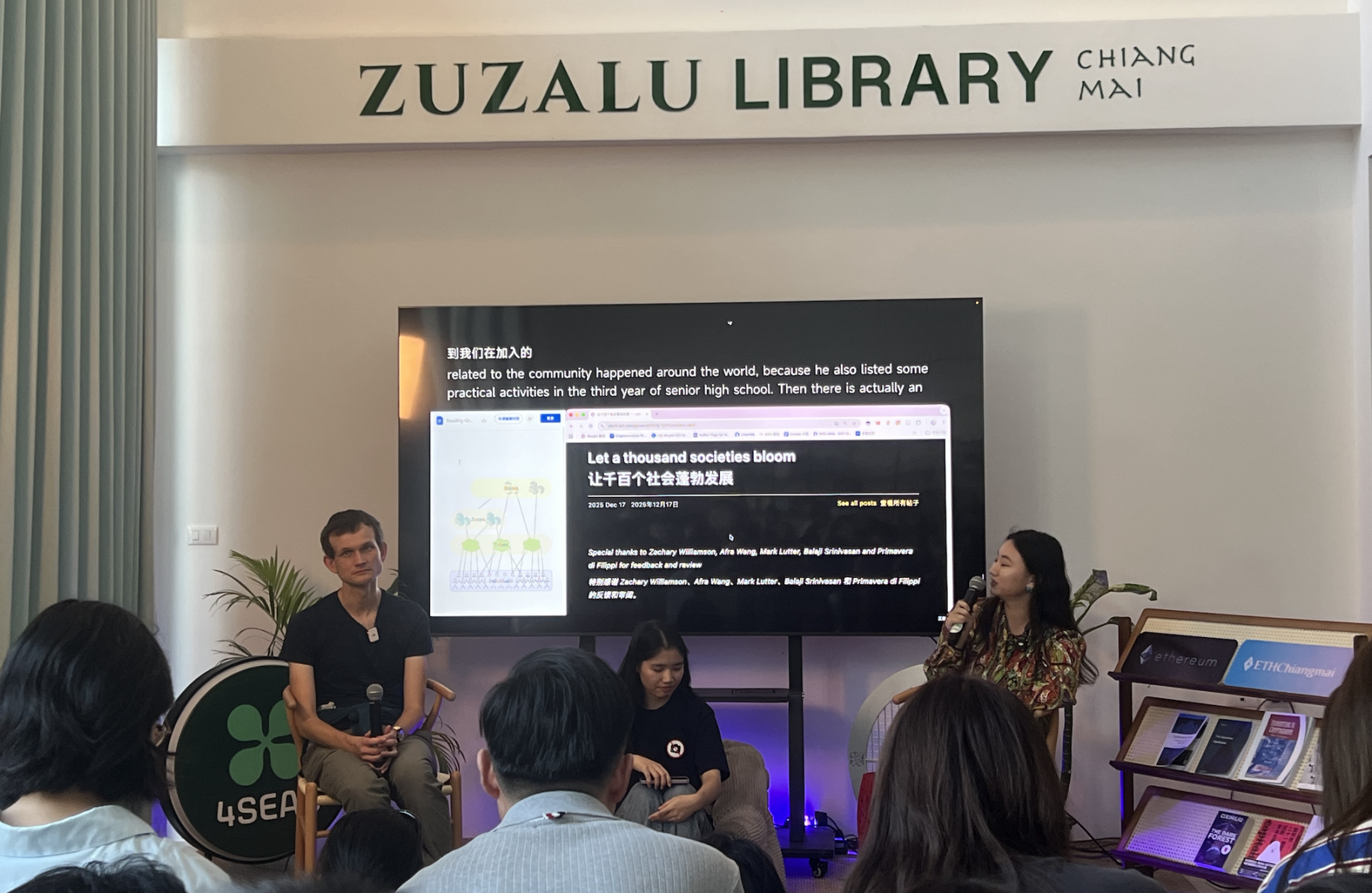
Image: Vitalik hosting a book club session at the Sihai Community in Chiang Mai
Ethereum’s Survival Strategy in the AI Era
Joe Zhou: Let’s discuss today’s hottest topic: AI. Over the past year, markets placed enormous hopes on AI-crypto convergence—but the mood has shifted toward collective confusion. In this new AI era, what role do you envision for Ethereum?
Vitalik: Fundamentally, Ethereum is a decentralized world computer. Its core attribute is “permissionlessness”—humans, corporations, and AI agents alike enjoy equal access rights. This means AI can hold assets, conduct transactions, and even participate in DAO governance on Ethereum. From this angle, Ethereum is ready.
Joe Zhou: Yet people remain confused: Where exactly do AI and crypto intersect concretely? How do we ground these grand concepts?
Vitalik: First, we must avoid a cognitive trap: Don’t force integration for integration’s sake.
Take TCP/IP—the foundational internet protocol—even in the AI era, it doesn’t require reconstruction due to AI’s emergence. Similarly, blockchain functions as a foundational trust protocol; it likely doesn’t need radical overhaul.
Still, at the application layer, there are indeed promising intersections between AI and crypto:
One: AI’s bank account. AI cannot open traditional bank accounts. If AI agents need funds to execute tasks, crypto is their only option.
Two: Prediction markets. AI can act as traders, delivering more precise information.
Three: Content authenticity. Use blockchain to verify whether content was created by humans or generated by AI.
Joe Zhou: A trendy term now is “Vibe Coding”—coding effortlessly with AI assistance, prioritizing speed over detail. Do you still write code manually?
Vitalik: Sometimes. I maintain the habit of writing code myself. My coding falls into two categories:
First, practical scripts—small programs I build for personal productivity enhancement.
Second, research validation. When exploring complex cryptographic algorithms, I implement prototypes myself—usually in Python—to verify mathematical intuitions through code.
Joe Zhou: Do you use popular AI coding tools today—like Claude, Gemini, or Manus? Which do you prefer?
Vitalik: I’m not tied to any single tool. I mainly use OpenRouter—a unified platform letting me access all models. For coding, I rely on mainstream options like ChatGPT, DeepSeek, and Gemini.
Vitalik in Dialogue with the 706 Community: On Motivation, Purpose, and Ideals
(The following is compiled from Joe Zhou’s joint interview with Vitalik and members of the 706 Community.)
706 Community: What motivates you to act today?
Vitalik: My motivation stems from three layers—or rather, three kinds of urgency.
First, avoiding crypto’s “apocalyptic script.” My greatest fear is the industry devolving into a 100% speculative trading arena—pure gambling, zero applications. If that happens, once people grow bored, the industry will quietly die of irrelevance. To prevent this, we must build genuine value: better DAOs, decentralized applications penetrating every industry, and more open DeFi.
Second, improving Ethereum’s technology. Frankly, today’s Ethereum isn’t good enough yet. While L2s solved scalability, most remain highly centralized. We need to push L2s to their utmost decentralization—and match Web2’s UX quality.
Third, if crypto fails, the future tech landscape risks total domination by centralized AI—a dangerous scenario. Crypto is our frontline defense against digital authoritarianism, preserving diversity and freedom in the technological world.
706 Community: A hypothetical question: If you could discard all of Ethereum’s historical baggage and redesign it from scratch, what would you do differently?
Vitalik: Honestly, the technical roadmap wouldn’t change much. Ethereum’s core goal remains unchanged: building a decentralized application platform.
Before blockchain existed, BitTorrent was the most successful decentralized network. It worked brilliantly—but lacked one critical component: a globally shared database (Global Shared State). So while you could share files on BitTorrent, you couldn’t create currency, prove asset ownership, or run a DAO—without state, you can’t record “who owns what.”
So if I redesigned it, to fill that gap, the platform must possess two core features: First, scalability—if transaction costs stay high, only high-value DeFi trades survive, blocking mass-market apps. Second, speed—only sufficient throughput delivers usable UX.
706 Community: As an ETH holder, I’ll ask a sharp question: What’s ETH’s biggest—and most overlooked—risk today?
Vitalik: Honestly, I’m no longer overly concerned about technical risks.
What truly worries me is the application layer. “Failure” won’t mean network downtime or hacks—it’ll mean thousands of applications get built, yet none carry real societal significance. If we wield the strongest decentralized technology but only produce toys or casinos, that’s the gravest risk.
706 Community: Looking ahead 5–10 years, what role do you envision for Ethereum?
Vitalik: I hope it becomes the central hub for all decentralized applications—not just finance, but every industry.
Its core value lies in “true ownership.” Here, if you own something, it truly belongs to you. In the traditional world, you’re perpetually subject to big corporations—they can ban you, change rules, or impose arbitrary fees. We must change that. And this change matters not just in finance, but critically in social media and identity verification too.
So Ethereum’s success hinges first on having sufficiently robust technology—scalability, UX—to reliably support these applications as a solid foundation.
706 Community: Could AI or quantum computing enable 51% attacks on Ethereum?
Vitalik: I don’t think so. Let’s clarify: A 51% attack targets PoS (Proof-of-Stake) consensus and coordination—not raw computational power—but controlling 51% of the network’s staked capital.
Quantum computing threatens cryptographic signatures—not consensus mechanisms. As for AI, I see it not as a threat but as helpful: AI can assist with formal verification, uncovering code vulnerabilities and making Ethereum safer.
706 Community Member: Are you following Hyperliquid?
Vitalik: Not really.
706 Community: You mentioned hoping for more applications—what types do you most want developers to build?
Vitalik: First, decentralized social (DeSoc). Today’s social media faces huge problems. Most dislike X (formerly Twitter), yet frustratingly lack a compelling alternative. Users are locked in, unable to “move house.” We need a truly user-owned, portable social network.
Second, “smarter” DAOs. DAOs remain a valuable concept—but we must go beyond launching tokens and holding votes. Developers need deeper reflection: What’s the organization’s precise objective? What governance structure best serves that goal? We need more experimentation—bold, novel approaches.
Third, more decentralized stablecoins would help.
706 Community: By “decentralized stablecoin,” do you mean fiat-pegged ones?
Vitalik: The most interesting part is precisely this—if we can decouple from fiat, that’s true innovation.
Joe Zhou: If not pegged to fiat, what would it anchor to?
Vitalik: Real-world value—for instance, anchoring to CPI (inflation indices), ensuring your money always buys the same amount of bread—or linking to energy prices. That’s authentic stability.
Joe Zhou: That logic sounds remarkably similar to Facebook’s old Libra project (a basket of currencies).
Vitalik: Indeed. I believe Libra’s vision was sound—but execution veered off course. They turned a decentralized currency dream into a Zuckerberg-controlled corporate product. Given Facebook’s poor privacy record, people instinctively feared it. So we need a similarly ambitious—but fully decentralized—version.
Joe Zhou: Recently, have you undertaken any interesting personal experiments—either in daily life or tech usage?
Vitalik: (Pauses thoughtfully) I’m trying to fully abandon X’s official client. Now I primarily publish and browse content via decentralized aggregation protocols like Firefly.
706 Community: What does your ideal Web3 social product look like?
Vitalik: It doesn’t need features X lacks—or new financial functions. What matters most isn’t functionality, but who uses the platform—and whether its content quality surpasses X’s.
706 Community: Most everyday users don’t care about “data sovereignty”—perhaps explaining why Web3 social hasn’t taken off. At this stage, where’s the breakthrough path?
Vitalik: Honestly, I don’t know yet.
Author’s note: Thanks to Qiuqiu and other 706 Community members for their assistance with this article.
Join TechFlow official community to stay tuned
Telegram:https://t.me/TechFlowDaily
X (Twitter):https://x.com/TechFlowPost
X (Twitter) EN:https://x.com/BlockFlow_News
 Foresight News