








Five Years Later, Vitalik Overturned His Own Vision for Ethereum’s Future
TechFlow Selected TechFlow Selected
Five Years Later, Vitalik Overturned His Own Vision for Ethereum’s Future
Just as Plasma was refuted years ago.
 Navigating Web3 tides with focused insights
By TechFlow
On February 3, 2026, Vitalik Buterin posted a statement on X.
The ripple it sent across the Ethereum community was no less significant than his 2020 advocacy for the “Rollup-centric” roadmap. In that post, Vitalik candidly stated: “The original vision of Layer 2 as ‘Branded Sharding’ to solve Ethereum’s scalability has ceased to hold.”
That single sentence effectively marked the end of Ethereum’s dominant narrative over the past five years. The Layer 2 ecosystem—once hailed as Ethereum’s lifeline and invested with immense expectations—is now confronting its most severe legitimacy crisis since inception. Harsher criticism followed swiftly: in the same post, Vitalik wrote bluntly, “If you build an EVM capable of processing 10,000 transactions per second, but connect it to L1 via a multisig bridge, you are not scaling Ethereum.”
So why has yesterday’s lifeline become today’s burden? This is not merely a technical pivot—it is a brutal contest over power, interests, and ideals. To understand it, we must go back five years.
How Did Layer 2 Become Ethereum’s Lifeline?
The answer is simple: it wasn’t a technical choice—it was a survival strategy. Let’s rewind to 2021, when Ethereum was mired in the “elitist chain” quagmire.
Data never lies: on May 10, 2021, Ethereum’s average transaction fee hit an all-time high of $53.16. During the peak of the NFT boom, gas prices surged above 500 gwei. What did that mean? A routine ERC-20 token transfer could cost dozens of dollars; swapping tokens on Uniswap could easily exceed $150—or even more.
The DeFi Summer of 2020 brought unprecedented prosperity to Ethereum: total value locked (TVL) exploded from $700 million at the start of the year to $15 billion by year-end—a growth of over 2,100%. Yet this boom came at the cost of extreme network congestion. By 2021, the NFT wave—fueled by blue-chip projects like Bored Ape Yacht Club—pushed the network further to its breaking point. Gas fees for individual NFT transactions routinely soared into the hundreds of dollars. One collector in 2021 received an offer exceeding 1,000 ETH for a Bored Ape—but abandoned the sale due to exorbitant gas costs and cumbersome transaction procedures.
Meanwhile, a challenger named Solana rose rapidly. Its numbers were staggering: throughput in the tens of thousands of transactions per second, transaction fees as low as $0.00025. Not only did the Solana community mock Ethereum’s performance—it directly attacked its architecture as bloated and inefficient. The refrain “Ethereum is dead” gained traction, and anxiety spread throughout the community.
It was against this backdrop that, in October 2020, Vitalik published “The Rollup-Centric Ethereum Roadmap,” formally proposing a vision: position Layer 2 as Ethereum’s “Branded Sharding.” At its core, this idea envisioned Layer 2 processing massive volumes of transactions off-chain, then bundling and submitting compressed results back to the mainnet—achieving theoretically infinite scalability while inheriting Ethereum’s security and censorship resistance.
At that moment, the entire Ethereum ecosystem’s future hinged almost entirely on Layer 2’s success. From the Dencun upgrade in March 2024—which introduced EIP-4844 (Proto-Danksharding) to provide Layer 2 with cheaper data availability space—to every major core developer conference, everything was aligned toward Layer 2. After Dencun, Layer 2 data publishing costs dropped by at least 90%; Arbitrum’s transaction fees plunged from ~$0.37 to $0.012. Ethereum sought to gradually recede into the background, becoming a quiet “settlement layer.”
So why hasn’t this bet paid off?
“Centralized Databases” Valued at $1.2 Billion
If Layer 2 had truly fulfilled its original vision, it wouldn’t be falling out of favor today. So what exactly went wrong?
Vitalik cut straight to the fatal flaw in his post: insufficient decentralization progress. The vast majority of Layer 2s still haven’t reached Stage 2—featuring fully decentralized fraud or validity proof systems and permissionless user withdrawals in emergencies. Instead, they remain controlled by centralized sequencers that dictate transaction ordering and packaging. In essence, they resemble centralized databases wearing blockchain costumes.
Here, the clash between commercial reality and technical idealism becomes stark. Take Arbitrum: its development company, Offchain Labs, raised $120 million in its Series B round in 2021, achieving a $1.2 billion valuation backed by top-tier firms like Lightspeed Venture Partners. Yet even today—despite managing over $15 billion in TVL and commanding ~41% of the Layer 2 market—it remains stuck at Stage 1.
Optimism’s story is equally telling. Backed by Paradigm and Andreessen Horowitz (a16z), it closed a $150 million Series B round in March 2022, bringing its cumulative funding to $268.5 million. In April 2024, a16z privately purchased $90 million worth of OP tokens. Yet despite such robust capital backing, Optimism too remains at Stage 1.
Base’s rise reveals another dimension. Launched by Coinbase as a Layer 2, Base rapidly became a market darling after its mainnet launch in August 2023. By end-2025, Base’s TVL reached $4.63 billion—capturing 46% of the entire Layer 2 market and surpassing Arbitrum as the Layer 2 with the highest DeFi TVL. Yet its decentralization is even lower: being fully controlled by Coinbase, its technical architecture aligns more closely with a centralized sidechain.
Starknet’s story is even more ironic. This ZK-Rollup built by Matter Labs has raised $458 million cumulatively—including a $200 million Series C round in November 2022 led by Blockchain Capital and Dragonfly. Yet its STRK token has lost 98% of its all-time high price, with a current market cap of ~$283 million. On-chain data shows its daily protocol revenue barely covers server operating costs—and its core nodes remain highly centralized, only reaching Stage 1 by mid-2025.
Some project teams have even admitted privately that full decentralization may never happen. Vitalik cited one such case in his post: a project argued it would never further decentralize because “regulatory requirements for its customers demand final control.” This infuriated Vitalik, who responded without restraint:
“That may be the right thing for your customers. But clearly, if you do that, you are not ‘scaling Ethereum.’”
This remark effectively sentenced every project claiming to be an Ethereum L2 while rejecting decentralization to death. Ethereum seeks a decentralized, secure extension of itself—not a cohort of vassals masquerading as Ethereum while acting centrally.
A deeper issue lies in the irreconcilable tension between decentralization and commercial interests. Centralized sequencers let project teams capture MEV (maximal extractable value), adapt flexibly to regulatory demands, and iterate products faster. Full decentralization, however, means relinquishing those controls—ceding authority to the community and validator networks. For VC-backed projects under intense growth pressure, that’s an agonizing choice.
Even if Layer 2s achieved full decentralization, would they still fall out of favor? The answer may still be yes—because Ethereum itself has changed.
When the Mainnet Outperforms Sidechains
Why does Ethereum no longer need Layer 2s for scaling?
As early as February 14, 2025, Vitalik signaled a critical shift. In his article titled “Even in an L2-Heavy Ethereum, There’s Reason to Raise the L1 Gas Limit,” he explicitly declared: “L1 is scaling.” At the time, this sounded like reassurance for L1 purists—but in hindsight, it was Ethereum’s mainnet sounding the charge to re-enter competition with Layer 2s.
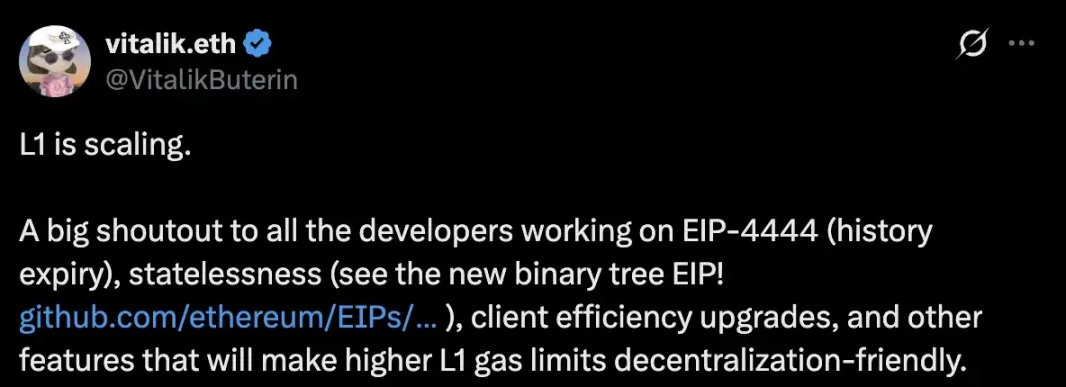
Over the past year, Ethereum L1’s scaling pace has far exceeded all expectations. Breakthroughs span multiple fronts: EIP-4444 reduces historical data storage requirements; stateless client technology lightens node operations; and most crucially, the gas limit has risen continuously. At the start of 2025, Ethereum’s gas limit stood at 30 million; by mid-year, it had climbed to 36 million—a 20% increase. This marks Ethereum’s first major gas limit hike since 2021.
But this is just the beginning. Per Ethereum core developers’ plans, two major hard forks are scheduled for 2026. The Glamsterdam upgrade will introduce perfect parallel execution, boosting the gas limit from 60 million to 200 million—an increase of over 3x. The Heze-Bogota fork will add FOCIL (Fork-Choice Enforced Inclusion Lists), further enhancing block-building efficiency and censorship resistance.
The Fusaka upgrade—completed on December 3, 2025—has already demonstrated L1 scaling’s power. Post-upgrade, Ethereum’s daily transaction volume rose ~50%, active addresses increased ~60%, and the 7-day moving average of daily transactions hit a record high of 1.87 million—surpassing the peak of the 2021 DeFi boom.
The results are striking: Ethereum mainnet transaction fees have plummeted to extremely low levels. In January 2026, Ethereum’s average transaction fee fell to $0.44—down over 99% from the $53.16 peak in May 2021. During off-peak hours, a transaction often costs less than $0.10—and sometimes as little as $0.01, with gas prices dipping to 0.119 gwei. That figure now rivals Solana’s, rapidly eroding Layer 2’s biggest cost advantage.
In his February article, Vitalik ran detailed calculations. Assuming ETH at $2,500 and gas at 15 gwei (long-term average), with demand elasticity near 1 (i.e., doubling the gas limit halves the price):
Censorship-resistance needs: Currently, forcing through an L2-censored transaction on L1 requires ~120,000 gas, costing $4.50. To bring that below $1, L1 must scale 4.5x.
Cross-L2 asset transfers: Withdrawing from one L2 to L1 (~250,000 gas) and depositing into another L2 (~120,000 gas) currently costs $13.87. An ideal optimized design would require only 7,500 gas ($0.28). To reach the $0.05 target, L1 must scale 5.5x.
Mass-exit scenarios: Take Sony’s Soneium, for example—PlayStation has ~116 million monthly active users. With an efficient exit protocol (7,500 gas per user), Ethereum can currently support emergency exits for 121 million users within one week. To support multiple applications of similar scale, L1 would need ~9x scaling.
And these scaling targets are gradually materializing in 2026. Technological progress has completely rewritten the rules. When L1 itself becomes fast and cheap, why should users endure Layer 2’s cumbersome cross-chain bridging, complex interactions, and potential security risks?
Cross-chain bridge security issues are no mere theoretical concern. In 2022, bridges became hackers’ prime targets. In February, Wormhole lost $325 million; in March, Ronin suffered the largest DeFi hack in history, losing $540 million; Meter, Qubit, and others were also compromised. According to Chainalysis, $2 billion in crypto assets were stolen from bridges in 2022—accounting for the majority of all DeFi attack losses that year.
Liquidity fragmentation is another pain point. As Layer 2 count surged, DeFi protocol liquidity dispersed across a dozen distinct chains—increasing slippage, reducing capital efficiency, and degrading user experience. Moving assets across Layer 2s forces users through complex bridging workflows, long confirmation waits, and added fees and risks.
This leads to the next—and most brutal—question: What should Layer 2 projects that raised massive funds and issued tokens do now?
Valuation Bubbles and Ghost Towns
Where did all the Layer 2 money go?
Over the past few years, the Layer 2 race resembled a massive financial game—not a technological revolution. Venture capital firms waved checks, inflating L2 valuations to astonishing heights. zkSync raised $458 million cumulatively; Arbitrum’s Offchain Labs was valued at $1.2 billion; Optimism raised $268.5 million; Starknet raised $458 million. Behind these figures stand top-tier VCs like Paradigm, a16z, Lightspeed, and Blockchain Capital.
Developers enthusiastically engaged in “matryoshka-style” deployments across different L2s—building intricate DeFi Lego sets to attract more liquidity and airdrop hunters. Meanwhile, real users were worn down by repetitive, cumbersome cross-chain operations and hidden high costs.
A harsh reality is that the market is consolidating sharply at the top. According to crypto research firm 21Shares, the three leading L2s—Base, Arbitrum, and Optimism—now command nearly 90% of transaction volume. Leveraging Coinbase’s traffic advantage and user base, Base achieved explosive growth in 2025: its TVL surged from $1 billion at year-start to $4.63 billion at year-end, with quarterly transaction volume hitting $59 billion—a 37% quarter-on-quarter increase. Arbitrum holds steady at #2 with ~$19 billion in TVL; Optimism follows closely.
Beyond the top tier, however, most L2 projects saw their genuine user counts collapse to near-zero once airdrop incentives faded—becoming literal “ghost towns.” Starknet is the quintessential example. Though its token price has fallen 98% from its peak, its P/E ratio remains absurdly inflated relative to its minuscule daily active users and fee revenue—revealing a yawning chasm between market expectations and its actual value creation.
More ironically, as Layer 2 fees dropped sharply due to EIP-4844, the data availability fees they pay to L1 also plunged—thereby reducing Ethereum L1’s fee revenue. Analysis in January 2026 indicated that the Dencun upgrade triggered a mass migration of transactions from L1 to cheaper L2s, contributing significantly to Ethereum’s network fees falling to their lowest level since 2017. While lowering their own costs, Layer 2s are simultaneously draining L1’s economic value.
In its 2026 Layer 2 outlook report, 21Shares predicts that most Ethereum Layer 2s may not survive 2026. The market will undergo brutal consolidation—only high-performance, genuinely decentralized projects with unique value propositions will emerge victorious.
This is the true intent behind Vitalik’s recent critique: to puncture the infrastructure self-congratulation bubble and douse this unhealthy market with cold water. If a Layer 2 cannot deliver functionality more compelling or valuable than L1, it will ultimately be relegated to an expensive transitional artifact in Ethereum’s history.
Ethereum Is Reclaiming Its Sovereignty
Vitalik’s latest proposal charts a new path forward for Layer 2s: abandon scalability as their sole selling point, and instead explore functional value-adds that L1 cannot—or chooses not to—provide in the short term. He specifically highlighted several directions: privacy protection (enabling on-chain private transactions via zero-knowledge proofs), application-specific optimization (e.g., for gaming, social networking, AI computation), ultra-fast transaction finality (millisecond-level, not second-level), and non-financial use cases.
In other words, Layer 2s will shift from being Ethereum’s “doppelgängers” to functionally diverse plug-ins. They won’t be the sole saviors of scalability—but rather, functional expansion layers within the Ethereum ecosystem. This represents a fundamental repositioning—and a return of power: Ethereum’s core value and sovereignty will re-anchor firmly on L1.
Vitalik also proposed a new framework: viewing Layer 2s as a spectrum—not binary categories. Different L2s can make varied trade-offs across decentralization, security guarantees, and functional features. Crucially, they must transparently communicate to users precisely what guarantees they offer—rather than all claiming to be “scaling Ethereum.”
This reckoning has already begun. Layer 2s sustained solely by inflated valuations—with no real daily active users—are facing final judgment. Those that carve out unique value propositions and achieve genuine decentralization may survive in the new landscape. Base may continue leveraging Coinbase’s traffic advantage and Web2 user acquisition to maintain leadership—but must contend with scrutiny over its insufficient decentralization. Arbitrum and Optimism must accelerate their progress toward Stage 2 to prove they’re more than centralized databases. ZK-Rollup projects like zkSync and Starknet must demonstrate the distinctive value of their zero-knowledge proof technology while dramatically improving UX and ecosystem vibrancy.
Layer 2s haven’t disappeared—but their era as Ethereum’s sole hope has definitively ended. Five years ago, cornered by competitors like Solana, Ethereum entrusted scaling to Layer 2s—and rebuilt its entire technical roadmap around them. Five years later, it discovered that the best scaling solution is simply to become stronger itself.
This isn’t betrayal—it’s growth. And those Layer 2s unable to adapt to this evolution will bear the cost. When the gas limit surges to 200 million by end-2026, when Ethereum L1 transaction fees stabilize at pennies—or less—and when users realize they no longer need to endure the complexity and risk of cross-chain bridges, the market will vote with its feet. Projects that once commanded sky-high valuations but delivered no real value to users will be forgotten by history in this great sifting.
Join TechFlow official community to stay tuned
Telegram:https://t.me/TechFlowDaily
X (Twitter):https://x.com/TechFlowPost
X (Twitter) EN:https://x.com/BlockFlow_News
 BlockBeats


