








X Offers $1 Million Prize for Outstanding Articles—What Kind of Content Ultimately Won the Money?
TechFlow Selected TechFlow Selected
X Offers $1 Million Prize for Outstanding Articles—What Kind of Content Ultimately Won the Money?
The era of pure opinion may be coming to an end.
 Navigating Web3 tides with focused insights
Author: David, TechFlow
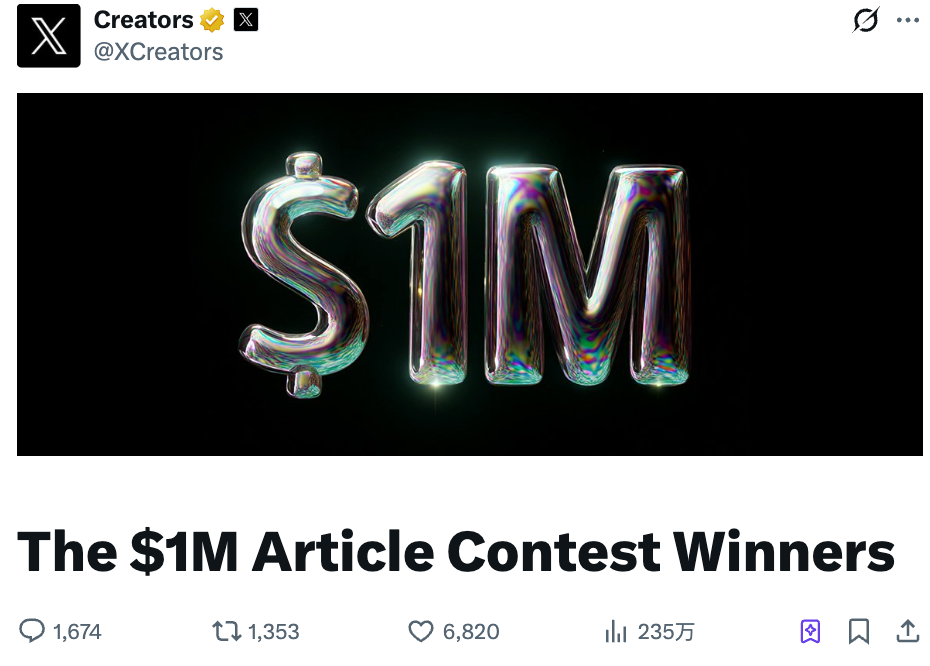
In mid-January, X announced a $1 million prize for the best-performing long-form Article on the platform.
Elon Musk personally retweeted to confirm. The rules were simple: U.S.-only participants; original English articles of at least 1,000 words; ranking determined primarily by impressions among U.S. paying users.
You may recall that just days before this content incentive program launched, personal development blogger Dan Koe published “How to Fix Your Entire Life in 1 Day,” which garnered 170 million impressions—the highest-performing Article in X’s history.
X clearly recognized the traffic potential of long-form content and moved swiftly: lowering the barrier to entry for Articles, adjusting algorithmic weights to prioritize long-form over short posts, and announcing the million-dollar writing contest.
The competition lasted two weeks, drawing tens of thousands of participants.
On February 4, results were announced: total prize money reached $2.15 million—more than double the initial commitment. The winner received $1 million; the runner-up, $500,000; a $250,000 “Creator Choice” award was introduced; and four honorable mentions each received $100,000.
The winners were as follows:
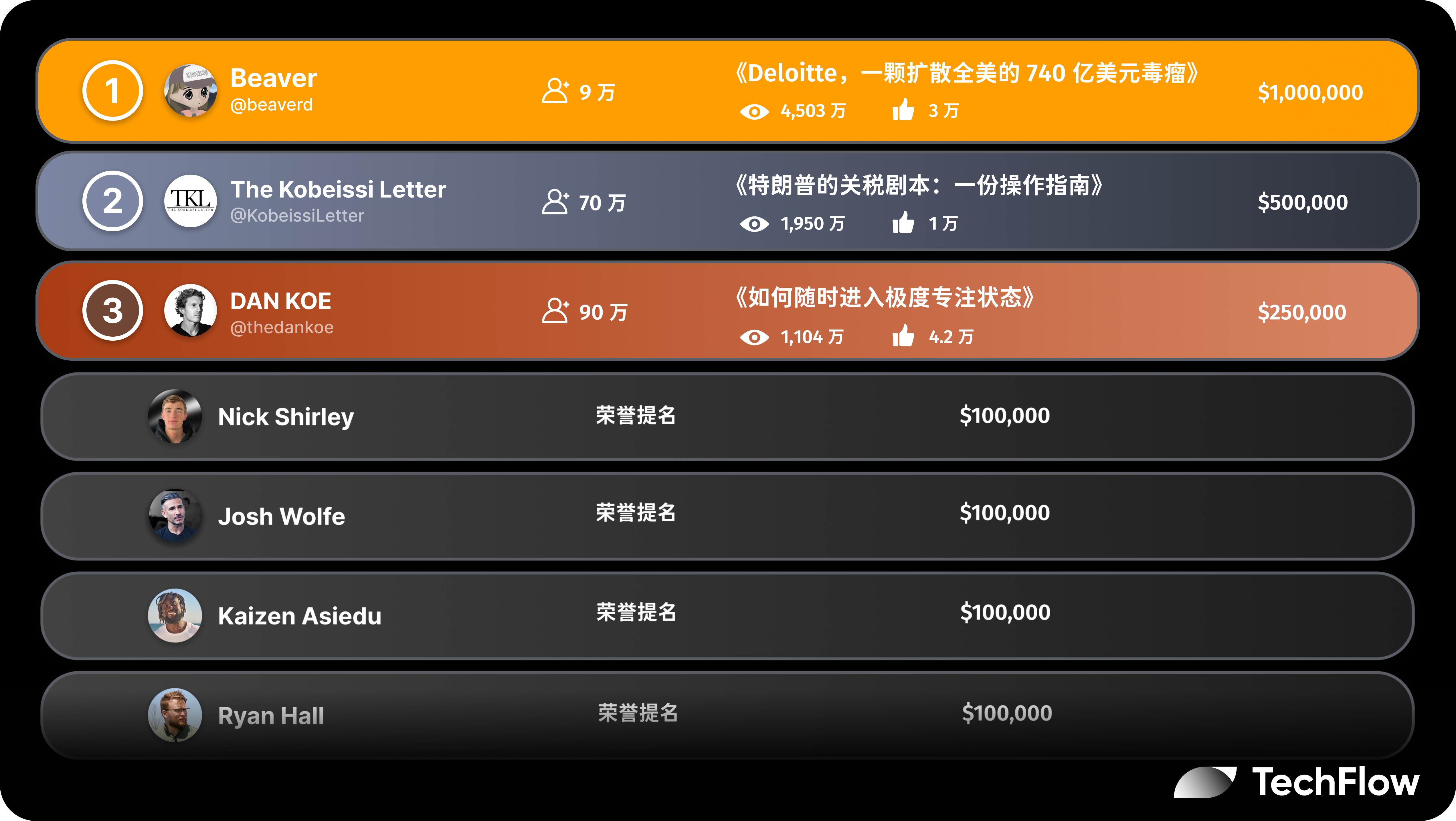
You’ll notice Dan Koe appears again. Yet his earlier viral article—“How to Fix Your Entire Life in 1 Day”—generated 170 million impressions, while this contest’s winner achieved only 45 million.
Viral hits remain elusive—but several winning pieces merit closer examination.
🏆 Winner: A 90K-follower “side account” wins $1M with a self-built database
The winning article by @beaverd is titled “Deloitte: A $74-Billion Toxic Growth Spreading Across America.” It investigates the prominent consulting firm Deloitte.
This account currently has only 90,000 followers—modest compared to other winners—and lacks institutional affiliation or any verification beyond the standard blue checkmark.
The topic avoids trending keywords entirely, yet tackles a highly discussable issue: how Deloitte secured $74 billion in federal and state government contracts—and then delivered disastrously flawed projects.
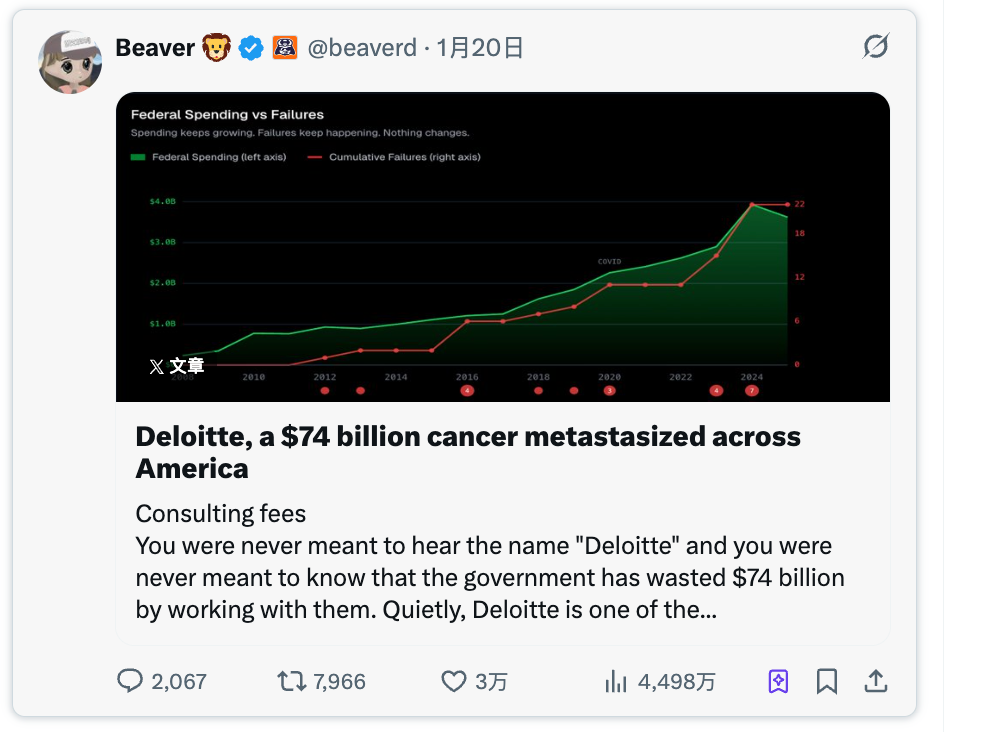
Clicking through reveals genuine depth of effort.
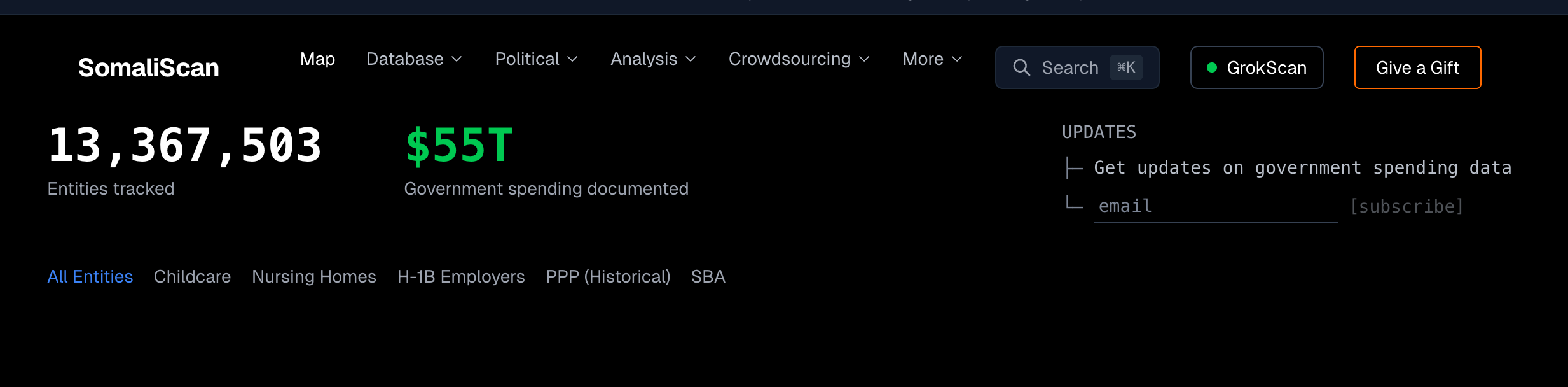
The author built his own website, somaliscan.com, scraping millions of government invoice records and cross-referencing them against audit reports and system failure logs.
Using these primary-source datasets, he tells a series of shocking stories: $32 billion stolen from California’s unemployment system; Tennessee’s Medicaid system collapse leaving 250,000 children without coverage; a $1.9 billion court digitalization project abandoned midstream… covering a total of 25 states.
He also uncovered the revolving door between Deloitte executives and government officials—naming specific individuals who left Deloitte to join particular agencies, and later approved contracts awarded back to Deloitte, listing names and dollar amounts with precision.
One person built his own database, conducted independent research—and earned $1 million.
🥈 Runner-up: A 700K-follower finance account teaches how to profit amid tariff panic
@KobeissiLetter, a veteran macro-finance commentator on X with 700,000 followers, regularly covers U.S. economic policy and market volatility.
His article takes a direct approach: breaking down Trump’s tariff playbook into a repeatable trading framework, titled “Trump’s Tariff Script: A Practical Guide.”
Given Trump’s reputation for erratic policy announcements and threats toward foreign nations—often followed by partial retreats—Wall Street analysts coined the term TACO: “Trump Always Chickens Out.”
TACO describes a recurring pattern:
Trump announces aggressive tariffs → markets crash → days later, he softens or delays implementation → markets rebound.
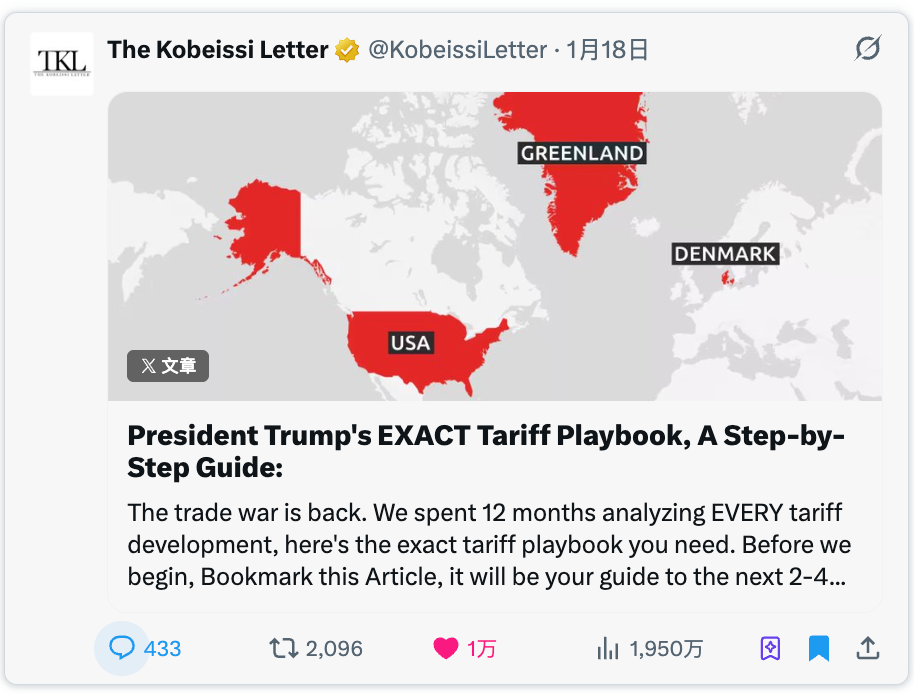
KobeissiLetter transforms TACO from an internet meme into a time-stamped operational manual. Drawing on tariff-related events over the past 12 months, he distills a complete cyclical template—enabling readers to execute trades based on precise timing.
For example: White House signals over the weekend spark panic; bargain-hunting capital enters midweek; a de-escalation signal emerges the following weekend; and some form of agreement materializes within 2–4 weeks. He also provides real-time updates via follow-up posts, tracking progress step-by-step—like a serialized pre-announcement thread.
He even offers actionable guidance: monitor the U.S. 10-year Treasury yield. If it breaches 4.60%, Trump is highly likely to back down.
For X’s macro- and trading-focused paying users, this kind of content is perfectly tailored.
It avoids debating whether tariffs are good or bad—or making moral judgments. Instead, it simply tells you exactly what action to take—and when—to profit the next time this script plays out.
🥉 Third Place: DAN KOE, the most-liked entry, revisits familiar life methodology
Dan Koe’s submission, “How to Enter a State of Extreme Focus Anytime,” received 42,000 likes and 8,681 retweets—the highest engagement metrics across all entries. Yet its impressions totaled only 11.04 million—less than one-quarter of the winner’s.
Technically, X did not designate him third place. Instead, they created a separate “Creator Choice” award worth $250,000.
This makes sense: Dan Koe was the person who “inspired this contest.” His early-January viral post—garnering 170 million impressions—directly demonstrated to X just how high the traffic ceiling for long-form content could be.
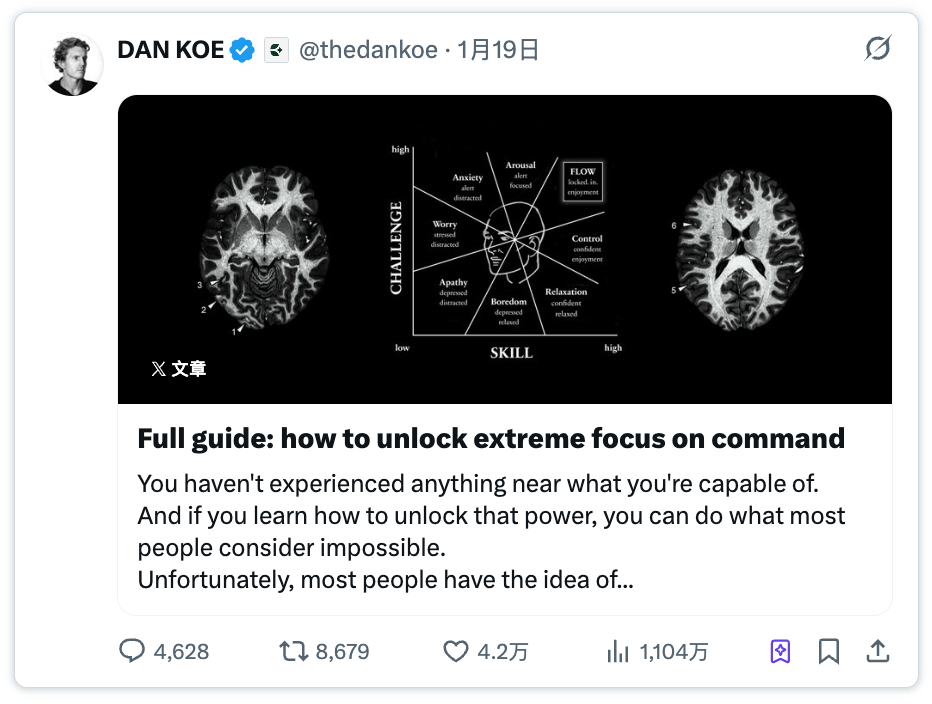
We won’t dwell on the article itself—it follows his usual self-improvement methodology. It outlines strategies for achieving deep focus, supported by references to neuroscience and flow-state theory.
Indeed, this piece led in engagement metrics—but under the contest’s core criterion—“impressions among U.S. paying users”—it ranked lower.
Why does the highest-engagement article have comparatively low impressions? We’ll address this misalignment shortly.
Honorable Mentions: $100,000 × 4
Nick Shirley, Josh Wolfe, Kaizen Asiedu, and Ryan Hall each received $100,000. Their accounts span public policy, geopolitics, history, and public safety.
Josh Wolfe, co-founder of Lux Capital and a prominent venture capitalist, pledged to match his prize by donating $100,000 to four charitable organizations.
Since the original post did not list the specific articles by these four winners—and given time and resource constraints—we did not conduct further investigation. Readers are welcome to help fill in these gaps.
Deeper Observations
A few patterns emerge from this contest’s outcomes:
- The most-liked article received only one-quarter the impressions of the winner
The most counterintuitive data point is undoubtedly Dan Koe’s.
42,000 likes, 8,681 retweets, and 4,627 comments—the top three engagement metrics across all entries. Yet impressions stood at just 11.04 million—less than one-quarter of @beaverd’s. Meanwhile, @beaverd earned only 30,000 likes—fewer than Dan Koe’s.
If you’ve managed social media accounts, this seems paradoxical. Conventional wisdom holds that higher engagement should trigger stronger algorithmic amplification—and thus greater impressions.
But this contest measured not total impressions, but specifically “impressions on the home timelines of U.S. paying users.” This metric excludes non-U.S. users, non-paying users, and traffic from search or profile pages.
Dan Koe writes about personal growth—a globally resonant topic attracting many non-U.S. followers. @beaverd’s piece, however, focuses squarely on how Deloitte squandered American taxpayers’ money—naturally concentrating its audience in the U.S. Under identical algorithmic promotion logic, geographic concentration directly determines performance on this metric.
- A 90K-follower account beats a 900K-follower account: Content scarcity > Follower count
Prior to the contest, @beaverd had 90,000 followers; @KobeissiLetter, 700,000; Dan Koe, 900,000.
If follower count alone dictated impressions, rankings would be inverted. In reality, the outcome shows that in X’s Articles recommendation logic, follower count carries far less weight than commonly assumed.
@beaverd won because he possessed something no one else did—content scarcity made the decisive difference.
This departs sharply from traditional traffic logic. Large accounts rely on existing follower bases and posting frequency. But in an algorithm-driven distribution environment, “Do you possess exclusive assets?” matters more than “How many followers do you have?”
- You must build your own content “hardware”
Step back: the topics of these three winning pieces bear no relation to one another—one investigates government contracts, another teaches tariff-trading tactics, the third explains focus techniques.
In any conventional content platform taxonomy, they wouldn’t appear on the same leaderboard. Yet they share one critical trait: each possesses its own independent “hardware”—in other words, a distinct narrative framework.
@beaverd’s hardware is his self-built database of scraped government data; KobeissiLetter’s is a trading framework validated over 12 months of backtesting; Dan Koe’s is a six-chapter methodology integrating neuroscience and psychology—perhaps sounding sophisticated, yet grounded in widely known principles.
None of the winning pieces are pure opinion essays. Each requires extended length to convey substantive information—and that is precisely the raison d’être of X Articles as a product format.
Another notable fact: none of the eight winners represent traditional media outlets.
All are independent creators. This isn’t because legacy media abstained—but rather, under this contest’s structure, individual accounts held inherent advantages.
Institutional media typically publish full-length content on their own websites, using social media merely to share links and summaries. But Articles require complete publication on X itself—a practice awkward for publishers accustomed to driving external traffic.
What, exactly, did X buy with $2.15 million?
Returning to the platform itself.
X initially committed $1 million in incentives but ultimately disbursed $2.15 million. During the contest, X rolled out several complementary measures: opening Articles access to all paying users (not just creators), adjusting algorithms to boost long-form content visibility, and shifting the scoring metric to “impressions on the home timelines of U.S. paying users.”
Such significant investment clearly signals X’s urgent need for original, long-form content hosted natively on the platform.
Historically, long-form content on X relied almost entirely on external links—Substack, Medium, personal blogs. One click, and users left X entirely—taking reading time and engagement data with them. Articles aims to retain that content within X, enabling users to read from start to finish without ever navigating away.
Digging deeper: X owns Grok. Training large language models demands high-quality, long-form textual data—yet the vast majority of X content consists of 280-character tweets. If Articles successfully attracts sustained creator output of in-depth long-form content, those pieces become vital training data for Grok.
Finally, there’s the value proposition for paying users.
By restricting the metric to “impressions on the home timelines of U.S. paying users,” X explicitly signals to creators: “Your content must serve paying users.”
This leverages creator output to reinforce X’s subscription model—making paying users feel their money is justified because they gain exclusive access to deep, platform-native content unavailable elsewhere.
From the content creator’s perspective, we believe the era of pure opinion may be ending.
This trend applies equally to crypto creators. The crypto space abounds with opinions: daily price predictions, trade calls, regulatory commentary—all happening constantly on X.
Yet few creators emulate @beaverd’s self-built on-chain analytics tool—or KobeissiLetter’s systematic dissection of market cycles into repeatable trading scripts.
Maintaining scarcity and independence while consistently producing high-value work is not only deeply professional—it’s also profoundly rewarding and self-reinforcing.
We also hope to see more Chinese-language creators appear on such leaderboards in the future.
Join TechFlow official community to stay tuned
Telegram:https://t.me/TechFlowDaily
X (Twitter):https://x.com/TechFlowPost
X (Twitter) EN:https://x.com/BlockFlow_News
 深潮TechFlow


