








Bankless Founder: Ethereum in the New World Order
TechFlow Selected TechFlow Selected
Bankless Founder: Ethereum in the New World Order
When a unified world fractures into regional powers, Ethereum unifies cyberspace.
 Navigating Web3 tides with focused insights
By David Hoffman, Founder of Bankless
Translated by Hu Tao, ChainCatcher
This year’s World Economic Forum (WEF) in Davos was truly spectacular.
It brought together numerous heavyweights from the cryptocurrency industry, including Brian Armstrong, Jeremy Allaire, CZ, and Larry Fink.
Although crypto was a central topic at the forum, what truly captured attention was the Trump administration’s explicit declaration of a phase shift in the global order.
Two major speeches delivered at Davos underscored this point: U.S. Secretary of Commerce Howard gave a talk titled “Globalization Has Failed,” while Canadian Prime Minister Mark responded: “The rules-based international order is experiencing a rupture—not a transformation.”
Rules-Based International Order vs. the Law of the Jungle
Since World War II, the international community has maintained a certain degree of order and cooperation. Though the United Nations holds relatively limited formal power, it commands widespread respect and plays a pivotal role in national decision-making.
“International law” once existed in practice—not because it was enforced by any sovereign authority, but because we collectively believed in it. We conferred meaning upon it.
The Trump administration has chosen to puncture that shared illusion.
Trump believes the “rules-based international order” exists solely because the United States permits it to exist. As the world’s strongest military power, the U.S. is therefore the true architect of that order—and Trump’s “America First” doctrine signals his unwillingness to maintain friendly relations with the rest of the world.
According to Trump—as articulated by Lutnick in his speech—this model no longer serves America’s best interests, so we must now chart a new course.
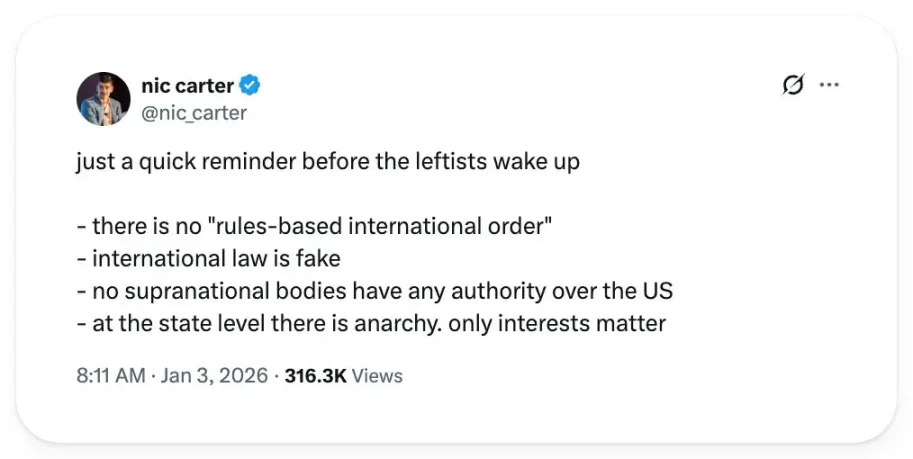
Nic Carter is right: the nation-state is the highest-order organizational structure humanity has ever created. Before the emergence of nation-states, religion and monarchy represented the highest levels of human organization; before those came feudalism and tribal structures.
We attempted to build even higher-order structures through collective agreements—such as those embodied by institutions like the UN—but these agreements proved extremely fragile and had negligible impact on the world.
So here we are in 2026: the United States has abandoned its efforts to construct a unified, higher-order global structure and declared that we’re better off going it alone.
Notably, “pariah states” like Russia and Iran have grown stronger precisely because of the weakness of the international order. They have long operated under the law of the jungle, exploiting the vulnerabilities of the rules-based international order to expand their own power—even committing human rights abuses that the UN does little more than condemn.
While it’s regrettable to see attempts at global cooperation ultimately fail, at least we can now candidly acknowledge that countries like Russia never truly abided by those rules in the first place.
Bitcoin, Ethereum, and Decentralized Cryptographic Protocols
Decentralized cryptographic protocols represent powerful, autonomous “higher-order organizational structures”—ones that the rules-based international order paradigm failed to produce.
The fragmentation of global unity under Trump is precisely the imbalance Ethereum seeks to correct.
When the unified world fractures into regional powers, Ethereum re-unifies it—in cyberspace.
These protocols do not enforce laws or protect members. They will not replace nation-states. Yet they constitute a ubiquitous, autonomous coordination layer through which people worldwide can unite.
Brian Armstrong’s dialogue with the Governor of the Bank of France exemplifies this power. The central bank governor committed the error all central bankers make: misunderstanding and underestimating Bitcoin. Brian corrected him: “Bitcoin has no issuer—it’s a decentralized protocol…” and then highlighted Bitcoin’s most important function in unifying the world: “…[Bitcoin] is actually the most effective accountability mechanism for deficit spending.”
No—we cannot achieve a rules-based international order through voluntary coordination and cooperation among nations. But can we derive one from a decentralized, cryptographic internet protocol?
Bitcoin operates via “if…then…” statements. To me, that sounds exactly like a rules-based international order. Doesn’t Ethereum extend the same principle to Turing-complete smart contracts?
Though the current crypto industry is steeped in despair and negativity, I remain convinced that we’ve barely scratched the surface of smart contracts’ potential.
So perhaps we won’t get a rules-based international order from the United Nations.
Perhaps we’ll get it from an unexpected source.
Perhaps we’ll get it from Ethereum.
Join TechFlow official community to stay tuned
Telegram:https://t.me/TechFlowDaily
X (Twitter):https://x.com/TechFlowPost
X (Twitter) EN:https://x.com/BlockFlow_News
 Bankless


