








The Lighthouse Has Arrived: ETHB Paves the Way for Ethereum’s Institutional Adoption
TechFlow Selected TechFlow Selected
The Lighthouse Has Arrived: ETHB Paves the Way for Ethereum’s Institutional Adoption
BlackRock’s iShares Ethereum Staking Trust ETF (ETHB) brings Ethereum’s “Internet Bond” innovation into Wall Street’s spotlight.
 Navigating Web3 tides with focused insights
By David Christopher
Translated by Saoirse, Foresight News
BlackRock’s iShares Ethereum Trust ETF (ETHB), a staking-based exchange-traded fund, officially began trading on the Nasdaq on March 12. This marks BlackRock’s first Ethereum staking fund—and quietly resolves the central bottleneck that has long plagued Ethereum’s institutional narrative since the launch of spot Ethereum ETFs.
It means Wall Street can now engage with Ethereum in its true, intended form—for the first time—as a productive asset capable of generating stable yield.
Core Product Launch: Filling the Institutional Investment Gap
The long-awaited staking Ethereum ETF has officially launched. The fund deeply integrates spot Ethereum exposure with staking rewards, offering institutional investors an unprecedented compliant access channel.
From inception, spot Ethereum ETFs suffered from a fatal product mismatch.
Ethereum has long been marketed to institutions as the “native internet bond”—a scarce asset (with an annual issuance cap of just 1.5%), a yield-bearing instrument (offering ~3–5% annualized compounded returns), and a foundational settlement layer embedded within the emerging financial system composed of stablecoins and tokenized assets.
Though this concept may sound somewhat “forward-looking,” it has nonetheless gained market acceptance. Yet the actual products launched failed to deliver on this vision.
After the spot ETFs launched, the critical element of “yield” remained conspicuously absent. Investors gained only price-volatility exposure—completely missing Ethereum’s economic engine. We sold institutions a yield-bearing asset, but delivered an empty, yieldless shell.
Bitcoin faces no such issue. Its core value proposition is “store of value”—simple and direct: holding spot Bitcoin grants full exposure to its value. Ethereum’s logic is fundamentally different. Staking is inseparable from its asset nature—the primary mechanism through which holders participate in and compound returns from the network economy. Spot ETFs cannot provide this functionality.
This is not the sole reason—but it is unquestionably the key factor behind the severe lag in institutional capital inflows into Ethereum. BlackRock’s Bitcoin spot ETF (IBIT) now manages over $55 billion, while Ethereum’s spot ETF (ETHA) stands at roughly $6.5 billion. True, Bitcoin’s first-mover advantage and simpler narrative contribute—but the product’s inherent flaw remains the root cause. Institutions received Ethereum’s upside narrative, yet were handed a neutered asset.
Wall Street Is Already In: Infrastructure Value Recognized
Weak asset-side performance obscures Ethereum’s rapid institutional adoption since the July 2024 launch of spot ETFs.
During this period, real-world asset (RWA) supply on Ethereum grew nearly sevenfold, while stablecoin supply doubled. Wall Street increasingly views Ethereum as infrastructure—the operational rails for stablecoins and tokenized finance—not merely a standalone trading asset.
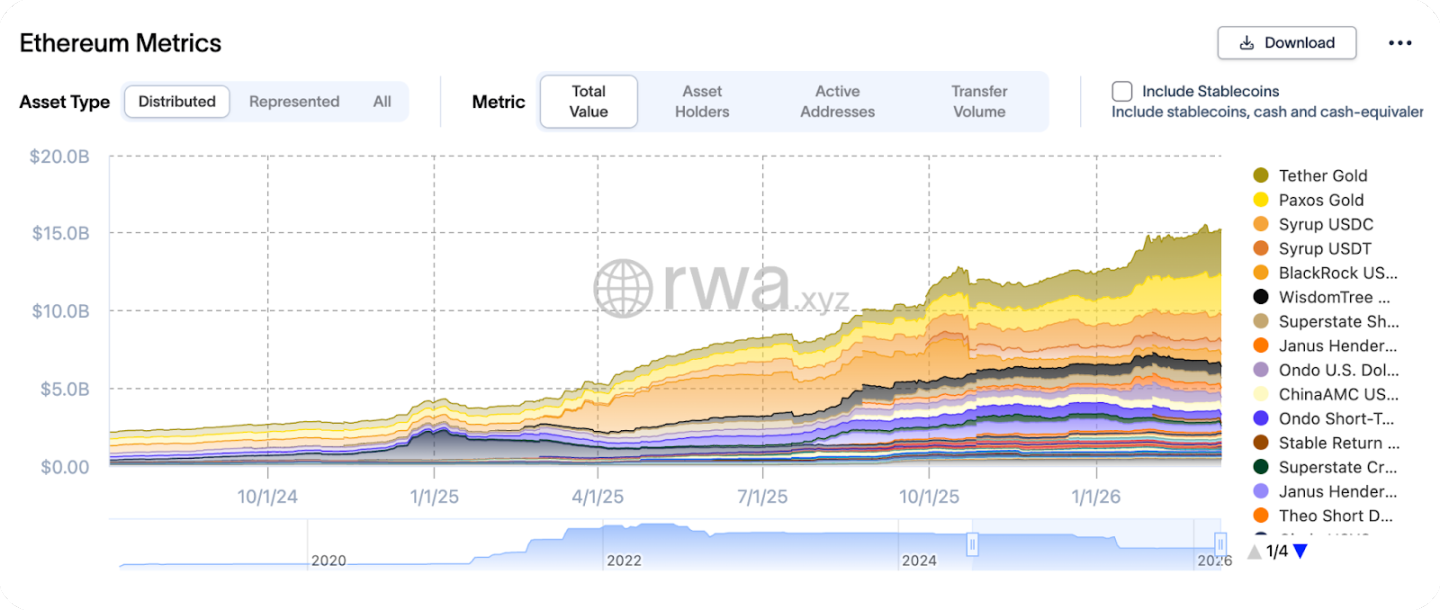
RWA Growth on Ethereum Since July 2024
BlackRock’s BUIDL Fund, Franklin Templeton’s FOBXX money market fund, and an increasing number of tokenized products all settle on Ethereum or its Layer 2 (L2) networks. Major banks are testing on-chain settlement capabilities—including SWIFT. Though ETF flows remain underwhelming, Ethereum’s institutional footprint is, in fact, expanding steadily.
The crux lies in this paradox: institutions can hold Ethereum’s price exposure, yet cannot compliantly participate in the Ethereum network economy they increasingly rely upon. ETHB eliminates this pain point entirely.
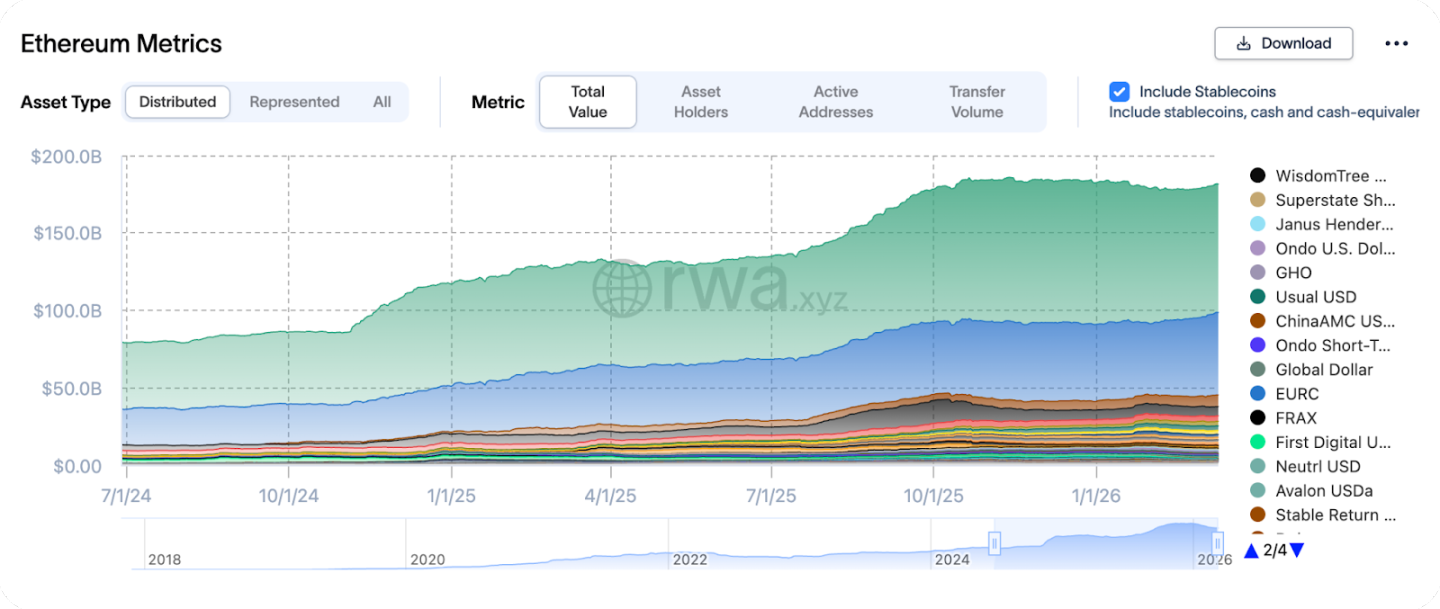
Stablecoin Growth on Ethereum Since July 2024
Structural Impact: Reshaping Institutional Investment Logic
This impact extends far beyond ETHB itself.
Prior to ETHB, non-native crypto institutions seeking yield-bearing Ethereum exposure had to resort to workarounds like digital asset trusts (DATs). While these structures enable participation in staking, restaking, and DeFi ecosystems, their fund valuations bear no direct link to underlying assets.
These structures exist precisely because regulatory constraints prevent institutions from staking directly. With the launch of staking ETFs, the rationale for such intermediaries is significantly weakened. Capital previously forced through intermediaries into alternative architectures may now flow directly back into native Ethereum assets.
Market Valuation & Fundamentals: Deeply Undervalued
At ETHB’s launch, multiple cyclical metrics indicate Ethereum’s valuation sits squarely in the fair-to-deep-value range.
Its MVRV (Market Value to Realized Value) ratio stands below 1—signaling the market is collectively underwater; its “profitable supply” remains lower than during the 2022 crash; and this cycle’s price has yet to surpass the 2021 all-time high, remaining confined within prior consolidation ranges—historically indicating exceptional price compression and value density.
Of course, Ethereum’s own development trajectory also contributes to underperformance. Its Layer 2 roadmap prioritizes scale and user experience over Layer 1 fee capture. Blob data blocks have dramatically reduced rollup anchoring costs—and consequently slashed the fee-burn volume that once supported deflationary narratives—making its investment thesis harder to model.
Yet critically, Ethereum’s monetary system remains intact: its annualized issuance hovers around 0.8%, roughly matching Bitcoin’s inflation rate. Today, all key elements are re-converging: institutional usage demand continues accelerating; ecosystem applications—including RWAs, stablecoins, and tokenized funds—are growing steadily on Ethereum; the staking yield channel is now fully open; and price sits firmly in value territory.
Looking Ahead: Wall Street’s Value Litmus Test
For years, Ethereum has pitched itself to institutions as both a “yield-bearing reserve asset” and the settlement layer for tokenized economies. That story has been refined, formalized, and reiterated—presented squarely to institutions that already recognize the network’s value but lacked avenues to participate in Ethereum’s economic proposition.
Now, product design finally aligns perfectly with value proposition. ETHB’s market performance will serve as the definitive litmus test—revealing whether Wall Street truly embraces Ethereum’s intrinsic asset value.
Join TechFlow official community to stay tuned
Telegram:https://t.me/TechFlowDaily
X (Twitter):https://x.com/TechFlowPost
X (Twitter) EN:https://x.com/BlockFlow_News
 Bankless


