Huobi Growth Academy | Crypto Market Macro Research Report: AI Bubble, Interest Rate Repricing, and Crypto Cycle Transition
TechFlow Selected TechFlow Selected
Huobi Growth Academy | Crypto Market Macro Research Report: AI Bubble, Interest Rate Repricing, and Crypto Cycle Transition
The crypto market is entering a structural phase of migration from weak hands to strong hands, laying the foundation for the next cycle's chip distribution.
 Navigating Web3 tides with focused insights
Summary
By the end of 2025, the crypto market is in a period of deep volatility driven by highly macroeconomic factors: while Bitcoin remains in the high range around $90,000, sentiment has plunged into extreme fear levels not seen since the 2020 pandemic, with massive daily outflows from ETFs, structural whale turnover, and retail capitulation collectively forming a typical mid-bull-run "chip redistribution." At the same time, U.S. rate cut expectations are being repriced, and concerns over sustained high interest rates are significantly compressing valuations for risk assets. Although external macro liquidity has not deteriorated—with Japan, China, and Europe all shifting toward easing—the pace now depends more on individual data points, placing the market in a rare combination of "liquidity-friendly but emotionally cold." Credit pressures from the AI bubble are also intensifying cross-asset risk transmission, squeezing crypto across capital, attention, and narrative dimensions. Against this backdrop, the crypto market is entering a structural phase of migration from weak hands to strong hands, laying the foundational chip base for the next cycle.
1. Cryptocurrency Market Macroeconomic Analysis
In recent weeks of market turbulence, Bitcoin’s price and sentiment have exhibited an unusual divergence: its price remains firmly above $90,000 at historical highs, yet market psychology has plunged into “extreme fear.” The Fear & Greed Index briefly hit 16, the coldest reading since the global pandemic crash in March 2020. Even with slight recovery, it has struggled within the 12–18 range. Positive narratives about Bitcoin on social media have simultaneously declined, rapidly shifting from firm optimism to complaints, anger, and blame-shifting. This disconnect is no accident—it typically occurs in the middle-to-late stages of a bull market: early entrants with large unrealized gains take profits at the first sign of macro instability, while latecomers who bought high become quickly trapped in losses, amplifying panic and disappointment. Bitcoin currently trades around $92,000—nearly unchanged from the start of the year (~$90,500)—and after experiencing sharp rallies and deep pullbacks, it has returned close to where it began, reflecting a “high-level sideways stagnation” pattern.

On-chain fund flows offer more direct signals than sentiment. First, spot ETFs have shifted from being a “pressure booster” driving the bull market to a short-term “drainpipe.” Since November, ETFs have recorded over $2 billion in cumulative net outflows, with single-day outflows peaking near $870 million—setting the worst record since launch. The narrative impact outweighs the actual capital movement: previously, the idea of “long-term institutional allocation” was the core support for the market; now that this pillar is turning into selling pressure, retail investors feel the insecurity of “no adults holding the bag.” Whale behavior also shows clear divergence. Medium-sized whales holding 10–1,000 BTC have been consistent net sellers over recent weeks, offloading tens of thousands of BTC—clearly early, profitable players taking profits. In contrast, super-whales holding over 10,000 BTC are accumulating, with on-chain data showing some long-term strategic entities buying aggressively during downturns, acquiring tens of thousands of BTC. Meanwhile, net inflows from small retail holders (≤10 BTC) are slowly rising, indicating that while the most emotional novice users may be panic-selling, other more experienced long-term retail investors are seizing opportunities to buy. The realized loss metric on-chain has also hit the largest single-day loss in the past six months, with massive amounts of supply being sold at a loss—revealing a classic “capitulation sell-off” signal. Taken together, these on-chain indicators do not suggest a full market exit, but rather rapid reallocation—shifting from short-term, emotionally driven capital toward participants with greater patience and higher risk tolerance. This is a structural phenomenon recurring in every major bull market's later stages. The market is currently in a high-range consolidation phase of the latter half of a bull run—market cap has pulled back but remains on a strong platform, sentiment has cooled sharply, structural fragmentation is intensifying, quality assets show resilience, while speculative assets continue to be purged. Overall crypto market cap is trending downward.
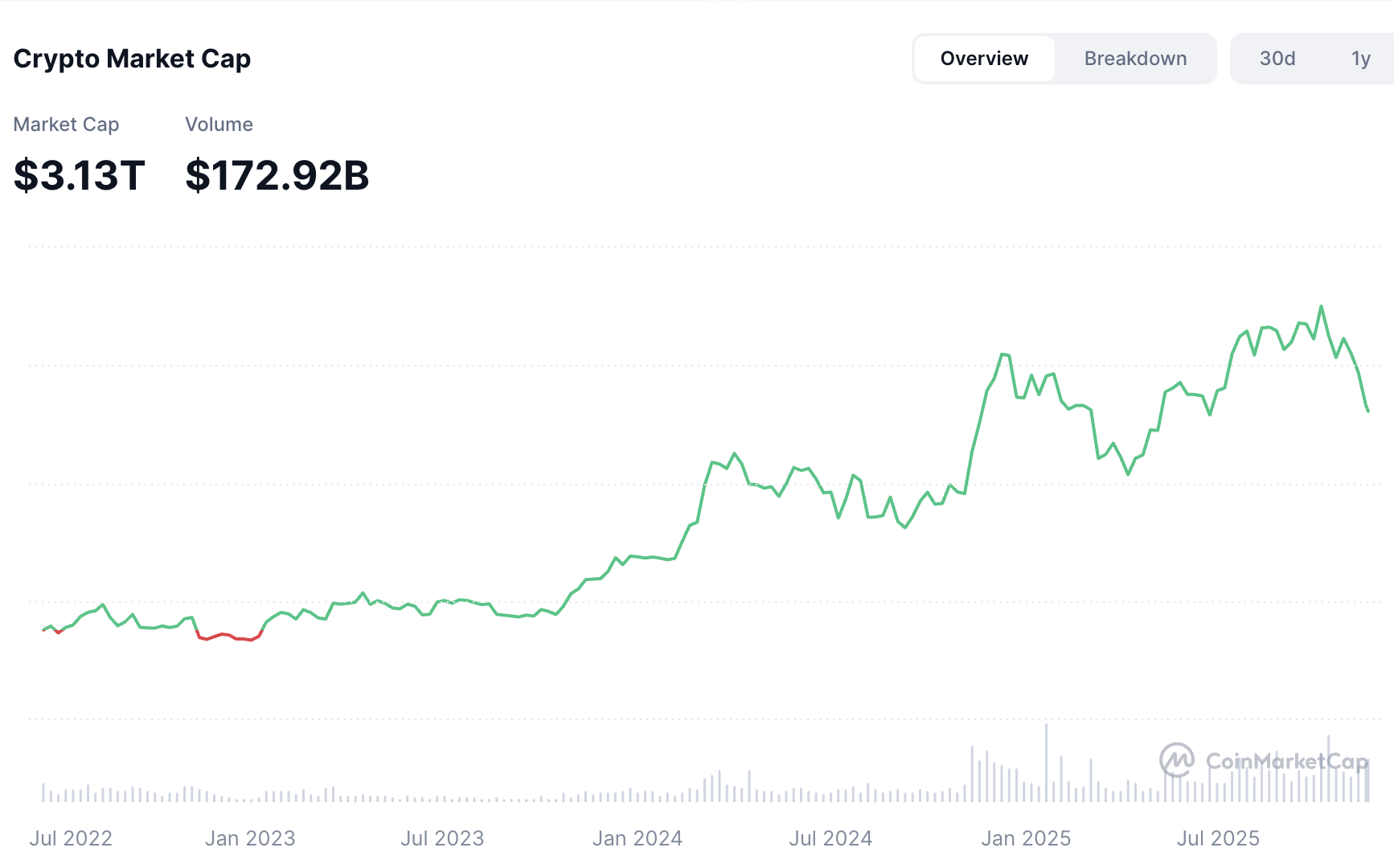
If on-chain data and sentiment explain short-term fluctuations, the true driver behind this market shift remains macro interest rates—Bitcoin’s real “house” isn’t institutions or whales, but the Federal Reserve. In the previous quarter, markets widely expected the Fed to gradually begin a rate-cutting cycle between late 2024 and early 2025. Rate cuts imply improved liquidity and higher valuations for risk assets, making them a key catalyst for the prior rally. However, recent economic data and official comments have strongly repriced these expectations. While U.S. employment and inflation have eased somewhat, they remain insufficient to justify aggressive easing. Some officials have even signaled “cautious rate cuts,” raising concerns that high rates may persist longer than anticipated. Cooling rate-cut expectations directly reduce the present value of future cash flows, thereby compressing valuations for risk assets—high-beta sectors like tech growth, AI, and crypto are hit first. Thus, the recent decline isn’t due to a lack of new narratives in crypto, but because the macro environment has directly raised the “discount rate” across the entire universe of risk assets—a violent devaluation.
2. Deep Impact of the AI Bubble on Crypto Macroeconomics
From 2023 to 2025, artificial intelligence has overwhelmingly become the dominant force in global risk asset pricing, replacing old narratives like “metaverse,” “Web3,” and “DeFi summer” as the primary engine driving capital market valuation expansion. Whether it’s Nvidia breaking trillion-dollar market cap, OpenAI’s infrastructure ambitions, or explosive growth in mega-data centers and sovereign AI projects, the market completed a paradigm shift from “tech growth” to “AI mania” in just two years. Yet beneath this feast lies an increasingly fragile leverage structure, ballooning capital expenditures, and growing reliance on internal financial engineering loops. Rapidly inflating AI valuations have paradoxically made the entire high-risk asset ecosystem more vulnerable, with volatility transmitted directly and continuously to the crypto market via risk budgets, rate expectations, and liquidity conditions—profoundly reshaping the cycle dynamics and pricing frameworks of Bitcoin, Ethereum, and altcoins.
Within institutional asset allocation systems, AI leaders have evolved from traditional growth stocks into “super tech factors,” becoming central to high-risk portfolios and even exhibiting endogenous leverage effects. When AI rises, risk appetite expands, naturally increasing institutional allocations to high-risk assets including Bitcoin. But when AI experiences sharp volatility, valuation pressure, or credit concerns, risk budgets are forced to contract—model-driven and quantitative strategies swiftly reduce overall risk exposure, and crypto assets—as the most volatile, cash-flow-unbacked segment—often become the first targets for trimming. Therefore, the tug-of-war and corrections in the later stages of the AI bubble amplify crypto market adjustments both emotionally and structurally. This was especially evident in November 2025: when AI-related tech stocks corrected due to financing pressures, widening credit spreads, and macro uncertainty, Bitcoin and U.S. equities jointly broke through key support levels, creating a classic case of “cross-asset risk transmission.” Beyond risk appetite, liquidity crowding-out is the most critical suppressive factor from the AI bubble. In a macro environment of “limited funding pools,” this inevitably squeezes marginal capital for other high-risk assets, making cryptocurrencies the most visible “funding sacrifice.”
A deeper impact comes from narrative competition. In market sentiment and valuation construction, narrative importance often rivals fundamentals. Over the past decade, the crypto industry gained widespread attention and premium valuations through narratives like decentralized finance, digital gold, and open financial networks. But from 2023 to 2025, AI narratives have proven extremely exclusive, with grand themes—“core engine of the Fourth Industrial Revolution,” “compute power as the new oil,” “data centers as the new industrial real estate,” “AI models as future economic infrastructure”—directly suppressing crypto’s narrative space. Policy, media, research, and investment attention are almost entirely focused on AI, leaving crypto to regain voice only when global liquidity fully turns loose again. This means that even with healthy on-chain data and active developer ecosystems, the crypto sector struggles to reclaim valuation premiums. However, when the AI bubble enters its bursting or deep adjustment phase, crypto assets may not face a bleak fate—in fact, they could gain decisive opportunities. If the AI bubble follows the path of the 2000 internet bubble—undergoing 30%–60% valuation corrections, clearing out highly leveraged and story-driven firms, seeing tech giants cut capital spending, while maintaining stable credit systems—then the short-term pain for crypto will yield significant medium-term benefits. Should risks escalate into a 2008-style credit crisis—though unlikely—the shock would be far more severe. Breakdowns in tech debt chains, concentrated defaults in data center REITs, and bank balance sheet damage could trigger “systemic deleveraging,” causing crypto to suffer waterfall-like crashes similar to March 2020. But such extreme scenarios often set the stage for stronger long-term rebounds, as central banks would likely restart QE, cut rates, or adopt unconventional monetary policies. As a hedge against currency oversupply, cryptocurrencies would then experience powerful recovery amid rampant liquidity.
In summary, the AI bubble is not the endgame for crypto, but rather the prelude to the next major crypto cycle. During the bubble’s ascent, AI crowds out crypto in terms of capital, attention, and narrative; but during its burst or digestion phase, AI releases liquidity, risk appetite, and resources back into the system, laying the groundwork for crypto’s resurgence. For investors, understanding this macro transmission mechanism is more important than predicting prices. Emotional bottoms are not endpoints, but critical transition phases where assets migrate from weak to strong hands. True opportunities rarely emerge in noise and hype, but often arise around shifts in macro narratives and liquidity cycle reversals. The next major crypto cycle is highly likely to officially begin only after the AI bubble recedes.
3. Opportunities and Challenges Under Crypto Macro Market Transformation
By the end of 2025, the global macro environment is undergoing structural changes distinctly different from previous years. After two years of tightening, global monetary policy has finally turned synchronously: the Fed implemented two rate cuts in the second half of 2025, confirmed the formal end of quantitative tightening, halted balance sheet contraction, and markets expect another rate cut in Q1 2026. This marks a shift in global liquidity from “draining” to “supplying,” with M2 growth re-entering an expansionary path and credit conditions clearly improving. For all risk assets, such cyclical turning points often signal the formation of new price anchors. For the crypto market, the timing of this global easing coincides with internal deleveraging, emotional lows, and ETF outflows hitting bottom—creating the foundation for 2026 to potentially become a “reboot point.” Synchronized global easing is rare, but the macro landscape from 2025 to 2026 shows remarkable consistency. Japan launched a fiscal stimulus plan exceeding $100 billion, continuing its ultra-loose monetary stance; China further intensified dual monetary and fiscal easing under economic pressure and structural demand; Europe began discussing QE restart at the edge of recession. Major economies adopting easing policies simultaneously is a super-positive factor unseen in the crypto market in recent years. The reason is simple: crypto assets are among the most sensitive to global liquidity, especially Bitcoin, whose valuation closely correlates with the U.S. dollar liquidity cycle. When the world enters a “loose money + weak growth” environment, traditional assets lose appeal, and excess liquidity first seeks higher Beta assets—and in each of the past three cycles, crypto precisely exploded under such macro conditions.
Meanwhile, the crypto market’s internal structure has gradually stabilized after 2025’s turmoil. Long-term holders (LTH) have not engaged in mass selling; on-chain data shows chips moving from emotional sellers to high-conviction buyers; whales keep accumulating during deep price corrections; ETF outflows stem largely from retail panic, not institutional retreat; futures market Funding Rates have returned to neutral or even negative zones, with leverage fully squeezed out. This combination indicates that selling pressure mainly comes from weak hands, while chips are concentrating in strong hands. In other words, the crypto market is in a position similar to Q1 2020: suppressed valuations, but risk structures healthier than they appear. Yet opportunity comes with challenge. While the easing cycle is returning, spillover risks from the AI bubble remain non-negligible. Tech giants’ valuations have reached unsustainable levels; any deviation in funding or earnings expectations could trigger another sharp correction in tech stocks, and crypto—being a high-risk peer—will inevitably suffer passive “systematic beta sell-offs.” Moreover, Bitcoin currently lacks a decisively powerful new catalyst. The 2024–2025 ETF model has been fully priced in; new narrative drivers must await whether the Fed launches QE, whether large institutions resume accumulation, and whether traditional finance accelerates investment in crypto infrastructure. Continued ETF outflows reflect extreme retail fear; a panic index dropping to an extreme low of 9 still needs time to complete a “capitulation bottom,” and the market awaits fresh positive signals. Considering both macro conditions and market structure, from a time perspective, Q4 2025–Q1 2026 will likely see continued range-bound consolidation and bottom grinding. AI bubble pressure, ETF outflows, and macro data uncertainty will jointly sustain a weak, choppy market. But as rate cuts accelerate and real liquidity returns in Q1–Q2 2026, BTC could reclaim the $100,000 level and, combined with QE expectations, new narratives like DePIN/HPC, and national BTC reserves in Q3–Q4 2026, confirm the start of a new bull cycle. This trajectory implies the crypto market is transitioning from a “multiple compression phase” to a “repricing phase,” with a true trend reversal requiring resonance between liquidity and narrative.
Investment strategies under this setup need recalibration to navigate volatility and capture opportunities. Dollar-cost averaging (DCA) delivers optimal statistical returns during extreme fear zones, serving as the best way to hedge short-term noise and emotional swings. In portfolio construction, reduce altcoin allocations and increase BTC/ETH weightings, as altcoins fall harder during risk contraction, while ETF accumulation mechanisms will continue strengthening Bitcoin’s relative advantage over time. Given that tech stocks may undergo another “dot-com-style” deep correction, investors should retain adequate emergency funds to secure optimal entry points when macro shocks cause excessive crypto selloffs. From a long-term view, 2026 will be a pivotal year for global liquidity reallocation and crypto’s return to center stage after structural cleansing. The real winners will be those who maintain discipline and patience when sentiment is coldest.
4. Conclusion
Combining on-chain structure, sentiment indicators, fund flows, and the global macro cycle, this downturn resembles a violent mid-bull-run rotation rather than a structural reversal. Repricing of rate expectations has caused short-term valuation pressure, but the clear global shift toward easing, synchronized stimulus from Japan and China, and the end of QT signal that 2026 will be a pivotal year for liquidity re-expansion. The AI bubble may continue to weigh down in the short term, but its eventual burst or digestion will release squeezed capital and narrative space, providing new valuation support for scarce assets like Bitcoin. Q4 2025–Q1 2026 will likely remain a period of range-bound consolidation, while the rate-cut-driven window from Q2–Q4 2026 could mark a trend reversal. Disciplined DCA, increased BTC/ETH weighting, and reserved emergency positions represent the optimal strategy to weather volatility and welcome the new cycle.
Join TechFlow official community to stay tuned
Telegram:https://t.me/TechFlowDaily
X (Twitter):https://x.com/TechFlowPost
X (Twitter) EN:https://x.com/BlockFlow_News
 @HTXAcademy