








Reflexivity Amid Market Fragmentation: Why This Cycle Focuses on Breadth, Not Depth?
TechFlow Selected TechFlow Selected
Reflexivity Amid Market Fragmentation: Why This Cycle Focuses on Breadth, Not Depth?
Perhaps we are in a transitional phase, and a deeper, more unified cycle has yet to arrive.
 Navigating Web3 tides with focused insights
Author: napkin
Translation: TechFlow
In 2021, market reflexivity was primarily driven by a few dominant narratives—such as DeFi and NFTs—and abundant liquidity.
However, today’s market exhibits clear fragmentation.
Why does this cycle have breadth but lack depth?

It's been a while since I last wrote anything here, but with the arrival of 2025, I’d like to briefly share some recent thoughts—a casual update from an ordinary market enthusiast.
That said, none of this constitutes investment advice. In what we call the “circus clown world” of crypto, please always conduct your own due diligence before investing.
Preface
As we continue navigating this cycle, one thing is clear: this market is fundamentally different from 2021. Back then, strong reflexivity emerged from just a few mainstream narratives and ample liquidity, fueling powerful upward momentum. Today, the market is fragmented into numerous micro-narratives. New trending tokens and concepts emerge daily, but liquidity is stretched thin. Reflexivity still exists—but its impact is scattered across countless tokens and stories, resulting in a market that is "wide but shallow": many assets see minor gains, yet few sustain meaningful rallies.
In this article, we’ll explore how reflexivity manifests in this new environment, analyze why liquidity has become the invisible killer of this cycle, and discuss my current positioning within the market.
Which Phase Are We In This Cycle?
I tend to believe we’re either at the edge of the bottom or already there (though admittedly, this may be wishful thinking to comfort myself about my holdings). Almost every sector has undergone sharp corrections this year, with AI and Memes hit hardest—down 80%–90%.

By now, you’ve likely felt firsthand the market’s fragmentation and thinning liquidity as you chase narratives and hunt for the “next big coin.” Since the start of this bull run—though many mark the beginning after FTX collapsed in late 2022 or early 2023, I prefer to date the new paradigm from January 2024—we’ve seen an explosion of narratives beyond BTC, ETH, and DeFi.
Animal Themes
As pioneers of meta-narratives, “animal coins” remain active. Dog and cat memes deserve their own categories, having spawned endless subcategories, even sub-subcategories.
Real-World Assets (RWA)
A favorite among traditional finance (TradFi) circles, RWAs can be cleverly framed as “fundamental” trades rather than mere copycat speculation. Key projects include: $ONDO, $PRCL, $CPOOL, etc.
AI (Intelligent Agents)
In the first half of 2024, AI narratives centered around $RNDR, $NEAR, $FET, $AGIX. Then came the “truth terminal,” shifting focus almost entirely toward intelligent agents and their frameworks. Notable projects: $VIRTUAL, $ARC, $AIXBT, $AI16Z, $pippin, $AVA.
DeFAI (Decentralized AI)
A niche within AI, yet large enough to stand as its own category. Intelligent agents now execute DeFi tasks, forming distinct subgroups. Examples: $GRIFFAIN, $ANON, $GRIFT, $BUZZ.
Presidential Themes
This one needs little explanation. Projects include: $TRUMP, $MELANIA, $BARRON, $KAI.
Web2 Founder Narratives
If you're active on Crypto Twitter (CT), you've seen this story unfold: Web2 founders embarking on “redemption journeys” in crypto. Examples: $VINE, $JELLY.
The narratives currently in spotlight are merely the tip of the iceberg. But you might have forgotten that just months ago, we had hat coins (wifhats), celebrity coins, zoo themes, cute animal coins, “euthanasia animal coins,” quant coins, baby coins, elderly coins, youth coins, TikTok coins—the list keeps growing.
From a broader perspective, let’s examine three key metrics: TOTAL3, BTC.D, and stablecoin supply.
TOTAL3
TOTAL3 refers to the total market cap of the crypto market excluding BTC and ETH. It essentially reflects the combined value of all altcoins, stablecoins, and memecoins. Currently, it’s approaching the peak levels seen in November 2021.

BTC.D
BTC.D measures Bitcoin’s market dominance, currently steady at 58%, down slightly from 61% in November 2024.

From November 2024 to January 2025, the market experienced a chain-driven “alt season,” particularly around AI and memecoins. During this time, BTC.D dropped, TOTAL3 surged, and stablecoin supply grew in tandem—now nearing $215 billion.

Reflexivity in Past Cycles
George Soros defined reflexivity as a theory where a positive feedback loop between expectations and economic fundamentals causes prices to deviate significantly and persistently from equilibrium. This is often described as “price driving narrative, not narrative driving price.”
Crypto markets offer fertile ground for reflexivity:
-
Lack of clear valuation frameworks: Entirely reliant on pure speculation;
-
Low liquidity: Thin market depth;
-
Attention economics (Attentionomics): Amplification by influencers on Crypto Twitter (CT), TikTok, and Telegram groups.
ICO mania in 2017; DeFi yield farming in 2020; memecoins and NFTs in 2021. From January to May 2021, Dogecoin ($DOGE) rose nearly 200x.

Dogecoin serves as a perfect case study illustrating crypto’s reflexivity and the evolution from past to present. With no fundamental valuation framework, it became the pioneer of what we now call “memecoins.”
High-profile endorsements—especially from public figures like Elon Musk—ignited a self-reinforcing feedback loop.
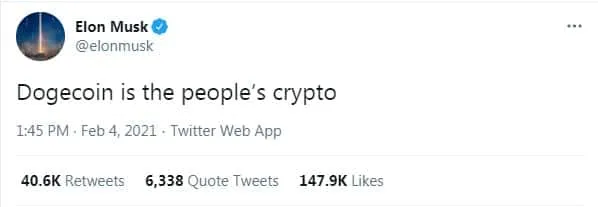
While stablecoin liquidity then was comparable to today’s levels, capital flowed into fewer outlets, creating a “crowded theater” effect—speculative energy highly concentrated in Dogecoin. Additionally, market novelty, retail-driven frenzy, pandemic stimulus checks, and lockdown-induced boredom lowered skepticism, allowing meme culture to dominate.
Most strikingly, this was almost entirely driven by retail spot demand—not leveraged derivatives. At Dogecoin’s peak, open interest (OI) was only ~$60 million. Today, at half its all-time high price, OI exceeds $1.5 billion.
Reflexivity Today
The 2024 crypto market broke historical patterns: Bitcoin remained strong while most alts struggled to gain traction.
The market seems afflicted with “attention deficit disorder” (ADHD), jumping from one shiny narrative to another, making it hard for any single trend to build lasting momentum.
Despite stablecoin liquidity matching 2021 levels, reflexive effects are diluted across too many narratives—AI, DePIN, RWAs, and over 100 memecoins. The weakening of reflexivity stems from three main factors:
-
Fragmented capital: Funds spread across hundreds of low-market-cap tokens weaken the strength of reflexive feedback loops.
-
Leverage saturation: More traders use perpetual contracts (perps), making open interest (OI) a critical metric.
-
Increased risk awareness: Trauma from 2022 (LUNA collapse, FTX) made investors more cautious about “dumb money” hype cycles.
Most new tokens or narratives end up looking like Bitconnect’s price chart—brief mania followed by rapid collapse.

The classic “altcoin season” feels elusive in today’s market.
The powerful rotation from Bitcoin (BTC) into alts hasn’t materialized as expected.
@intuitio_ noted that unlike previous cycles, Ethereum and other alts have significantly underperformed this time… (yes, Ethereum has never broken its all-time high).

Today’s market structure is characterized more by breadth: many tokens experience brief, modest rallies, but confidence in any single token remains shallow and lacking depth.
To illustrate the degree of fragmentation, consider late 2024: Bitcoin dominance reached levels unseen since early 2021. By January 2025, it peaked at 65%. All this occurred while total crypto market cap continued rising—meaning virtually all other tokens underperformed.

Although numerous tokens exist and show activity, few sustain performance long enough to outpace Bitcoin. In fact, the Altcoin Season Index spent most of 2024 in “Bitcoin Season” territory.
Attention Economics
In this crypto market cycle, “attention” has become the most sought-after asset. Fundamental analysis and traditional tokenomics take a back seat to memes, viral moments, and reflexive hype.
This phenomenon is known as “attention economics” (Attentionomics)—where a token’s value depends more on its ability to capture attention than intrinsic fundamentals.
In a market fractured across thousands of tokens, human attention is the truly scarce resource. Projects that successfully attract attention often see corresponding price appreciation.
As @redphonecrypto put it:
“In attention economics, a token’s ability to capture attention matters more than any other metric. The stronger that ability, the greater its potential upside. And that capacity can be assessed through very real, identifiable factors.”
The Attention Flywheel
In today’s social media-driven crypto landscape, “attention economics” (Attentionomics) can be distilled into a self-reinforcing “attention flywheel.” The cycle typically follows a similar path:
Viral catalyst: A meme or event sparks a new narrative and curiosity, prompting someone to mint a token. For example, “Ghiblification” is a textbook case.

Early speculators rush in, triggering rapid price spikes. In crypto, price itself becomes content. Charts showing 10x gains within hours go viral on social media, drawing widespread attention.

Rising prices are seen as proof of meme “strength,” attracting more attention. Viral posts bring a second wave of buyers who don’t want to miss the next “moonshot.” Influx of liquidity pushes prices higher, and imitators (beta tokens) begin to appear.
This feedback loop—attention → price → more attention—often unfolds rapidly, sometimes completing within a day of the meme’s birth.

Mainstream expansion: If the frenzy grows large enough, it spills beyond crypto circles. Media coverage, exchange listings, or celebrity endorsements amplify reach, creating value through virality.

This reflexive cycle means attention itself becomes potential energy. As crypto figure Cobie noted:
“People always talk about scarcity in crypto—digital scarcity via NFTs, or ‘55 million millionaires globally but only 21 million bitcoins.’ But the only truly scarce resource in crypto is attention. Risk-seeking capital is absolutely not scarce.”
Projects or tokens that win the “attention lottery” can see explosive market cap growth—an occurrence rare in traditional finance (TradFi).
The Rise of Shitposts: From Jokes to Wealth Codes
Recall that many of the hottest tokens between 2024–2025 were essentially “shitposts with a price feed.”

For instance, $ROUTINE was created purely for humor (and profit) around a trending topic. Ironically, this overt self-awareness didn’t deter investors—it became part of its appeal, fitting perfectly with crypto’s ironic humor.
Yet, attention-driven projects are often short-lived. Hence, some of the most successful memecoins are now attempting to add real utility or infrastructure.
But does this actually work?
Take $PEPE, whose team proposed building a dedicated Pepe Chain and related products, leveraging its massive community. By launching a Pepe-themed L2 or DEX, $PEPE holders could have more uses beyond buying and selling. It’s a strategy using “brand” recognition to bootstrap real platform users.
Many memecoins’ so-called “utility” feels like post-hoc justification after price pumps. Some may have branded DEXs or merch stores, but these rarely enhance intrinsic token value. Ultimately, such “utility” is often just a flimsy wrapper around community speculation.
In these projects, attention remains the core driver—products are secondary.
The Capital Musical Chairs Game
What happens when attention can’t stay? Answer: Traders enter an endless rotation game.
In crypto, capital rotates from one sector to another—or moves down the risk curve into “beta” imitators. This has become a mainstream strategy.
Since single narratives rarely deliver sustained 10x returns (especially for those missing the initial move), the optimal approach is capturing a series of smaller gains.
This is exactly how the “Euthanasia Coaster” meme emerged.

We’ve seen this play out: people made fortunes on $ROUTINE, then quickly rotated profits into related tokens (like $SARATOGA, another meme from the same viral video).
This hot-money rotation explains strange market cycles—like one week all dog-themed memecoins surge together, the next week it’s AI-related tokens, then suddenly legacy DeFi tokens get random inflows (“Hey, Yearn hasn’t moved—maybe it’s next”).
It’s a fast-paced game of reflexivity:
See price rise,
Buy in,
Push price higher,
Sell before reversal.
Repeat endlessly.
From Spot to Leverage: A Market Transformation
One major shift from 2021 to today is the growing role of leverage.
The 2021 Dogecoin craze was driven mainly by spot purchases. Millions of retail investors bought DOGE directly via Robinhood and Coinbase using pandemic stimulus funds.
Today, much of the market’s momentum comes from derivatives—especially perps and options. Many crypto traders now use high-leverage margin trades on platforms like Binance and Bybit.
With such massive open interest (OI), price swings can become extremely volatile.
In November 2024, Bitcoin surged from $75K to $90K in two days, marked by repeated short squeezes. This rally exemplified leverage-driven reflexivity: shorts forcibly liquidated = forced buying = price rises = more shorts liquidated, and so on. But this mechanism is a double-edged sword.
High leverage means high reflexivity—but often unhealthy and unsustainable.
We’re seeing price swings become more frequent and extreme, far beyond rational ranges. These moves are often leverage-driven, yet eventually revert to mean because they aren’t backed by stable new capital inflows. A key insight: OI can push prices up, but that doesn’t equal new capital entering. Ultimately, it’s more like a player-versus-player (PvP) game.
For example, from November to December 2024, total OI increased by ~$70 billion, while stablecoin supply grew only $30 billion.
Today’s OI dwarfs 2021 levels, signaling that this cycle’s reflexivity is more mechanical than organic. When tokens soared in 2021, people bought with conviction and held. Now, when tokens pump, it’s more common to hear traders yell, “I’m already long—don’t let me get rekt!” while hovering over the sell button.

Conclusion
The current crypto market is defined by breadth: numerous narratives and tokens erupting in isolated mini-cycles.
Perhaps we’re in a transitional phase, awaiting a deeper, unified cycle. Institutional foundations being laid—ETF approvals, RWA integration—might eventually ignite a broader bull market, flooding alts with capital. Stablecoins’ “dry powder” could finally deploy, BTC.D drops, and a classic “altseason” emerges.
Alternatively, market fragmentation may be the new normal—a sign of maturing crypto markets. The ecosystem is now vast and diverse; expecting mass FOMO into a single trade may no longer be realistic. We won’t see 2017-style “everything up” scenarios again. Survival now demands selectivity, flexibility, and skepticism more than ever.
No matter where the market goes, reflexivity will endure—just in different forms and intensities. The challenge (and opportunity) lies in distinguishing fleeting hype from emerging trends.
You think a narrative is dead—then it resurges.
Who would’ve thought “Trump memecoins” would become a thing? Yet here we are.
You assume an asset is “too big to fail”—then it falls harder (e.g., ETH dropping further from $1,800).
As the market evolves, I’ll carry forward this cycle’s lessons: stay flexible, know when to wait, and maintain skepticism toward every narrative.
I admit, “more breadth, less depth” sounds like a complaint—but it also reflects a maturing market evolving unpredictably. Perhaps depth will return in the next phase. Or maybe we’ll splinter further into micro echo chambers. Yet opportunities will always exist for the prepared—while traps await the careless.
Reflexivity hasn’t disappeared. It’s just become more complex.
Stay safe, stay sharp, and when your memecoin turns into an apartment, don’t forget to protect your freedom. Finally, I’ll close with a classic line from @mgnr_io:
“In subjective trading, the best position is often flat.
Do nothing. There are five opportunities a year where free money lies on the ground.
Pick it up, then go back to doing nothing.
That’s alpha.
Cheers!
Disclaimer
This article is for general informational purposes only, based on current facts and sources. It should not be considered professional advice. Please conduct your own research and consult qualified advisors before making any decisions. The author assumes no responsibility for any consequences arising from the use of this information.
Join TechFlow official community to stay tuned
Telegram:https://t.me/TechFlowDaily
X (Twitter):https://x.com/TechFlowPost
X (Twitter) EN:https://x.com/BlockFlow_News
 DefiNapkin






