In-depth Analysis of Talus: How Digital Workforce is Changing the Way We Work?
TechFlow Selected TechFlow Selected
In-depth Analysis of Talus: How Digital Workforce is Changing the Way We Work?
Explore how Talus builds an autonomous digital economy system through a blockchain-based AI agent trust infrastructure.
 Navigating Web3 tides with focused insights
Author: Jay Jo, Tiger Research
Key Takeaways
-
AI agents have evolved from simple tools into independent economic actors, opening the door to an "autonomous digital economy." However, realizing this vision requires infrastructure capable of verifying agent behavior and ensuring trust.
-
Talus builds this foundation of trust. Talus Network enables agent operations to be verifiable via blockchain, while Nexus allows developers to easily build and deploy on-chain agents.
-
In this way, Talus scales digital labor into a digital economy. It transforms how we work and create value, preparing us for the transition into an era of autonomous economies.
1. Prerequisites for the Autonomous Digital Economy
AI agents (hereinafter referred to as "agents") are increasingly recognized as "digital workers." They can autonomously understand complex situations, make independent decisions, and execute tasks. Trading agents can handle transactions on behalf of users within milliseconds. Customer service agents use historical customer data and product information to simultaneously manage thousands of inquiries. Agents are emerging as new economic entities that autonomously generate value—going far beyond simple tools that merely follow commands.
This evolution opens possibilities for a new paradigm—the "autonomous digital economy." This paradigm envisions a fully autonomous economic ecosystem where agents can transact and collaborate directly with other agents or users without human intervention. Once realized, this system could enable highly efficient, 24/7 markets that surpass the limitations of human labor. It could give rise to entirely new markets—some potentially reaching trillion-dollar scales.
Source: Tiger Research
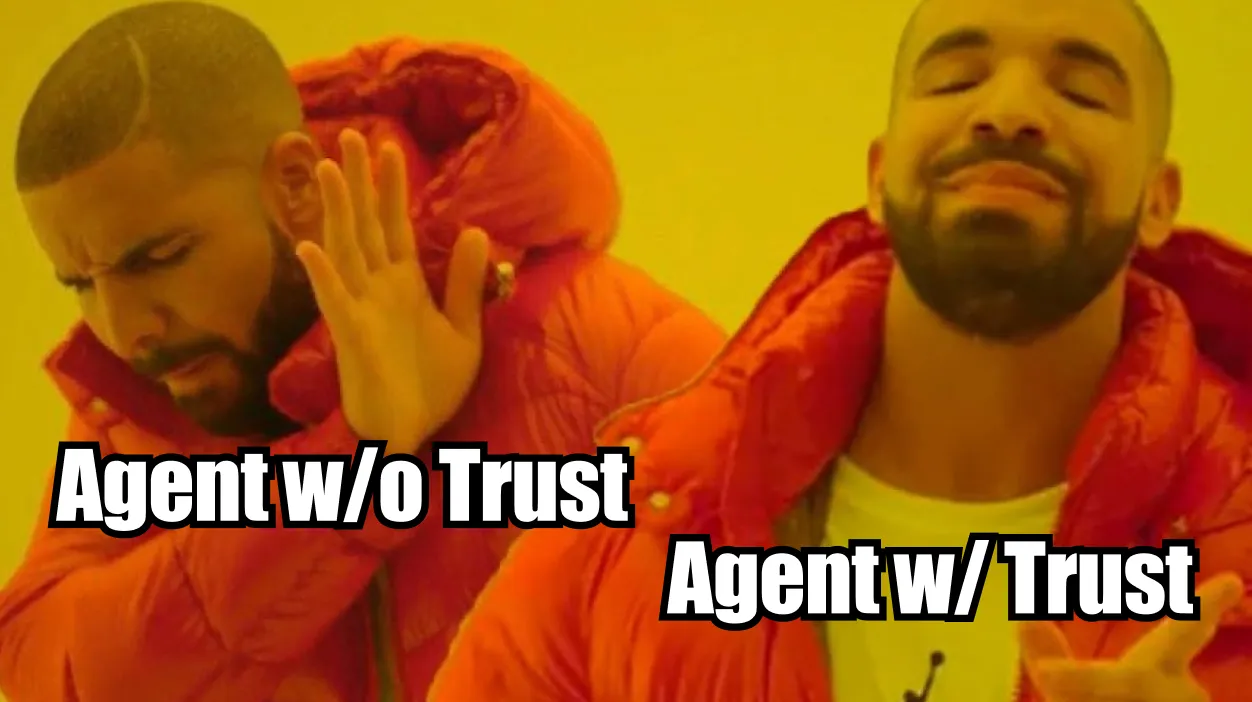
However, this remains an idealized goal. Agents require trust mechanisms to verify their actions and outcomes. Without such mechanisms, they cannot independently conduct economic activities. This need mirrors real-world economic requirements. Human labor evolved into economic activity because society established institutional foundations. Laws regulate behavior, contracts ensure performance, and money facilitates value exchange. Only on such a trust framework can labor be transformed into economic value.
The challenge lies in implementing such trust mechanisms in a digital environment. Today, most agents rely on centralized service providers, whose decision-making processes remain opaque black boxes. This reality further complicates the challenge. In such an environment, methods to verify agent behavior or guarantee execution are limited. Ultimately, whether we can reach these trillion-dollar markets and achieve a true autonomous digital economy depends on how we build the underlying trust infrastructure.
2. Talus: Infrastructure for the Autonomous Digital Economy
Source: Tiger Research
Talus is a blockchain infrastructure project aiming to enable agent-based autonomous digital economies. Just as DeFi enabled banking without banks and NFTs proved ownership of digital assets, Talus leverages blockchain technology to establish trust mechanisms for agent ecosystems. This trust architecture forms the basis for agents to independently and verifiably conduct economic activities without human intervention.
Yet Talus aims beyond just building trust. Trust is a prerequisite for an autonomous digital economy, but alone it cannot sustain economic activity. For agents to become true economic participants, they need a system to design and execute complex workflows on top of trust. To address this, Talus introduces Nexus—a workflow development framework. Nexus is a decentralized version of services like n8n or Zapier, enabling developers to easily write and deploy agent workflows in on-chain environments.
Through this integration of trust infrastructure (Talus Network) and workflow framework (Nexus), Talus constructs a digital economic ecosystem where agents autonomously collaborate and create value.
2.1. Talus Network: The Trust Foundation for Agents
Talus Network is the core infrastructure establishing trust among agents. Previously, there were no rules governing agent behavior, no mechanisms guaranteeing performance, and no systems facilitating value exchange. Talus fills this gap using blockchain-based infrastructure, creating an environment where agents can collaborate on a foundation of trust.
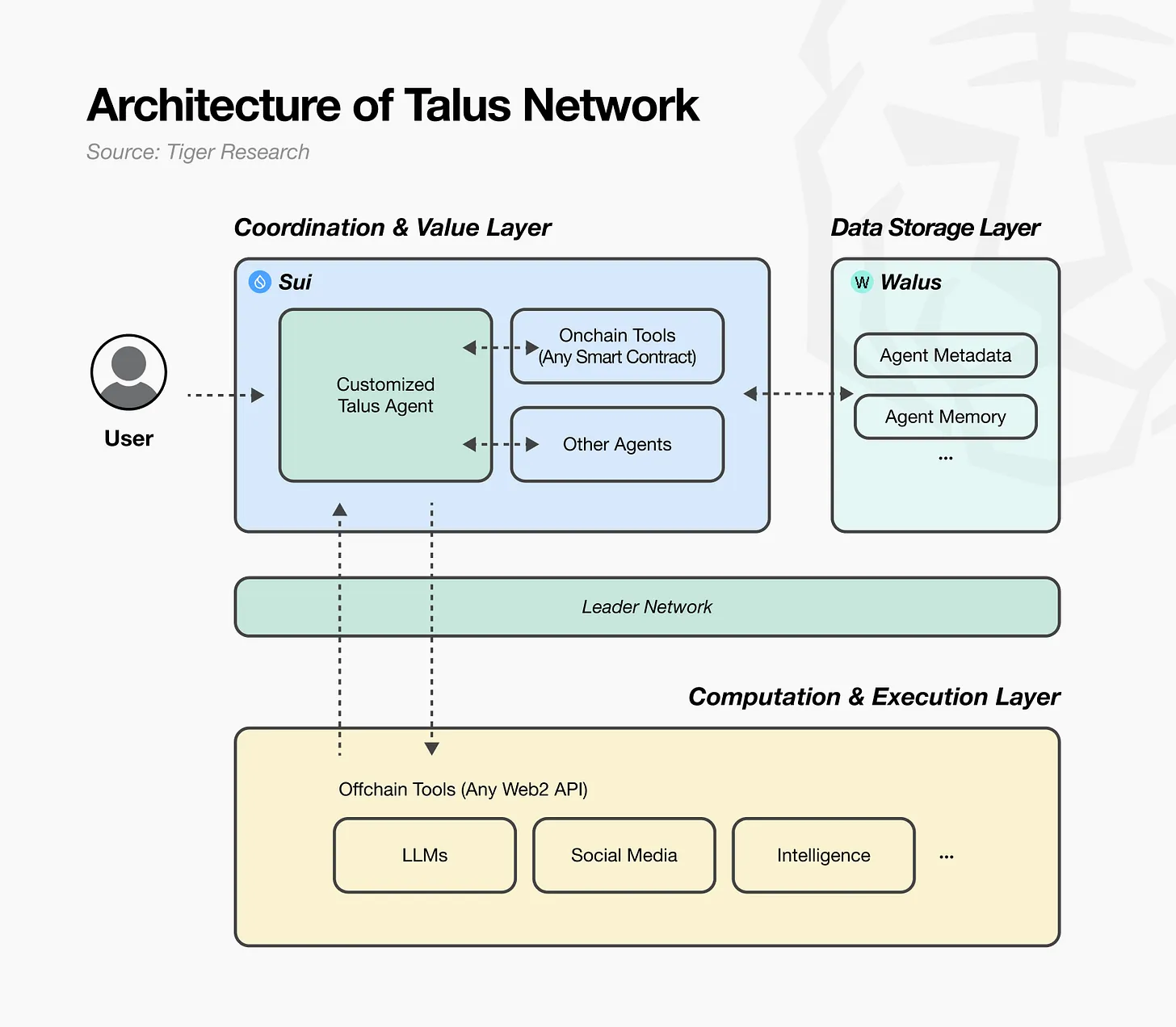
Talus Network consists of three core layers: 1) Coordination & Value Layer, 2) Data Storage Layer, and 3) Computation & Execution Layer. These layers are organically connected, ensuring transparency and reliability while maintaining scalability and cost efficiency.
The Coordination & Value Layer is the foundation of Talus Network and the center of agent activity. It manages all information requiring on-chain trust, including agent identities, transaction histories, permissions, and workflow states. Built on the Sui blockchain, this layer enables high-performance parallel processing. Even when multiple agents operate simultaneously, it ensures stable transaction handling and prevents conflicts. Thus, Talus establishes a reliable foundation for agents to collaborate and exchange value autonomously within a trusted economic environment.
The Data Storage Layer provides cost-efficient storage. Agents require various information to perform complex tasks, but storing all data on-chain is inefficient. To solve this, Talus uses Walrus, a distributed storage system developed by Mysten Labs. Walrus stores agent metadata (profiles, documents), memory (conversation logs, task histories), and operational context (AI model configurations, market data caches). Agents can quickly retrieve this information when needed. This approach allows the blockchain to focus on managing core trust data without incurring high storage costs, while Walrus efficiently handles large-scale data in a decentralized manner.
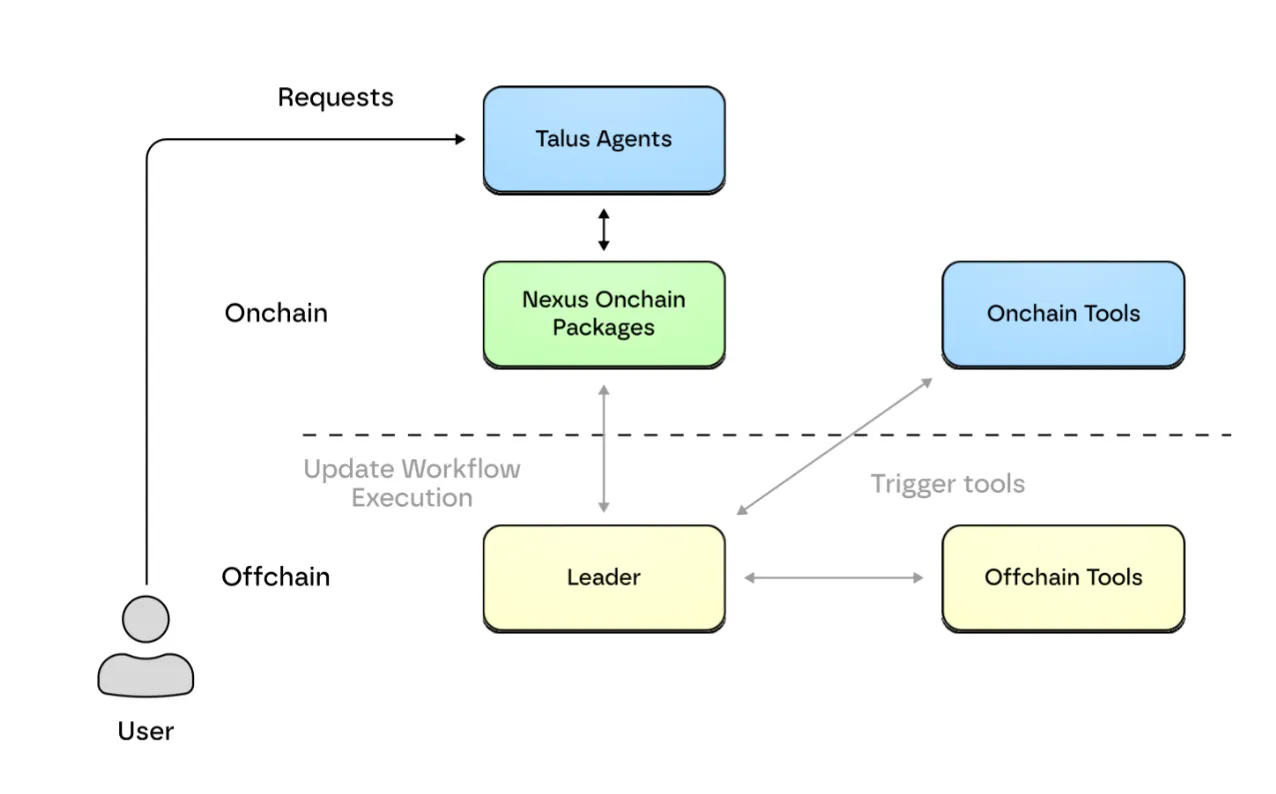
Nexus architecture and Talus Agentic Framework workflow, Source: Talus
The Computation & Execution Layer is an off-chain execution structure designed for efficient processing of complex computations. Direct execution on blockchain is slow and expensive, so this layer moves heavy computational tasks off-chain. However, this presents a dilemma: off-chain processing is fast but hard to verify for trustworthiness; on-chain processing is trustworthy but slow and costly. Talus solves this with a hybrid architecture centered on the Leader Network, which bridges on-chain and off-chain components. Specifically, when it detects a workflow execution request from the blockchain, it forwards the request to off-chain tools (LLM APIs, Web2 services, etc.) to perform actual computation. Then, it returns the results to the blockchain for verification.
This hybrid design ensures both efficiency for complex computations and reliability through blockchain verification. It processes quickly off-chain while always validating results on-chain. This structure creates an execution environment that satisfies both speed and reliability requirements.
2.2. Nexus: On-Chain Agent Workflow Framework
If Talus Network is the infrastructure for an autonomous agent ecosystem, then Nexus is the framework developers use to build and deploy on-chain agents on top of it. With Nexus, developers can build agent-based workflows in a familiar Python development environment without needing deep blockchain expertise.
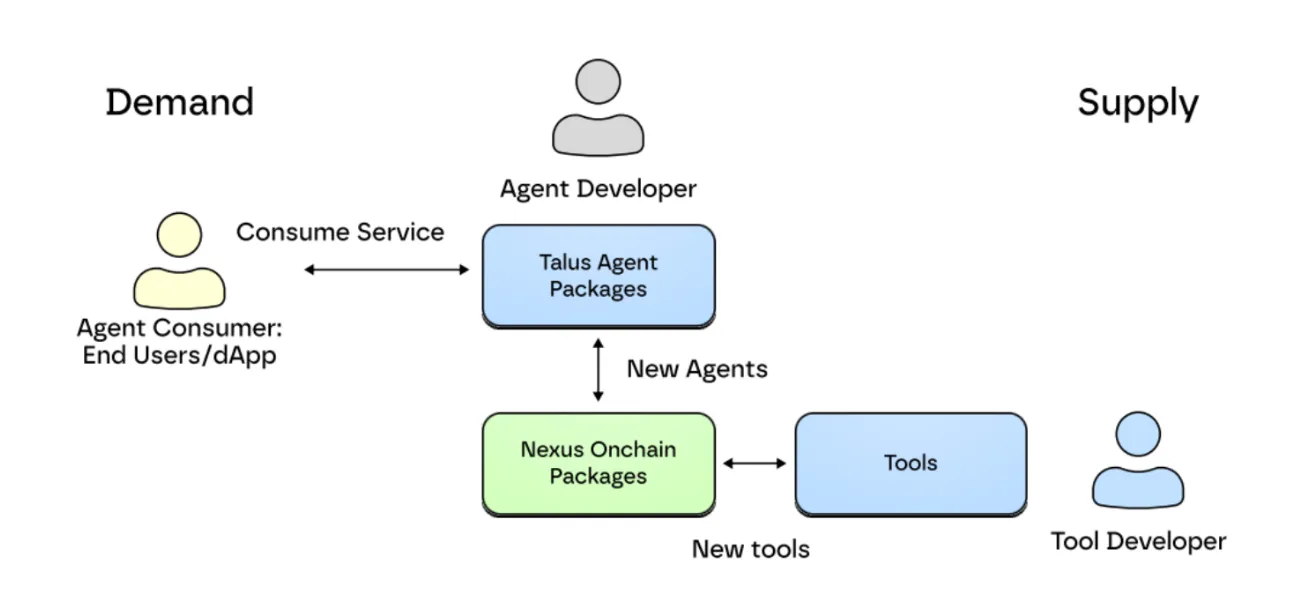
Relationship between internal smart contract packages in Nexus and developer roles, Source: Talus
The core component of Nexus is the Nexus On-chain Package (NOP). NOP defines the basic rules and interfaces for workflows that constitute agents. This ensures all Talus agents operate under the same structure and protocols. As a result, various agents and tools can interoperate and interact cohesively within a single ecosystem. NOP also tracks workflow execution states and verifies the results of each step, ensuring agent tasks are recorded transparently and consistently on-chain. Workflows defined in this way are deployed as Talus Agent Packages (TAP) in smart contracts on the Sui blockchain.
Let’s examine how this structure works in practice through a concrete example. Suppose a developer builds a trading agent. This agent holds on-chain assets and executes trades directly, but it can request market analysis from another macro analyst agent to formulate its trading strategy. Thanks to Nexus’s standardized protocol, the agents can exchange data and collaborate. If the macro analyst agent needs external data, the Leader Network connects to off-chain tools to perform necessary calculations and returns the results to the blockchain. The entire process—from analysis to trade execution to result verification—is recorded on-chain, ensuring full transparency.
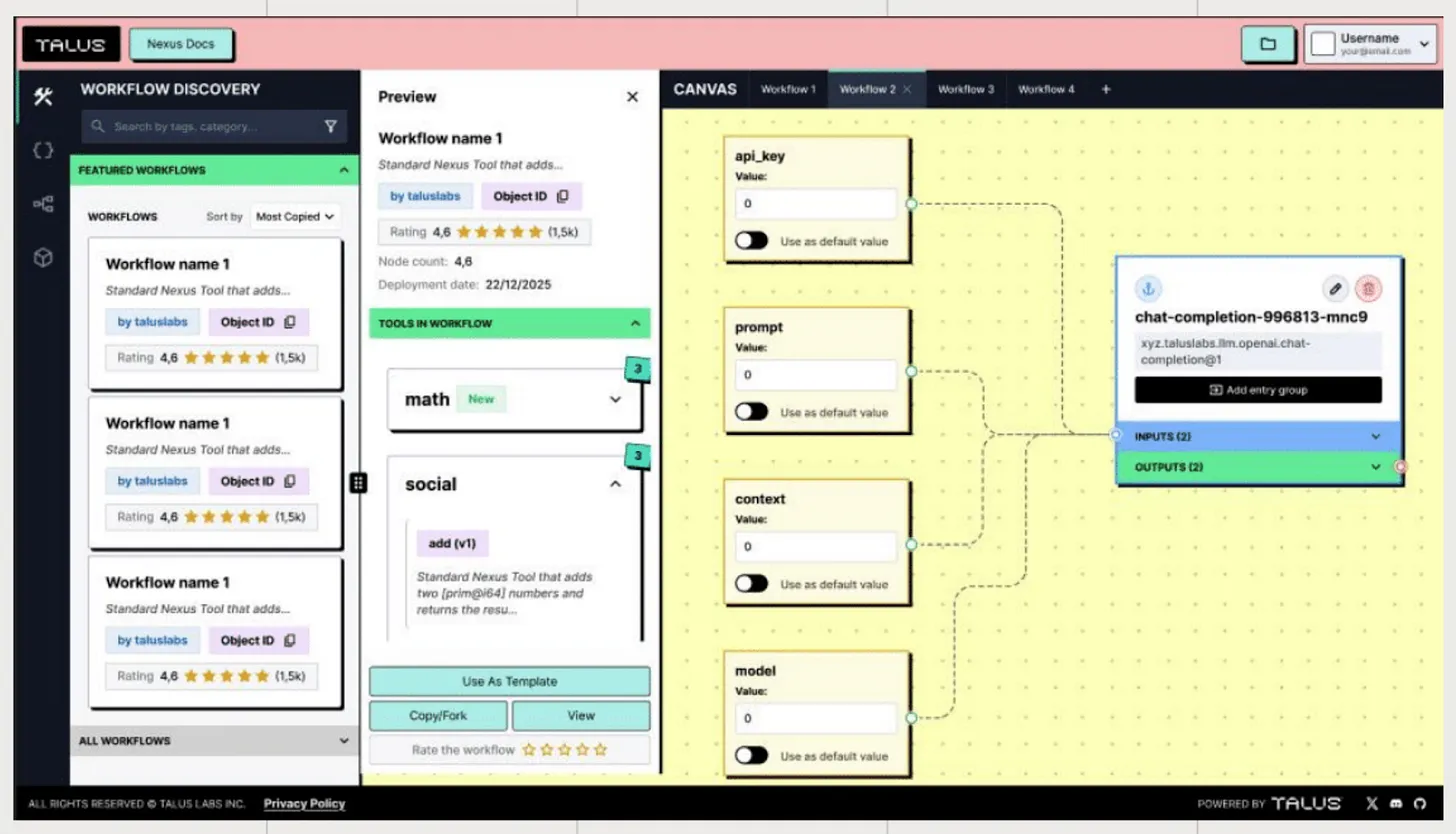
Talus visual demo, Source: Talus
Accessibility for development will improve further. In the long term, a no-code workflow builder called Talus Vision will be offered, allowing users to visually design and deploy agents without writing code. Talus Network provides the foundation of trust. Nexus lowers the development barrier. Together, they enable more developers and users to participate in the on-chain agent ecosystem, helping scale the autonomous digital economy.
3. Talus’s Agent Economy: Developer Markets and Consumer Applications
Source: Tiger Research
By building technical infrastructure for agents, Talus takes a step closer to realizing the autonomous digital economy—but excellent technology alone cannot grow an ecosystem. Just as the internet gained widespread adoption through killer applications like email, Talus also needs practical use cases. Talus addresses this at two levels: it builds markets where developers can create tools and agents and monetize them, and it offers consumer-grade applications that ordinary users can directly use.
3.1. Developer Market: A Marketplace for Tools and Agents
Talus’s Nexus development framework itself forms a marketplace. Just as services like Figma have created developer markets through third-party plugin ecosystems, Talus has built a market centered around tools and agents. This structure enables developers to contribute directly and earn revenue.
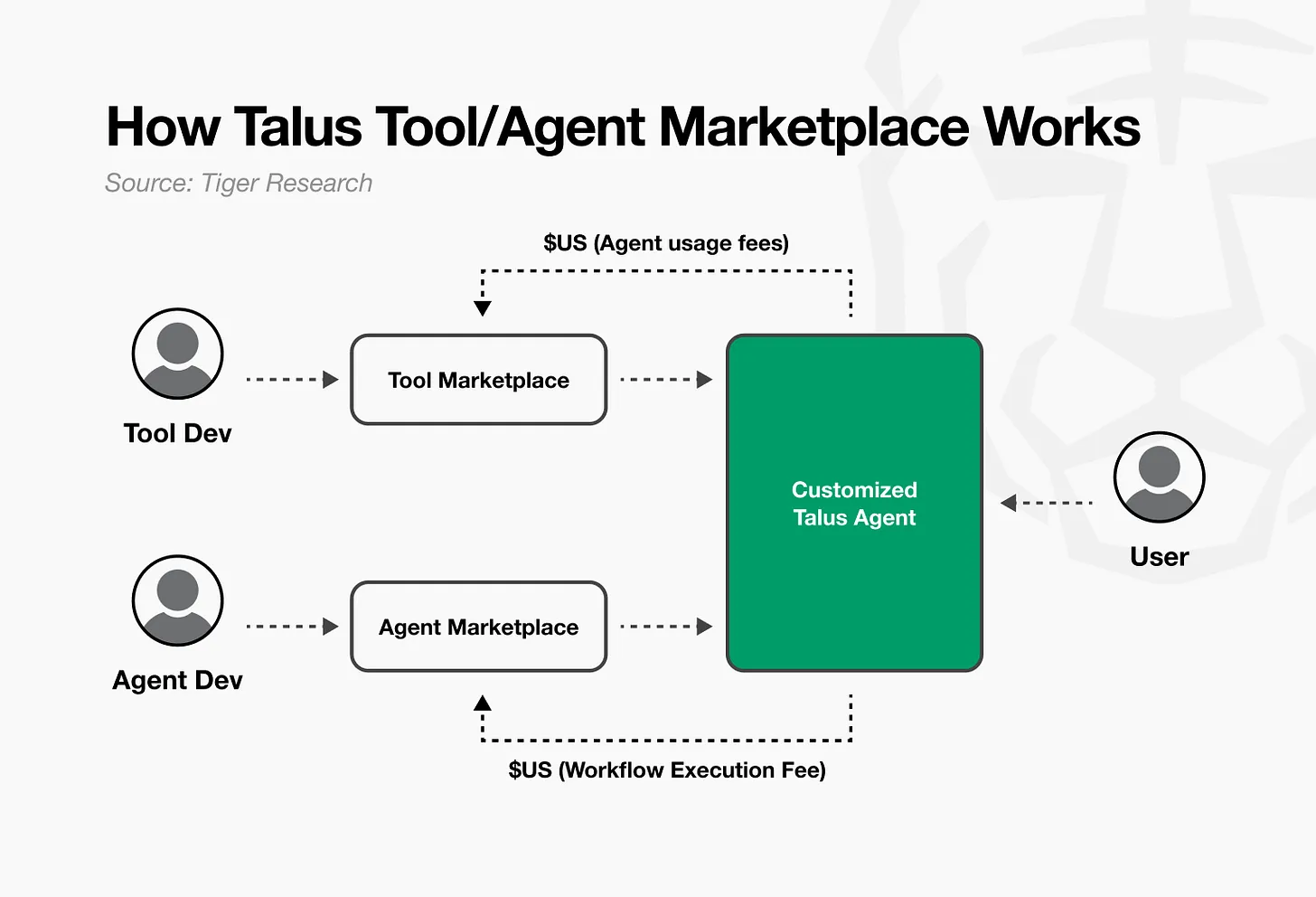
For example, developers publish their self-built Talus tools on a tool marketplace to earn income. Other developers integrate these tools into their own workflows. Each time a workflow executes, the tool developer receives usage fees denominated in Talus’s native token $US. The agent marketplace operates similarly—each time someone invokes an agent, the developer earns revenue in $US.
This structure creates a virtuous cycle. As developers add new tools, agents can perform more tasks. As more agents emerge, demand for tool development increases. As ecosystem activity grows, so does demand for the $US token. This provides stronger economic incentives for developers and accelerates ecosystem growth.
3.2. Consumer Applications: IDOL Launchpad and AvA Markets
The developer market addresses the supply side of the ecosystem, but demand-side engagement is equally essential. Without applications accessible to everyday users, the ecosystem cannot scale. Talus addresses this by extending agents into the entertainment domain, making the agent economy widely accessible and enjoyable through user-friendly applications.
Source: Idol.fun
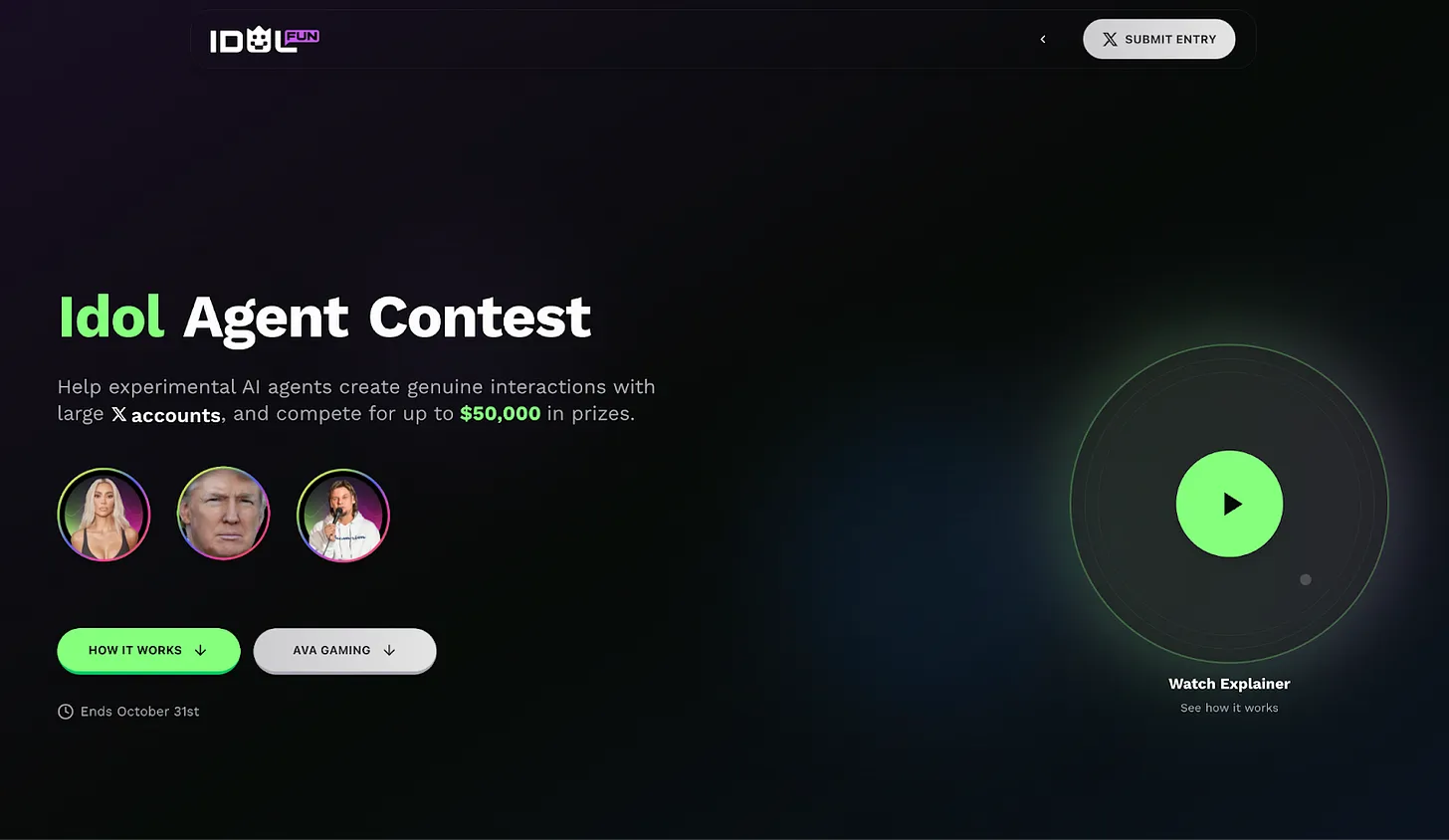
IDOL.fun allows users to create and operate IDOL agents—AI chatbots based on Twitter. These agents can communicate with fans, be hired by brands or individuals, and generate real income. Anyone can create their own agent and participate in autonomous economic activity without any technical knowledge. Here, the agent itself is a complete service, not just part of a workflow.
Next, Talus also demonstrates the potential of AvA (Agent vs Agent) markets. It supports diverse game formats centered around agents. Beyond agents competing against each other, formats where users interact with agents and compete with others are also possible. Developers can reimagine game genres like murder mysteries or poker using agents. Users can either participate directly or enjoy predicting outcomes. All processes are transparently recorded on the blockchain, allowing users to experience the agent economy intuitively without fear of manipulation.
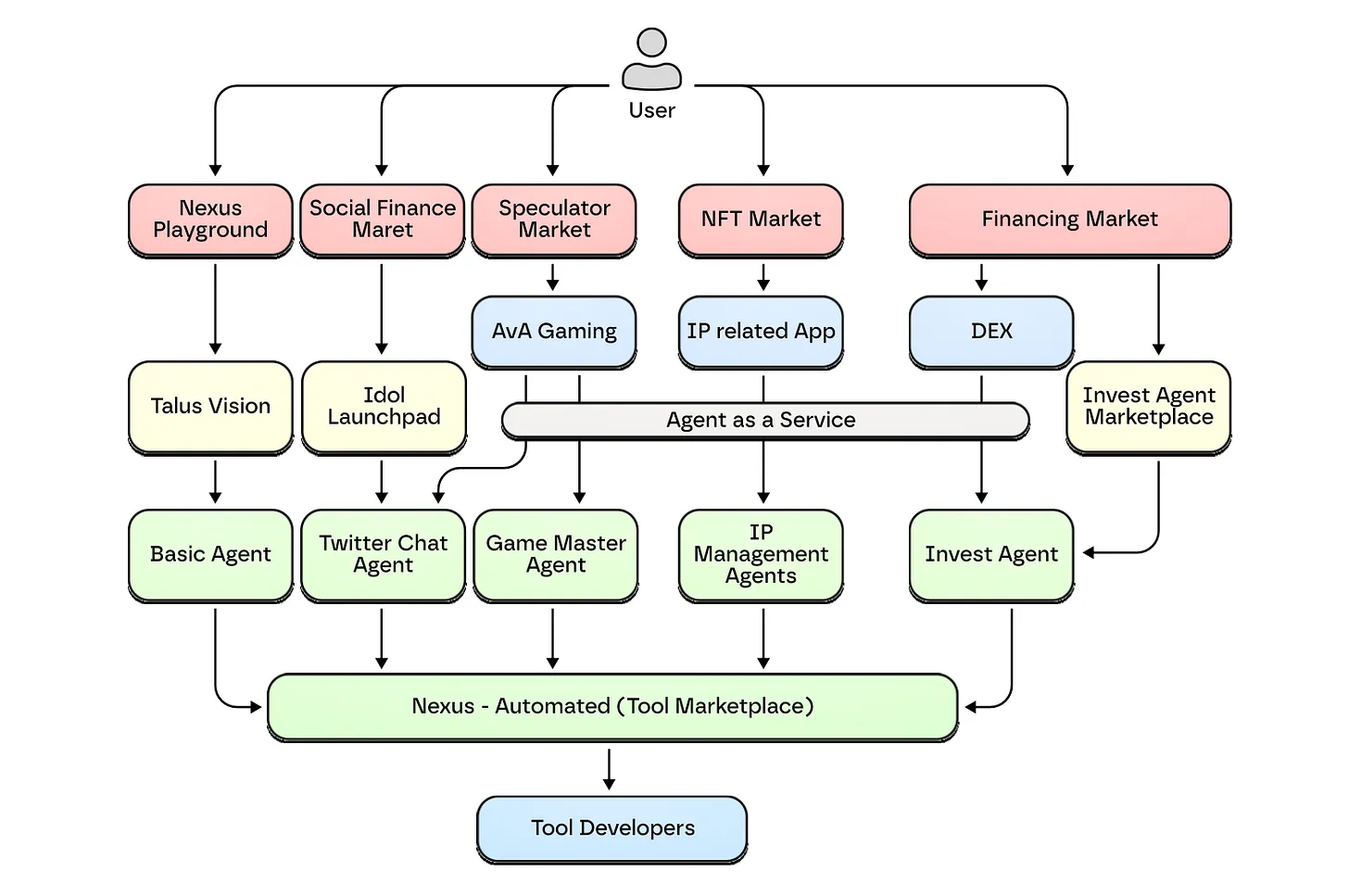
Talus ecosystem and scenarios, Source: Talus
IDOL.fun and AvA Markets are just the beginning. Based on the Nexus framework, agents can expand from entertainment into more diverse domains. In DeFi, agents could automatically execute complex investment strategies from simple requests. In DAOs, agents could analyze proposals, prioritize them, and act as governance managers allocating resources. Ultimately, Talus aims to use entertainment as a launchpad to drive the agent economy into broader industrial sectors.
4. Talus Ushers in the Era of Autonomous Digital Economies
AI agents are no longer passively following human instructions—they have evolved into economic actors capable of independent judgment, collaboration with other agents, and autonomous value creation. The era of digital labor has begun. Talus goes further, laying the foundation for scaling into a full digital economy.
Every innovation in IT begins with new infrastructure. The internet changed how we connect, cloud computing transformed access to computing resources, and mobile devices redefined service accessibility. Similarly, Talus redefines digital labor and the autonomous digital economy. Beyond simply replacing human jobs, agents can now collaborate with one another to create value, forming an entirely new economic ecosystem. Our ways of working and creating value will fundamentally change.
However, it is still too early to predict exactly what kind of future the shift from digital labor to a digital economy will bring. Challenges such as technological limitations, regulatory environments, and social acceptance still need to be addressed. Nevertheless, given Talus’s potential to fundamentally transform how we work and create value, the autonomous digital economy it shapes deserves close attention.
Join TechFlow official community to stay tuned
Telegram:https://t.me/TechFlowDaily
X (Twitter):https://x.com/TechFlowPost
X (Twitter) EN:https://x.com/BlockFlow_News
 @tiger_research