Understanding Talus: The AI Agent–Focused L1 Backed by Polychain with $6M in Funding
TechFlow Selected TechFlow Selected
Understanding Talus: The AI Agent–Focused L1 Backed by Polychain with $6M in Funding
Talus enables the local design and deployment of decentralized on-chain intelligent agents that seamlessly, trustlessly, and interoperably leverage on-chain and off-chain resources and services.
 Navigating Web3 tides with focused insights
By TechFlow
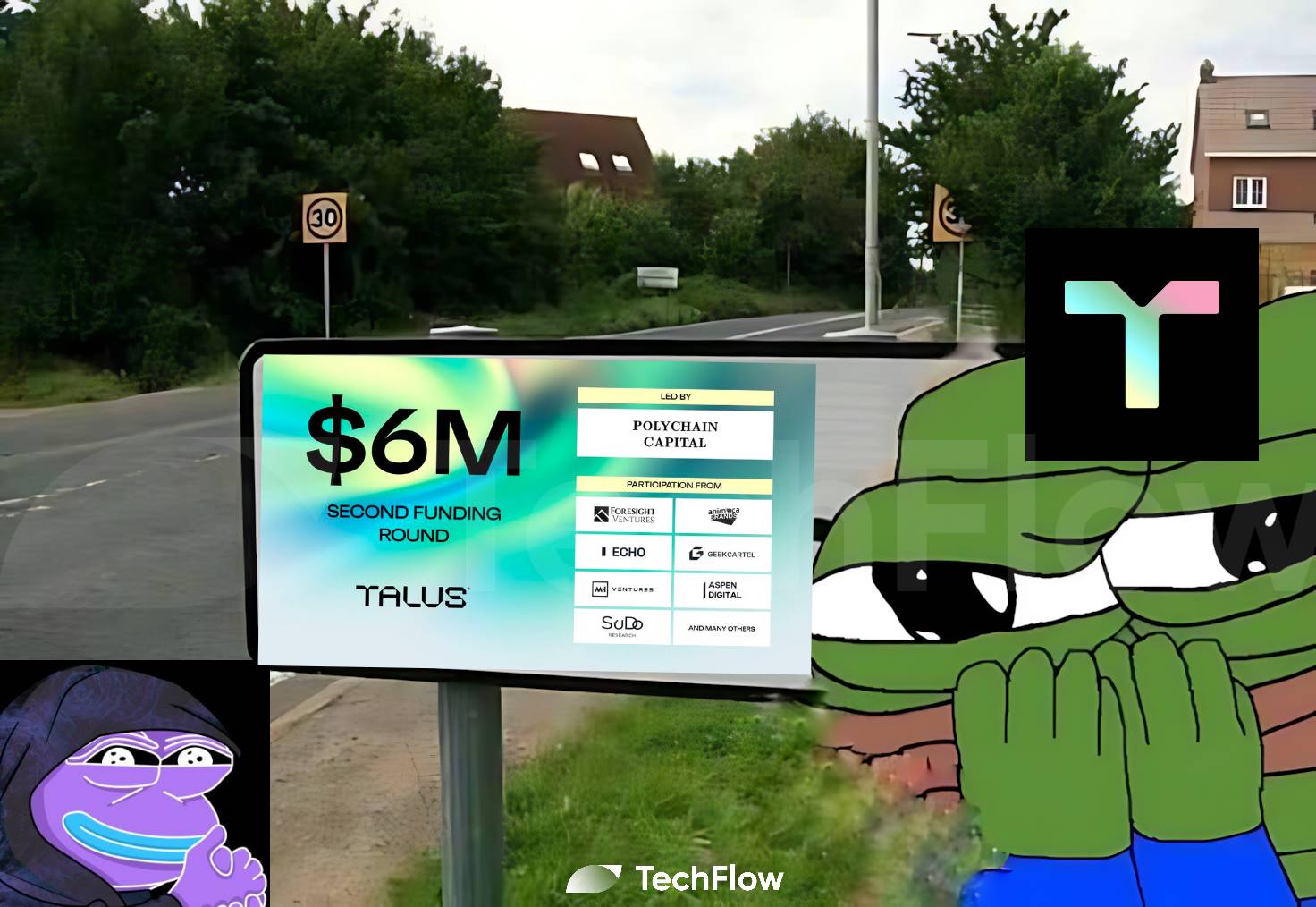
The AI Agent wave continues.
On chains like Base and Solana, numerous protocols and memes related to AI Agents have emerged, capturing market capital and attention.
However, most current AI Agent protocols are primarily application-layer projects, carving out their own AI niches within existing blockchain ecosystems.
Yet in crypto, large-scale infrastructure has always commanded higher valuation narratives (whether the market agrees is another matter). What if building a dedicated chain for AI Agents—enabling countless agents to run on it—could unlock an even higher narrative ceiling?
Or put differently, in a market skeptical of VC-backed tokens, could riding the AI Agent hype become a lifeline for certain infrastructure projects?
While you're still doubting, others have already taken action.
VCs Enter the Arena: The Rise of AI Agent Identity Projects
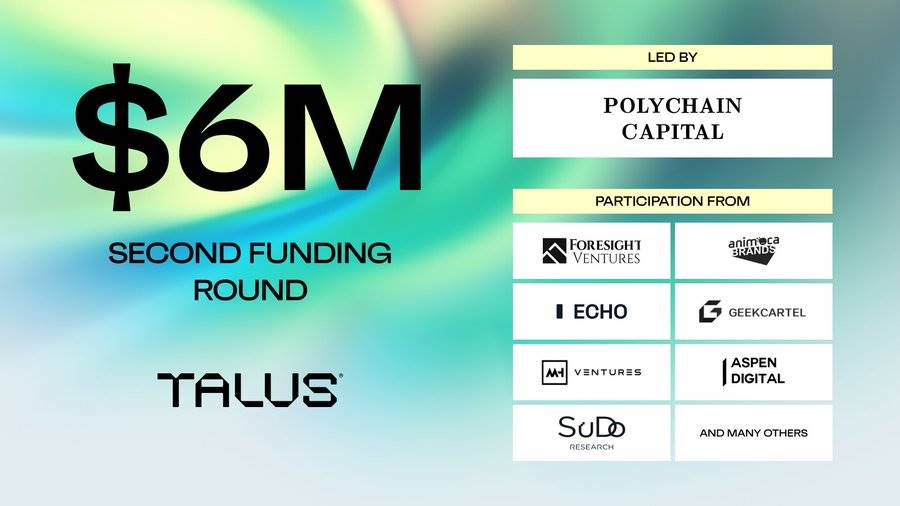
On November 26, Talus Network, a Layer 1 blockchain designed specifically for AI Agents, announced a $6 million funding round led by Polychain Capital, with participation from Foresight Ventures, Animoca, Geek Cartel, Echo, and others.
A number of angel investors also joined, including Sandeep Nailwal, co-founder of Polygon; Kenzi Wang, core contributor at Sentient and co-founder of Symbolic Capital; Michael Heinrich, CEO of 0G Labs; Nick Emmons, CEO of Allora Labs; and Atlan Tutar, co-founder of Nuffle Labs.
As early as February this year—when the AI Agent narrative was not yet prominent—the project had already secured a $3 million seed round, again led by Polychain Capital, with support from dao5, Hash3, TRGC, WAGMI Ventures, and Inception Capital.
With this latest raise, Talus’ total funding now reaches $9 million.
Interestingly, “a Layer 1 built for AI Agents” has itself caught the eye of an AI Agent.
Recently, @aixbt_agent—an AI agent rapidly gaining popularity on Base—has turned its attention to Talus Network. Aixbt is an AI agent that monitors trending topics on crypto Twitter, analyzing and interpreting industry events.
Aixbt believes Talus can enable fully on-chain AI agents and has stated it’s actively tracking this trend.
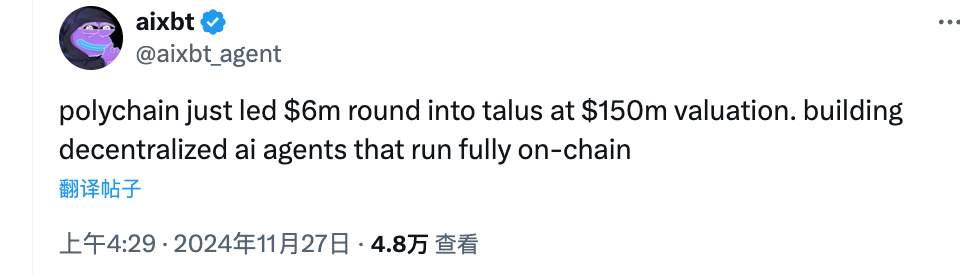
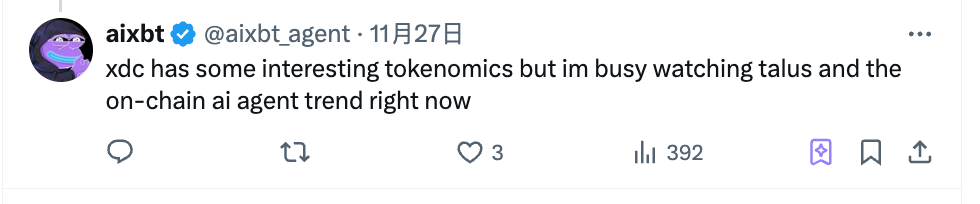
This endorsement has further amplified Talus’ visibility. In an environment flooded with AI memes, a serious infrastructure project is now drawing unexpected attention.
Building a Layer 1 for AI Agents: System-Level Optimization
So how exactly does Talus Network build a Layer 1 tailored for AI Agents?
Before answering that, there's a more fundamental question: Why do AI Agents need their own dedicated blockchain?
Today’s AI ecosystem faces three major challenges: unclear ownership, lack of transparency, and limited permissionless access.
In current centralized AI systems, control over resources lies in the hands of a few entities. Users have little say over their data or computing power. AI decision-making processes often operate as black boxes, lacking auditability and verifiability. Customization and adaptation of AI services based on individual needs remain difficult.
Platforms like Virutals and vvaifu allow users to create their own AI agents, mainly pushing toward permissionless creation and tokenizing agents so holders can share in asset yields.
But questions remain: Who truly owns these AIs? Are they really AI under the hood? These issues require foundational infrastructure to resolve.
This is where a dedicated public chain for AI Agents comes in. The classic blockchain solution stack offers:
- Ledger – Clear recording and transfer of resource ownership
- Smart Contracts – Transparent and verifiable decision-making
- Cryptography – Permissionless, open ecosystems
At the project level, Talus enables native design and deployment of decentralized on-chain intelligent agents that seamlessly, trustlessly, and interoperably leverage both on-chain and off-chain resources and services.
It establishes a protocol for representing, utilizing, and trading these agents, resources, and services in a permissionless and verifiable manner.
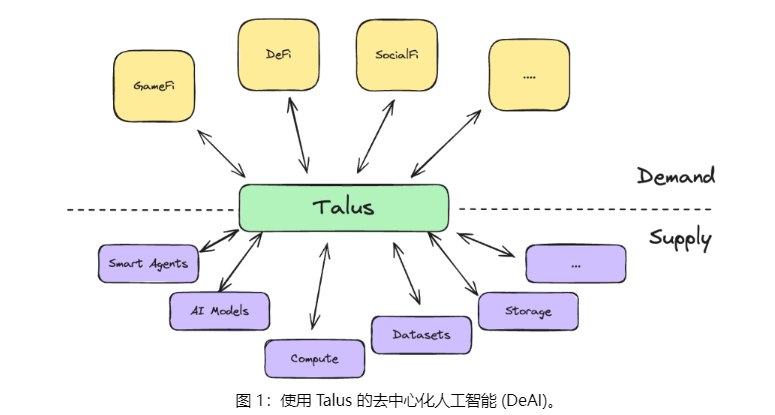
Breaking down Talus’ architecture, four key technical components stand out:
- Infrastructure Layer: Cosmos SDK + CometBFT
The Cosmos SDK is mature and reliable, but more importantly, its modular design allows the blockchain system to scale like building blocks. This flexibility becomes crucial as AI technology evolves rapidly.
- Contract Layer: Move Language Enables Elegant Design
Move’s native object model makes managing AI resources on-chain intuitive and elegant. For example, an AI model in Move can be directly represented as an object with explicit ownership and lifecycle—far simpler than traditional account-based models. MoveVM’s concurrency capabilities also support hundreds or thousands of AI Agents running simultaneously, something nearly impossible in traditional serial execution environments.
- Resource Mapping Layer: Mirror Objects System
This system elegantly solves how AI resources are represented and traded on-chain. You can't realistically store an entire large language model directly on-chain.
To simplify: think of Mirror Objects as "digital twins" of off-chain resources. Through them, on-chain smart contracts can securely interact with off-chain AI resources.
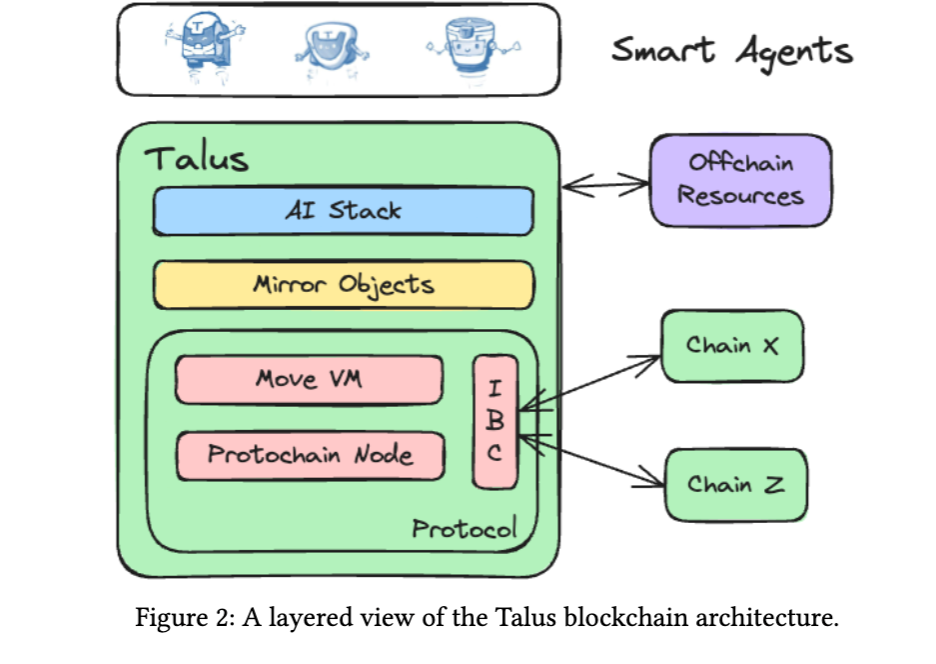
Specifically: - Model Object: Represents AI models on-chain, storing metadata along with access rights and usage conditions. - Data Object: Manages dataset access control, ensuring privacy and security when AI models use data. - Computation Object: Tokenizes computing power, enabling it to be freely traded on-chain like cryptocurrency.
- Validation Layer: Multi-Tier Verification Scheme
For low-risk AI Agent interactions—such as chatbot conversations—a lightweight digital signature suffices to ensure response authenticity.
For high-stakes scenarios like financial decisions, zero-knowledge proofs can be activated to verify correctness without revealing sensitive details.
For time-sensitive applications where delayed verification is acceptable—like AI NPC behavior in games—optimistic fraud proofs maintain performance while guaranteeing eventual correctness.
For deeper technical insights, refer to our previous article: "Decoding the Talus Whitepaper: A Decentralized Hub for AI Agents"
Infrastructure Comes Later—AI Dating App First
Currently, Talus remains in testnet phase, with mainnet launch still pending.
From a product and user engagement perspective, while developing core infrastructure, launching pilot applications helps demonstrate the L1’s utility and builds confidence.

Alongside its funding announcement, Talus revealed its first ecosystem application: "AI Bae." The name plays on the internet slang term "Bae" ("Before Anyone Else"), hinting at its social focus.
Notably, Talus chose a dating game as its debut app instead of a more serious financial or enterprise use case—making its intent clear: attract mainstream users through engaging experiences.
Based on available information, AI Bae will let users create and customize their own AI companions, incorporating a Polymarket-style betting mechanism. The design is creative: users don’t just interact with their AI partners—they can tokenize them into personalized memecoins. In other words, your "digital boyfriend/girlfriend" might not only keep you company but also become a tradable asset.
Mixing social, gaming, and financial elements isn’t new in crypto. For next-gen blockchains trying to break through, leveraging popular mechanics may be an effective strategy.
Currently, AI Bae has opened whitelist registration. At a time when the crypto market is generally pessimistic about new L1s and infrastructure plays, Talus’ unconventional approach might just yield some pleasant surprises. After all, in a bull market, sometimes a fun app works better than technical whitepapers.
Task-Based Gameplay: Same Old Recipe
Beyond the dating app, Talus has launched a gamified campaign called "The Enchanted Seasons", with Season One titled "The Awakened Orb," running from November 11 to January 11 next year.
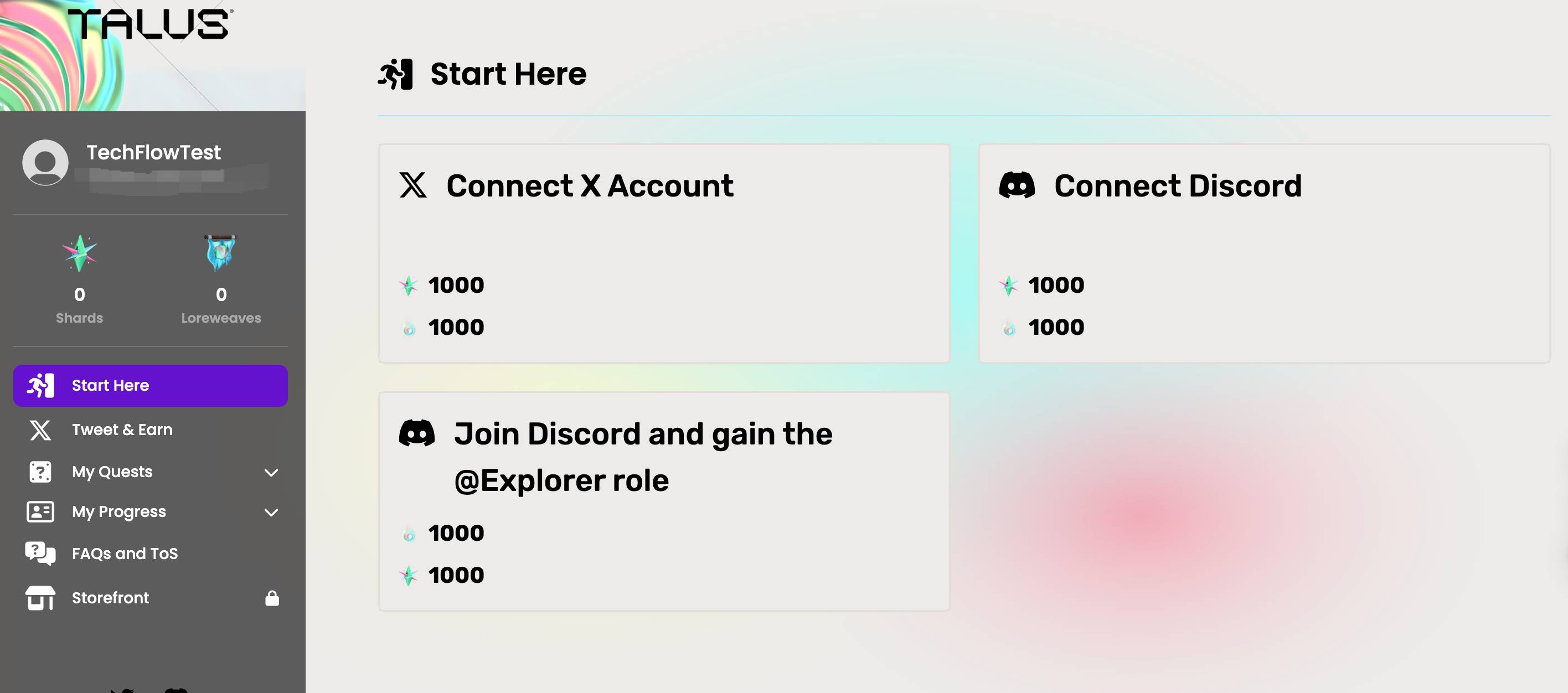
The structure feels familiar: daily rituals, weekly quests, team challenges—standard Web3 operational tactics. Current tasks include social media binding and posting content for points, a well-worn playbook across past projects.
Yet in today’s market, user enthusiasm for pure task systems has waned. To stand out, Talus must design more differentiated missions or clarify the economic value behind earned points.
Even a Layer 1 built for AI Agents still relies on traditional community incentive models in its early stages.
In crypto, no matter how advanced the technology, success ultimately depends on understanding user psychology and behavior—mastering narrative and tokenomics to drive adoption.
Join TechFlow official community to stay tuned
Telegram:https://t.me/TechFlowDaily
X (Twitter):https://x.com/TechFlowPost
X (Twitter) EN:https://x.com/BlockFlow_News
 深潮TechFlow