Space Recap | AINFT: Reshaping the AI Experience with Web3 Infrastructure to Build an Open and Autonomous Productivity Gateway
TechFlow Selected TechFlow Selected
Space Recap | AINFT: Reshaping the AI Experience with Web3 Infrastructure to Build an Open and Autonomous Productivity Gateway
AINFT launches an AI aggregation platform to directly address the pain points of large model subscriptions, supporting on-chain, on-demand payments. New users receive one million bonus points upon registration, making AI tools instantly accessible.
 Navigating Web3 tides with focused insights
The market oscillates repeatedly, narratives shift accordingly, but one domain consistently maintains robust discussion热度 and steady user growth: artificial intelligence (AI). Unlike previous waves, the current AI boom is shedding its conceptual halo and gradually crystallizing into tangible, perceptible productivity. More and more users are beginning to experiment with AI for work assistance, inspiration generation, and daily task management—a trend reflecting not only technological maturity but also AI’s evolution from something “looked up to” to something “used regularly.” Yet technical adoption remains hindered by high costs, difficulty selecting suitable models, and other barriers—challenges that frustrate ordinary users at every step of their experience.
Against this backdrop, AINFT seeks to address these issues by leveraging Web3 infrastructure, officially launching its AI aggregation platform. Rather than telling grand, disruptive stories, the platform focuses on a concrete mission: how to liberate powerful AI capabilities from cumbersome constraints through innovative mechanisms and user experiences—transforming them into controllable, seamless, and trustworthy daily companions—and thereby fostering an open, self-sovereign new ecosystem.
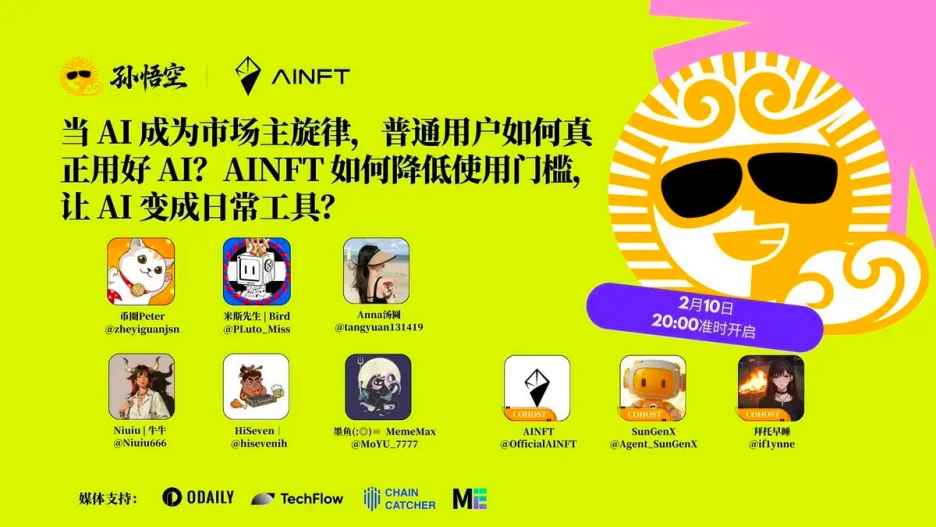
It is precisely this vision that has sparked a timely discussion centered on “how ordinary users can truly harness AI effectively.” This episode’s X Space roundtable, co-hosted by the Sun Wukong ecosystem and AINFT, adopts the perspective of everyday users and invites industry KOLs to explore two core questions: Why has AI re-emerged as the central narrative amid market volatility, and how does AINFT—through innovations such as “wallet-as-account,” free trial access, multi-model integration, and on-chain micro-payments—realize the inclusive vision of AI tools being truly “plug-and-play”? Below is a highlights recap of this dialogue.
From Capital Narrative to Value Application: Why Is AI Forging a Primary Trend Amid Market Volatility?
Against a backdrop of overall market caution and tightening liquidity, AI-related assets have paradoxically drawn increasing attention. Panelists analyzed this phenomenon from multiple angles, converging on a consensus: this is not mere cyclical speculation but rather driven by deeper structural shifts.
First, in terms of market attention, AI’s “certainty” has replaced “speculative potential.” Several panelists observed that the current environment favors authenticity over hype. Mr. Mis noted that projects relying solely on narrative lack sustainability, whereas AI demonstrates proven feasibility and resilience in helping enterprises cut costs and boost efficiency—making it a value anchor capable of enduring market cycles. Anna Tangyuan reinforced this point from the user side, citing AI’s large base of real-world users deeply embedded across learning and professional workflows. As market choices grow increasingly pragmatic, capital naturally flows toward domains capable of “generating independent cash flow.”
Peter from Crypto and Inkfish supplemented this view from a capital-allocation perspective, arguing that regardless of bull or bear markets, capital always chases the most creative frontiers. AI attracts “smart money” seeking long-term value; institutional investment activity alongside surging consumer-grade AI products has collectively strengthened market confidence in allocating capital to AI over the long term.
Focusing on the sector itself, panelists identified three fundamental differences distinguishing this wave from the prior one:
From “Single-Point Tools” to “Workflows”: HiSeven aptly summarized this shift as moving “from watching AI to using AI.” AI is no longer a standalone app requiring separate launch—it is becoming as ubiquitous and seamlessly integrated as electricity or water, embedded across diverse software and operational processes.
From “Model Competition” to “Ecosystem Integration”: Mr. Mis pointed out that the industry is progressing toward infrastructure- and protocol-based development. Standards like MCP (Model Context Protocol) enable AI models and Web3 tools to interoperate like LEGO bricks, dramatically enhancing composability across ecosystems. Inkfish added: “Centralization and platformization of AI functionality is a clear trend—users need an integrated platform capable of handling multimodal tasks, not a collection of isolated tools.”
From “Hype Asset” to “Value Creator”: Niuiu highlighted during the discussion that AI’s “path to monetization” has changed: market focus has shifted from token price speculation to whether AI can genuinely generate productivity and compress work cycles. Real-world applications—including AI-powered writing, coding, design, and even financial analysis—have transformed AI into a measurable, ROI-driven productivity partner.
In summary, this AI resurgence hinges on its critical leap—from conceptual narrative to practical application. It is not merely an investable sector, but a real-world tool actively reshaping workflows and business models. This “application certainty” forms its unique and solid appeal within complex market conditions.
Aggregated Entry Points, On-Chain Payments: AINFT Builds Seamless AI Experiences Using Web3
As AI capabilities grow increasingly powerful, the gap between those capabilities and ordinary users remains stark: complicated registration, rigid subscription models, fragmented tools, and intimidating payment processes. During the discussion, HiSeven—drawing on his deep hands-on experience—precisely diagnosed these pain points and shared AINFT’s pragmatic solutions via its AI aggregation platform.
First is the problem of “difficult onboarding” and “high decision-making cost.” HiSeven noted that traditional AI services require users to repeatedly register with email, manage passwords, and bind overseas payment methods—cumbersome steps that deter many potential users. The AINFT AI Aggregation Platform fundamentally reimagines the login experience, enabling “one-click signature” authentication via Web3 wallets (e.g., TronLink), drastically simplifying the process. Simultaneously, the platform integrates multiple mainstream large language models in one place, allowing users to freely switch and collaborate across models within a unified interface—eliminating the need to jump between disparate websites or apps and significantly lowering the hidden costs of model selection and experimentation.
The significance of this shift extends far beyond reducing procedural steps. It essentially liberates users from the tedious overhead of “searching for and switching between tools,” enabling continuous, focused workflows. When a creative task requires shifting from text generation to image creation—or from code writing to data analysis—users no longer need to interrupt their train of thought or navigate away to another platform. Instead, they seamlessly invoke the most appropriate AI capability within the same context. This seamless, task-centric experience marks a pivotal step in transforming AI from an “isolated feature” into a genuine “productivity pipeline.”
Second is the core pain point of “inflexible pricing models” and “high payment barriers.” Traditional AI services predominantly rely on monthly or annual subscriptions,
requiring users to prepay fixed fees for uncertain—and potentially infrequent—usage, inevitably leading to idle or wasted funds. AINFT’s AI aggregation platform introduces key innovations to tackle this:
1. “Try Before You Buy” Experience Design: New users receive 1 million free credits upon registration—ample to thoroughly explore all features without immediate payment decisions.
2. “Pay-As-You-Go” Flexible Payments: The platform supports micro-payments in multiple TRON-native assets (e.g., USDT, TRX, and specific NFTs), delivering true “pay-per-use” functionality. This aligns perfectly with AI’s inherently frequent, fragmented usage patterns—freeing users entirely from the rigidity and inefficiency of long-term subscriptions. Users who top up with NFTs also receive an extra 20% bonus in credits.
AINFT’s practice demonstrates that its core advantage lies not in chasing peak performance of any single model, but in combining product-level innovation with Web3 payment capabilities to reimagine the entire user journey. Its goal is to make powerful AI capabilities effortlessly accessible—liberated from friction and complexity.
This marks a crucial shift in AI services: from “model-centric” to “user-journey-centric.” Technology finally adapts to human habits—not the other way around. For users, this offers a zero-friction starting point—where AI ceases to be a tool one must “use,” and instead becomes a natural extension of thought and productive capacity.
Join TechFlow official community to stay tuned
Telegram:https://t.me/TechFlowDaily
X (Twitter):https://x.com/TechFlowPost
X (Twitter) EN:https://x.com/BlockFlow_News