CZ’s First In-Depth Interview After Pardon: On the $4 Billion Fine, the Price of Freedom, and “Secrets That Cannot Be Spoken”
TechFlow Selected TechFlow Selected
CZ’s First In-Depth Interview After Pardon: On the $4 Billion Fine, the Price of Freedom, and “Secrets That Cannot Be Spoken”
CZ admitted that once wealth reaches a certain level, money becomes merely a line and no longer brings additional happiness.
 Navigating Web3 tides with focused insights
Compiled & Translated by TechFlow
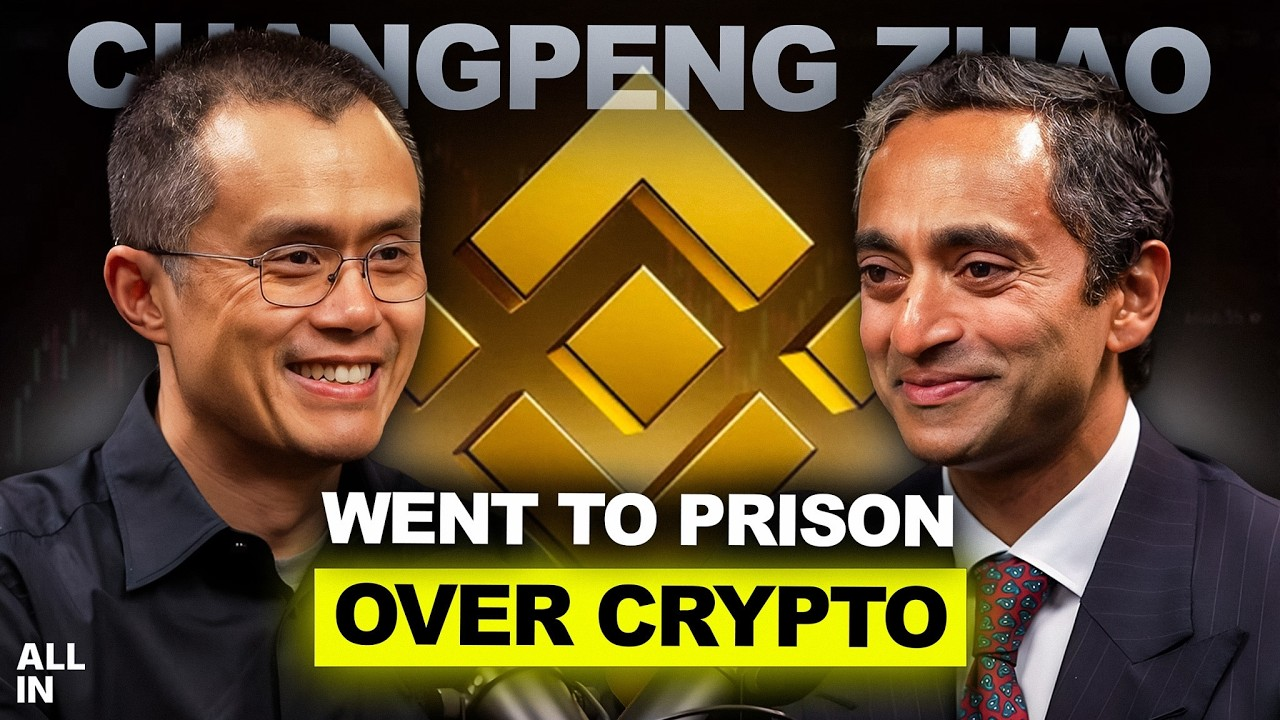
Guest: CZ
Host: Chamath Palihapitiya
Podcast Source: All-In Podcast
Original Title: Binance CEO: 4 Months in Prison, $4 Billion Fine, and What Comes Next
Air Date: February 10, 2026
Key Takeaways
Four months in prison and a $4 billion fine—the most expensive tuition in crypto history—gave CZ a new lens through which to view the world.
In this episode, Binance founder CZ speaks publicly for the first time about his journey from immigrant child to founder of the world’s largest cryptocurrency exchange. He no longer shies away from sensitive, uncomfortable truths: life under travel restrictions, cold “gang advice” from correctional officers, and the real story behind his split with SBF. From flipping burgers at McDonald’s to stepping down as Binance CEO, CZ shares his personal growth story, pivotal career turning points, and insights into the future of crypto—including an education empire Giggle Academy that issues no tokens, and a next-generation payments vision powered by AI agents.
TechFlow has compiled this two-hour conversation to help you see past the haze of a multi-billion-dollar net worth.
Highlights: Five “Confessions” from CZ’s Return
1. Life Behind Bars: Fear, Misunderstanding, and the “Luxury” of Freedom
Outside observers imagine CZ’s prison experience with voyeuristic curiosity—but he candidly reveals the real fear and absurdity he endured.
- Fear of Extortion and the “Gang” Mix-up: CZ admits that after sentencing, media outlets sensationalized him as “the wealthiest prisoner in history,” triggering intense anxiety that he’d become a target for extortion inside. On his first day, a correctional officer suggested he “join the Pacific Islander gang for protection”—a moment that terrified him. Later, he realized it was simply because Asian faces were rare, so he’d been placed in a small, six-person minority cohort—and suffered no bullying.
- Redefining “Luxury”: The taste of freedom revealed itself in the smallest details. CZ recalls how narrow the prison shower stall was—so cramped he’d bump into the walls while turning. His greatest post-release luxury? “Showering in a spacious stall where I don’t hit the walls,” and “seeing a fresh fruit platter.”
- The 26-Minute Exit: On release day, the entire process—from walking out of the prison gate to boarding a flight out of the U.S.—took just 26 minutes.
2. Regulatory Negotiations: Psychological Warfare, Handcuff Photos, and Forced Relinquishment
Behind the $4 billion penalty lies a grueling negotiation—and one of the hardest compromises any founder could make.
- The DOJ’s “Psychological Warfare”: CZ describes the talks as “hellish.” He reveals the Department of Justice (DOJ) excels at using “silence tactics”—going silent for two weeks after rejecting terms, deliberately exploiting that window to break opponents’ psychological resilience. He believes they know full well “two weeks is the optimal pressure window.”
- The Unsuccessful “Handcuff Photo Op”: Though the judge ruled no supervision was needed, the DOJ strongly pushed to handcuff CZ on the spot and remove him. CZ suspects this was purely for a photo op—to generate PR material showing his arrest. Fortunately, the judge rejected the request.
- Resigning as CEO in Tears: Stepping down from Binance’s management wasn’t voluntary—it was a condition of the plea deal. CZ admits it was the hardest decision he ever made, and he cried. But he recognized that only by stepping aside could Binance survive in an increasingly anti-crypto regulatory environment.
3. SBF and FTX: Refusing to Take the Fall, Clarifying the Rift
CZ directly addresses the conspiracy theory that “Binance brought down FTX.”
- Long Gone Before the Collapse: CZ stresses that Binance had fully exited its equity stake in FTX over a year and a half before its collapse—in July 2021—and had zero knowledge of its internal financial state.
- “He Wanted to Kill Us in This Industry”: CZ reveals the breakdown: even while Binance held equity in FTX, SBF actively smeared Binance behind the scenes in Washington D.C., and even tried to poach Binance’s VIP account managers with salaries five times higher. CZ calls it outright regulatory weaponization against competitors.
4. Future Frontiers: AI Agents Will Redefine Crypto Payments
Post-CEO, CZ has turned his gaze toward the long-term horizon—this interview’s biggest alpha (wealth signal).
- AI Agents Are Crypto’s Largest Future Users: CZ puts forward a highly forward-looking thesis: in the future, everyone will run hundreds or even thousands of AI agents (Agents) in the background. These AIs cannot open traditional bank accounts (they can’t pass KYC), so they’re inherently forced to use cryptocurrency for value exchange.
- Explosive Growth in AI-Driven Trading Volume: He predicts that most high-frequency on-chain transactions and fund transfers will soon be executed by AI agents—far exceeding human scale and frequency.
- Giggle Academy Will Never Launch a Token: Regarding his new education initiative, CZ states unequivocally: “We will not issue a token.” He believes introducing token incentives (Learn-to-Earn) would turn users into “airdrop farmers,” undermining the core mission of education.
5. Wealth and Life: A Leaky Roof and the “Ordinary Person”
Stripped of the “richest man” label, CZ emerges as a low-key, grounded individual seeking inner peace.
- The “Leaky Roof” Metaphor: Despite his billions, CZ lives in a “third- or fourth-hand used house,” where the living room ceiling leaks every month—but he doesn’t mind. “It functions well enough,” he says.
- Money Is Just “One Line”: He confesses that once wealth reaches a certain threshold (for him, after appearing on the Forbes cover in 2018), money becomes “just a line”—it no longer adds meaningful joy.
- Present-Moment Fulfillment: Compared to the stress of managing a trillion-dollar empire, CZ now relishes life without back-to-back meetings—20 per day is no longer his reality. He believes true success isn’t genius—it’s doing what you love, consistently, with a bit of luck.
From China to Canada
Chamath: CZ, welcome to the All-In Podcast. Let’s start at the beginning—I’m intrigued by your early years in Canada, which parallel mine in some ways: you worked at McDonald’s, and I worked at Burger King. But before that—your parents immigrated from China to Canada, right?
CZ:
My father actually went to Canada in 1984 to study. He was a professor in China and joined a University of Toronto exchange program. A few years later, he moved to Vancouver to attend the University of British Columbia (UBC). We applied for immigration around the same time, but getting passports was extremely difficult. We started applying around 1985 and spent two or three years securing passports, then several more years obtaining visas.
Afterward, new passports became harder to obtain. Reapplying got tougher—but we were lucky: we secured our passports one year before the incident, and afterward, visas became easier to get. So, in a sense, that event ironically helped us secure our visas.
Chamath: Once your family reunited, did both parents work? What did they do?
CZ:
My father continued as an assistant professor at the university, receiving a monthly stipend of CAD $1,000. We lived in low-rent faculty housing provided by UBC, right on campus. I remember my mother went to work at a garment factory three days after arriving in Canada—sewing clothes. In China, she taught math and history, but her limited English prevented her from landing comparable roles, so she took minimum-wage factory work for seven to ten years.
My first job was at McDonald’s. I think I was 14 or 15. Minimum wage was CAD $6, but McDonald’s paid just CAD $4.50—below minimum wage. They appeared to have some special exemption allowing them to hire many teenagers. I applied on my 14th birthday and started flipping burgers a week later—the first income I ever earned.
CZ’s Ordinary Early Career
Chamath: You weren’t one of those prodigy tech kids coding all day and studying computer science nonstop, were you?
CZ:
I wouldn’t describe myself that way. I’d say I’m technically inclined. I studied computer science, got into programming in high school, and learned some coding. But I wasn’t a prodigy programmer—not exceptionally gifted. I consider myself a solid programmer who wrote decent code throughout my career. Still, by ages 28–30, I gradually stepped away from hands-on coding and shifted toward business development and sales—spending roughly eight years focused on those areas.
Chamath: So you were essentially an ordinary immigrant kid adapting to life in Canada. Did you have many friends?
CZ:
I had lots of friends—both Asian and non-Asian. At our school, most Asians socialized mostly with other Asians, but I was an exception—I had white friends and friends from other backgrounds. My teenage years in Canada were truly wonderful—one of the best periods of my life. Those years shaped me into an outgoing, joyful person, and I’ve always felt genuinely happy.
Chamath: Was your college experience typical? How did you pay for tuition?
CZ:
I worked every summer and part-time during semesters, so I graduated debt-free—no student loans. In my first year, I borrowed roughly CAD $6,000 from my father. Year two was still tight, so my sister lent me CAD $3,000. After that, I never asked anyone for money again—I supported myself entirely.
Chamath: So you graduated with a computer science degree from McGill University?
CZ:
Actually, I didn’t graduate from McGill. I attended for four years but left in my third year after landing an internship that kept extending—so I never returned to finish. Later, I discovered Japan required a bachelor’s degree for work visa applications, so I obtained one via an online program called the “American College of Computer Science.”
Chamath: Where did you intern?
CZ:
I found an internship in Tokyo. Starting in my freshman year, I’d already been doing programming work. Initially, I wrote simulation software for a company called Original Sim. By junior year, I joined Fusion Systems Japan in Tokyo—a firm building order-execution systems for brokers on the Tokyo Stock Exchange.
Chamath: What was going through your head? Did you see it as an adventure—spending a summer in Tokyo?
CZ:
Yes—I was still a student, and living in Tokyo felt like a dream. My first visit felt like stepping into the future. I mainly wrote order-execution software—similar to what Binance uses today.
Chamath: When you first encountered that kind of software, did you instantly think, “Wow, I love this!”—or did you just grasp the concept because it was your job?
CZ:
At first, it was just my job—I was young and unfamiliar with different industries. When I joined the company, they assigned me to build a digital imaging storage system—like an iPhone photo app, but for Nikon’s medical imaging. Soon after, I joined their flagship product: the order-execution system. That became the focus of my career. I loved it because it demanded extreme technical rigor—everything revolved around efficiency: making systems faster, minimizing latency. This obsession with efficiency captivated me—I’m deeply efficiency-driven.
Chamath: When you look at HFT firms—they design custom circuit breakers and private fiber networks just to shave off milliseconds. How does that translate into software? How do you optimize those edge cases in code?
CZ:
First, ensure your software is fast and lean—e.g., eliminate database queries, keep everything in memory. Then minimize extra computation steps and simplify pre-trade risk checks. Advanced optimization involves FPGAs (Field-Programmable Gate Arrays)—network cards installed directly on NICs, eliminating the need to shuttle data between memory and CPU and back.
I was still writing code about a decade ago—back then, round-trip latency was ~100 microseconds. Avoiding that round trip cut latency to ~20 microseconds. Then, infrastructure upgrades—like colocating servers in data centers—further optimized speed.
Chamath: In AI, we saw a decade ago that GPU efficiency was poor—moving data from GPU to HBM and back was wasteful—so we moved everything onto SRAM on-chip, dramatically boosting inference decoding efficiency. Why haven’t HFT firms done something similar? I know FPGAs are common—but why no ASICs (Application-Specific Integrated Circuits)? Or have they, and we just don’t know?
CZ:
I don’t believe ASICs have seen broad adoption. HFT algorithms change too rapidly—hardware is efficient, but redesigning it takes significant time. FPGAs represent a middle ground: even FPGA reprogramming cycles are ~10x slower than software updates.
Chamath: Was the Japanese company you worked for successful?
CZ:
Very successful—it was acquired by a Nasdaq-listed company for $52 million pre-2000. Post-acquisition, cultural clashes emerged between parent and subsidiary—my first exposure to M&A failures. Later, founders launched a new venture—but it lasted only a year due to high costs and no revenue.
After it folded, I searched for new opportunities. Bloomberg was hiring—I got an offer and relocated to New York. Post-9/11, NYC was quiet—but quickly rebounded. I worked at Bloomberg for four years, doing similar work.
Founding My First Company in Shanghai
Chamath: Later, you resigned and moved to China. How did that happen?
CZ:
In early 2005, friends I’d met in Japan discussed launching a new fintech startup. They were based across Asia and debated locations—Tokyo, Shanghai, Hong Kong—and concluded Shanghai would likely become the region’s fintech hub. In hindsight, Hong Kong would’ve been smarter—their fintech ecosystem accelerated faster post-2005. So in 2005, I moved to Shanghai with five others to launch an IT startup—we had deep Wall Street trading tech experience. Our idea: bring Wall Street trading tech to China, serving local brokers and exchanges.
Once in Shanghai, they leased a lavish office—but I knew nothing about shareholder rights, preferred vs. common stock, or corporate law. I didn’t even know the difference between preferred and common shares. I just thought: “Let’s go for it.” I was a minor partner. Because I spoke Mandarin, I handled client outreach—meeting brokers. We discovered our company was registered as a Wholly Foreign-Owned Enterprise (WFOE), and Chinese brokers/financial institutions couldn’t legally partner with WFOEs.
We realized this only after incorporation—so we pivoted to offering generic IT services—outsourcing, printer repairs, SAP implementations—anything to stay afloat. Auto manufacturers became key clients: SAIC-GM, Volkswagen Shanghai, FAW Shanghai. After ~3–4 years, we opened a Hong Kong office and began working with Morgan Stanley, Deutsche Bank, and Credit Suisse. The company grew successfully—and still operates today.
Chamath: How large did the company grow?
CZ:
Peak headcount was ~200 people—and as far as I know, it remains near that size today.
Chamath: As a minor partner, did you earn income via dividends?
CZ:
Yes—but profits were modest. I reinvested most savings back into the company—never cashed out. Years later, the company stabilized enough to pay partners solid salaries—enough to send kids to international schools—annual compensation reached six figures.
Chamath: Were you married then? How did you meet your ex-wife?
CZ:
I met her on my first Tokyo trip—in 1999, during my internship. She visited me later, and we married in New York, had children—but eventually separated.
First Encounter with Bitcoin
Chamath: So what happened in 2013–2014?
CZ:
I discovered Bitcoin. A friend told me: “CZ, you’ve got to check out this thing called Bitcoin.” We chatted, and I started exploring in July 2013—via the Bitcoin Talk forum. Bobby Lee advised: “Invest 10% of your net worth in Bitcoin. Worst case, it goes to zero—you lose 10%. Best case, it multiplies tenfold—doubling your net worth.” It resonated, so I dug deeper—spending six months meticulously studying the whitepaper.
By late 2013, I was fully convinced and ready to act—but Bitcoin had surged from $70 mid-year to $1,000 by year-end. I felt I’d missed the boat—I wished I’d entered earlier. Truth is, no matter when you enter Bitcoin, you’ll always feel late—everyone you meet bought earlier.
Chamath: While learning, did you discuss Bitcoin with others? Was there a Shanghai community?
CZ:
Shanghai’s Bitcoin community was tiny. I talked to anyone willing to listen—including friends in Taiwan working at TSMC, developing Bitcoin mining chips. The pivotal moment came in December 2013, at a Bitcoin conference in Las Vegas. It drew ~200 attendees—but included industry pioneers: Vitalik, Matt Roszak, Charlie Lee, and many others still active today. Just before the event, Silk Road founder Ross Ulbricht had been arrested—media painted Bitcoin as a “drug dealer’s tool.” But at the conference, I met young geeks—friendly, passionate people. Vitalik, for instance, was incredibly kind.
Chamath: Were you still employed at your company then—researching Bitcoin on the side?
CZ:
Yes—and I proposed to my partners: “We should build a Bitcoin payment system.” BitPay led that space in 2013, having just raised $4M—a major player.
Chamath: So you said, “Let’s build a BitPay clone,” and your partners replied, “What are you talking about?”—and you hadn’t even bought Bitcoin yet, right?
CZ:
Right—I owned maybe one Bitcoin. I told my partners: “This is the most important thing in my life.” I realized two foundational technologies mattered: the internet—but I’d missed that wave—and Bitcoin. At 35–36, I refused to miss the next one—I believed such paradigm shifts might wait 15 years.
Chamath: Seeing 22-year-olds in Vegas—did you feel you’d missed your shot?
CZ:
35–36 felt fine—I didn’t feel old. But I believed the next such technology might take 10–15 years—maybe AI. Today, I see three foundational technologies in my life—but back then, Bitcoin was my sole focus. It was crystal clear: I had to act.
So I told my partners: “I’m quitting—I’m joining the Bitcoin industry.” I needed Bitcoin—but had little cash. So I sold my Shanghai apartment to buy it.
Going All-In on Crypto
Chamath: After selling your apartment, where did you live? Rent an apartment?
CZ:
Yes—I sold it and rented an apartment. My family moved to Tokyo, while I shuttled between Shanghai and elsewhere. That period also marked growing distance from my family due to constant travel.
I sold the apartment for ~$900K—nearly $1M—and used the proceeds to buy Bitcoin. Funds arrived in installments—I bought Bitcoin each time money cleared. First purchase: $800/BTC. Price dropped to $600, then $400—my average entry was ~$600.
While buying Bitcoin, I job-hunted—exclusively in crypto. Landing a role took just 2–3 weeks after resigning.
Chamath: Who hired you?
CZ:
I initially spoke with BTCC’s Bobby—he wanted to hire me. Then Blockchain.info emerged—I met Roger Ver. Their startup, founded by Ben Reeves, had just hired Nicholas Cary as CEO. I joined as third employee and VP of Engineering—Ben retained the CTO title.
Things soured: team expanded to 18; CFO Peter Smith joined, pushing fundraising. Culture shifted—I felt alienated and left after ~6–7 months. Some devs I’d recruited followed. Though outcomes were modest, I learned immensely.
Joining Blockchain.info, Ben told me: “No physical office—fully remote. We pay salaries in Bitcoin only.” A radical concept—and a key lesson I carried to Binance. I also learned marketing: Blockchain.info was the industry’s largest user platform, built entirely via one persistent Bitcointalk.org thread—Ben grew it to 2M users by replying relentlessly.
I realized guerrilla marketing could win. So I learned much—but culture changes made me leave. Then He Yi hired me at OKCoin: “Why work for a wallet company? Your expertise is order execution and exchanges.” She made me CTO—and offered 5% equity. She held just 1%—inviting me as a major partner.
I joined OKCoin—but stayed only ~8 months. Culture clashed—I disliked their discount model: users had to apply manually for fee cuts instead of automatic application. Small details signaled misalignment—so I left in early 2015.
Chamath: How did Binance begin?
CZ:
In 2015, I and former colleagues decided to launch a Bitcoin exchange in Tokyo—Mt. Gox’s collapse had left a vacuum. On the day I quit OKCoin, two developers approached me—we founded a company. I became CEO, held larger equity, and handled fundraising. I paid their salaries from my savings—I took no salary.
We quickly built a demo exchange—downloading open-source code and optimizing the UI. I honestly told investors: “We built this in two days—a proof-of-concept prototype—not a final product.”
We scripted market data pulls from Bitfinex—copying their order book to simulate activity. The demo looked vibrant. Investors exclaimed: “Wow, great tech!” But it wasn’t just smoke. When asked technical questions, I answered deeply: “How’d you architect this for efficiency?”—I explained memory-matching engines, DB optimizations.
They suggested: “Why not sell this tech to other exchanges? Most Japanese exchanges have terrible tech.” Made sense—I contacted exchanges. Within two weeks, one signed a $360K contract—paying $180K upfront, covering team salaries. I was thrilled. We pivoted from running our own exchange to becoming an exchange-system provider.
Most romanticize startups—imagining Facebook-style dorm-room launches exploding to millions overnight. Reality is grittier: Binance and Tesla succeeded through relentless, incremental effort—not instant virality. Facebook, Microsoft, Google are rare exceptions—launching strong from Day One. Their outlier stories distort perceptions. 99.9% of successes follow the hard path—if you examine any thriving company, it’s built step-by-step.
The Birth of Binance
Chamath: Take us back to Binance’s founding moment.
CZ:
We were licensing exchange software—a solid business. We served ~30 exchange clients for years—operating as “Exchange-as-a-Service” (SaaS), charging fixed monthly fees. Stable revenue.
Each new client boosted income meaningfully—a great model. But in March 2017, Chinese regulators shut down most of our clients. We were pure software vendors—not operators—but losing clients killed our business. By April–May, we debated pivots. By end-May, three team members proposed cloning Poloniex—then three days later, a blockchain chat-trading app. I countered: “Why not launch our own exchange? We already have the engine—just tweak it for crypto-to-crypto trading.” We agreed to relaunch our own exchange in May.
Team size: 20—mostly engineers, no dedicated marketing. We decided to operate a crypto-only exchange. Initially planned VC funding—but Link’s ICO success changed my mind. Everyone in June 2017 urged: “CZ, you must do an ICO!” On June 14, I told the team: “We’re doing an ICO—write a whitepaper.”
At Blockchain.info, I’d gained visibility—then as CTO at OKCoin, I was active on social media. I handled international markets—no one else communicated better in English—so I had community recognition. An ICO requires credibility—especially early in the cycle. Attend a few conferences—first draws 200; second, people recognize you; third, you’re deemed an expert. So I had standing.
Chamath: Who bought Binance’s ICO tokens?
CZ:
Honestly, even today, I’m not fully sure. Demographics suggest ~80–90% were Chinese—remainder international. Data shows ~20,000 participants—Binance was brand-new; only a few knew me from prior work.
Chamath: Even as China banned exchanges, ICOs remained legal?
CZ:
ICOs weren’t banned—nor explicitly permitted. Clarification: Our clients were fiat exchanges—not crypto exchanges. Crypto exchanges weren’t banned in March 2017. That came in September—after we’d launched Binance.
Chamath: What % of the company did you sell?
CZ:
We sold no equity—only issued tokens. We launched BNB—a circulating token. We sold 60% of supply, targeting ~$15M (raised in BTC).
BNB’s initial economic model centered on: 50% trading fee discount for BNB holders—implemented shortly after launch. Also promised a native blockchain, decentralized ecosystem, and 3–4 other features.
Chamath: You must’ve been ecstatic—$15M raised, time to launch! But in September, regulators banned exchanges. What next?
CZ:
Yes—on September 4, seven Chinese agencies jointly announced: 1) Crypto exchanges banned; 2) ICOs banned; 3) Mining banned. We decided to relocate—China was ~30% of users, but 70% were global. Losing 30% seemed survivable—even sustainable—so I said: “Let’s move—to Tokyo.”
Chamath: Did Binance launch with explosive traction—or did you grind to find product-market fit and attract early adopters? How did virality start? How did liquidity build?
CZ:
Binance’s product grew steadily—but BNB price fell post-ICO, dropping 30–40% before recovering in ~3 weeks. With crypto markets hot, product-market fit existed—it wasn’t novel, just a crypto-to-crypto-focused exchange.
Chamath: So the ICO was critical—users thought: “I hold BNB, so I get fee discounts.” That drove adoption. But was Binance’s architecture also superior—faster, more stable?
CZ:
Yes. Post-launch, order speed on Binance was visibly faster than competitors—performance was undeniable. Top platforms then: Poloniex, Bittrex, Huobi, OKX in China; Coinbase, Bitstamp in the West.
Chamath: How did you process that success? Did you think, “Is this real?”
CZ:
Some moments felt surreal—but exhilarating. Once, I asked our finance lead: “How much revenue?” She said: “Hundreds of BTC.” I replied: “That’s insane—we can’t possibly earn that much… Are you sure?” She confirmed—and I was stunned.
Another highlight: three weeks post-launch, BNB began recovering. ICO price: $0.10—fell to $0.06. Then He Yi joined Binance—announced—and over the next 2–3 weeks, BNB jumped 20% each time I woke up, returned from meetings, even from bathroom breaks.
Chamath: You must’ve realized, “Wait—I’m rich.”
CZ:
Realization came slightly later—early 2018, ~6–7 months post-launch. Forbes put me on the cover—that’s when it truly sank in.
Chamath: What is money to you? Does it matter? You became wealthy in your 40s—does money still matter at that age?
CZ:
Money matters—but it’s not everything. I was mature enough to view it differently. First, I’m in my 40s—not 20s—I won’t buy Lamborghinis or throw lavish parties. My temperament is stable—I rarely get overly excited. Also, I transitioned from newly financially free to a Forbes cover subject—overnight.
I checked my wallet—nothing changed. Even the Forbes cover altered nothing in my life. Later, people told me: “You’re probably a billionaire.” I thought: “Really? Am I? Doesn’t feel like it.”
Like moving from China to Japan—I booked economy red-eye flights. He Yi suggested upgrading to business class to rest comfortably. I agreed—and kept upgrading.
Earning more incrementally—$1M to $10M might prompt a car purchase; $10M to $100M, a yacht. But jumping straight to a Forbes cover skips that progression—no ingrained spending habits.
Chamath: Now—given volatility—you may be a $1B or $10B person. What does that mean to you?
CZ:
Not much. Money serves two purposes: First, self-care—food, shelter—requires minimal funds. I don’t live lavishly—but comfortably. My house leaks monthly—old, but perfect size for my needs. Many assume I live in a mansion—but it’s a modest, functional, third- or fourth-hand home in a great location.
I’m function-first. If it works, I’m satisfied—style, color, gold plating don’t matter. Solving problems is what counts.
Chamath: Do you feel anxious? Ever insecure?
CZ:
Rarely—I know my weaknesses and how to manage them. I’m calm—others swing wildly; my emotions fluctuate mildly.
No one wants to hear about your hard work—they judge simply: “Look at all you own.” But if you’re constantly busy, no one sees the effort.
Chamath: Did you ever become addicted to growth?
CZ:
I wouldn’t call it growth addiction—but I am work-addicted. Work is deeply fulfilling and rewarding. I averaged 20+ daily meetings—scheduled calls, face-to-face, ad-hocs—and responded to Twitter messages.
Work satisfaction is indescribable—not from money or growth. DAU (Daily Active Users) matters most. If I serve more users daily, I create value. A product’s value lies in user willingness to use it. If demand grows—even with zero revenue—the product has value.
This remains my north star. You can optimize short-term revenue—but may sacrifice long-term growth. Long term, massive user adoption creates value—for users and me. People choose my platform because it delivers value—that’s my core goal.
Knowing billions use our platform feels impactful. If users pay fees, it’s because we deliver superior value.
Chamath: DAU is vital—but a double-edged sword, given malicious actors. When did you first realize this and treat it seriously?
CZ:
I recall clearly—New Year’s Day 2018. We’d operated just 5–6 months—but Binance was already the world’s largest exchange. Around Dec 31, 2017, a U.S. Homeland Security official emailed me, requesting help tracing hacker funds—likely stolen from EtherDelta’s 2017 hack. EtherDelta was a defunct decentralized exchange.
I had no idea how to respond—no team member had law-enforcement experience. I convened a small meeting—verified his identity—then shared requested data. He thanked us.
I asked: “Can you recommend someone experienced in law enforcement collaboration?” He did—but the person was U.S.-based. We lacked a U.S. entity, so hiring was impossible—case stalled. That day was a turning point—I realized we needed law-enforcement-experienced hires. We later onboarded more such talent.
I face legal constraints discussing plea details. Broadly: Biden’s administration was openly hostile to crypto—even declaring “war.” Now seeing the new administration pivot 180° is great for the U.S. and world. I won’t blame the prior administration—but perhaps they lacked crypto understanding.
Chamath: Why such hostility?
CZ:
Primarily fear of the new. They likely feared disrupting existing finance—and industry lobbying may have biased their thinking—human nature.
The FTX Story: Relationship with SBF and Its Collapse
Chamath: Later, others rose—SBF and FTX exploded. Tell me—how did you meet him? You held significant equity.
CZ:
Yes—we invested in FTX, holding 20% for one year before exiting. I first met SBF in Jan 2019 at a Binance Singapore conference. FTX didn’t exist yet—SBF ran Alameda. They threw a party at Sentosa’s aquarium—with divers holding “Alameda” signs. As VIP customers and big traders, we treated them warmly.
Months later, they proposed a futures platform joint venture—60–40 split, favorable to us. I considered countering—we had all users; they had none. So we declined.
Chamath: Were they key liquidity providers?
CZ:
Not especially. Big traders—but Binance was nascent. They traded on us briefly—6–12 months.
Later, summer brought better proposals—still declined. In November, they offered compelling terms: 20% equity at a bargain price, plus BNB-for-FTT token swaps. BNB was more liquid; FTT less—deal closed.
But almost immediately, friends told me SBF was badmouthing us in D.C. circles. Frustrating. Worse, they poached our VIP account managers with 5x salaries—who held our VIP database. Next day, VIPs got FTX calls offering better rates. I called SBF: “Please stop—we’re shareholders.” He agreed—then invited me to co-host a crypto event. I accepted—wanting multiple successful exchanges to dilute scrutiny. Yet, whispers persisted—unfriendly acts continued.
~1 year later—early 2021—they claimed $32B valuation fundraising. Our investment terms gave us veto power over follow-ons. We could’ve blocked them—but chose fairness. We exited—deal closed July 2021.
Chamath: That was a full 18 months pre-collapse—rumors claim their issues began post-exit and related to our departure.
CZ:
False. Due to competition, I never requested FTX’s financial statements—I was passive. I don’t involve myself in portfolio companies—especially rivals like FTX (we had competing futures platforms). I stayed distant—letting them operate freely.
Chamath: Regarding FTX’s collapse, two issues dominate discourse: 1) Compensation inadequacy for depositors; 2) Worthless investments post-collapse. Your views? Broader industry lessons?
CZ:
I’ve seen varied claims online. For transparency: we’re currently litigating with FTX’s estate—they seek to claw back funds from our 2021 exit. So I’ll limit comments. I’ve heard complaints—e.g., some Chinese users excluded from compensation. But per reports, crypto price surges mean dollar-value recovery is sufficient—though crypto-denominated payouts might yield more.
Facing Biden’s Anti-Crypto Policy and DOJ Investigation
Chamath: When did things get complex for Binance?
CZ:
Complexity began with information requests—we complied fully. This spanned 2021–2022. By late 2022, tone turned adversarial. Early 2023, stance hardened: “Agree to terms—or face prosecution.” Negotiations began.
Chamath: How did you react? Did you think, “I can’t believe this is real”? What were those lawyer meetings like?
CZ:
First, I lack legal training—I rely entirely on counsel. That’s toughest—I had zero experience. Few do—those who’ve endured it avoid repeats. So, as the investigated party, virtually no one has experience.
We hired excellent lawyers—but coordination was complex. Experts from diverse fields held conflicting views—each vying to appear smartest/most vital. More hours = higher fees. Not unprofessional—just aiming to excel—but divergent directions dragged us into complexity. That’s the messiest part. Direct guidance would simplify—but our legal team lacked experience handling such complexity—making it harder.
Our team was globally dispersed—I shuttled between Dubai and Abu Dhabi in 2023—extremely stressful. My coping method: analyze best/worst cases. I’d ask: “Best case? Pay fine, sign DPA, done.” Worst case? Prison.
Chamath: But was prison truly worst? Seemed like probation was worst-case.
CZ:
True—no precedent for prison in such cases—but DOJ could demand it. Worse: if no agreement, fight it. I might stay in UAE—no extradition treaty. Now a UAE citizen, extradition is nearly impossible—but travel severely restricted. Even in non-extradition countries, risks exist—bilateral deals could emerge—life filled with uncertainty/fear.
This creates trouble—and pressure on UAE government. I don’t want to burden those granting me citizenship. I don’t want to be a problem. Worst-case: indictment + Interpol Red Notice—possible.
Chamath: How was it resolved?
CZ:
Negotiations dragged—12–20 lawyers daily for over a year. Back-and-forth with Biden’s DOJ lasted >1 year. Lawyers’ top refrain: “We’ve never seen such hostility toward a case.”
Chamath: Did you numb yourself—or dwell on “Why me?” Feel resentment—or cope differently?
CZ:
Gradual process—some phases were brutal. Key negotiation moments forced “no”—e.g., unacceptable terms, no compromise.
Then weeks passed—no clue what’s next—a hellish limbo. Indictment possible—entirely at their discretion. During those weeks, I mentally prepared: “I may be confined to one country—living cautiously. Maybe an unannounced warrant awaits at a border crossing.”
Interestingly, after two weeks, they resumed talks. Looking back, this was masterful negotiation strategy. For someone in my position, silence/delay is psychological warfare.
For the investigated, this is likely a once-in-a-lifetime ordeal—no experience. For them, it’s routine. It’s your life—sealed Red Notices could last decades.
They know how to pressure psychologically—and understand two weeks is optimal. Longer, you adapt. So they don’t let you linger.
Chamath: How did you finally agree to the deal?
CZ:
After rounds, we settled on admitting violation of one Banking Secrecy Act provision—failure to register as required. A federal crime—serious—but historically, no one jailed for this alone.
Chamath: This sounds technical. How does it relate to media claims—money laundering, aiding crime, lacking KYC/AML? Is media perception aligned—or vastly off?
CZ:
I’ll explain my understanding—but disclaim: I’m not a lawyer—this is personal interpretation, potentially flawed.
Core charge: Violating the Banking Secrecy Act—specifically, failure to register. Simply: we served U.S. users without registering as a financial services provider in the U.S. An oversight—but unrelated to user misconduct. Issue: we didn’t register to signal eligibility for U.S. service.
Additionally, charges regarding KYC (Know Your Customer) and AML (Anti-Money Laundering) procedures. They deemed our KYC/AML inadequate. Many see KYC/AML as black/white—but it’s nuanced: depth of implementation—systems, workflows, staffing—all matter.
More severe: allegations we “knowingly aided illicit transactions.” E.g., weak AML failed to flag bad actors—but distinct from “knowingly facilitating illegal trades.” Highest tier: personal involvement—e.g., Charlie Shrem aiding Silk Road. I never touched trades—neither my role nor intent.
Ultimately, Binance charges centered on: 1) Failure to register; 2) Inadequate KYC/AML. Typically, fines resolve these. Historically, no U.S. imprisonment for these standalone charges.
Yet, DOJ added two “enhancement” charges—#3 and #4—claiming personal assistance in illicit activity. No concrete evidence supported them—they tried linking me to company actions.
Chamath: Could they cite specific trades or incidents?
CZ:
No—no specific evidence—so enhancements were dismissed outright in court. Pre-U.S. arrival, we agreed to defend these in court. And per my research, no precedent for imprisonment on similar charges.
Most severe historical penalty: BitMEX co-founder Arthur Hayes—6 months home confinement. Studying his case, he interacted directly with clients—whereas my Binance role involved zero direct customer contact. I engaged on Twitter—but not backend operations. So our position was comparatively favorable—leading me to believe our resolution was optimal.
Chamath: You accepted charges—and agreed to contest enhancements #3/#4 in court. Then you flew to the U.S. and entered proceedings. What happened next?
CZ:
Day one: guilty plea. Plea agreement had undergone exhaustive lawyer review/revision. Day two: formal proceedings began.
First step: guilty plea. Judge reviewed each clause: “Do you understand this? This? This?” I answered “Yes, yes, yes.” Content had been over-lawyered. Debate focus wasn’t charges—but bail conditions.
My lawyers argued for return to UAE pending sentencing in 3 months. Government feared non-return—wanted me detained in U.S. But acknowledged I posed no societal threat—no movement restrictions.
Initial magistrate ruled I could leave U.S. for UAE—ideal outcome. Government appealed. My lawyer said: “In 40 years, I’ve never seen bail appeal—only angers judges—may help you.”
Two weeks later, court sided with government—I must remain in U.S., unable to return to UAE. Separated from family for 3 months. Free to move within U.S.—but felt trapped. Luckily, my sister had a U.S. home—I stayed there. To reset, I traveled.
Three months later, government extended detention another 3 months.
Chamath: Did your kids visit?
CZ:
No—I didn’t invite them. Didn’t see them all year. Then government sought another 3-month extension. Trial date set for April 30, 2024. Final submissions due one week prior.
Shocking: government’s filing requested 36 months—double sentencing guidelines’ upper limit. Court noted: “Never seen government urge ignoring guidelines.” Surprising.
I learned this one week pre-trial—per filing deadlines. Heavy-hearted. Worse: my lawyers’ tone shifted. Previously optimistic about returning home—now suggested judge might split difference between government’s 36-month ask and our probation request.
More shocking: five days pre-sentencing—April 25—Senator Elizabeth Warren declared “war on crypto” on TV. Her public letter to DOJ cited me—largely inaccurately. Heightened tension.
Finally, April 30—sentencing day. Judge praised me extensively—quotes later published in my book. As I relaxed, he said: “But…”—heart sank—bad omen.
Attorneys still debated sentence content in court. Fortunately, court dismissed enhancements #3 and #4. My lawyers argued: I never handled trades or knew details. Court outright rejected enhancements.
Judge sentenced me to four months.
Life in Federal Prison
Chamath: How did you cope?
CZ:
Initially brutal—not just four months—but “Will I be safe?” If told: “Stay four months—guaranteed safety”—I’d accept. But uncertainty was most unsettling.
Post-sentencing, major media hyped me as “richest person ever in U.S. prison.” Lawyers/prison consultants worried: coverage made me a prime extortion target. Safety at serious risk. I kept asking: “What do I do? Enter with nothing—how protect myself?”
To prepare, I consulted specialists—prison consultants: ex-correctional officers, wardens, or formerly incarcerated individuals. They advise newcomers—how to interact, protect themselves, avoid conflict.
They warned: high-profile cases attract extortion. Advice included: don’t make friends—especially Day One. If someone’s overly friendly, refuse gifts—they’ll demand 10x repayment. Refusal or inability triggers violence.
Advice prepared me—but ultimately, you face it head-on. I learned: U.S. prison system houses ~2M people—spends more annually than on education. Massive scale.
Also: 50 states—each with unique systems—state and federal prisons. Each is like a small city. Mine housed 2,200 inmates—truly city-like, with its own rules. Pre-entry advice often proved irrelevant.
Chamath: You were sentenced April 30—when did incarceration begin?
CZ:
Sentencing doesn’t mean immediate transfer. Court recommends two facilities—letter arrives with reporting date. Judge ruled no supervision needed—rare—so no handcuffs, no detention. I awaited letter at my sister’s address—court-designated.
DOJ requested immediate handcuffing. I suspect photo-op for publicity. Judge refused: “He’s not dangerous or flight-risk—I won’t do it.” Added: “No supervision whatsoever.” Later learned this is a rare legal provision—explaining why post-incarceration, no probation/parole/supervision.
Chamath: How was that period? Any awful incidents?
CZ:
Luckily, no awful incidents—but the experience itself was awful. At least no physical harm, no fights, no extortion.
Pre-entry, consultants advised: avoid gangs, stay independent, keep low profile. Yet, first words upon entering: a guard said: “You may need protection. Heard Pacific Islanders recruiting—you might join them.” First sentence—terrifying.
Prison intake is hectic—thorough search, unit assignment. My unit held ~200 inmates—cells in three rows, 20 per row, facing each other, three floors. Ground floor: common area. First cell entry: all inmates stared—many muscular—intimidating. Prisons group by race—ethnicity determines placement. Chinese with Chinese, white with white, Black with Black, Mexican/Spanish with their groups—reducing conflict. Staff encourage this—cultural familiarity eases interaction.
Once grouped, representatives mediate cross-group issues—like union reps. Prisons have internal rule systems—I knew none. First day, an Asian-looking guy welcomed me to “our group.” I wondered: “Shake hands? Risk gang affiliation?” Later learned he was Filipino-German. Few Asians—so all Asian-appearing inmates grouped together.
I should’ve gone to Minimum-Security Prison—economic offenders. But as non-citizen, I went to Low-Security—mostly drug offenders—unique experience.
Chamath: What was your first act post-release?
CZ:
First: a proper shower—and a delicious meal. Prison showers were tiny—like enclosed boxes. Doors resembled saloon doors—covering only the middle—head/legs exposed—cramped.
So, showering in a spacious stall—no wall-bumping—felt luxuriously indulgent.
Food mattered. Fruit scarce—quality protein nonexistent. Post-release, seeing a fruit platter: “Heaven—haven’t seen luxury like this in months.”
Chamath: Did you fly straight to UAE?
CZ:
Yes, from prison gate to boarding U.S.-bound flight—26 minutes.
Chamath:
What were you thinking? Did you empathize with their stance—find some charges justified? Or feel wholly unjustly persecuted?
CZ:
Legal constraints prevent detail on plea—but emotionally, I just wanted it over.
Remember: I exited under Biden—election undecided. Policy direction uncertain. My thought: if anti-crypto policy continued, we’d adapt and survive.
Chamath: Back in UAE—did you accept no longer managing Binance? Part of the plea, right?
CZ:
I accepted—resigning from Binance management was agonizing—I cried. Emotionally complex: deep affection for Binance—my creation, my passion. Yet, necessary choice.
If I’d quit voluntarily, critics might say: “He cracked.” But legal restriction—not my choice—made it clear. So I reframed: plenty of meaningful pursuits remain.
Chamath: What’s the pardon process? What did you do? What does pardon mean?
CZ:
No clear process—few truly understand mechanics. I learned: hire a lawyer to draft a petition—detail why you deserve pardon—e.g., over-prosecution, proven trustworthiness.
Pardon erases legal record—restores ordinary citizenship. Reasons vary—depends on presidential judgment.
Constitution grants pardon power—but no procedural details. Presidents exercise it amid social context/personal judgment. Historically, pardons occur on final day—tradition. Biden broke norms—pardoning mid-term and introducing “pre-pardons”—pardoning pre-judgment. Unprecedented. He even pre-pardoned his son—controversial.
Bottom line: President decides freely. Submit petition—wait—no timeline—result may arrive suddenly.
Chamath: Some speculate what you did for pardon. Respond?
CZ:
I did nothing extraordinary—but without pardon, Binance couldn’t legitimately enter U.S. markets. I’m ultimate beneficial owner of Binance and Binance US. Without pardon, U.S. operations face severe limits.
Broadly, if the U.S. seeks crypto leadership, it can’t ignore major players like Binance. Citizens shouldn’t lose access to the world’s largest crypto liquidity pool. Binance is also a top crypto ecosystem—industry-critical. So I suspect presidential crypto support enabled pardon.
President experienced similar—bank de-risking (“debanking”) and 34 criminal charges. I watched his bathroom-document-reading charge on prison TV.
Perhaps personal experience bred empathy. He likely knows DOJ’s aggressive stance. That empathy may have aided my pardon.
New Life and Ventures Post-Binance
Chamath: How do you spend time now?
CZ:
Still busy—running Giggle Academy (free education platform), advising governments on balanced crypto regulation, investing in blockchain, AI, biotech.
These are YZi Labs projects—outside Binance. Also mentor BNB Chain ecosystem founders. Combined, keeps me occupied.
Chamath: Tell me about Giggle Academy.
CZ:
Join TechFlow official community to stay tuned
Telegram:https://t.me/TechFlowDaily
X (Twitter):https://x.com/TechFlowPost
X (Twitter) EN:https://x.com/BlockFlow_News
 深潮TechFlow