








From prison to presidential pardon, Changpeng Zhao is set to begin his "political life"
TechFlow Selected TechFlow Selected
From prison to presidential pardon, Changpeng Zhao is set to begin his "political life"
What does CZ's pardon by Trump mean?
 Navigating Web3 tides with focused insights
Author: Tuoluo Finance
Last week, a piece of news sent shockwaves through the industry.
On October 22, President Trump suddenly signed a presidential pardon for CZ at the White House, disclosing it to the public the following day. White House Press Secretary Karoline Leavitt stated: "The President exercised his constitutional authority to pardon Mr. CZ, who was prosecuted during the Biden administration's war against cryptocurrency. That war is now over."
Although rumors had circulated as early as March this year that Zhao Changpeng was seeking a pardon, the confirmation still sparked an enthusiastic market reaction. Following the pardon of what could be considered the most prominent figure in the Chinese-speaking crypto community, BNB surged, with BTC and ETH also rising in rare unison, reigniting speculation about Binance’s return to the U.S. market.
From paying massive fines and serving prison time to now being pardoned and welcomed by multiple national leaders, Zhao Changpeng's winding journey has added another legendary chapter to the crypto world.
Turn back the clock to November 2023, when Binance reached a settlement with the U.S. Department of Justice (DOJ), the Commodity Futures Trading Commission (CFTC), the Office of Foreign Assets Control (OFAC), and the Financial Crimes Enforcement Network (FinCEN) regarding investigations into Binance’s historical registration, compliance, and sanctions issues.
Zhao Changpeng ultimately admitted to operating unlicensed money transmission services in violation of the Bank Secrecy Act, the International Emergency Economic Powers Act, and the Commodity Exchange Act, along with charges of conspiracy and prohibited transactions. He paid a record-breaking $4.368 billion fine—marking FinCEN’s largest penalty ever—for his freedom.
At the time, many believed Zhao, as the Chinese leader of the world’s largest exchange, had been politically targeted. The signs of persecution were evident: Zhao’s initial estimated sentence was 18 months, later pushed by the DOJ toward three years. However, after pleading guilty and amid intense public backlash, Seattle Federal Court sentenced him in April 2024 to just four months in prison. Recalling his incarceration, Zhao described undergoing a deeply humiliating body search upon entry and sharing a cell with a double murderer—an experience he called “the hardest time of my life.”
In September 2024, Zhao completed his sentence and was released. Yet clearly, the imprisonment brought more than just pain—it profoundly taught him that while crypto knows no borders, laws do, and even the crypto industry must learn to survive within political constraints. Moreover, as head of the largest crypto platform, his Chinese identity carried complex implications in American eyes—carrying both political symbolism and an indelible sense of “otherness,” despite Zhao being a fully Canadian citizen. Under these circumstances, finding a powerful ally became especially critical.
Possibly for this reason, after his release in September, Zhao frequently traveled to the UAE and Hong Kong, unusually engaging with regulators to rebuild his political standing from scratch. After the November election, Trump’s return to power opened a new era for crypto—and presented Binance and Zhao with fresh opportunities.
In March 2025, Binance officially announced a $2 billion investment from Abu Dhabi’s sovereign fund MGX, acquiring 5% equity. Given Binance’s annual revenue exceeding tens of billions, the deal could only be described as “making friends.” More subtly, the transaction was settled in USD1—the stablecoin launched by Trump family project WLFI. Shortly afterward, Zhao posted a photo on social media with WLFI co-founder Zach Witkoff; two weeks later, USD1 officially launched on BNB Chain, receiving extensive promotion across Binance’s ecosystem.
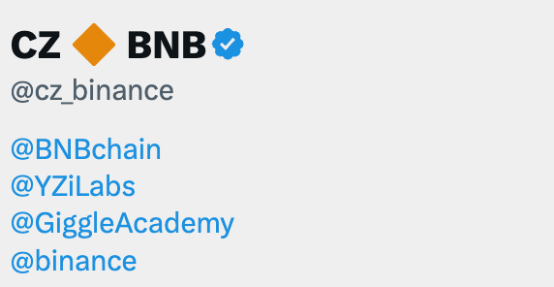
In April, Zhao formally submitted a petition for presidential pardon to the Trump administration. A turning point came in September when CZ changed his X profile from “ex-@binance” back to “@binance,” fueling growing speculation about his comeback. Capital markets, always quick to sense shifts, reacted swiftly: on October 22, U.S.-based compliant exchanges Coinbase and Robinhood began allowing BNB trading again. Mainstream finance no longer shied away from Binance, and BNB successfully re-entered the U.S. financial market.
Finally, on October 23 this year, Trump signed an executive pardon, vacating Zhao Changpeng’s criminal conviction. To briefly explain presidential pardons: the 1787 U.S. Constitutional Convention granted the president the power to pardon or commute sentences under certain conditions. A pardoned individual is no longer burdened by federal criminal records, and penalties may be terminated or lifted. This authority is confirmed in Article II, Section 2 of the U.S. Constitution, allowing the president to grant reprieves and pardons for federal offenses except in cases of impeachment. Thus theoretically, presidential pardons apply broadly—anyone convicted of violating federal law can be pardoned, except those impeached by Congress. To date, Trump has issued over 40 pardons covering approximately 237 individuals, with Zhao Changpeng among them.
In practical terms, since Zhao had already served his sentence and paid all fines, the pardon brings no tangible reduction in punishment, nor does it allow recovery of the fine. This means its symbolic value far outweighs any material benefit. The pardon clears Zhao’s criminal record, restoring his clean status and enabling greater advancement on political and resource-building stages. In a September interview with Caixin, Zhao mentioned dedicating more effort to his venture capital firm YZi Labs and noted he had already been invited as an official crypto advisor to several governments—a clean slate will undoubtedly support broader political ambitions. Just three days ago, Zhao attended the second on-site meeting of Kyrgyzstan’s National Blockchain and Cryptocurrency Committee alongside President Sadyr Japarov.
On another front, the original sentencing stipulated that Zhao would be barred from participating in Binance’s management or decision-making for three years post-release, during which Binance must operate under supervision by an independent compliance officer reporting directly to the U.S. Department of Justice—meaning every move Binance makes remains under DOJ scrutiny. While compliance oversight cannot be lifted via pardon, the restriction on direct managerial involvement may now be removed, potentially allowing Zhao to return to lead Binance once again. In fact, given ongoing controversies surrounding current CEO Richard Teng, market sentiment toward him has been far from favorable. Furthermore, Binance may regain access to the U.S. market, reopening two-way liquidity channels and significantly disrupting the existing U.S. crypto exchange landscape.
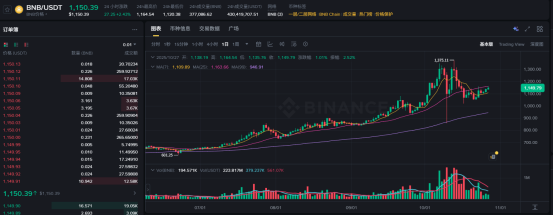
For the industry, the return of its “leader” is undoubtedly positive—not only reaffirming Trump’s pro-crypto stance but also boosting sector-wide confidence. Upon news of the pardon, BNB immediately rose 7%, surpassing $1,100, while major cryptocurrencies followed suit: Bitcoin reclaimed $110,000 and Ethereum approached $4,000. Ripple effects spread quickly: meme coins on Binance collectively spiked, with Bingan Rensheng (Binance Life)—a star performer during China’s National Day period—jumping from $0.23 to $0.28, up over 20%. Companies listing BNB as treasury assets also benefited, including BNB Network Company and Nano Labs, both seeing gains. Even Trump’s WLFI saw significant upside, climbing past $0.14, while ALT5 Sigma, a company holding WLFI in its treasury, rose over 13% in 24 hours.
Naturally, not everyone is pleased. Trump’s opponents expressed particular dissatisfaction. Looking back at the timeline—from frequent meetings with UAE officials to Abu Dhabi investment, from photos with WLFI co-founders to supporting their stablecoin, from applying for clemency to successful pardon—a clear thread connects Zhao to political circles. Put simply, Zhao managed to board Trump’s powerful ship, reclaiming his clean standing.
Interestingly, when asked about his reasoning, Trump replied, “I don’t know him, but many people say he was innocent and persecuted by the Biden administration.” Whether this statement is merely a public disclaimer or genuinely true, it suggests Zhao is closely connected to Trump’s inner circle, rather than truly “not knowing” the president. More coincidentally, shortly after the pardon, Trump mentioned at a White House briefing that due to Democratic-caused government shutdowns creating a military pay shortfall, a “wonderful friend whose name I won’t disclose” personally donated a $130 million check to help cover it. This sparked rumors that the unnamed donor might be Zhao Changpeng, leading some to speculate that political contributions secured the pardon.
The truth behind the military payment remains unclear, but Wall Street-style lobbying is certainly real. Politico reported that according to disclosures by lobbying firm Checkmate Government Relations, Binance hired Ches McDowell—friend of Trump’s eldest son Donald Trump Jr.—in late September to lobby on financial policy and “executive relief” matters at the White House and Treasury, paying $450,000 per month. Crypto attorney Teresa Goody Guillén also disclosed receiving a total of $290,000 in lobbying fees this year from Binance and Zhao Changpeng.
In reality, given Trump’s businessman nature, Zhao’s pardon clearly involved substantial financial and strategic maneuvering. Political opponents quickly seized on this, accusing Trump of disregarding the rule of law and using pardons as naked quid pro quo deals.
According to AXIOS, Senate Democrats are moving to formally condemn Trump’s pardon of Zhao Changpeng. Some Republican senators have also criticized the move, and Democrats are attempting to forge a rare bipartisan alliance to oppose the White House decision. However, Democratic attacks on Trump are nothing new, and this incident likely won’t trigger lasting consequences.
Returning to the main theme, Zhao Changpeng’s path to compliance, though seemingly concluded for now, is far from over. While favored under this administration, aligning with one side carries significant risks. His complex political journey has only just begun—this is precisely why overseas Chinese entrepreneurs often have no choice but to navigate carefully between powers, skillfully balancing relationships.
After his release, Zhao quickly expressed gratitude to Trump, stating he would “do everything possible to help the United States become the global capital of cryptocurrency and advance Web3 development worldwide.”
The focus of his statement is the United States—indicating Zhao himself understands that no matter how he returns, the greatest benefits will inevitably come from, and must go through, America.
Join TechFlow official community to stay tuned
Telegram:https://t.me/TechFlowDaily
X (Twitter):https://x.com/TechFlowPost
X (Twitter) EN:https://x.com/BlockFlow_News






