Wall Street Plunges into “AI Phobia”: An Indiscriminate Sell-Off Is Spreading
TechFlow Selected TechFlow Selected
Wall Street Plunges into “AI Phobia”: An Indiscriminate Sell-Off Is Spreading
The market has entered an irrational state of “sell first, ask questions later.”
 Navigating Web3 tides with focused insights
Source: JIN10 Data
On Wall Street, growing fears about artificial intelligence (AI) are hammering stocks of companies potentially vulnerable to disruption—from small software firms to large wealth management firms.
The latest wave of selling erupted on Tuesday, when a little-known startup, Altruist Corp., launched a tax-planning tool that triggered declines of 7% or more in shares of Charles Schwab Corp., Raymond James Financial Inc., and LPL Financial Holdings Inc.
This marked the steepest drop for some of these stocks since last April’s market crash triggered by the trade war. Yet it is only the latest example of a “sell first, ask questions later” mindset—one rapidly gaining traction as hundreds of billions of dollars invested in AI begin yielding commercial products, fueling anxieties over AI’s potential to upend entire industries.
“Any company with even potential disruption risk is being sold off indiscriminately,” said John Belton, portfolio manager at Gabelli Funds.
For several years, advances in AI technology have been front and center on Wall Street, with tech stocks leading the rally. As this surge pushed share prices to record highs, persistent questions remained: Was this an unsustainable bubble about to burst—or the dawn of a productivity boom poised to reshape U.S. corporate America?
But since early last week, a string of AI product launches has triggered a clear market shift. Investors have moved away from picking winners and instead rushed to avoid holding any company facing even the slightest risk of displacement.
“I don’t know what’s coming next,” said Will Rhind, CEO of GraniteShares Advisors.
“Last year’s story was that we all believed in AI—but we were searching for use cases. And as we keep discovering seemingly more powerful and compelling applications, it’s now driving disruption.”
Concerns about AI have long plagued the software industry. Last week, those worries broadened significantly across other sectors—including financial services, asset management, and legal services—after Anthropic PBC unveiled a new tool that sent stocks in those industries sharply lower.
The same fear battered U.S. insurance brokers’ stocks on Monday, following the launch of a new application by online insurance marketplace Insurify that uses ChatGPT to compare auto insurance rates. On Tuesday, wealth management stocks became the next casualty, dragged down by Altruist’s newly launched product Hazel—a tool designed to help financial advisors craft personalized strategies for clients.
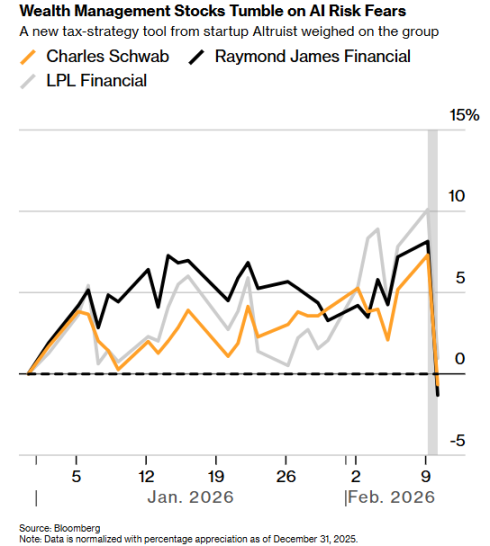
Wealth management stocks plummet amid AI-related disruption fears
Jason Wenk, CEO of Altruist, said he too was surprised by the scale of the stock market reaction—which wiped out billions of dollars in market value across multiple investment firms. Still, he views it as a strong signal of the competitive threat his company poses.
“People are beginning to realize—the architecture we used to build Hazel can replace any job in wealth management,” he said in an interview. “Typically, these jobs are performed by entire teams. Now, AI can effectively do them for just $100 per month.”
AI firms like OpenAI and Anthropic have already secured solid footing in software engineering—through products that help developers streamline and debug code—and are now expanding into other industries.
Yet many questions remain about how this technology will ultimately be adopted. Take banking, for instance: Though it has periodically faced challenges from electronic services and other technologies, none have succeeded in undermining its dominant position.
Belton of Gabelli is among those skeptical about Wall Street’s swift pivot—from fretting about an AI bubble to fearing AI’s imminent disruption of much of the economy.
“Every industry will have winners and losers,” Belton said. But he added: “A rule of thumb is that technological disruption often takes longer to materialize than expected.”
This pullback may also reflect broader investor anxiety over the sharp stock-market gains driven in recent years by AI-related spending surges and the unusually resilient U.S. economy—factors that have inflated valuations and heightened sensitivity to any sign of reversal.
“If they emit even a slightly negative signal, stocks drop 10%—something that simply wouldn’t happen in a market not trading at today’s elevated levels,” said GraniteShares’ Rhind.
For Ross Gerber, CEO of Gerber Kawasaki, the anxiety over AI “losers” battering parts of the market over the past week is premature. He says it’s still too early to pinpoint exactly what the impact will be.
“We can try to extrapolate how AI will change the world five years from now—but we just don’t know,” he said. “The market is trying to judge this while we’re still at the very beginning of infancy.”
Join TechFlow official community to stay tuned
Telegram:https://t.me/TechFlowDaily
X (Twitter):https://x.com/TechFlowPost
X (Twitter) EN:https://x.com/BlockFlow_News