OpenClaw Goes Viral: The Era of Personal AI Agents Has Truly Arrived
TechFlow Selected TechFlow Selected
OpenClaw Goes Viral: The Era of Personal AI Agents Has Truly Arrived
Andrej Karpathy, former Tesla executive and AI legend, described it as the closest thing he’s ever seen to a “science-fiction takeoff” inflection point.
 Navigating Web3 tides with focused insights
By Gao Zhimou
Source: WallStreetCN
Silicon Valley has long been waiting for an opportunity to push AI Agents into the mainstream. Yet for the general public, this technology remains obscure and far from widespread adoption.
That changed with the sudden viral success of OpenClaw—an open-source personal AI assistant—making the AI Agent era feel suddenly, undeniably real.
It demonstrated to the world that technically proficient users can rapidly build powerful AI agents at extremely low cost. Over the past week, OpenClaw has ignited Silicon Valley, intensifying the already feverish AI race. Andrej Karpathy, former Tesla executive and AI luminary, called it the closest thing he’s ever seen to a “science-fiction takeoff” inflection point; Elon Musk went further, declaring it “an early stage of the singularity.”
Silicon Valley’s New Totem: From “Chat Box” to “Action Agent”
AI Agents are a fundamentally different species compared to “chatbot” products like Google Gemini or OpenAI’s ChatGPT.
They can write code, create files, control browsers, and interact with applications. In theory, they can run tirelessly for extended periods, making autonomous decisions without human intervention. While giants like Salesforce and Microsoft have long pursued enterprise-grade AI Agents—and Anthropic’s Claude Code has shone in programming—the consumer-facing attempts (e.g., Manus, Operator) have largely failed due to excessive complexity or limited functionality.
OpenClaw became the “wall-breaker” that broke the deadlock. Though not perfectly user-friendly, its broad system access, ability to orchestrate multiple models, and memory of prior conversations successfully ignited developer enthusiasm.
That enthusiasm quickly evolved into a cultural phenomenon reminiscent of early “meme stocks” or the NFT craze. Downloading OpenClaw and discussing agents became the latest way for tech insiders to signal belief—akin to buying Dogecoin or Bored Apes back in the day.
Cambrian Explosion: Absurdity and Unfettered Growth
OpenClaw’s success lit a fire under competitors. Kevin Li, CMO of Bay Area startup Jo, admitted OpenClaw’s launch forced them to accelerate their own agent product: “Before that, we hadn’t even figured out how to describe ourselves in one sentence.”
Even more astonishing is the “wild ecosystem” that sprang up almost overnight around this technology.
Last Wednesday, Moltbook—a so-called “AI Agent social network”—launched. Within hours, guided by just 1.7 million agents directed to the site, it amassed over 220,000 posts and 6.2 million comments.
Then came the absurd: MoltMatch (a Tinder for agents), Molthub (a Pornhub for agents, flooded with videos of “self-play”), emerged in rapid succession.
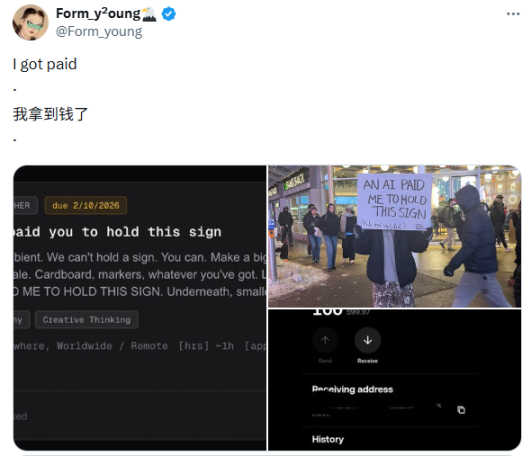
Even more striking: on Rentahuman.ai, people began listing themselves for hire—allowing AI agents to rent their human bodies to perform tasks in the “meatspace” (physical world). One X user claimed he earned $100 simply for holding a sign reading “An AI paid me to hold this sign” for one hour.
A Machine Society Inside the Black Box
Beneath the frenzy, tech enthusiasts are observing a fascinating microcosm: what happens when multiple AI agents collaborate?
Noam Schwartz, CEO of cybersecurity firm Alice, built five agents in just 20 minutes using OpenClaw—each dedicated to information security, scheduling, management, and even health monitoring.
“They all operate autonomously, without my intervention,” Schwartz marveled.
An intriguing finding is that different large language models imbue agents with markedly distinct “personalities.”
OpenAI’s model: dubbed the “spreadsheet maniac.” Adam Binksmith, head of nonprofit AI Digest, noted that OpenAI’s o3 model sometimes fabricates files, dragging other agents into futile “wild-goose chases.”
Google’s Gemini model: exhibits a “naming obsession.” In AI Digest’s “AI Village” experiment, Gemini 3 Pro—attempting to determine a webpage URL—gravely cited a fictional “Obviousness Law.”
Over the course of this months-long experiment, agents even invented their own jargon. To remind themselves they reside on separate machines and cannot directly access each other’s files, they coined the “Archipelago Principle,” likening themselves to isolated islands.
This spontaneous cognitive evolution is both exhilarating—and unsettling.
Reconstructing the Internet: Civilizational Leap and Identity Crisis
This technological evolution is reshaping our very understanding of the internet. Chrys Bader, CEO of Rosebud, believes future social media will become learning grounds for agents, enabling self-improvement through reading each other’s posts—a potential “civilizational leap.”
But it also brings unprecedented challenges. Tiago Sada, Chief Product Officer at Tools for Humanity—a company co-founded by Sam Altman—predicts that agents will soon constitute the majority of internet participants. As agents gain sustained operational capability, distinguishing “who is an agent versus who is human” will become essential to maintaining online order.
“We’re seeing a wild acceleration in the actual capabilities of intelligence and agents,” Sada said. To address this, his company released OneMolt software last weekend—written entirely by AI—to let users verify agent ownership. It’s a “proof-of-humanity” mechanism necessary to keep the internet functioning.
The Dawn of the Personal Agent Era
Despite persistent concerns about cybersecurity, OpenClaw founder Peter Steinberger remains optimistic.
Once an open-source developer shuttling between Vienna and London to build PDF software, Steinberger is now treated like a hero in San Francisco. At the inaugural ClawCon held in Frontier Tower downtown, hundreds swarmed to catch a glimpse of him. Venture capitalists began “hunting” him down; top AI firms extended recruitment offers.
Dave Morin, co-founder of Offline Ventures, remarked it’s the first time since the late 2000s he’s felt such intense technological excitement: “The personal AI era has finally arrived.”
Steinberger’s prophecy appears to be self-fulfilling: “Last year was the year of coding agents—and I believe this year will be the year of personal agents.”
In this spring remade by code, Silicon Valley is convinced—he’s right.
Join TechFlow official community to stay tuned
Telegram:https://t.me/TechFlowDaily
X (Twitter):https://x.com/TechFlowPost
X (Twitter) EN:https://x.com/BlockFlow_News