Yuanbao’s AI Fails, Qwen Goes Viral—Major Chinese Tech Companies Launch Spring Festival AI Traffic War
TechFlow Selected TechFlow Selected
Yuanbao’s AI Fails, Qwen Goes Viral—Major Chinese Tech Companies Launch Spring Festival AI Traffic War
AI marketing should focus on delivering real-world scenario value rather than simply throwing money around; Qwen’s practical scenario integration outperforms Yuanbao’s short-sighted viral campaigns.
 Navigating Web3 tides with focused insights
The pace in China’s AI community has recently felt noticeably disjointed.
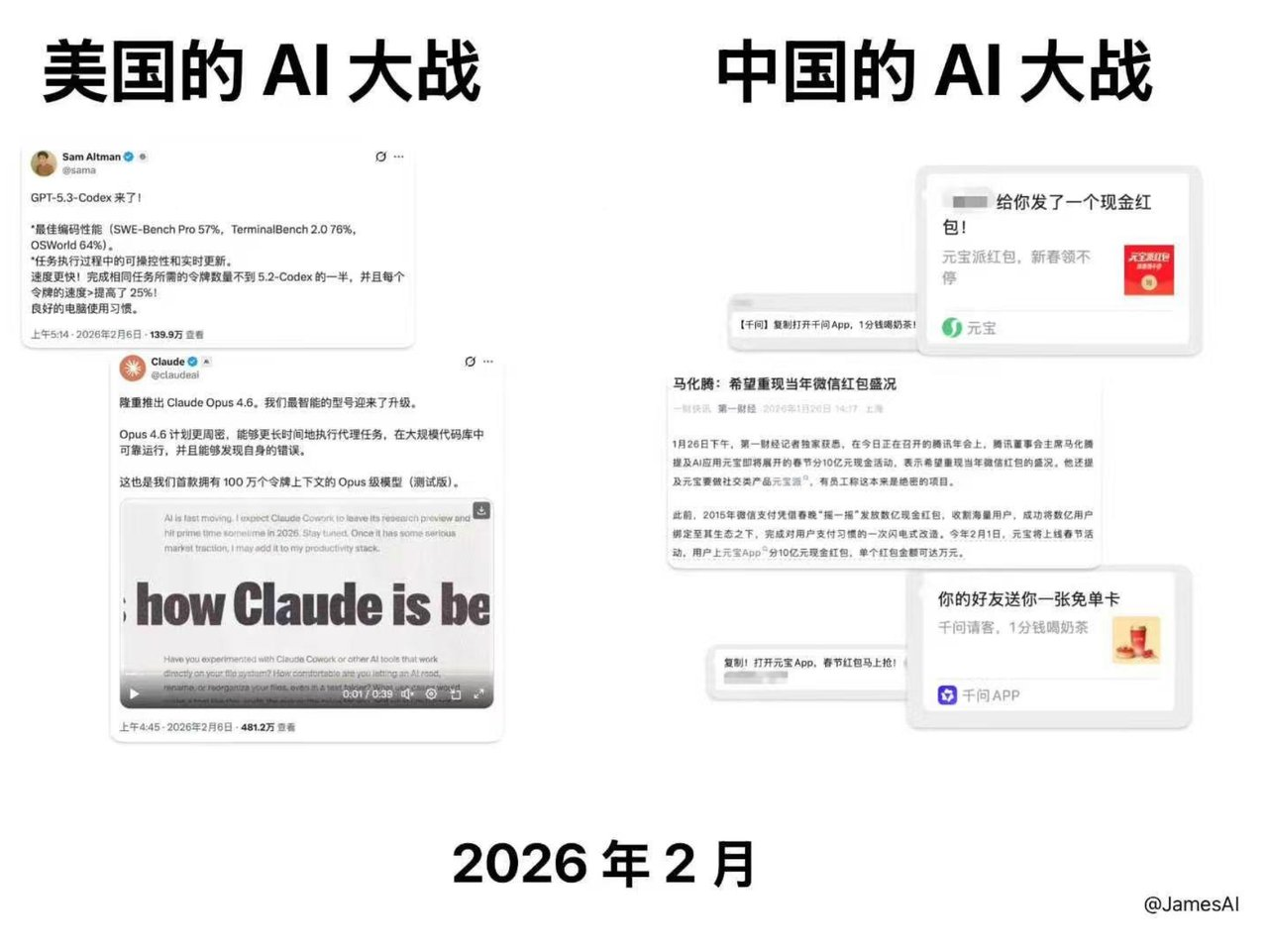
Source: @JamesAI
On one side, overseas models are releasing new versions almost daily.
You haven’t even finished deploying OpenClaw before Moltbook and Codex are already being pushed onto the next wave.
On the other side, domestic tech giants are aggressively “spending money” on Spring Festival marketing campaigns for their AI products.
The Spring Festival remains the most fiercely contested “traffic battlefield” for major tech firms
In terms of investment scale alone:
Alibaba: ¥3 billion > Tencent: ¥1 billion ≈ ByteDance (unofficially disclosed, but its CCTV Spring Festival Gala sponsorship is valued at hundreds of millions of RMB) > Baidu: ¥500 million
In fact, the Spring Festival—a national-level traffic gateway commanding trillions of interactions—has become an annual battleground for all players.
If we rank this year’s BBAT AI marketing strategies from “solid” to “pull-based,” based on netizens’ general impressions, it looks roughly like this:
- Qwen: Deeply integrated with Alibaba’s consumer ecosystem—complex path, but strongest long-term value
- Doubao: Leveraged the Spring Festival Gala and Douyin’s ecosystem for mass exposure—strong brand awareness, weak conversion
- Wenxin: Steady progress via red envelopes and interactive features—visible presence, but lacking breakthrough moments
- Yuanbao: Aggressive viral growth tactics, yet weak tool-oriented perception and user retention

While common tactics remain largely unchanged year-on-year, this year brought both winners and losers.
Yuanbao’s marketing misfire: fundamentally applying Web2-era traffic strategies to an AI-era product
Tencent’s Yuanbao launched its ¥1 billion red envelope campaign—and within three days, suffered a dramatic setback: it was “blocked” by WeChat itself.
On February 4, WeChat’s Security Center issued a notice stating that Yuanbao’s Spring Festival marketing activities involved “inducing users to frequently share links into group chats through ‘task completion’ and ‘red envelope collection’ mechanisms,” thereby disrupting the platform’s ecosystem and restricting direct access to Yuanbao within WeChat. Tencent’s stock price dropped 3.53% that day.
Ironically, 11 years earlier, WeChat Red Envelopes’ “shake-to-collect” feature during the Spring Festival Gala had revolutionized mobile payments. Today, Tencent hoped Yuanbao would replicate that success—but overlooked how much the times have changed.
Superficially, Yuanbao merely crossed a line in WeChat’s ecosystem rules. But beneath the surface lies a classic AI-product marketing pitfall:
1. Misalignment between product logic and growth strategy
AI is inherently a “task-driven tool”: users turn to it only when facing a problem or seeking efficiency gains.
Red-envelope-based viral campaigns, by contrast, are fundamentally “emotion-pulling tactics”—users act not for product value, but due to immediate incentives.
Viral red-envelope campaigns aren’t unprecedented successes.
Pinduoduo succeeded because its product and strategy were naturally aligned: near-zero cognitive load, extremely short user paths, and instantly visible, redeemable rewards.
AI products are precisely the opposite:
- Relatively high learning cost
- Complex scenario comprehension
- Delayed value realization
This mismatch between product attributes and growth strategy is akin to opening a world-class neurosurgery clinic—but instead of promoting your lead surgeon’s surgical expertise, you hand out eggs at the entrance to draw crowds.
2. Acquisition without retention: the illusion of data
From a backend perspective, Yuanbao’s viral campaign may appear “highly successful”:
Its referral layers expanded rapidly, DAU spiked sharply, and sharing metrics looked impressive.
In reality, users had already performed “garbage sorting” on Yuanbao—collecting red envelopes and closing the app, then returning to main group chats to discuss technology or DeepSeek.
This traffic is one-time “passerby traffic.” After the Spring Festival, all that remains is the vague impression of “that orange app where I could collect money”—not recognition of Yuanbao as a valuable AI assistant.
3. A KPI-designed solution—not a user-designed one
From an industry perspective, this move resembled a reactive, data-chasing maneuver.
Doubao’s DAU surpassed 100 million; Qwen and Wenxin soon followed, each reaching over 100 million users—while Yuanbao remained stuck at the 20-million mark.
In the “AI ranking race among major tech firms,” such performance indeed appeared underwhelming.
Under this pressure, growth targets took precedence: “doing something” mattered more than “doing the right thing.”
This also reflects a systemic flaw across major tech firms: as long as metrics rise and reports look good, short-term misalignments and long-term side effects can be temporarily ignored.
Qwen’s breakout: grounding AI in real-world use cases, feeding marketing with live offline adoption
In contrast, Qwen succeeded by directly linking AI capabilities to users’ authentic needs and Spring Festival scenarios—not just chasing new users or boosting traffic. Through Qwen Agents, users don’t just snag “no-pay coupons”; they can seamlessly connect to Taobao Flash Buy and Hema for instant home delivery—delivering immediate, tangible value.
Its core advantages include:
- Task-driven experience: Users deploy AI to complete actual consumption or life tasks—low learning curve, clear outcomes.
- Tight alignment with holiday pain points: Spring Festival shopping, gifting, and New Year preparations—AI tools directly address users’ urgent needs, rather than offering mere interactive games.
- Long-term mindset building: While gaining practical utility, users develop trust and reliance on the AI product—not just recall of “the red-envelope-app.”
- Reusable mechanism: This scenario-based approach can extend to everyday consumption and promotional events, sustaining user stickiness and engagement.
Overall, Qwen’s Spring Festival marketing has so far made AI “useful,” not just “fun”—creating a closed loop from short-term stimulation to long-term value. With further scaling and broader real-world applications, integrating Qwen Agents across the entire Taobao ecosystem could become exceptionally powerful.

Source: Internet
How should AI Spring Festival marketing be done?
The Spring Festival is indeed a must-win arena for AI marketing—offering the broadest user coverage, highest usage frequency, and ideal conditions for concentrated campaigns.
Red-envelope grabbing aligns with Chinese cultural norms, yet AI tools doing so risk criticism—unless they genuinely solve real pain points.
Basing our analysis on major tech firms’ cases and industry trends, the correct approach to AI Spring Festival marketing should be:
1. From “distributing red envelopes” to “getting things done”
Counterexample: Yuanbao’s red envelopes were completely disconnected from its AI functionality—users collected money and left.
Positive example: Alibaba’s Qwen enables users to order food, book flights, buy movie tickets—and get them fully reimbursed via AI. This lowers trial barriers while letting users experience “AI that gets things done.”
Suggestions for Spring Festival travel scenarios:
- Smart itinerary planning: Input departure location, destination, and budget—AI automatically generates optimal routes home (combining trains, flights, ride-sharing)
- Ticket-grabbing assistant: Real-time monitoring of remaining tickets, intelligent recommendation of transfer options, and delivery of actionable, cost-effective alternatives—not just speed-up packages
- Packing list generator: Based on destination weather, trip duration, and personal habits, AI auto-generates customized packing lists
- Local customs crash course: For users traveling home with partners or children, AI provides dialect-learning quick guides and one-click curation of regionally preferred gifts—making New Year greetings smoother
2. From “spending money to buy users” to “saving users money to retain them”
Major tech firms’ massive spending to acquire users has become an arms race—but users are growing smarter: “You spend ¥1 billion—I collect and leave.”
High-ROI strategies:
- AI-generated personalized New Year greetings: Based on relationship closeness and recipient preferences, AI crafts heartfelt greeting messages + AI-generated greeting cards—solving the “awkward group message” problem
- Family photo album organizer: Upload photos taken throughout the year during Spring Festival—AI auto-categorizes them and generates annual memory videos, solving “exploding phone storage”
- Relative Q&A rehearsal: Input likely questions from relatives (salary, dating status, having kids)—AI generates polished, socially appropriate responses—alleviating “Spring Festival social anxiety”
3. From “social virality” to “word-of-mouth virality”
WeChat’s ban on Yuanbao essentially protects social experience. AI marketing shouldn’t disrupt relationship chains—it should strengthen them.
Innovative approaches:
- AI family-group admin bot: Automatically consolidates critical info from family group chats (e.g., party time/location changes), and alerts users to grab red envelopes before missing them
- Cross-generational games: Design AI-powered interactive games suitable for grandparents, parents, and children (e.g., AI riddle guessing, AI couplet writing)—using AI to bridge generational gaps
- New AI red envelope formats: Not cash—but “AI-generated personalized blessing videos” or “AI-customized family tree diagrams,” making sharing feel prestigious
4. From “Spring Festival blitz” to “long-termism”
All Spring Festival marketing faces the same challenge: after the hype fades, how do you retain users?
Suggested retention mechanisms:
- Spring Festival task continuity: AI tasks completed during Spring Festival (e.g., generating New Year greeting videos) trigger automatic reminders at Lantern Festival, Qingming Festival, etc., prompting users to “create holiday content with AI”
- Habit-building challenges: “7-Day AI Life Challenge”—solve one practical problem daily with AI (check weather, plan trips, draft emails); completion earns redeemable points (usable for waived handling fees in WeChat/Alipay wallets)
- Personalized memory: AI remembers users’ Spring Festival patterns (e.g., “I return to my hometown in Henan every year”) and proactively offers related services ahead of next year’s travel planning
Making AI genuinely useful “for Spring Festival” is the best marketing.
One flower does not make spring—only when many bloom does spring truly arrive
We hope domestic tech giants, while actively pursuing marketing, also push hard to optimize their models—because great products ultimately win. We look forward to the next shining star of Chinese AI.
Join TechFlow official community to stay tuned
Telegram:https://t.me/TechFlowDaily
X (Twitter):https://x.com/TechFlowPost
X (Twitter) EN:https://x.com/BlockFlow_News
 https://x.com/gwl_gg