The Crypto-American Regime Change: Peter Thiel at a Historic Turning Point
TechFlow Selected TechFlow Selected
The Crypto-American Regime Change: Peter Thiel at a Historic Turning Point
When technology and finance integrate, the balance of political power in Washington will also shift—that's the underlying message of cryptocurrency and AI: excluding Wall Street from productivity and the financial system, allowing right-wing tech giants to take control of America, and everything in the world.
 Navigating Web3 tides with focused insights
Original author: Zuo Ye Wai Bo Shan
On September 4, at the White House tech summit, a gathering of Silicon Valley elites sat around the table, but Peter Thiel was absent.
From left to right: Figma's CEO is a Thiel Fellow; Scale AI is a unicorn nurtured by Founders Fund; David Sacks, beyond being the White House crypto czar, was PayPal-era Peter Thiel’s right-hand man; Meta CEO Zuckerberg represents the debut masterpiece of Peter Thiel’s legendary Silicon Valley venture capital career; Palantir is the primary contractor for Trump’s Project Iron Dome; and Peter Thiel was also one of OpenAI’s earliest investors.
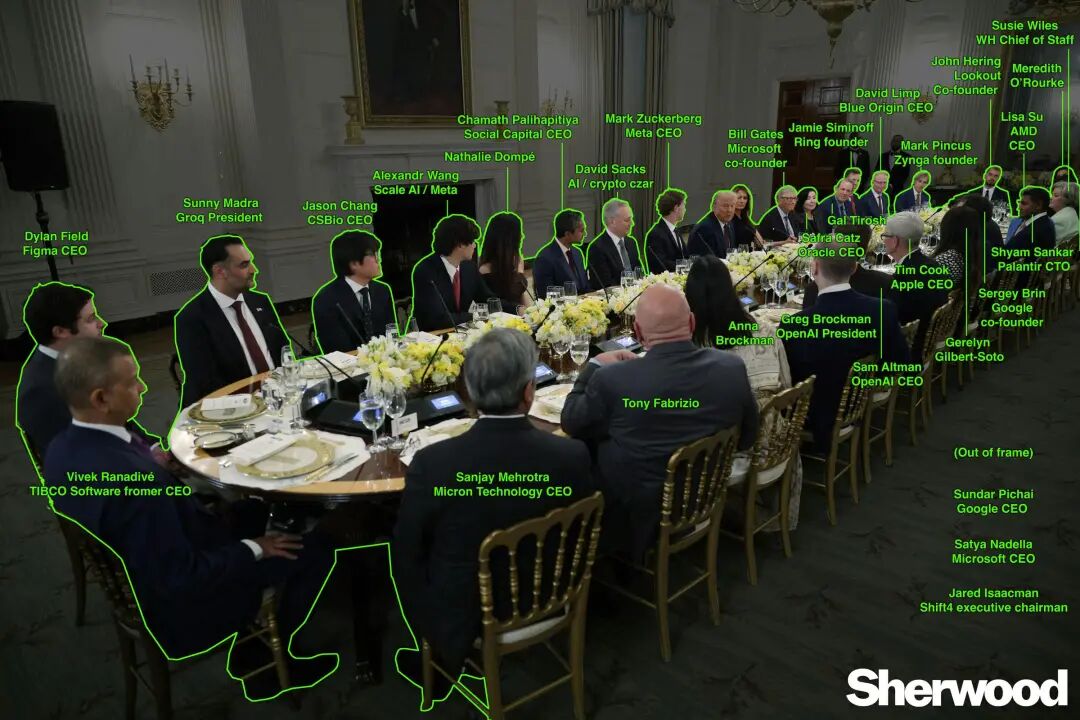
Distant people, distant places—all are connected to Peter Thiel.
On the eve of 9/11, Charlie Kirk died in Utah. The world knows only that Vance carried his coffin and Trump ordered flags flown at half-mast. Less known is that it was precisely Charlie Kirk who fundamentally changed J.D. Vance’s view of Trump—convincing this Yale Law School PhD to abandon his conventional career path and go all-in on Trump.
As it happens, Vance is also Peter Thiel’s deepest mole embedded within the MAGA movement and Washington. Behind them, the Silicon Valley right wing is consuming the entire Western world.
Wall Street cannot save the Federal Reserve; the banking sector cannot stop stablecoins.
The right-wing America, shaped by Peter Thiel’s 15-year strategy, has now emerged before the world—and will shape crypto, AI, and global order in the coming era.
The Collapse and Reconstruction of Western Order
Musk worries about white birth rates; Peter Thiel despises the morality of slavery.
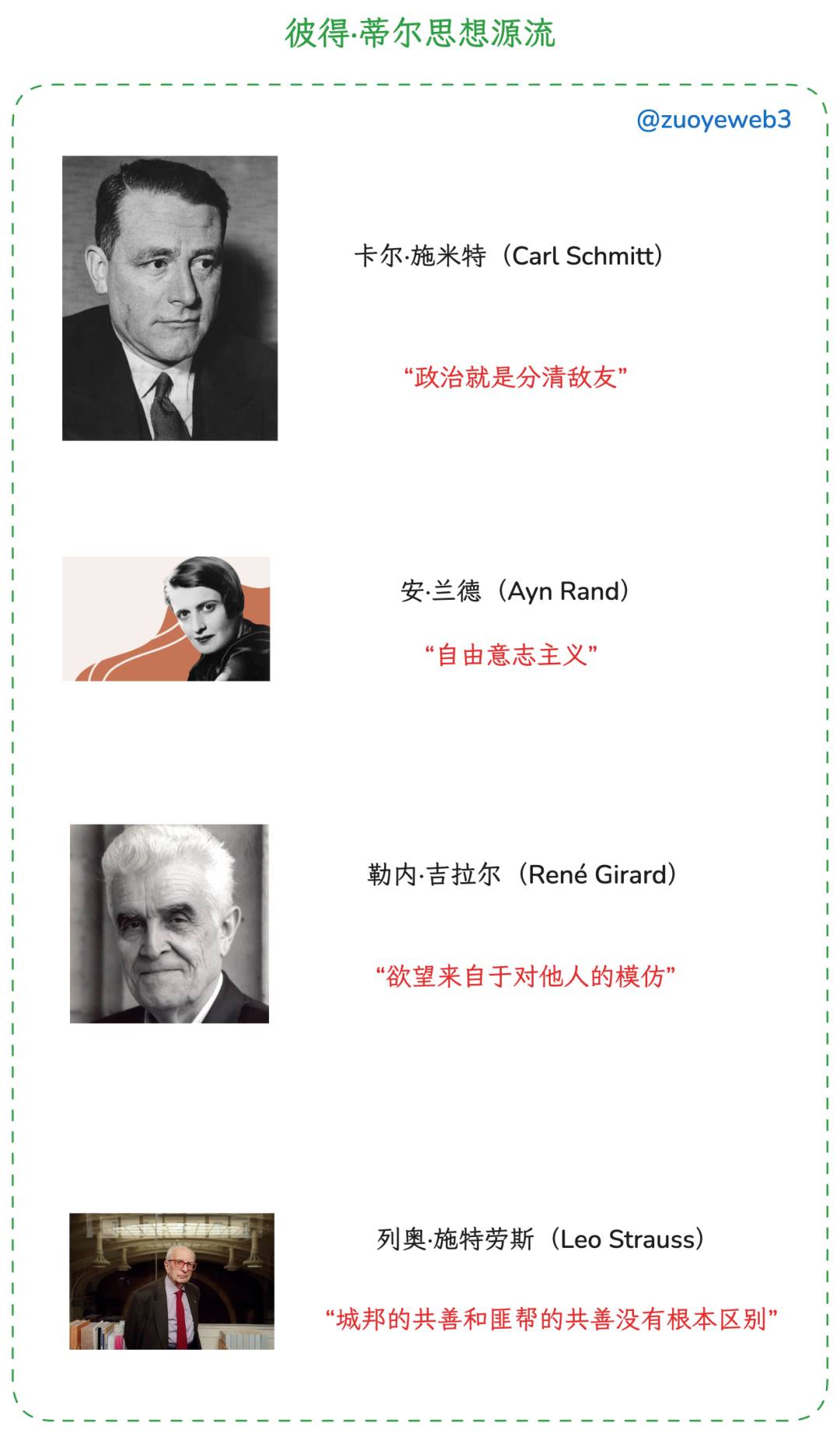
After WWII, large numbers of Germans fled continental Europe, settling in Latin America and southern Africa—especially Swakopmund, Namibia, which even publicly celebrated Hitler’s birthday on April 20, 1989, revealing its ideological leanings.
Peter Thiel, born in 1967, moved to Namibia at age four and returned to California—the new Rome—at age ten. Unlike Musk, who spent his entire childhood in South Africa, Thiel’s memories of Namibia and South Africa were of “white” societies.
At that time, both South Africa and Namibia were under racial segregation and colonial rule—the longest-lasting colonial order after WWII. This shared historical memory unites Musk and Peter Thiel, though Thiel’s childhood fixation was anti-authoritarianism.
Opposing imposed freedoms from others, yet wishing to maintain Western authority over the world—all contradictions stem from here.
Politics is about distinguishing friend from foe. Carl Schmitt, dubbed the spiritual mentor of the Nazis, is also seen by some as Peter Thiel’s guiding light. Yet Thiel recognized that the post-WWII political order is ambiguous.
You contain me, I contain you. The East-West confrontation during the late Cold War was ideological, but more deeply cultural warfare. From the hippie movement to Reagan’s rise in the 1980s, a generation of Americans drifted toward self-destruction in confusion.
By the time Peter Thiel entered Stanford in 1985 at the latest, he had already read *Atlas Shrugged*. Sadly, Ayn Rand passed away in 1982, missing the most glorious moment of libertarianism sweeping America—Reagan’s election.
Luckily, in 1987, Peter Thiel founded the *Stanford Review*, vigorously promoting neoconservatism and libertarianism as a response to the university’s replacement of Western civilization courses with “diversity” curricula.
The West Coast’s rapid leftward shift, or so-called diversity movement, never ceased its relentless advance—not even during the Reagan era. But thanks to the sustained efforts of Reagan’s ideological heirs, Trump and Peter Thiel, we now see signs of submission.
Sustained effort—this has always been Peter Thiel’s style. Even the *Stanford Review* became a right-wing stronghold within left-leaning Stanford. Thiel long sponsored it and maintained close ties with key members. The so-called PayPal Mafia originated precisely here.
During his studies, the philosopher René Girard influenced Thiel most profoundly. Girard’s best-known theory—“Desire arises from imitation of others”—like Ayn Rand, rejected the Christian doctrine of original sin, placing human nature within an objective rational framework, ultimately legitimizing innovation, especially technological innovation.
Thiel’s famous quote—“We wanted flying cars, instead we got 140 characters”—traces its theoretical roots to Girard. Whether welcomed or not, Girard has effectively become the intellectual fountainhead of Silicon Valley’s right wing.
In 2011, Peter Thiel again criticized contemporary Silicon Valley for fake innovation, ignoring true technological frontiers. Among the audience then was someone named Vance. Already in 2010, Thiel had established the Thiel Fellowship to fund visionary college dropouts—including Figma CEO Dylan Field and Ethereum founder Vitalik.
Even more radical was Thiel’s contrarian bet on Trump during the 2016 presidential election—defying Silicon Valley’s collective allegiance to the Democratic Party. Remarkably, even after Trump’s 2020 defeat, Thiel continued investing in him, eventually stepping down from Meta’s board in 2022.
In contrast: Soros represents the Democratic mainstream; Peter Thiel, the Republican underground; Musk, the chaotic line.
Before the 2024 election results, Microsoft rolled back LGBT policies; Bezos, owner of *The Washington Post*, instructed his editorial board not to take sides; Zuckerberg remained hesitant until September 4, when he finally submitted.
Peter Thiel treats money as ideology; Soros hides ideology within politics. Different paths, same destination.
Thiel’s ultimate goal isn’t protecting his own interests or expanding rights as a gay man, but preserving an imagined super-community—the survival of Western civilization. Through a city-state lens equating white America with the West, he resists all outsiders’ assaults on the spirit of ancient Greece.
Earning Beta Across the Entire Market
Chaos is a ladder; cracks create space.
Peter Thiel Investment Timeline
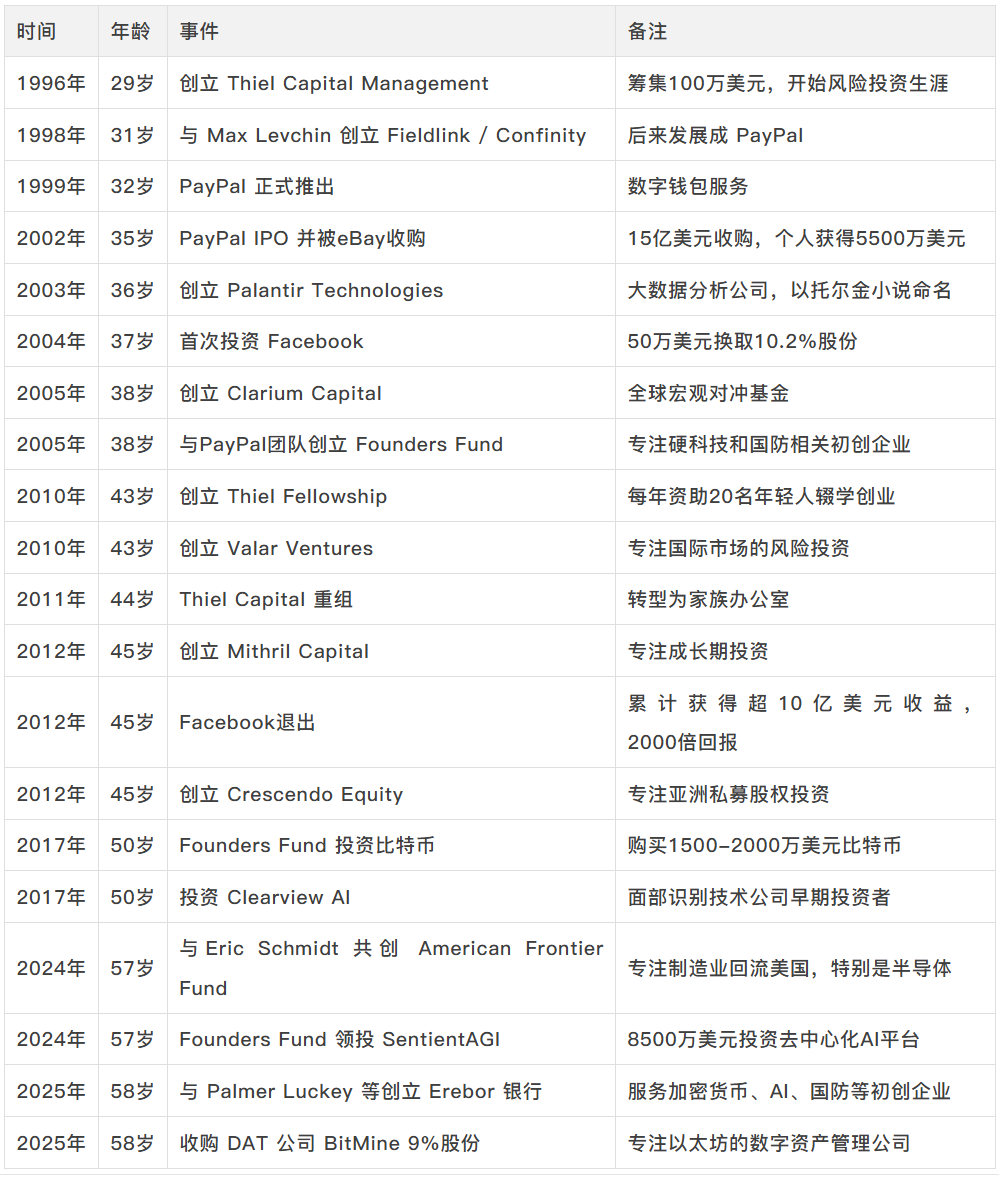
Venture capital and political speculation seem unrelated, but both turn expectations into reality—using small cash flows to buy discounted access to vast futures.
In 1995, before venturing into VC or founding PayPal, Peter Thiel co-authored *The Diversity Myth: Multiculturalism and the Politics of Intolerance at Stanford* with David Sacks—ideology precedes products and money.
In fact, after earning his Stanford PhD in 1992, Thiel cycled through various roles before catching the frenzy preceding the dot-com bubble, founding Thiel Capital Management in 1996 with about $1 million raised from family and friends.
In 1998, Confinity was established. Max Levchin developed CAPTCHA-based anti-fraud measures and discussed cryptocurrency experiments with Peter Thiel. Crypto-punk ideals thus evolved alongside internet commercialization—but soon diverged.
Back then, even dollar digitization hadn’t begun; credit cards dominated cashless payments. Thiel, embracing libertarianism, saw internet dollars’ biggest advantage: regulatory arbitrage—a necessity for the gambling industry.
In 1999, PayPal officially launched. For Americans, it symbolized freedom—no complex approvals, just email-based transfers. Globally, it met urgent demand for value preservation—people needed dollars to escape inflation.
Then, the dollar was a stable currency, just as stablecoins are stable dollars today.
Just as MGX used USD1 to pay Binance $2 billion, a $3 million investment in PayPal also flowed through PayPal.
There’s nothing new under the sun: internet dollars arbitrage credit cards; stablecoins arbitrage the internet. PayPal’s entry into PYUSD shows deep understanding of this dynamic.
Yet success eluded Thiel: PayPal collided with Musk’s X.com, leading to a merger. Not until 2002’s IPO and eBay’s $1.5 billion acquisition did Thiel earn $55 million.
At 35, Thiel finally achieved financial freedom—just before potential obsolescence.
Thereafter, Thiel retreated behind the scenes. Max Levchin, David Sacks, even Musk—all part of the PayPal Mafia, acting in concert. Thiel invested in Musk’s Tesla and SpaceX, building alliances like in the *Stanford Review* days.
Sustained effort, once again. Thiel’s network, grown through venture capital, matured into an all-encompassing canopy.
After 9/11, U.S. government poured funds into security. For anti-authoritarian libertarians, cooperating with government meant betraying freedom; refusing meant betraying the West. In this tension, Thiel faced a spiritual crisis.
To resolve it, Girard wasn’t enough; neither was Carl Schmitt. Ultimately, Leo Strauss stepped in:
-
The common good of the city-state and the gang share no fundamental difference; common good emerges from calculating private goods.
-
If science can progress infinitely, meaningful history can never reach an end or completion.
-
Technology is justice; virtue is knowledge.
Strauss is influential in both China and the U.S., but with vastly different meanings. For secular rationalists, Strauss offers a complete spiritual lineage: Ancient Greece → Alexander → Ancient Rome—equating the West with human civilization, a spiritual resonance transcending Christianity.
Homosexuality, citizenship, slavery—these form the republic that excludes outsiders, completing Thiel’s mental puzzle. Only through interaction between city-state and individual can philosopher-kings rule correctly and sustainably.
In short: Thiel believes the West must become great again; greatness lies in technological innovation; innovation requires dismantling regulatory barriers.
From oceanic islands to Mars colonization, even life-extension biotech—all must be radically accelerated. Accelerate until humans can’t halt technology’s sprint; accelerate until history returns anew—using technology to resurrect ancient Greece, redeeming the fallen.
The irony? Leo Strauss champions neoconservatism: because the West is declining, we must accelerate relentlessly—to loosen constraints and restore vitality.
This is e/acc accelerationism by another name, SBF’s effective altruism pathway, even Musk’s long-termism. Long-termism isn’t merely persistence—it’s desperate acceleration toward ultimate victory.
I finally know who I am. In 2003, Peter Thiel founded Palantir, using big data to detect hidden terrorist signals—its top clients: CIA and security agencies. His life entered fast-forward.
In 2004, $500,000 invested in Facebook secured 10.2% equity—proving Thiel not a theorist, but a supremely decisive actor.
In 2005, Founders Fund launched, cementing Thiel’s dominance in venture capital. Its goal wasn’t “profit,” but building technologies advancing human civilization—AI, crypto, hard tech—not spinning wheels within 140-character limits.
To quantify Thiel’s investment achievements: he truly embodies grassroots right-wing financial capitalism. Once again, the Republican mirror image of Soros:
-
Co-founder of PayPal: exited with $55 million
-
Early Facebook investor: $500,000 turned into over $1 billion
-
Founder of Palantir: valued at tens of billions of dollars
-
Personal net worth: $20.8 billion (2025), ranked 103rd globally
Thiel achieved not only economic success, but more importantly, shifted—or attempted to shift—the balance between coasts. Before him, the West Coast housed tech elites; the East Coast, finance and political complexes. Once business scaled up, one had to enter Washington’s political game.
But if technology and finance integrate, Washington’s power balance will tilt accordingly. This is the subtext of crypto and AI: excluding Wall Street from productivity and financial systems, allowing right-wing tech giants to seize control of America—and all the world.
Musk speaks; Peter Thiel acts.
Conclusion: He Changed Silicon Valley
From founding the *Stanford Review* to securing Trump’s second term, Peter Thiel has achieved the return of neoconservatism in the freest corner of Silicon Valley, embedding Vance and Trump as dual insurance within the most entrenched power center of Washington.
Within Trump’s political landscape, West Coast crypto, fintech, and AI professionals are gradually replacing Wall Street’s traditional elite—this is the most visible aspect of America’s current political upheaval.
K.K. once wrote *What Technology Wants?*, arguing technology follows its own natural trajectory, eventually escaping human subservience—what Musk critiques as “anti-human centrism.” Humanity’s status as crown of creation may not survive the AI explosion.
Before that, Peter Thiel first seeks to save the core of humanity—the Western world. Admittedly, this vision carries strong Western-centric racial tones. Unlike Oracle’s Larry Ellison or former Google CEO Schmidt, Thiel’s disdain for outsiders isn’t emotional hatred, but rational eros.
Love for the Greek polis must be marked by hatred for the outsider.
No matter how much Western power has declined, no matter how grave its dangers, the West’s decline, peril, failure, or even destruction does not necessarily prove it’s in crisis: if the West remains certain of its purpose, it could fall honorably.
In a sense, through Peter Thiel’s hands, Girard has indeed changed the world—but not enough.
The shortfall lies in the human spiritual crisis. A rational West leaves no room for God—thus the West itself becomes indefinable. Thiel’s choice: Leo Strauss—reconstructing Western spirit from ancient Greek rationality.
In human governance, the philosopher-king best fulfills Strauss’s ideal. Machiavellianism is merely a clumsy imitation. If no philosopher-king exists, aristocratic republicanism is the most rational political form. Democracy and tyranny alike will gradually shed civilization’s garments under outsider erosion, becoming synonymous with the foreign.
Join TechFlow official community to stay tuned
Telegram:https://t.me/TechFlowDaily
X (Twitter):https://x.com/TechFlowPost
X (Twitter) EN:https://x.com/BlockFlow_News
 @zuoyeweb3