Quick Look at Hyperion: What's Behind Binance's New Game's First Project?
TechFlow Selected TechFlow Selected
Quick Look at Hyperion: What's Behind Binance's New Game's First Project?
Will RION launch its Binance Wallet Bonding-Curve TGE today at 16:00? Is it worth participating?
 Navigating Web3 tides with focused insights
By: Alex Liu, Foresight News
On July 16 at 16:00, Binance Wallet will host the first Bonding-Curve version of TGE, launching RION, the native token of Hyperion, an Aptos-based DEX project. Eligible users must participate using Binance Alpha points. The event will use the "Bonding-Curve" algorithm to dynamically price RION and provide liquidity for trading.
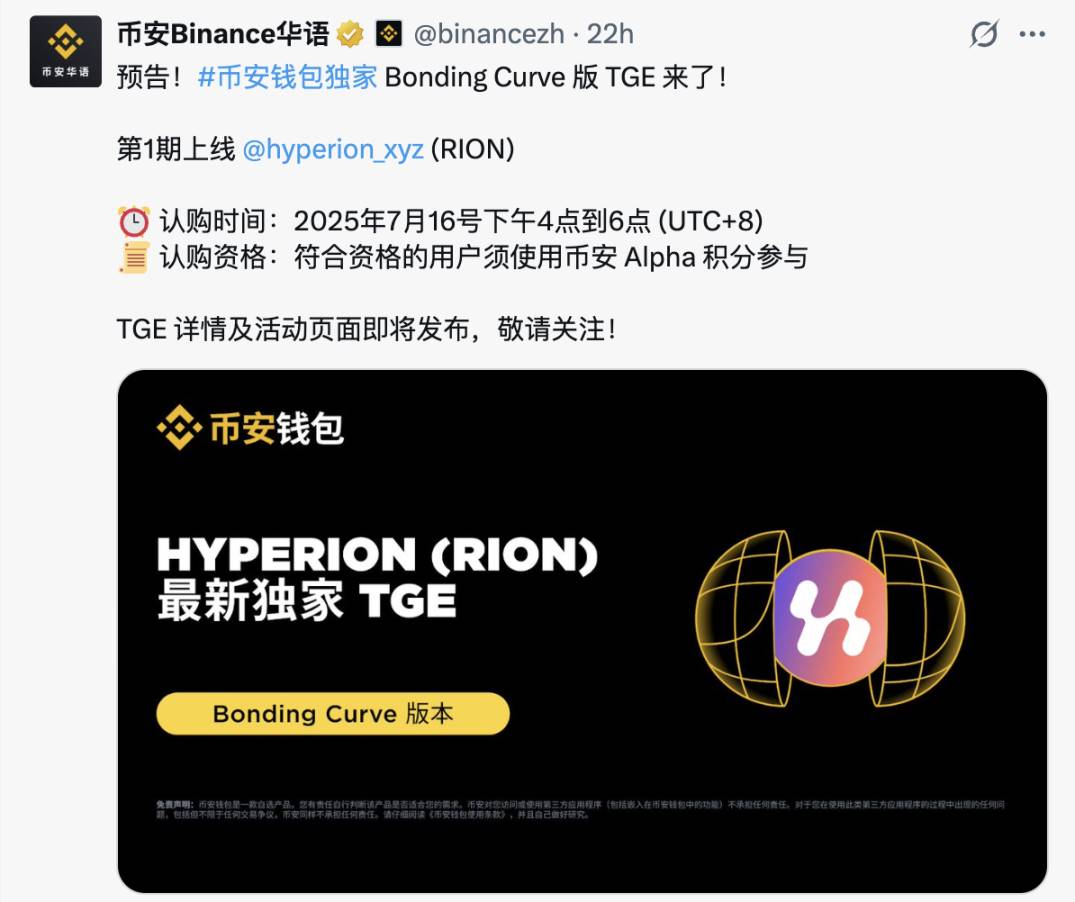
Taking this opportunity, we comprehensively review Hyperion’s project positioning, technical features, funding history, data metrics, token economics, airdrop plan, as well as introduce other popular projects and overall activity within the Aptos ecosystem.
Protocol Features: Hybrid Order Book + AMM + Aggregation
Hyperion is a hybrid decentralized exchange (DEX) natively deployed on the Aptos chain, integrating both order book matching and advanced automated market making mechanisms. Its core design is based on concentrated liquidity (similar to Uniswap V3), allowing liquidity providers to allocate capital within specified price ranges to improve capital efficiency.
Hyperion also features a Directional Liquidity Market Maker (DLMM) mechanism, which dynamically adjusts fund distribution within the x+y=k curve to enable zero-slippage trading for high-volatility assets. This allows Hyperion to efficiently serve stablecoin pairs while meeting trading demands for long-tail assets—making it the first DEX on Aptos to satisfy both scenarios simultaneously.
In June 2025, Hyperion launched its aggregation routing function, shifting its positioning from a single DEX to a cross-chain liquidity hub. This feature intelligently splits transaction paths and aggregates liquidity from all DEXs on Aptos to offer users optimal prices and minimal slippage.
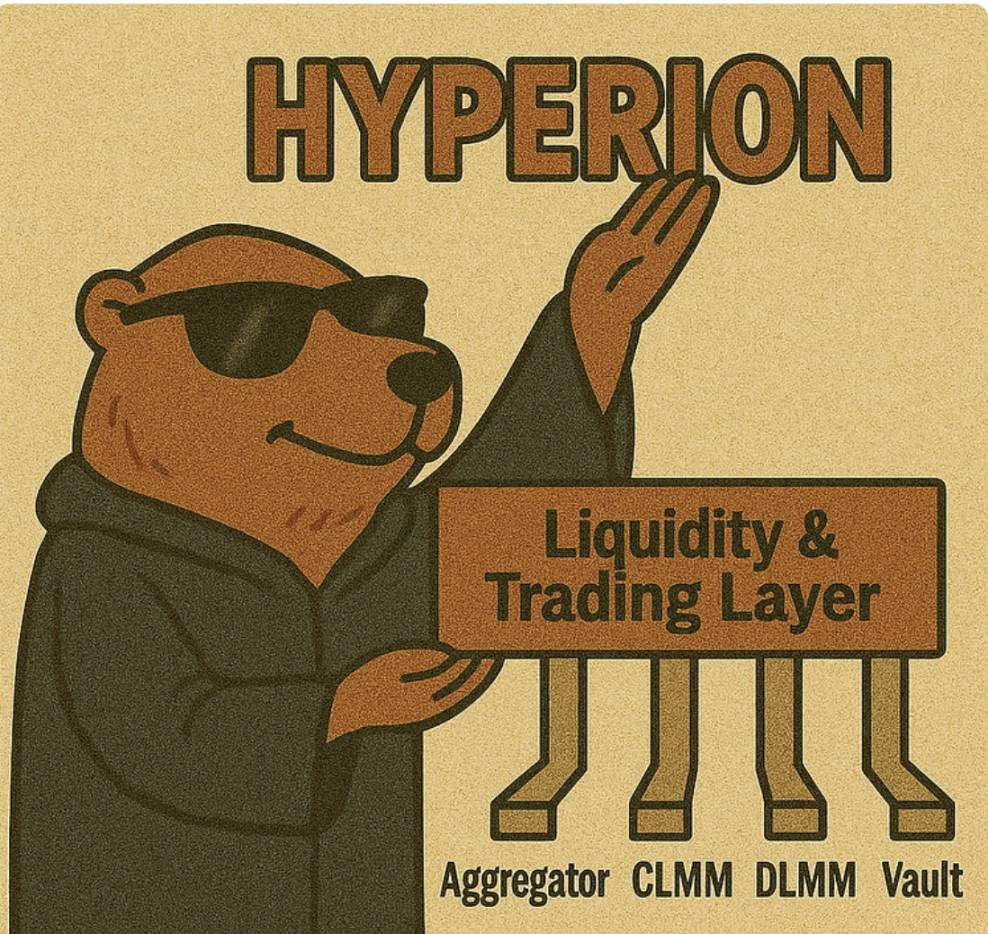
According to Hyperion's official documentation, its "fully on-chain hybrid order book-AMM DEX" leverages Aptos’ parallel execution engine natively, catering to both professional traders and retail users. Additionally, Hyperion is developing limit order functionality and includes features such as a yield vault and Drips incentives, forming a complete trading infrastructure layer.
Funding: Backed by OKX, Maelstrom, and Others
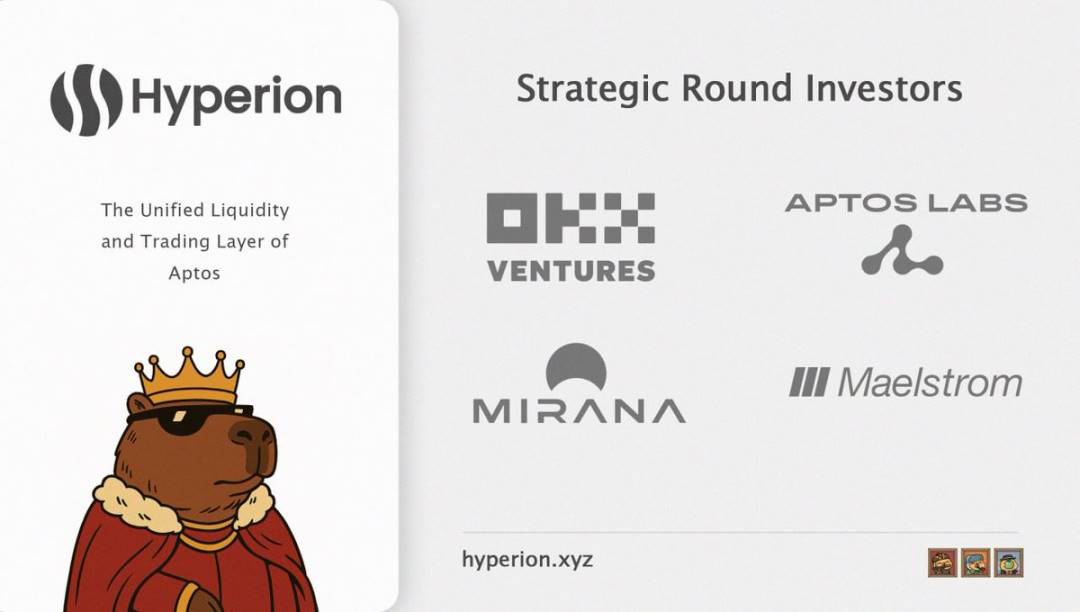
Shortly after launch, Hyperion received support from multiple institutions. In April this year, Hyperion completed a strategic funding round led by OKX Ventures, with participation from Aptos Labs (the supporting entity behind Aptos' founding team). Subsequent investors include Maelstrom (the family office of BitMEX co-founder Arthur Hayes) and Mirana Ventures, though exact amounts were not disclosed.
Project Metrics: High Trading Volume and Active Users
In just a few months, Hyperion has rapidly become the liquidity center of the Aptos ecosystem. It is currently the highest-volume protocol on Aptos, with cumulative on-chain trading volume exceeding $6.5 billion. As of July, Hyperion’s TVL (Total Value Locked) exceeds $130 million. Daily trading volume fluctuates between $125 million and $150 million, peaking at $174 million in early July.
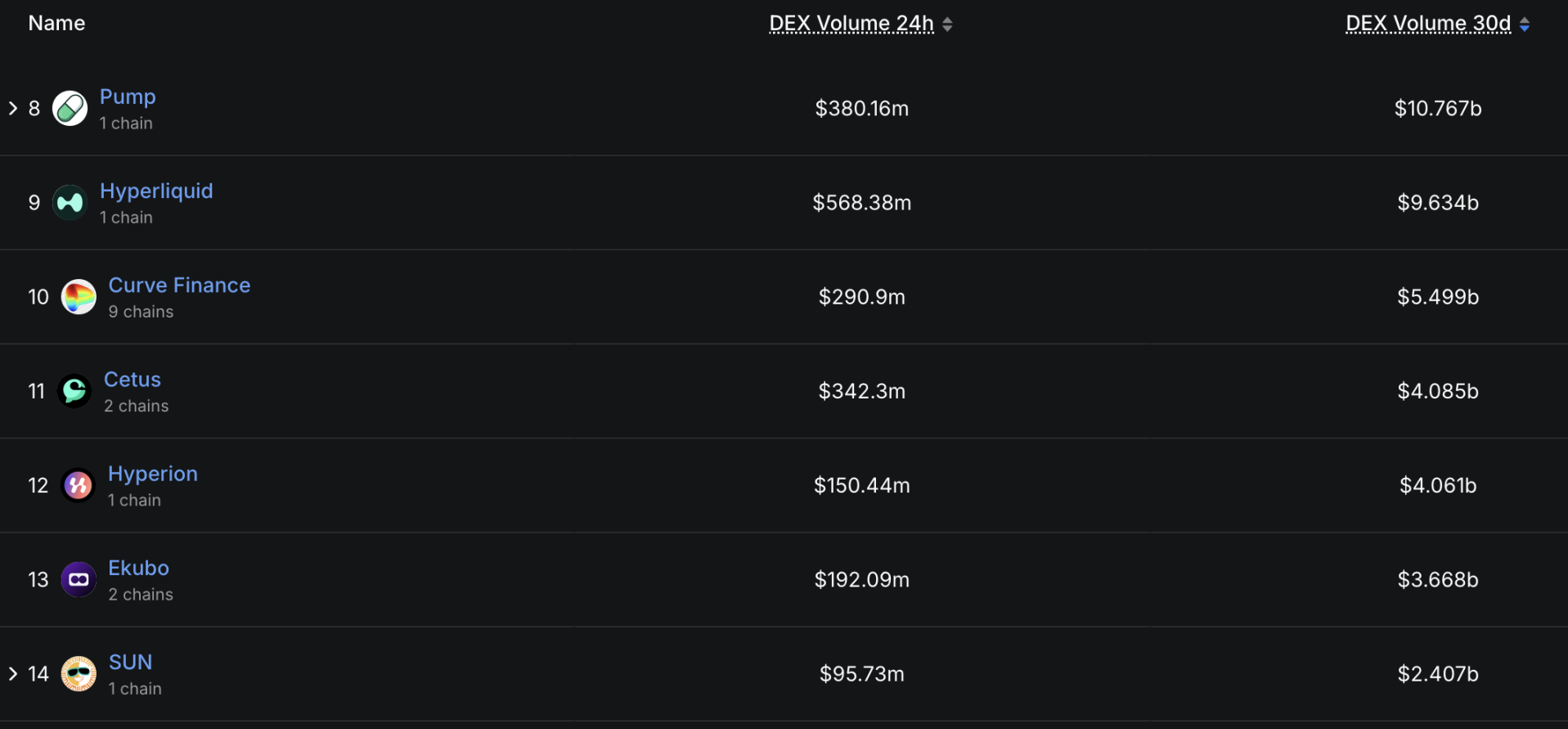
According to DefiLlama data, Hyperion’s total trading volume over the past 30 days exceeded $4 billion, ranking 12th among all DEXs.
It has also partnered with major wallets and platforms to run numerous user incentive campaigns. For example, DeFi activities with USDC via OKX Wallet, and trading mining and airdrop campaigns with Bitget Wallet and Gate Wallet have brought users and liquidity to the protocol.
Hyperion introduced the Drips points system, enabling traders, LPs, and community contributors to accumulate points through on-chain interactions, which are linked to future airdrops and governance rights. These initiatives collectively drove user growth: to date, nearly 940,000 unique addresses have interacted with Hyperion on-chain.
Token Economics: Dual-Token Model and Allocation
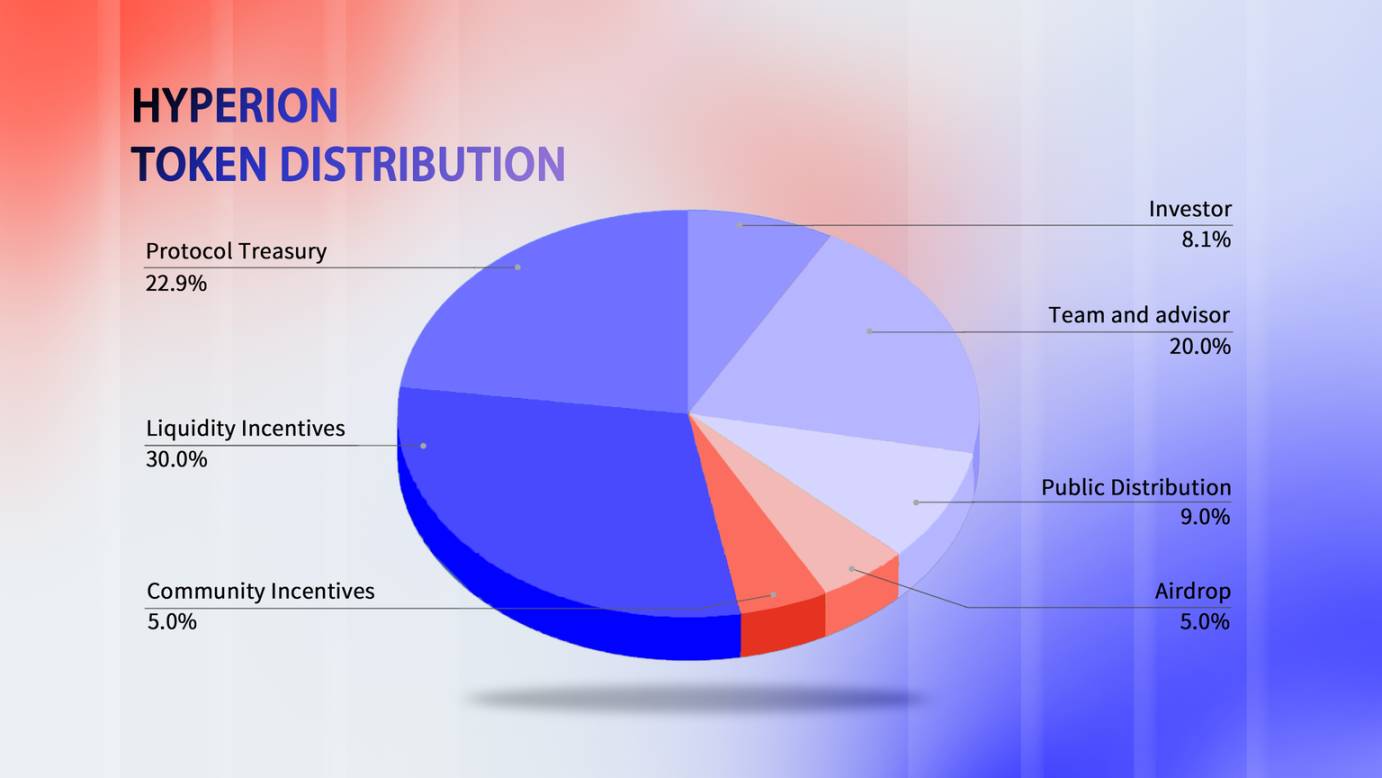
Hyperion adopts a dual-token model: the tradable native token RION (total supply of 100 million) and the staking-derived governance token xRION. RION serves as the utility token for the Hyperion platform, used for fee payments, trade settlements, and reward distributions. xRION is a non-transferable governance token; users can lock RION (for up to 52 weeks) to receive xRION, which grants voting power in governance and allocation rights in new project launch pools. The xRION voting weight decreases linearly over time, designed to encourage long-term holding and sustained engagement.
Hyperion has announced its genesis airdrop plan: 5% of RION tokens are allocated to reward early protocol participants, with 3% released at token generation and the remaining 2% linearly unlocked one month after TGE. RION will also be used for platform operations and ecosystem development incentives (as stated in official documents, RION will only be distributed based on actual on-chain activity, and inactive users will not receive additional tokens). RION will be issued via Binance Wallet’s Bonding Curve mechanism, where its price is determined by supply and demand during the event, and becomes a freely tradable asset afterward.
Airdrop Details and Participation Methods
Hyperion has established community incentives and an airdrop program to drive user engagement. As mentioned, the genesis airdrop targets early traders, liquidity providers, and community contributors, totaling 5% of RION supply. Key to qualifying is active participation in the Hyperion ecosystem: users earn Drips points by trading, providing liquidity, or completing community tasks. Points are directly tied to future token airdrops and governance weight, and can be redeemed for future airdrop rewards or Launchpad whitelist access.
The Hyperion airdrop includes a lucky draw for Aptos 2022 airdrop recipients, with approximately 800 randomly selected addresses eligible to claim RION.
Participating in Binance Wallet’s Bonding Curve TGE
This RION TGE is exclusively issued through Binance Wallet’s Bonding-Curve version of TGE, marking Binance Alpha’s first such event. The subscription window is from 16:00 to 18:00 on July 16, 2025, and requires Binance Alpha points to participate.
The rules are as follows: each user may contribute up to 3 BNB. A smart contract dynamically calculates the current RION price based on the total amount sold. Once a user confirms their contribution, BNB is locked and an equivalent amount of RION is allocated to their Alpha account. During this phase, RION cannot be withdrawn off-chain but can only be traded via order books within the event page. Orders are irrevocable and will execute upon matching with another user’s order. After the event ends, any unspent BNB is automatically refunded, and all RION holdings are unlocked and become freely tradable assets.
In short: "Buy early, pay less; buy late, pay more", with internal-only trading during the event and full tradability afterward.
Join TechFlow official community to stay tuned
Telegram:https://t.me/TechFlowDaily
X (Twitter):https://x.com/TechFlowPost
X (Twitter) EN:https://x.com/BlockFlow_News
 Foresight News

![In-depth Analysis of Trade[XYZ]: How Were 92 Markets and 98% HIP-3 Trading Volume Established?](https://upload.techflowpost.com/upload/images/20260716/20260716061117965147.jpeg?x-oss-process=image/resize,p_50/quality,q_80)