Quick Look: Loud — an experiment in decentralized attention markets, rewarding contributors with transaction fees
TechFlow Selected TechFlow Selected
Quick Look: Loud — an experiment in decentralized attention markets, rewarding contributors with transaction fees
Loud is an experimental project centered around the $LOUD token, exploring whether attention can be directly converted into value.
 Navigating Web3 tides with focused insights
Author: @0x_ultra
Translation: Zen, PANews
TL;DR
Loud is an experiment on the relationship between attention and value. The $LOUD token itself has no intrinsic value—every transaction incurs fees, which are used weekly as a marketing budget and distributed to the top 25 users who most increase Loud’s mindshare. Distribution is based on mindshare data from @KaitoAI, making this one of the most efficient incentive mechanisms currently available.
This is not a revolutionary paper on attention mechanisms in neural networks, but rather an experiment on the purest form of an attention market. This experiment will run permanently and without human intervention.
Inspiration
We often talk about the attention economy in Web3, and Kaito AI has built a platform that essentially enables everyone to participate in trading attention, accelerating industry-wide progress. In doing so, it has created one of the most optimal Proof-of-Work incentive mechanisms in history: a reward system based on "mindshare." This Web3 primitive allows projects to maximize output per dollar spent by creating a reward pool for those willing to put in effort. This is the first piece of the puzzle.
The second inspiration comes from Believe, a Web3 launchpad, and its successful practice: using trading volume and fees to create a long-term alignment between speculators and creators, thereby reinvesting in continuous creation. In reality, a project's visibility entirely depends on creators' output and maintenance—making creators the key drivers behind sustained attention.
So what happens if we combine the strengths of these two models and create a new incentive mechanism that aligns all participants around the shared goal of maximizing mindshare?
What is Loud?
Loud is an experiment that distills crypto primitives into their purest form, removing any intermediary product layer.
It’s time to return to (3,3) game theory.
The (3,3) game theory concept originated from Olympus DAO. Rooted in cooperative game theory, it expresses the idea of mutual benefit when participants collaborate. At its core, it's an optimized version of the prisoner’s dilemma, combined with Web3 tokenomics to clearly communicate the message of “we win together” to the community.
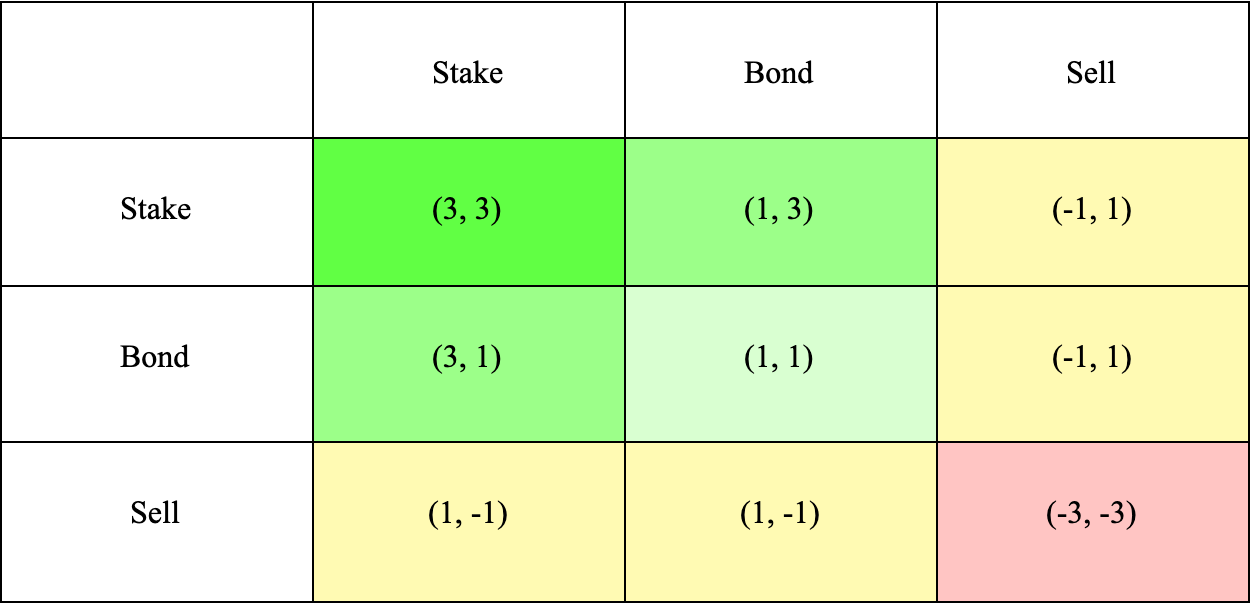
In the payoff matrix, "3" means the action benefits both the protocol and the participant; "-3" means harm. Therefore:
-
(3,3): You stake, I stake—we both support the protocol, the protocol grows, and we both gain the most → win-win
-
(-3,-3): You sell, I sell—the protocol collapses, and we both lose → lose-lose
-
(3,-1): You stake, I sell—I profit at your expense → unilateral exploitation
Experiment Design
We’re combining the best "proof-of-attention" model with a mechanism that gives creators long-term fee-sharing rights. What happens if we offer ongoing rewards to those spreading a topic?
We get the purest form of (3,3): a direct bond between speculators and influencers (KOLs)—no intermediary product needed. A perpetual attention engine, funded by speculators and driven by KOLs.
Fees paid by traders flow directly into a prize pool, which is split among the top-ranking “topic creators” on the attention leaderboard, incentivizing them to generate even greater buzz and trading volume. You can already see the flywheel taking shape.
-
Topic creators’ goal: Drive higher trading volume
-
Traders’ goal: Buy attention via fee subsidies
This is an experiment on whether "attention alone can confer value." If something receives enough attention, does its price rise? And vice versa?
How It Works
-
The $LOUD token will trade on Solana via Meteora’s liquidity pools. Each swap incurs a fee denominated in SOL
-
Users earn "mindshare" by publishing content about Loud
-
Kaito AI’s mindshare ranking system objectively quantifies contributions
-
Users can visit stayloud.io to view rankings and register wallets to claim rewards
-
Once per week, transaction fees (in SOL) are distributed proportionally to the top 25 users based on mindshare contribution
-
20% of fees go to $KAITO stakers to drive ecosystem momentum and align incentives
-
The flywheel runs indefinitely, with zero intervention required
Loud is the purest symbiotic model of speculators subsidizing KOLs.
About the Top 25 Ranking Mechanism
Why limit rewards to the top 25? As mentioned earlier, every fee paid by traders is essentially a purchase of attention. A smaller reward pool incentivizes participants to work harder to amplify visibility for token holders and traders. Even being in the top 25 isn’t safe—distribution is strictly proportional to mindshare contribution, so participants must continuously maximize their reach and impact.
Note: Loud is an experimental project. Its mechanisms may be iteratively improved based on community feedback, but always under the principle of minimal intervention. It aims to conduct the first large-scale experiment on a decentralized attention-value system.
What Happens Next?
The $LOUD token is即将 launched. Specific release timing and distribution methods will be announced later. The experiment is about to begin, powered by Holoworld AI.
This is a fully community-owned experiment: no team allocations, no hidden interests, fair launch only, 100% transparent. How it evolves next depends entirely on the community.
Join TechFlow official community to stay tuned
Telegram:https://t.me/TechFlowDaily
X (Twitter):https://x.com/TechFlowPost
X (Twitter) EN:https://x.com/BlockFlow_News
 @0x_ultra