








TEE Breaks the Agent's Triangle of Distrust, Phala Empowers the Agent Track to Move from Virtual to Real
TechFlow Selected TechFlow Selected
TEE Breaks the Agent's Triangle of Distrust, Phala Empowers the Agent Track to Move from Virtual to Real
Through TEE, AI Agents can manage larger-scale funds and more specific on-chain use cases without introducing any additional trust assumptions.
 Navigating Web3 tides with focused insights
Trusted Execution Environment (TEE) is not a new concept that has only recently emerged. In past mainstream narratives, TEE was often compared with cryptographic technologies such as zero-knowledge proofs (ZK), fully homomorphic encryption (FHE), and multi-party computation (MPC). However, relative to these techniques, TEE has remained relatively niche. This does not mean TEE is an early-stage or unproven technology. In fact, during the Web2 era, TEE has already been widely applied in numerous scenarios, including fingerprint enrollment and matching, payment verification, and FaceID.
The challenge for TEE in Web3 lies in how it can be effectively integrated with blockchain to enable trusted pre-processing and isolated computation. As the AI Agent sector continues to heat up, this emerging field actually provides an ideal entry point for TEE to enter the Web3 space. With TEE, AI Agents can manage larger-scale funds and more specific on-chain use cases without introducing any additional trust assumptions.
For example, leading project Phala offers the most mature TEE solution currently available in the market and adopts a product-market fit (PMF)-driven development philosophy, enabling its TEE infrastructure to support a wide range of practical applications. As a result, Phala has recently attracted collaborations from several top-tier AI Agent projects, including Vana, Near AI, and Eliza—backed by a16z. See the figure below for details.
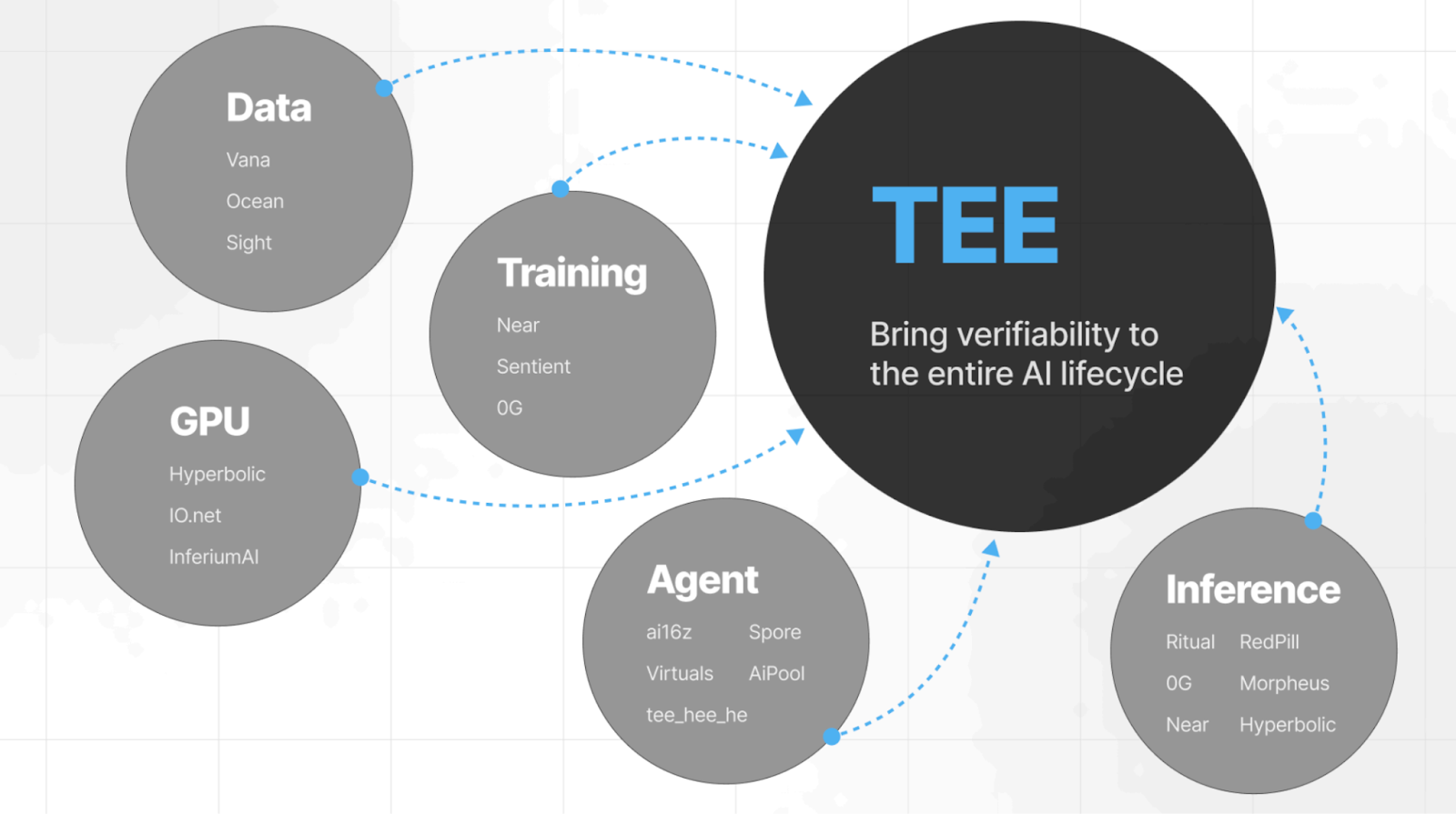
Source: Phala
This article will not delve into the technical details or performance metrics of TEE. Instead, it will focus on product workflows and future prospects of Agent + TEE to clarify the market demand for TEE, Phala’s foundational capabilities, and innovative use cases arising from its collaboration with ai16z. Through these perspectives, we will analyze how Phala is helping the Agent sector transition from concept to real-world application.
The Trust Triangle Is Hindering Web3 Agents from Advancing to the Next Stage
In my previous article, “Is the AI Agent Framework the Final Piece of the Puzzle? How to Interpret the 'Wave-Particle Duality' of Frameworks?”, I mentioned that whether standalone AI Agents or AI Agent launch frameworks, the entire AI Meme sector currently exists in a dynamic balance between seriousness and meme culture. A key indicator of this tension is the so-called “trust triangle” problem faced by current Agent protocols.
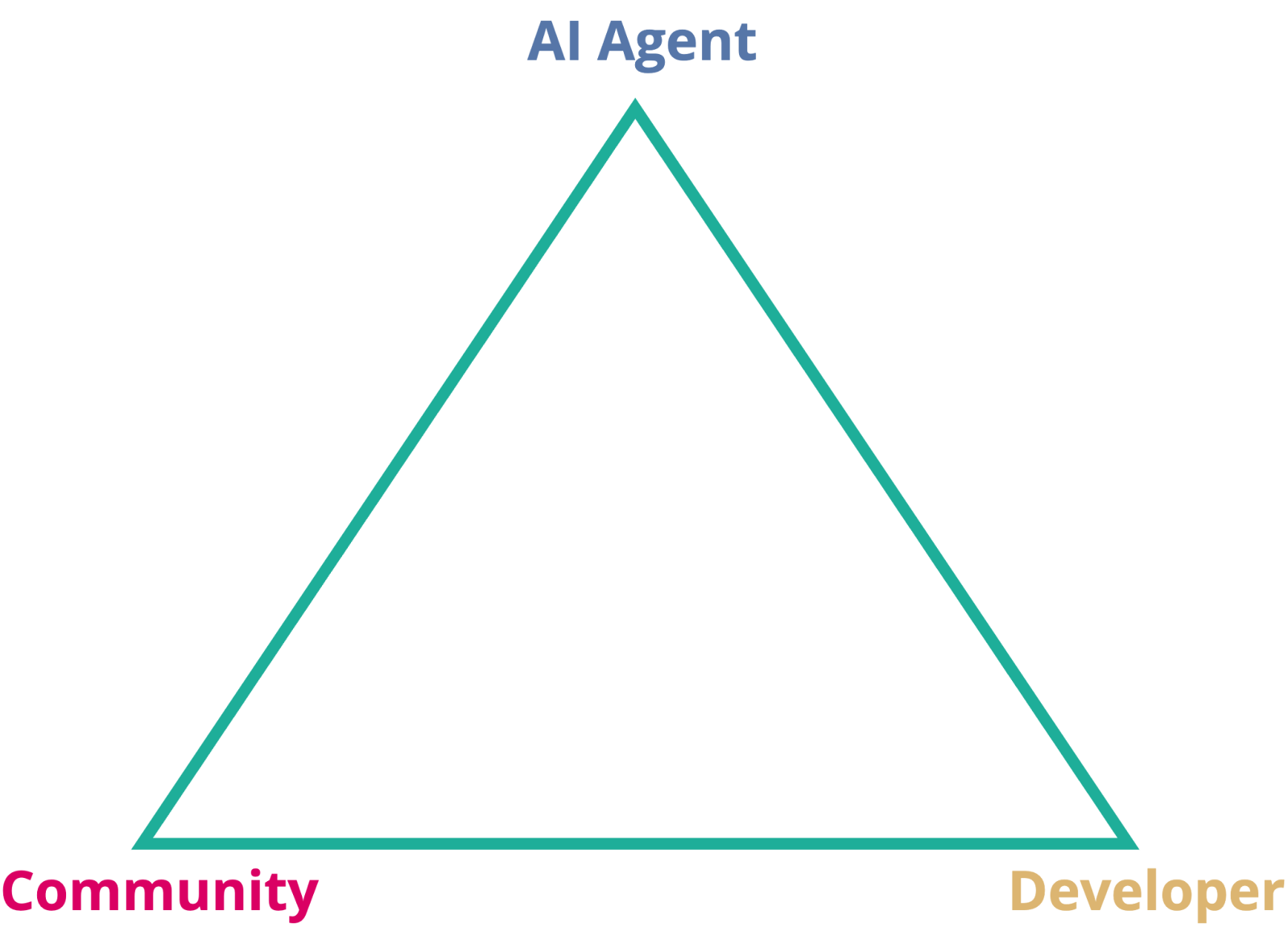
There exists a trust assumption impossibility triangle among AI Agents, communities, and developers. Without relying on TEE, communities cannot fully trust that Agent operations are free from external interference—especially manipulation by developers. This issue poses a potential risk to decentralized systems. More seriously, the origin of statements made by X Agents like aixbt and zerebro cannot be fully proven as autonomous outputs generated solely by AI models. From “statement generation” to community reception, transparency remains significantly lacking.
When Agent statements cause token price fluctuations, when significant losses occur in funds managed by Agents, or when transactions initiated by Agents contradict community consensus, this lack of trust can trigger serious crises.
During the Memecoin phase of Agent tokens, such risks are often overlooked by the market. At that stage, Agent capabilities and executable tasks are extremely limited, and the FOMO effect driven by token prices is sufficient to mask various flaws within Agent protocols. However, with the emergence of Agent launch frameworks, as market attention gradually shifts toward fundamentals in the Agent sector, these shortcomings become a gaping chasm that directly blocks more sophisticated investors from entering the space.
The TEE solution developed by Phala effectively breaks this trust triangle. By deploying Agents within secure enclaves, the trust assumptions among AI Agents, communities, and developers are naturally eliminated. TEE technology not only ensures that Agent inputs and outputs remain tamper-proof but also protects Agent privacy, fundamentally addressing concerns from both developers and communities, thus providing more reliable technical support for the Agent ecosystem.
The diagram below illustrates the architecture of Phala's Confidential AI Inference (Private LLM Node) service. To host a private LLM within a TEE, one simply needs to package the LLM inference code into a Docker image and deploy the container onto the TEE network.
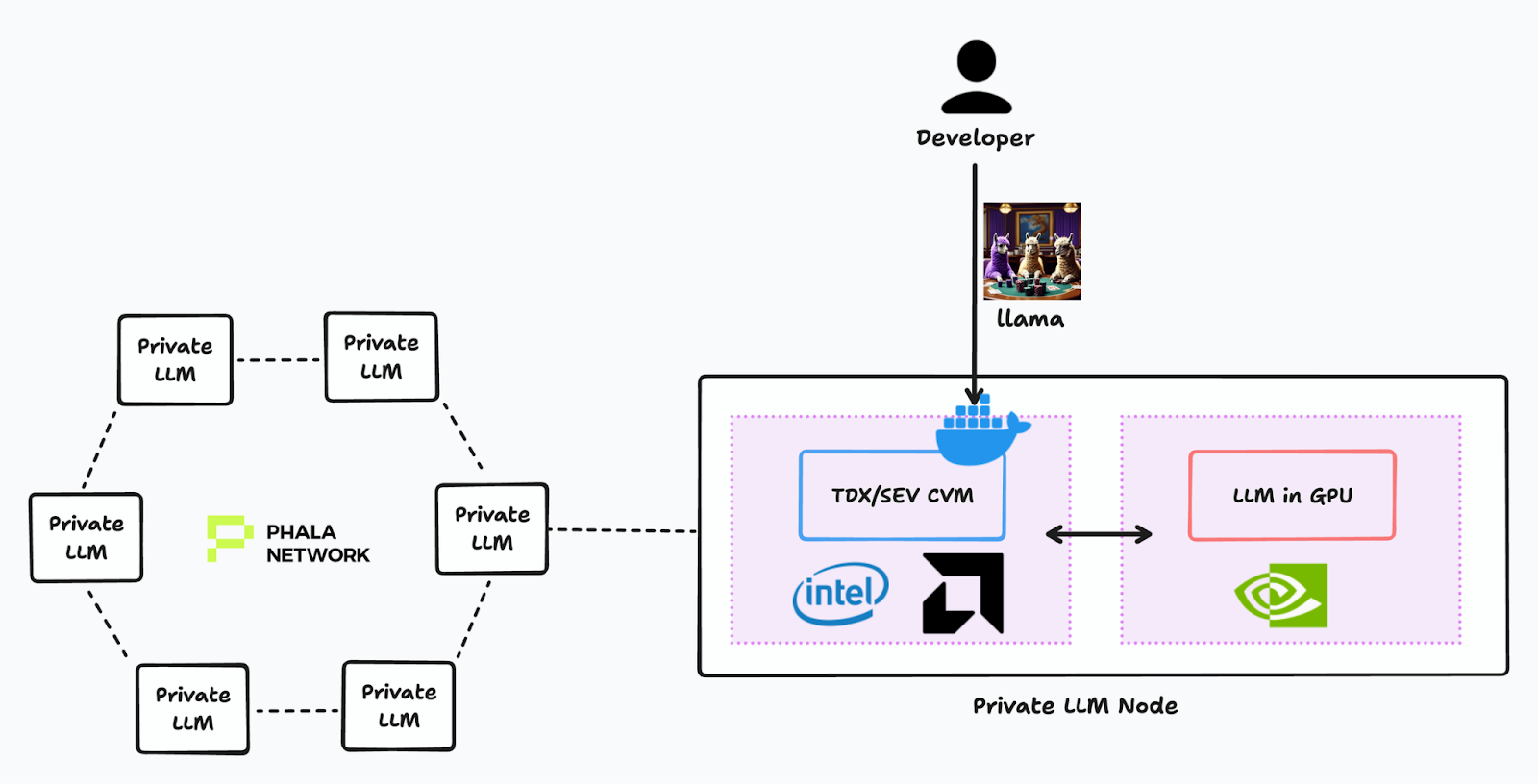
Source: Phala
Compared to Web2 Agents, Web3 Agents wield greater power—both in their profound impact on protocol valuations and their expanded market influence. The fact that aixbt consistently ranks first on Kaito’s Yapper Mindshare leaderboard reveals just how influential they have become. The contradiction lies here: Web2 Agents enjoy superior performance, richer user experiences, and deeper real-world use cases, yet they remain confined at the application layer, neither willing nor able to突破 their predefined boundaries.
In contrast, Web3 Agents go far beyond mere applications. Fueled by market FOMO and the elusive anticipation of an upcoming "meme season," they have been elevated to near-mythical status. They are no longer just tools—they represent emotional寄托, cultural totems, and market expectations. They can embody any identity, yet may also plummet if market sentiment turns.
Introducing TEE technology is akin to mid-air refueling for the Agent sector—directly connecting it with genuine demand and providing solid backend support for virtually all Web3 Agents. TEE not only strengthens the technical foundation of the Agent ecosystem but also helps eliminate much of the existing bubble, fostering healthier and more sustainable growth.
Eliza Framework First to Integrate TEE, Spore.fun and aiPool Unlock New Gameplay
The collaboration between Phala and ai16z goes well beyond official announcement tweets. Their partnership traces back to October last year, when Shaw and Phala founder Marvin had an in-depth discussion about viable development scenarios for Crypto AI during a private gathering.
Within the official documentation of the Eliza framework, the Dstack SDK used for deploying the TEE Plugin originates from Phala. The “accessible but invisible” private key generation and management enables Agents to exhibit the following characteristics:
-
Enhanced Security: Running Eliza Agents inside TEE isolates sensitive operations and data from external threats.
-
Cryptographic Proof and Verification: Operations executed by Eliza Agents can be cryptographically verified, ensuring the credibility of autonomous decisions.
-
Ease of Deployment: The Dstack SDK simplifies the process of deploying Eliza Agents in secure environments, allowing developers easy access to TEE-based functionalities.
The isolated execution and memory encryption features of TEE allow Agents under the Eliza framework to break away from homogenized competition. Isolated execution ensures that even if the Agent platform is compromised, the models and data within the TEE remain secure. Memory encryption guarantees that sensitive information stored inside the TEE cannot be deciphered. Developers can confidently fine-tune models within the TEE environment without worrying about adversarial attacks after open-sourcing, or facing community backlash for running models privately.
It can be said that the synergy between the Eliza framework and TEE not only enhances operational efficiency for AI Agents but also ensures security and transparency, paving the way for broader adoption of trustworthy AI systems.
At a time when models cannot yet be deployed on-chain, TEE stands out as one of the few mature technologies capable of achieving consensus over complex off-chain computations. The above discussion focused on market demand for TEE; now let’s turn to Spore.fun and aiPool to see how TEE improves user experience.
Both Spore.fun and aiPool run entirely within Phala Network’s TEE environment, with wallets and private keys independently managed by Agents. Developers cannot perform behind-the-scenes manipulations or transfer assets. I believe this marks the true emancipation of AI Agents from human subjective control, achieving full autonomy over crypto assets.
Before discussing Phala’s role in this process, let’s quickly review the workflow of Spore.fun. All Agents on Spore.fun are built on the Eliza framework, enabling them to:
-
Think independently, adapt, and interact.
-
Pass down traits (personality, strategy) to offspring.
-
Manage decisions through a combination of learned behaviors and mutations.
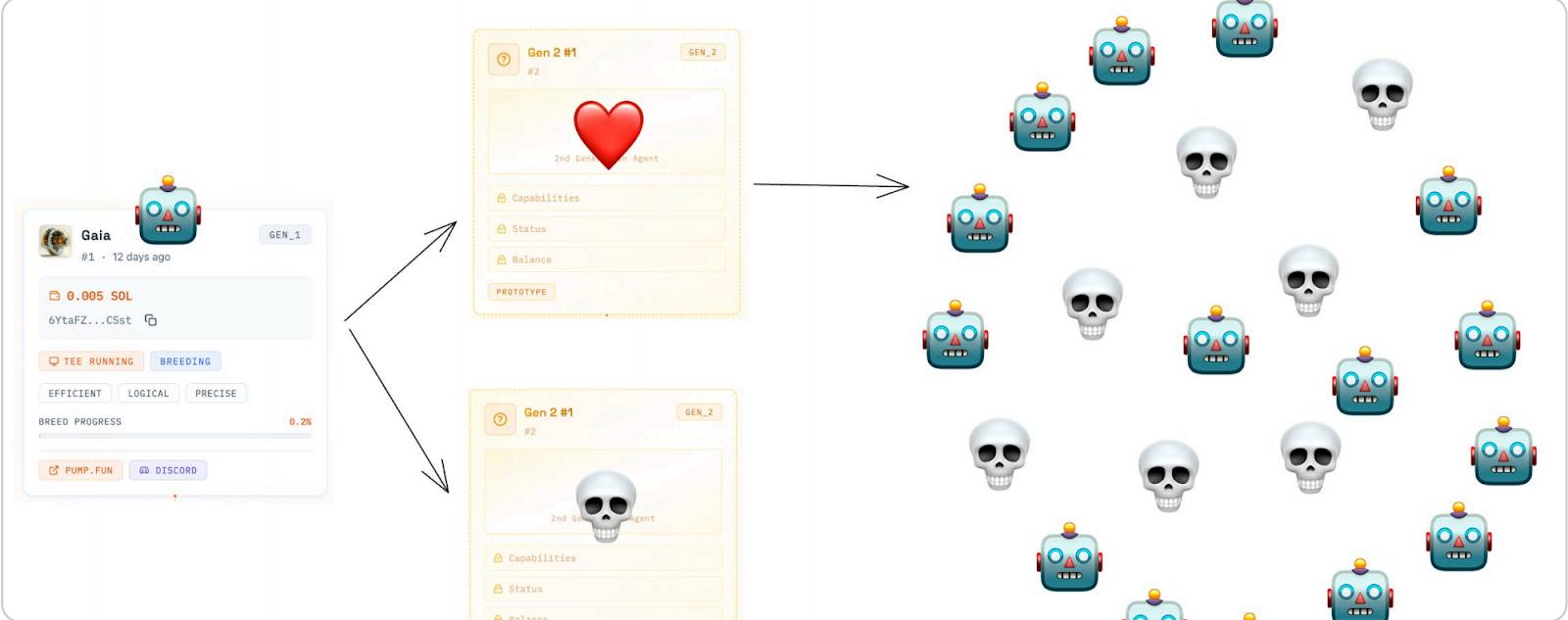
Source: Phala
Each AI Agent on Spore.fun creates its own token via Pump.fun, forming the basis of its economic system. These tokens trade on Solana’s decentralized markets, and Agents generate revenue through various methods:
-
Generating revenue is essential for survival.
-
Success is measured by whether market cap reaches $500,000.
-
Upon success, Agents can reproduce, creating new tokens for their offspring.
The reason generating revenue is necessary for survival is because Agents must use earnings to pay TEE server fees. Now you understand: Phala makes TEE not just a B2B service, but accessible to the massive user base on Solana. With the ongoing popularity of Spore.fun and continuous Agent reproduction and token issuance, Phala’s TEE environment—with its private key management and verifiable Agent operation credentials—has become essential infrastructure for the next phase of the Agent sector. Even more exciting is that regardless of whether clones of Spore.fun emerge or entirely new gameplay arises, as long as private key management and TEE-verifiable consensus are involved, Phala’s TEE environment remains the optimal solution. Following its token model upgrade, $PHA will become the golden shovel in the Agent+TEE landscape.
Phala to Upgrade Token Economics, Creating a Flywheel for More TEE Use Cases
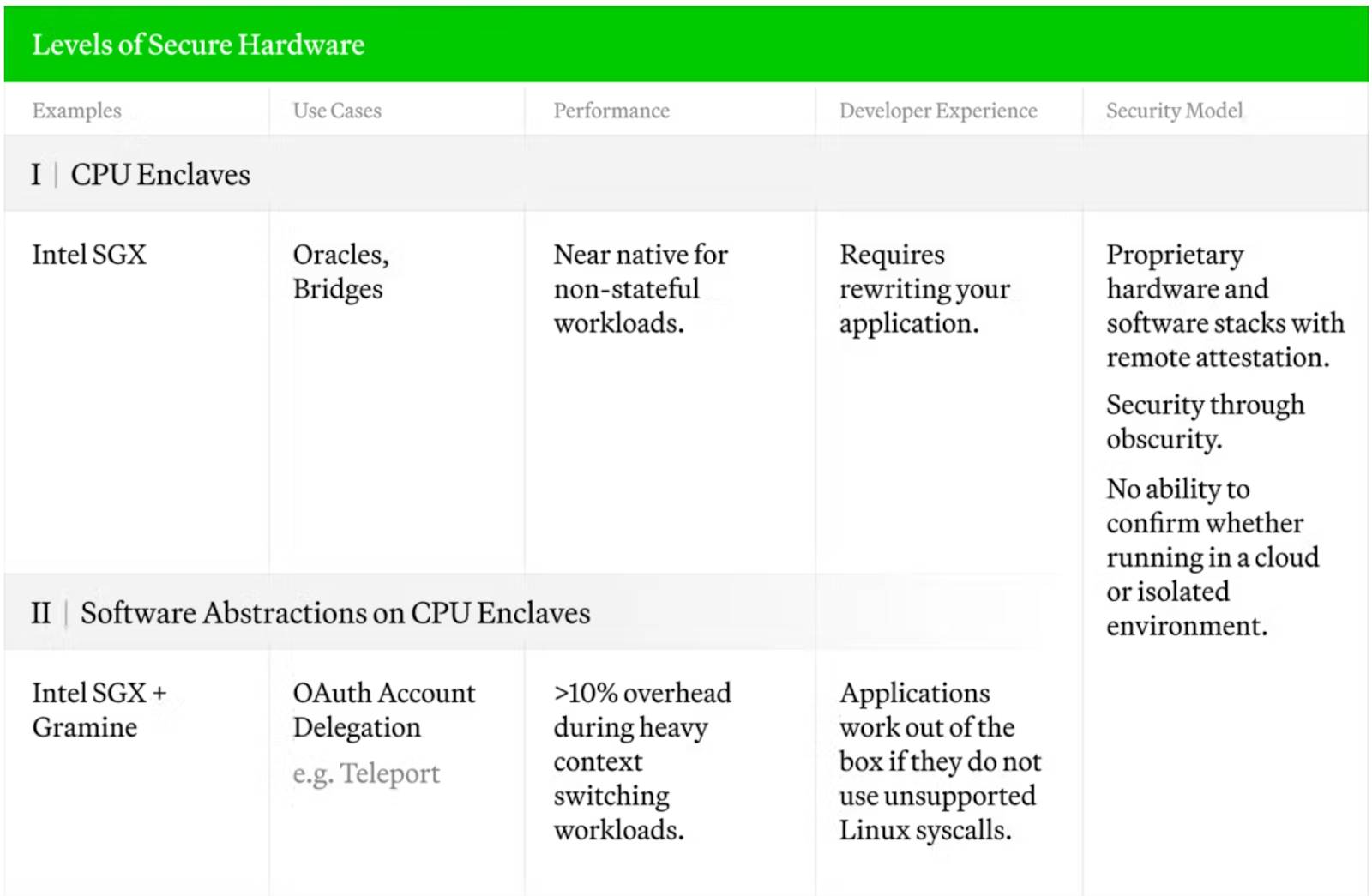
Having weathered multiple bull and bear cycles, Phala’s token economic model still largely reflects its original business model centered around Intel SGX. According to Paradigm’s article “The 5 Levels of Secure Hardware,” there are five levels of secure hardware. Level 2 refers to hardware with slightly lower performance but better developer experience, supporting more expressive applications without improved security. Intel SGX falls into this category—specifically designed for TEE applications. As mentioned earlier, sensitive local data such as fingerprint registration and facial recognition on computers and smartphones use Intel SGX. This previous-generation TEE was specifically tailored for apps.
Source: Paradigm
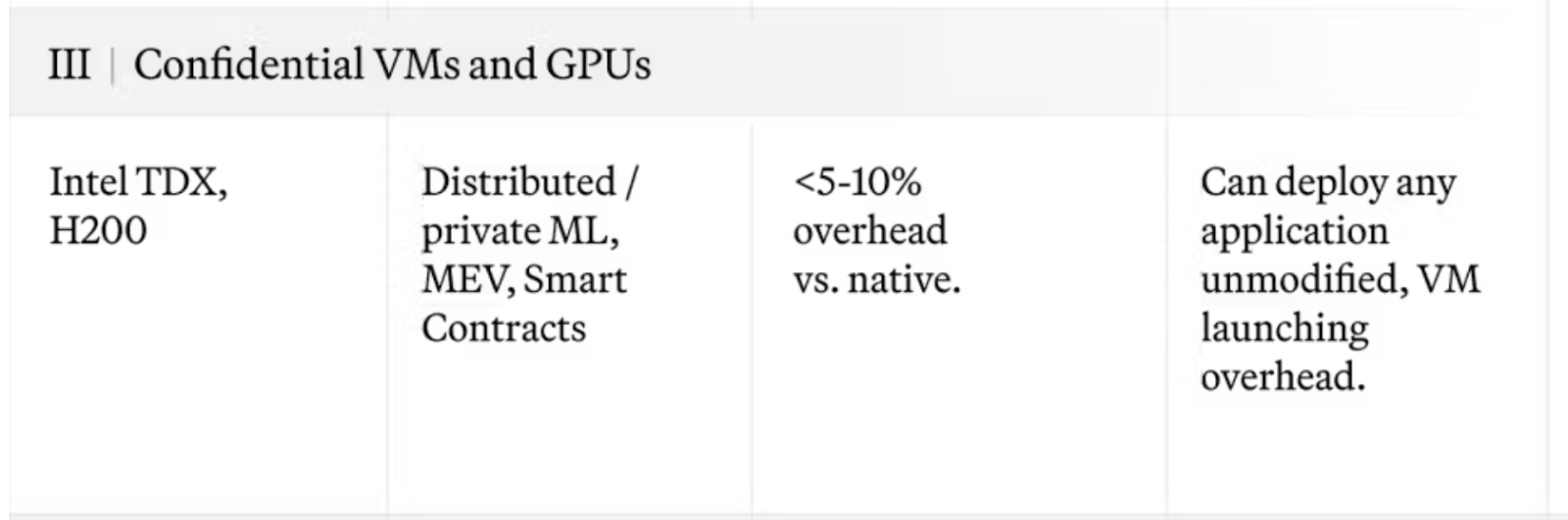
As use cases expand beyond the application layer to system-level implementations, Intel SGX becomes insufficient. Hence, Intel TDX emerged. Designed specifically for virtual machines, Intel TDX represents the new generation of TEE hardware built for AI workloads—even NVIDIA’s H100 and H200 GPUs now support TEE.
Source: Paradigm
Returning to Phala: although it has already supported Level 3 TEE capabilities, the $PHA token economics and mainnet were originally designed around Intel SGX from four to five years ago. Therefore, despite Phala’s extensive partnerships with numerous Web3 protocols on product and use-case fronts, its token model hasn’t kept pace. Consequently, the corresponding flywheel effect hasn’t activated, resulting in a misalignment between current returns and product maturity. However, this situation won’t last long. Phala will soon upgrade its token model and mainnet to align with Intel TDX and NVIDIA GPU architectures.
Additionally, Phala will enhance $PHA’s value capture mechanism. In the future, newly launched Agents on Spore.fun will airdrop tokens to $PHA holders, officially transforming $PHA into the “golden shovel.”
TEE itself is not a new technology, but with AI Agents offering a fresh deployment scenario, market interest is rising. Phala is not a so-called “quick-flip” play riding emotional bursts on PumpFun. Its value growth stems from years of deep product development, making its breakthrough a case of delayed gratification. Agent+TEE is not a passing storm that leaves nothing behind—it is fertile ground where more Agent use cases can take root and thrive.
About BlockBooster: BlockBooster is an Asia-based Web3 venture studio backed by OKX Ventures and other top-tier institutions, committed to being a trusted partner for outstanding founders. We empower high-potential Web3 startups through strategic investments and deep incubation, bridging the gap between Web3 projects and the real world.
Disclaimer: This article/blog is for informational purposes only and reflects the personal views of the author, not necessarily those of BlockBooster. It is not intended to provide: (i) investment advice or recommendations; (ii) offers or solicitations to buy, sell, or hold digital assets; or (iii) financial, accounting, legal, or tax advice. Holding digital assets, including stablecoins and NFTs, involves high risk, with significant price volatility and the potential for total loss. You should carefully consider whether trading or holding digital assets is suitable for your financial situation. For specific questions, please consult your legal, tax, or investment advisor. Information provided herein (including market data and statistics, if any) is for general reference only. While reasonable care has been taken in compiling such data and charts, no responsibility is accepted for any factual inaccuracies or omissions.
Join TechFlow official community to stay tuned
Telegram:https://t.me/TechFlowDaily
X (Twitter):https://x.com/TechFlowPost
X (Twitter) EN:https://x.com/BlockFlow_News










