








Phala Network: Artificial Intelligence Router
TechFlow Selected TechFlow Selected
Phala Network: Artificial Intelligence Router
Phala Network makes AI agents as easy to run as smart contracts by introducing AI agent contracts.
 Navigating Web3 tides with focused insights
Author: Frontier Lab
Introduction
PhalaNetwork was founded in 2018. Initially positioning itself in the privacy computing sector, Phala Network combined smart contract execution environments with TEE (Trusted Execution Environment) to achieve secure and reliable smart contract execution. It also provides a complete privacy protection mechanism, ensuring users retain full control over their data. In 2023, riding the wave of AI-driven market trends led by U.S. stock markets, Phala Network pivoted toward artificial intelligence agents. Aligning with modular design principles, it redefined itself as an execution layer for AI in Web3.
Project Overview
Basic Information
Website: https://phala.network/
Twitter: https://twitter.com/PhalaNetwork
Telegram: https://t.me/phalanetwork
Discord: https://discord.com/invite/phala-network
Whitepaper: https://docs.phala.network/
Launch Date: Token launched in 2020
Team
Core Team
Marvin Tong: Founder & CEO. Holds a master's degree from Communication University of China. Previously worked as a product manager at Tencent and Didi.
Hang Yin: Co-founder & Chief Technical Developer. Graduated from Fudan University, China. Former expert in machine learning for Google Search, one of China’s Polkadot ambassadors, and founder of Bitcoin Gold.
Zhe Wang: Co-founder & Chief Operating Officer. Holds a master's degree from Huazhong University of Science and Technology. Expert at the computer hardware lab of HUST, and served as CTO & CEO of Bitcoin Gold, Xiaohei Technology, and Haha Retail.
Jun Jiang: Co-founder & CTO. Former站长 of RubyChina, ex-CTO of KnewOne, and former software architect at DJI.
Advisory Team
Shun Fan Zhou: One of the authors of the Phala Network whitepaper, PhD candidate at Fudan University’s System Software and Security Lab. Published research on transaction attacks and defense mechanisms within the Ethereum ecosystem at top-tier security conference USENIX Security, and co-authored multiple papers presented at leading international security conferences.
Sandro Gorduladze: Angel investor and partner at HASH CIB. Established the research division at HASH, known for its in-depth reports. Prior to joining HASH, Sandro worked at PwC Russia, providing tax advisory services to companies in the TMT industry.
Konstantin Shamruk: PhD in Economics from the University of Toulouse, France. Led game-theoretic analysis for the economic design of Phala Network.
Jonas Gehrlein: Research Scientist at Web3 Foundation. Responsible for researching economic issues in the Polkadot ecosystem. Before joining W3F, Jonas earned a PhD in Behavioral and Experimental Economics from the University of Bern, where he studied human behavior in markets and organizations. He previously obtained a master's degree in Quantitative Economics from the University of Konstanz.
Zo Meckbach: Senior Polkadot Ambassador, researcher, and advocate for Web3 and cybersecurity. Currently COO at MH-IT & Service GmbH; prior to that, held an application analytics role at Google.
Funding Status
Phala Network has raised approximately $10 million in one funding round.
Seed Round
In July 2020, Candaq Group, IOSG Ventures, SNZ, Incuba Alpha Group, nfiChain, Exoplanet Capital, and Blue Mountain Labs invested in this round totaling $10 million.
Development Capability
Phala Network was initiated in 2018 by founder Marvin Tong. Key milestones in the project’s development are shown below:
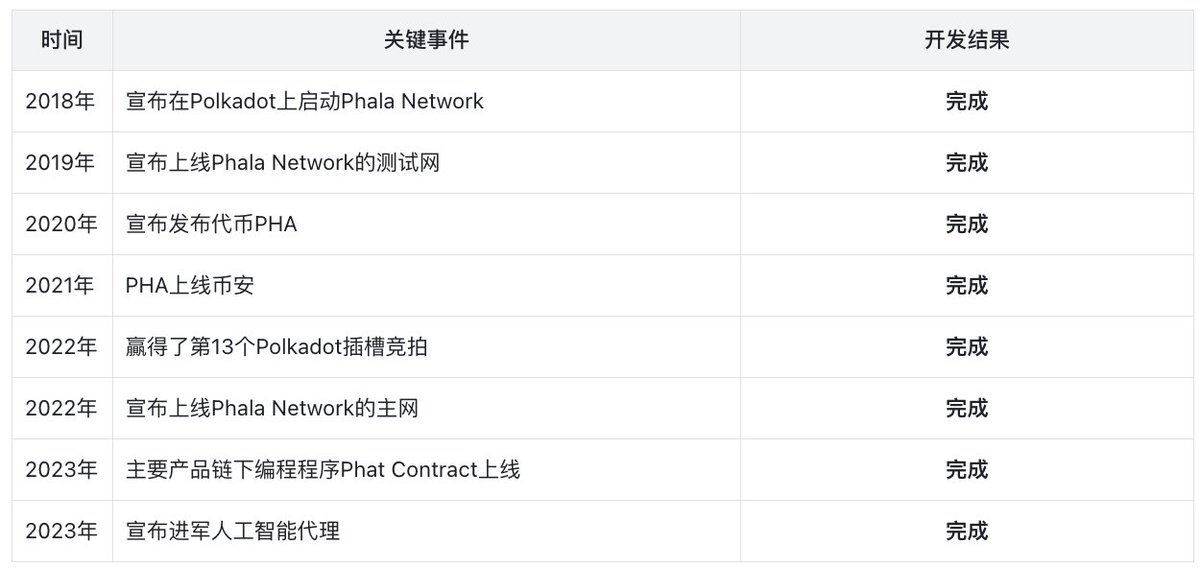
From Phala Network’s roadmap, it is evident that the team consistently met key development deadlines. This demonstrates the strong technical capabilities led by Marvin Tong and Hang Yin. While entering the AI space opens broader prospects for Phala Network, it also brings greater technical challenges and higher demands on the development team.
Technical Features
Phala Network is a privacy computing infrastructure built on the Polkadot ecosystem, aiming to ensure data confidentiality and privacy through Trusted Execution Environments (TEE), cloud computing services, and cross-chain confidential data layers. Additionally, Phala employs AI coprocessors to provide secure, verifiable computing solutions that integrate encryption and artificial intelligence at the application layer.
In simple terms, Phala Network adds an AI coprocessor atop its existing privacy computing infrastructure, enabling deployment of AI agent contracts on its network, thus becoming the execution layer for Web3 AI. Using TEE technology, Phala protects these operations—allowing AI agent contracts to access top-tier LLMs, with control governed by on-chain smart contracts.
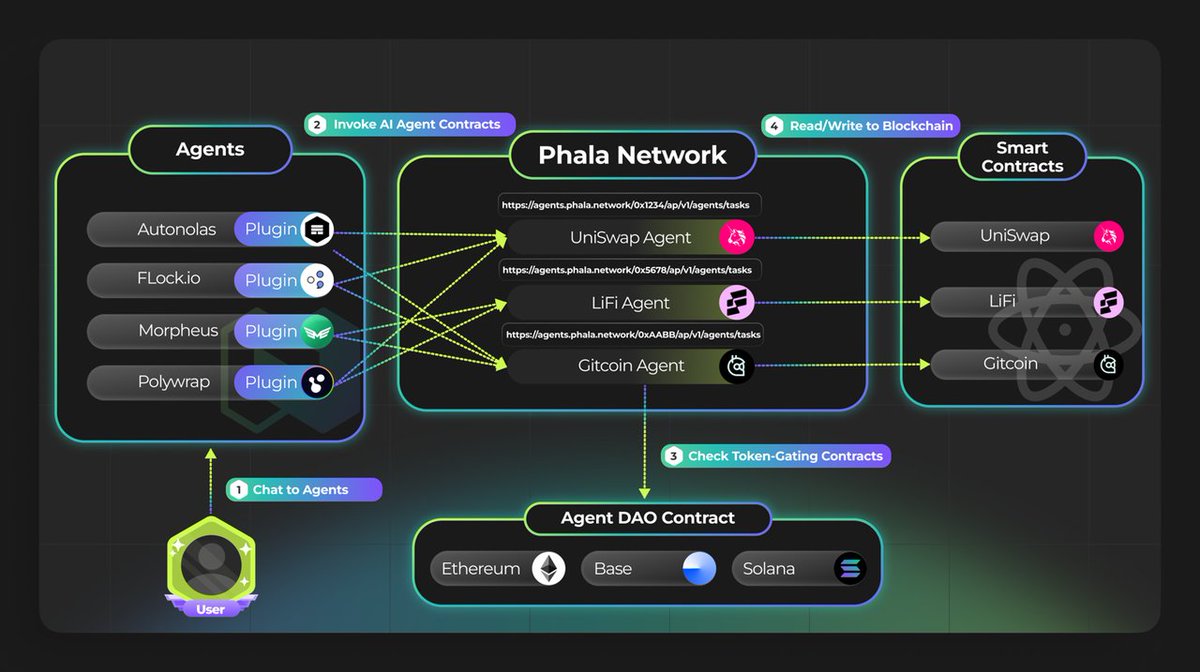
Illustration of Phala Network’s AI Agent (Image source: Phala Network Whitepaper)
Prior to introducing AI agent contracts, Phala Network focused on using various technologies to ensure data confidentiality and privacy. First, it adopted hardware-based privacy computing, particularly Trusted Execution Environments (TEE), to safeguard data confidentiality and integrity during computation. All computations within TEEs guarantee correct program execution and data security. Phala also integrates zero-knowledge proof (ZKP) technology to enable private transactions, allowing smart contract data to remain hidden and protecting user privacy. Through this approach, Phala offers general-purpose, easy-to-use confidential smart contracts and supports trustless cloud services.
The key components are Trusted Execution Environment (TEE) and multi-layered key rotation system.
Trusted Execution Environment (TEE): TEE is a privacy-focused technology that isolates code execution and operations of nodes from the main operating system of the processor. Phala uses Intel’s Software Guard Extensions (SGX) for TEE processing. This ensures that even individuals with physical access—such as Phala operators or malicious third parties—cannot view node states or manipulate processed data. Typically, TEE serves as an alternative to zero-knowledge proofs (ZKPs). In Phala Network, TEE not only protects data confidentiality and integrity but also supports complex computational tasks. By offloading smart contract execution to secure off-chain workers powered by TEE, Phala fully leverages individual worker computing power without risking data leakage or tampering.
Multi-Layer Key Rotation System: Phala Network operates a set of special worker nodes called "Gatekeepers," whose primary role is to ensure computational security. Worker nodes in Phala cannot exit the network arbitrarily; therefore, tasks must be deployed across redundant worker nodes sharing the same key to maintain access to encrypted inputs, outputs, and program states. Gatekeeper nodes manage encryption keys and dynamically distribute secrets to worker nodes, ensuring data security and integrity. Phala implements a comprehensive key rotation mechanism to preserve contract privacy and overall system security. The master key is periodically updated according to election rules. A new set of gatekeepers is elected, then generates a new master key via a secure key exchange protocol. The new key re-encrypts the gatekeeper state and is distributed and confirmed among the new gatekeepers. During this transition, communication between miners and gatekeepers is temporarily suspended to maintain consistency and security. Communication resumes only after key rotation completes, following two on-chain confirmations. Besides rotating the master key, Phala regularly updates cluster and contract keys to enhance security.
After integrating AI agent contracts, Phala Network shifted its core business from a privacy computing infrastructure to the execution layer for Web3 AI. Its original privacy computing foundation now underpins this new AI execution layer, with current AI agent contracts operating atop the established privacy infrastructure.
AI Agent Contracts: These are tools allowing users to build smart contracts to control AI agents running either on-chain or off-chain. Written in TypeScript/JavaScript, these AI agents execute on Phala Network nodes, aggregate data from external APIs, and allow integration of custom AI agents. They leverage Phala’s trustless cloud computing infrastructure for confidential off-chain computation. Technically, AI agent contracts run inside the TEE of worker nodes managed by Phala Network. A subset of gatekeeper worker nodes manages keys to ensure network security. These contracts offer developers powerful tools to deploy AI agents for diverse tasks, with execution environment security and privacy ensuring safe handling of sensitive data. The development of AI agent contracts opens new possibilities for blockchain applications and expands innovation opportunities for developers.
pRuntime: Worker nodes host AI agent contracts within their TEE, preserving workload code integrity and privacy, preventing malicious attacks or tampering during execution, while delivering robust computing power. pRuntime (Phala Runtime) is a program running inside the TEE and serves as the core component of Phala’s worker nodes. It receives and executes computing tasks from the blockchain, ensuring tamper-proof and secure computation.
In summary, by introducing AI agent contracts, Phala Network simplifies AI agent execution akin to smart contracts, placing them under smart contract management for real-time access control. AI agents can freely invoke each other, forming complex applications—all executed within TEE to ensure code integrity and privacy. This transformation allows Phala Network to fully leverage its prior advantages in privacy computing infrastructure as it evolves into the execution layer for Web3 AI.
Innovation Compared to Peers
After introducing the AI coprocessor, although Phala Network’s underlying operational logic remains unchanged, its narrative has shifted from privacy computing infrastructure to a niche segment within the AI sector—specifically the algorithm track. Its competitors now include Morpheus, QnA3.AI, Fetch.AI, SingularityNet, ChainGPT, and others.
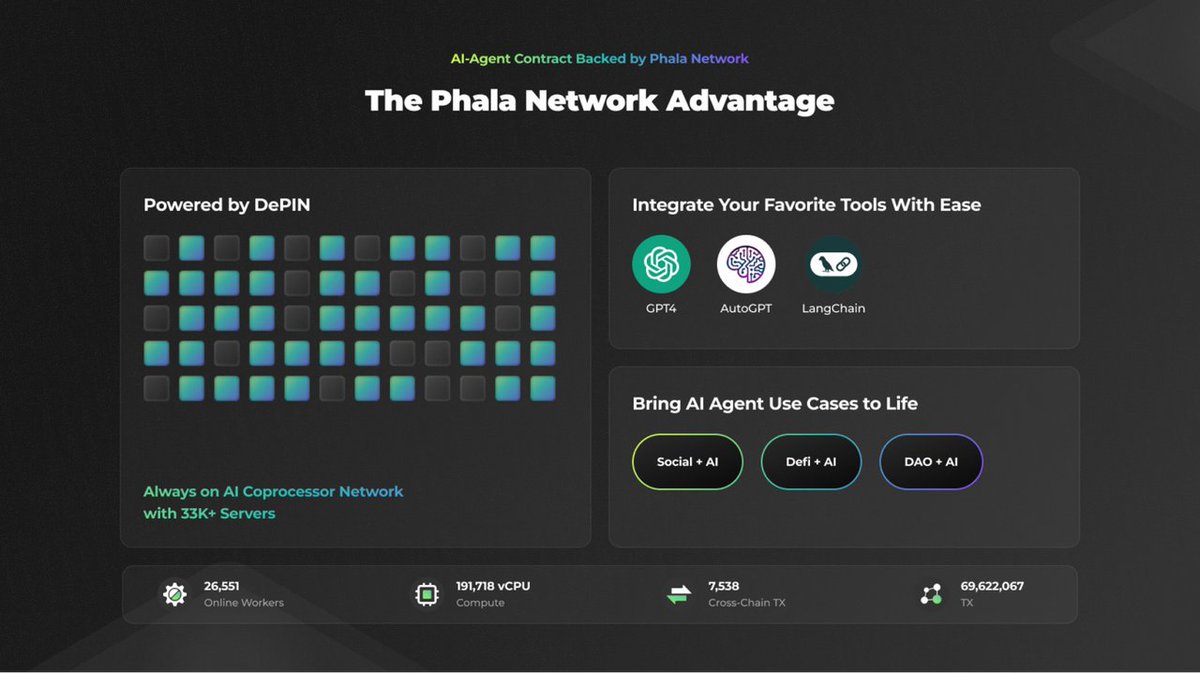
Advantages of Phala Network (Image source: Phala Network Whitepaper)
-
Superior Privacy: Benefiting from its origins in privacy computing, Phala enjoys inherent privacy advantages. It uses hardware-based privacy computing techniques, especially TEE, to ensure data confidentiality and integrity during computation. All computations within TEE guarantee correct program execution and data security. Combined with zero-knowledge proof technology, it enables private transactions, keeping smart contract data confidential and protecting user privacy. This provides users with secure, reliable privacy computing solutions and solid technical support for blockchain privacy protection.
-
Powerful Functionality: The introduction of AI agent contracts gives Phala a decisive edge in the AI agent space. These contracts simplify AI agent execution like smart contracts, place AI agents under smart contract management for dynamic access control, and allow EVM smart contracts to extend functionality off-chain—greatly improving deployment efficiency and workflow. This achieves a smart contract-centric AI agent framework.
-
Rich Integrations: By leveraging AI agent contracts, Phala aggregates data from external APIs and supports insertion of custom AI agents. It removes barriers to entry for decentralized applications, enabling seamless large-scale integration with leading external AI tools and platforms such as OpenAI, LangChain, and GPT-4.
-
Broad Applicability: Thanks to AI agent contracts, deploying AI agents on Phala Network is simple and applicable across many domains. Users can easily connect their self-built AI agents to Social, DeFi, or DAO platforms based on personal needs, enhancing productivity and daily life efficiency.
In conclusion, Phala Network turns AI agent deployment and usage into a remarkably simple process. By addressing both usability and privacy concerns, it gains significant competitive advantage in the AI赛道.
Project Model
Business Model
As Phala Network’s core narrative shifts from privacy computing to AI, its economic model now involves four roles: miners, stakers, AI agent contract users, and privacy computing users.
Miners: Miners provide computational power to the network by contributing CPU resources from their computers. They are the sole entities performing actual computations in Phala Network and form the foundational backbone of the entire system. The more computing power they contribute, the greater their rewards.
Stakers: Phala’s mining design requires miners not only to provide computing power but also to stake a certain amount of PHA tokens as collateral to prevent malicious behavior. However, some miners may prefer to provide only computing power without additional token stakes. Thus, stakers fall into two categories: Stakepool and Vault. Stakepools consist of miners who provide both computing power and are willing to stake PHA tokens directly. Alternatively, token holders who do not wish to stake directly with a specific Stakepool can deposit their PHA into a Vault, which allocates stakes across Stakepools based on performance metrics.
AI Agent Contract Users: These users are currently the primary participants in the Phala Network ecosystem. They run AI agent contracts on Phala Network and pay fees in PHA tokens—the main revenue stream for Phala Network.
Privacy Computing Users: Despite the pivot to AI, Phala still attracts users with genuine privacy computing needs due to its strong capabilities in this area. Fees paid by these users represent another key income source for both miners and Phala Network.
From the above analysis, Phala Network’s revenue streams include:
-
Fees paid by AI agent contract users
-
Fees paid by privacy computing users
Token Model
According to the whitepaper, the total supply of $PHA is 1 billion, with 738.3 million currently in circulation (73.83% circulating rate). Token distribution is as follows:
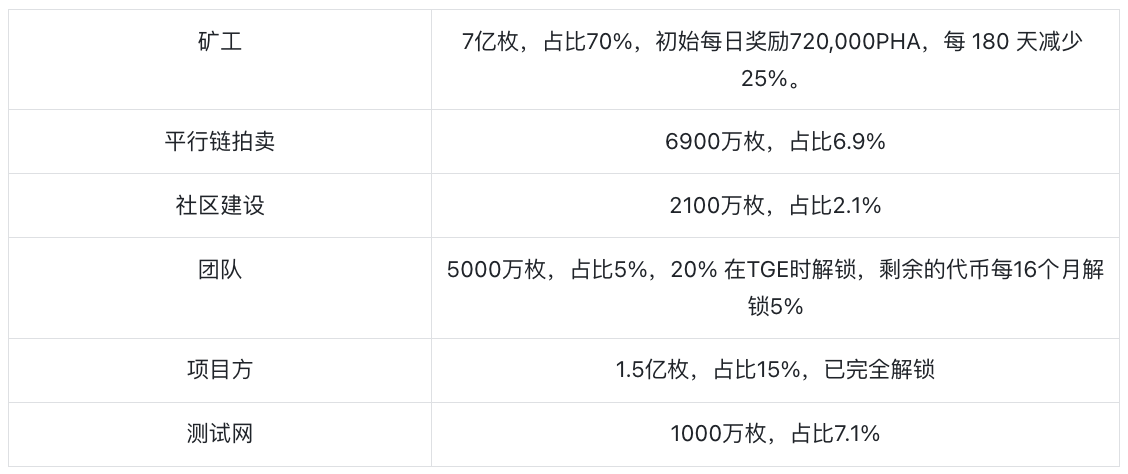
Token Utility:
As outlined in the whitepaper, PHA serves the following purposes in Phala Network:
-
Mining Rewards: Miners receive PHA tokens for providing computing power to mine new blocks.
-
Usage Fees: Users of AI agent contracts and privacy computing services pay fees in PHA tokens.
-
Governance Participation: Staking PHA tokens enables participation in governance via PhalaDAO.
-
Staking Requirement: To prevent miner misbehavior, miners must stake a certain amount of PHA tokens as collateral in addition to providing computing power.
PHA Value Assessment
The whitepaper describes PHA’s utility as standard, with the addition of staking mechanisms indirectly increasing value by locking up tokens. Currently, PHA’s circulating rate stands at 73.83%. While relatively high, nearly one-third of the total supply remains unissued, meaning future value accrual will largely depend on the intrinsic growth of the Phala Network project—particularly market adoption of AI agent contracts. Higher usage would drive token price appreciation, increasing miner returns and incentivizing more miners to join and stake tokens, thereby reducing circulation and creating a positive flywheel effect. However, the absence of centralized or periodic token burns represents a weakness in its tokenomics. If Phala Network fails to achieve strong business traction, its token price is unlikely to rise accordingly.
Token Price Performance
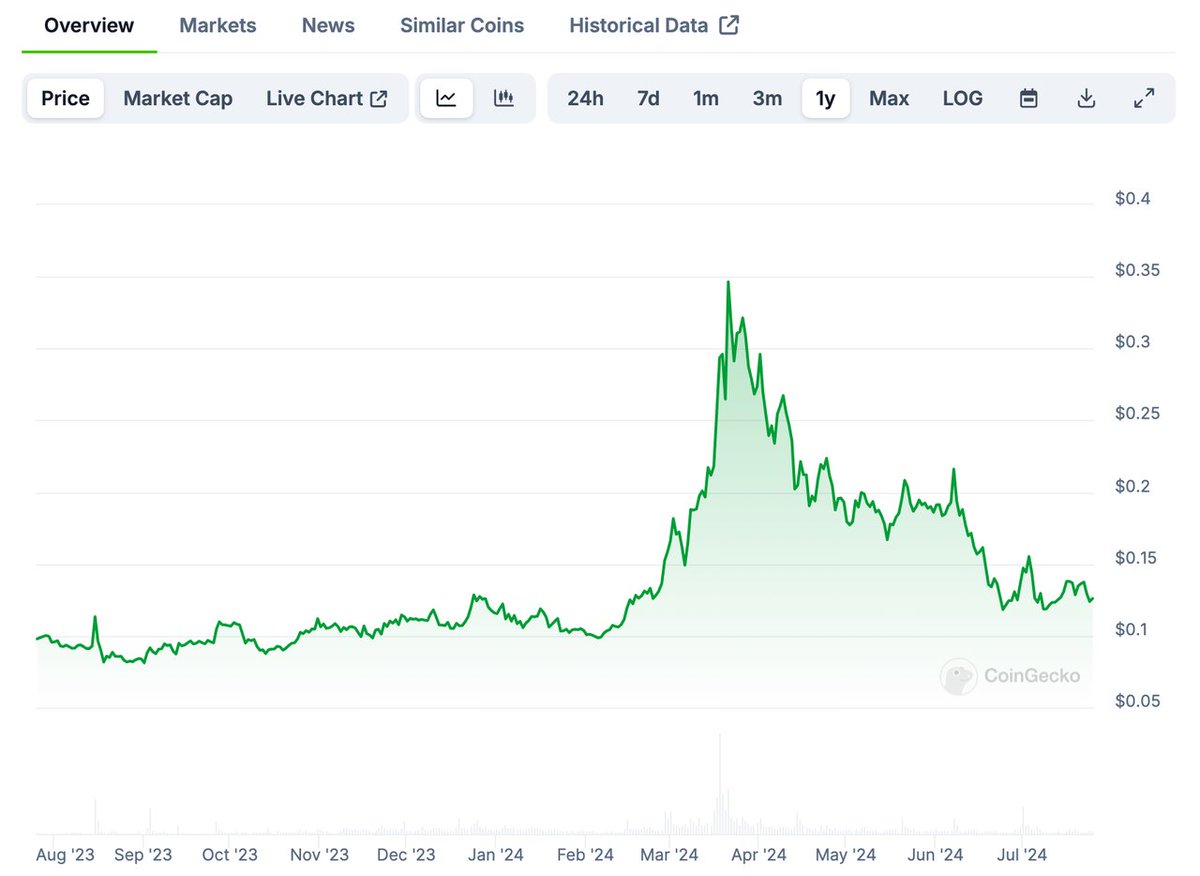
PHA Price Trend
Data Source:https://www.coingecko.com/en/coins/phala-network
According to CoinGecko data, PHA has increased over fourfold in the past year since July 2023 (from a low of $0.0816 to a high of $0.3465), primarily traded on major exchanges including Binance, OKX, and HTX. This year’s rally was largely fueled by the broader AI sector boom.
Market Cap
Current PHA price: $0.126
Current circulating supply: 738,334,838 PHA
Market cap: $93.43 million
FDV
Current PHA price: $0.126
Total supply: 1 billion PHA
Fully diluted valuation (FDV): $126.54 million
Daily Trading Volume
Average daily trading volume of PHA is around $5.66 million.
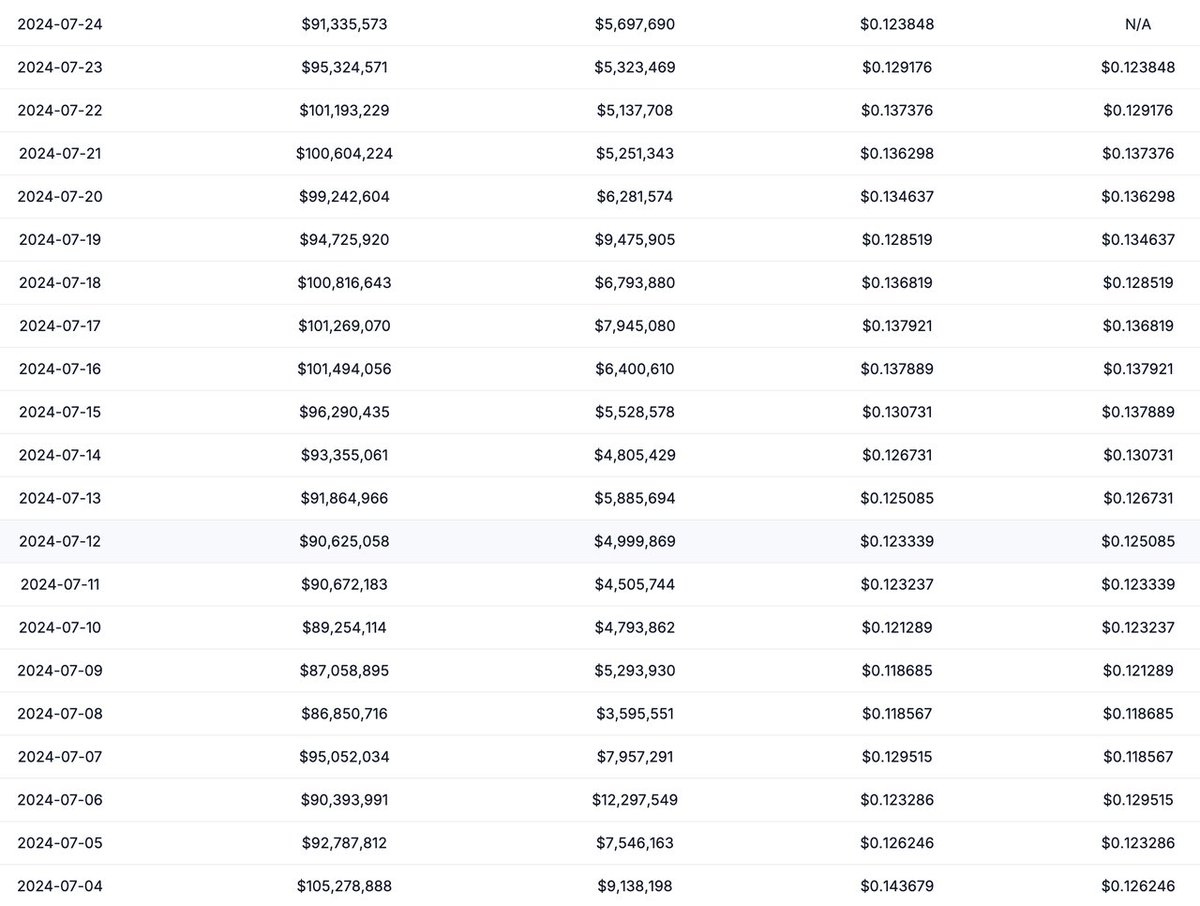
PHA Daily Trading Volume
Data Source:https://www.coingecko.com/en/coins/phala-network/historical_data
With a daily trading volume of $5.66 million and a circulating market cap of ~$126.54 million, PHA’s turnover rate is about 4.47%, which is relatively low. However, this reflects the generally bearish market sentiment, exacerbated recently by the Mt. Gox developments, leaving most users in观望 mode.
Top 10 Token Holder Addresses
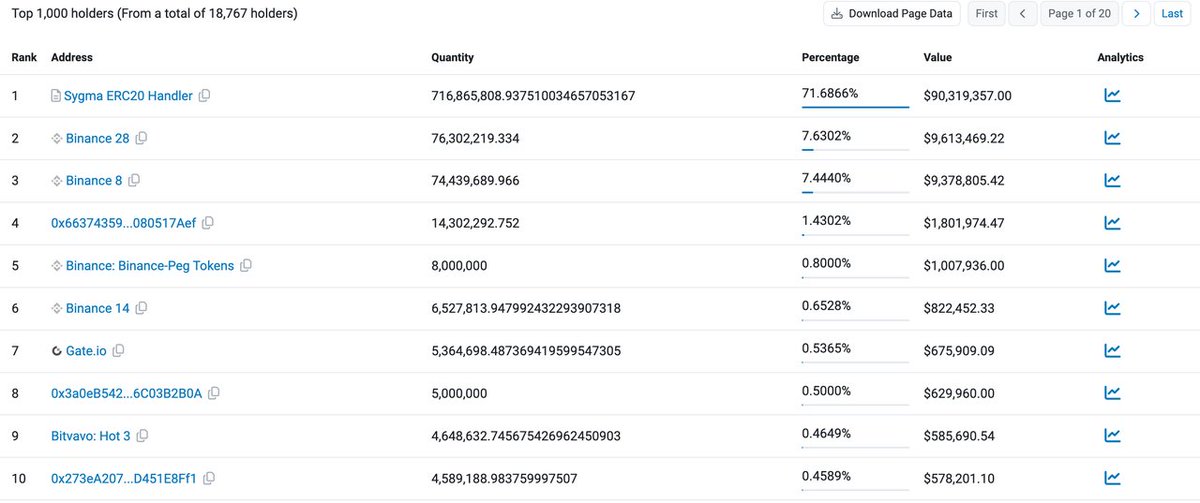
Top 10 PHA Holding Addresses
Data Source:https://etherscan.io/token/0x6c5bA91642F10282b576d91922Ae6448C9d52f4E#balances
The top 10 PHA addresses collectively hold 92.19% of the total supply.
Number of PHA Holders
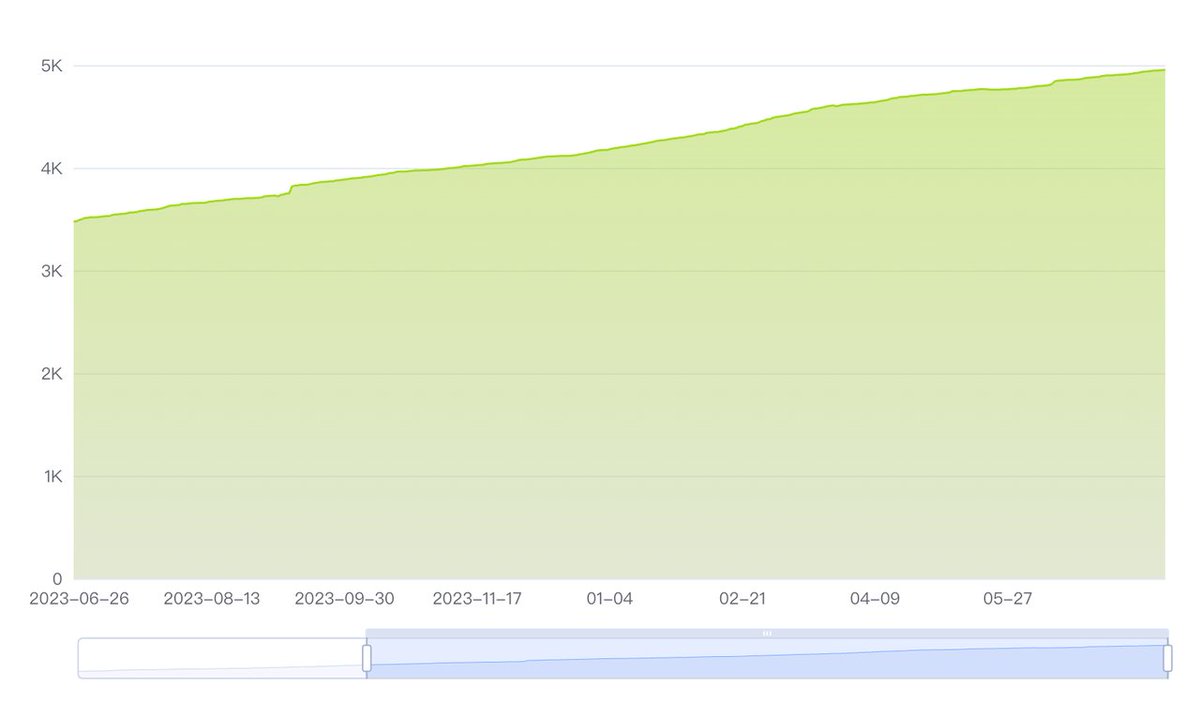
Number of PHA Holders
Data Source:https://phala.subscan.io/tools/charts?type=holder
Holders of PHA have steadily increased over the past year.
Daily Active Accounts
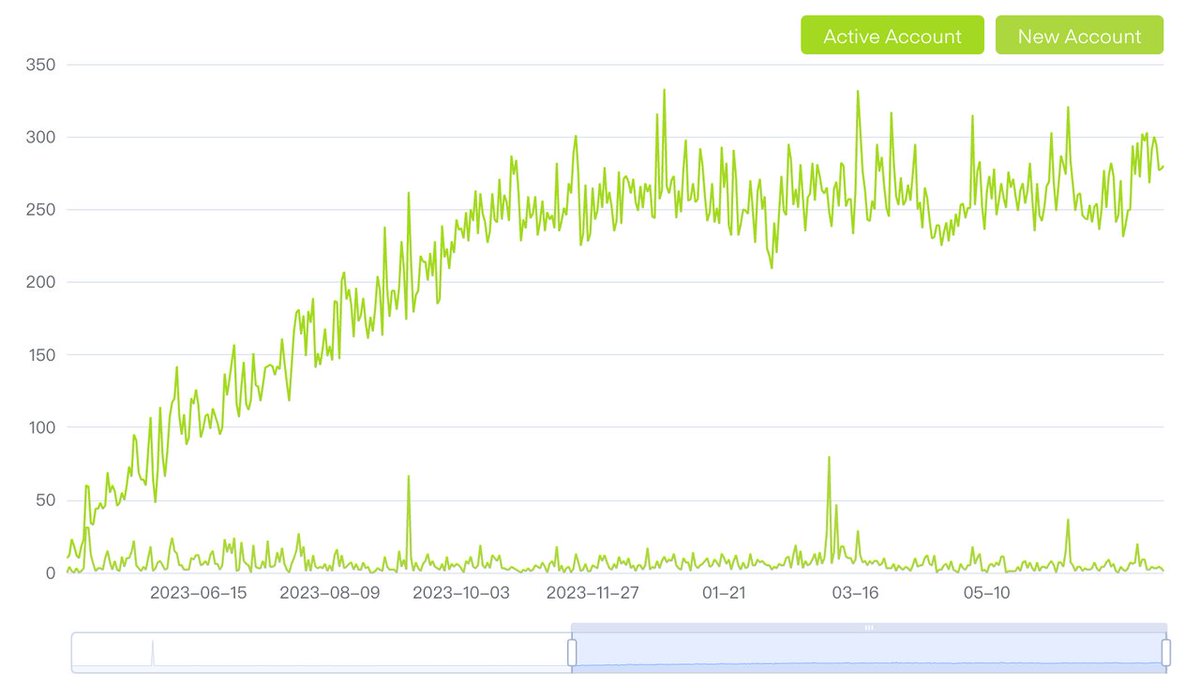
Daily Active Accounts
Data Source:https://phala.subscan.io/tools/charts?type=account
Daily active accounts on Phala Network have continuously grown over the past year.
Staking Status
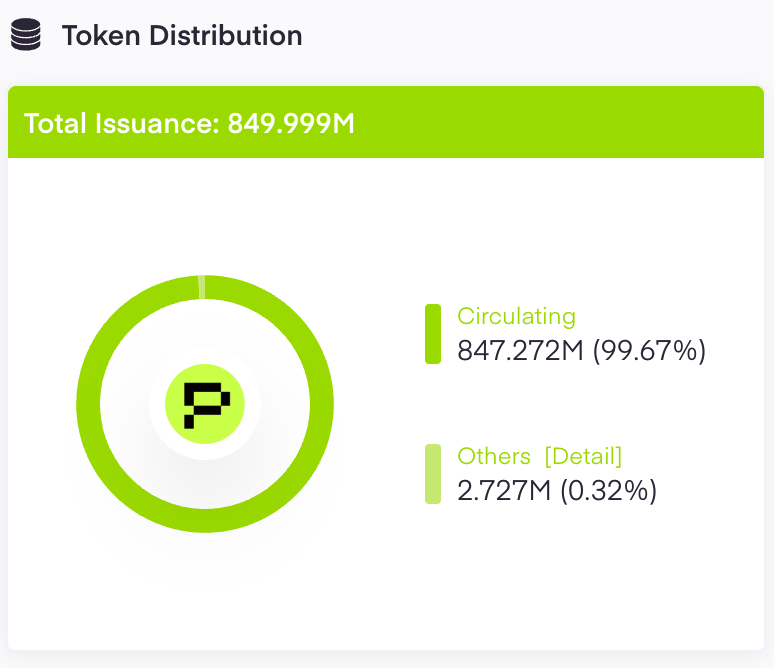
Actual Circulating Supply of PHA
Data Source:https://phala.subscan.io/
The chart shows a theoretical circulating supply of 847.27 million PHA, yet actual circulation is 738.33 million, indicating approximately 108.94 million PHA are currently staked.
Risks
Although shifting to the AI赛道 through AI agent contracts benefits Phala Network’s development and token price growth, it also significantly increases technical challenges. Particularly, building complex AI agent contracts atop an already sophisticated privacy computing foundation—and continuously integrating new AI agents—poses substantial hurdles for the technical team. Future system issues are expected, making the team’s problem-solving capability and the actual performance of AI agent contracts critical. As such, there remain many uncertainties ahead.
Conclusion
By introducing AI agent contracts, Phala Network makes AI agents as easy to run and manage as smart contracts, enabling real-time access control and management. Different AI agents can freely call each other, forming complex applications—all operating within Trusted Execution Environments (TEE) to ensure code integrity and privacy. This allows Phala Network to fully leverage its prior strengths in privacy computing infrastructure, transforming into a Web3 AI execution layer. This innovation delivers novel solutions for securing and protecting AI applications and strengthens the integration of smart contracts with blockchain technology.
Following the launch of AI agent contracts, Phala Network has positioned itself firmly in the AI赛道—a strategic move beneficial for both project growth and token appreciation. However, the accompanying technical challenges have multiplied. Especially given the complexity of implementing AI agent contracts on top of privacy computing, and the ongoing integration of new AI agents, the technical team faces immense pressure.
In summary, Phala Network initially gained an edge in the privacy computing infrastructure space through its use of Trusted Execution Environments (TEE). With the added strength of AI agent contracts, if the project continues executing according to plan, it is well-positioned to gain a competitive advantage in the AI赛道 as well.
Join TechFlow official community to stay tuned
Telegram:https://t.me/TechFlowDaily
X (Twitter):https://x.com/TechFlowPost
X (Twitter) EN:https://x.com/BlockFlow_News
 @FrontierLab_ZH






