The "Fog" and the "Lighthouse" of Bitcoin L2: GOAT Network's Path Selection and Industry Baseline
TechFlow Selected TechFlow Selected
The "Fog" and the "Lighthouse" of Bitcoin L2: GOAT Network's Path Selection and Industry Baseline
When everyone can call themselves a Layer2, a more fundamental question begins to emerge: what does the Bitcoin ecosystem truly need?
 Navigating Web3 tides with focused insights
Author: ChandlerZ, Foresight News
In the crypto market since 2024, "Bitcoin Layer2" has almost become a generalized label. From sidechains to rollups, from state channels to any EVM-compatible system, numerous projects have claimed to be Bitcoin L2s, competing for narrative dominance in a vacuum of authoritative discourse. However, when everyone can call themselves a Layer2, a more fundamental question emerges: What does the Bitcoin ecosystem truly need?
What Bitcoin L2 development requires is not more stories, but engineering solutions that are verifiable, operational, clearly standardized, and supported by sustainable economic models. It is against this backdrop that GOAT Network has gradually established its technical positioning. Instead of pursuing token launches or abstract conceptual packaging, GOAT focuses on the practical implementation of BitVM2, proposing an executable and verifiable framework, complemented by an economic white paper and industry benchmark standards, aiming to rebuild a credible path for Bitcoin L2.
Origins and Motivation: The Chronic Issues of BTC L2 and the Breakthrough Path
BTCFi has long hovered between technical ideals and real-world bottlenecks. Its core dilemma can be summarized as a classic trilemma: security must align with Bitcoin's mainnet consensus, functionality demands scalability and smart capabilities, yet all this must be achieved without compromising decentralization. Even more challenging is the fact that native BTC assets still lack stable yield mechanisms, having long relied on centralized platforms' funding rates or incentives from tokens on other chains, making it difficult to build a sustainable financial ecosystem. These structural flaws have led many Bitcoin L2 projects into awkward paths—pseudo-bridges, centralized custody, or even reliance on Ethereum-based cross-chain infrastructure—leaving them technically ambiguous and commercially incoherent.
From the outset, GOAT Network adopted a vertical strategy emphasizing execution-first and technical verifiability. In hardware architecture, it abandoned the immature RISC-V in favor of the industrially stable MIPS architecture, combining circuit optimizations to build Ziren (formerly zkMIPS), creating an efficient on-chain computing environment. In system design, by integrating BitVM2 with a decentralized sequencer architecture, GOAT established a non-custodial, on-chain verifiable execution path, enabling traceable states and verifiable data through on-chain dispute resolution.
Strategically, GOAT did not rely on B2B partnerships or co-branded marketing campaigns. Instead, it centered its efforts on Bitcoin zkVM, building authentic zk use cases from the ground up. While most so-called L2 projects remain stuck in narrative loops, GOAT has transformed Bitcoin L2 from a buzzword into a sustainable, practical solution.
Evolution and Engineering Implementation of BitVM2
The architecture proposed by GOAT BitVM2 marks a critical step forward—from theoretical feasibility to engineering practicality in Bitcoin scaling technology. Compared to the logic gate simulation and fraud-proof concepts of early BitVM v1, GOAT’s version achieves systemic reconstruction in security mechanisms, challenge efficiency, and execution economics, bringing native Bitcoin zkRollup to actual usability for the first time. GOAT BitVM2 reduces the challenge period from 14 days to under one day. By combining zkMIPS zero-knowledge proofs, decentralized sequencing, and a multi-round challenge reward mechanism, it delivers a complete native Bitcoin ZK Rollup solution. Specifically, its core breakthroughs manifest in three aspects:
-
Security: Introduces a validator set commitment mechanism for L2 consensus verification, resolving the Operator double-spend attack issue;
-
Efficiency: Integrates streamlined reimbursement processes with a real-time proof network based on zkMIPS, improving Operator reimbursement efficiency;
-
Incentives: Proposes the Universal Operator scheme, using cryptographic lotteries for random role rotation, establishing a systematic incentive model that balances interests among all participants (Sequencers, Operators, and Challengers).
Currently, the GOAT BitVM2 testnet is live and has demonstrated Ziren’s off-chain computation combined with on-chain challenge simulation. In testing environments, the system supports zkRollup execution paths using native BTC inputs, verifying that L2 execution results can undergo deterministic on-chain adjudication without trust assumptions—laying the engineering foundation for future full-scale deployment of BTC L2 applications.
Meanwhile, GOAT Network is actively advancing innovation toward BitVM3. As a member of the BitVM Alliance, GOAT primarily focuses on a verifiable obfuscated circuit solution combining DV-SNARK and NIZK, and has already completed prototype implementation and testing. This breakthrough improves on-chain challenge efficiency by over 1,000x, reducing challenge costs to 1/1000 of previous models.
GOAT Network will continue collaborating with ecosystem partners to advance the engineering and large-scale adoption of BTC Layer2 technologies, accelerating the functional expansion and value realization of the Bitcoin network.
Economic Model and the "Yield Loop"
In all explorations of Bitcoin financialization, while technical architecture is important, the true determinant of whether a Bitcoin L2 project can achieve long-term sustainability lies in whether its economic model is self-consistent and closed-loop. GOAT Network’s release of the "Bitcoin zkRollup Economic Brown Paper 2.0" addresses precisely this central issue—not to create another idle incentive narrative, but to systematically establish an incentive structure rooted in native BTC security and usage behavior. This enables the L2 to generate, distribute, and continuously release yield through genuine network usage and participant activity, eliminating dependence on centralized bridges, fake liquidity, or third-party token subsidies.
In the first version of the Economic Brown Paper, GOAT introduced a dual-token model beyond simple BTC staking. pBTC represents locked principal, redeemable at any time to ensure asset sovereignty; yBTC serves as the system’s native yield token, representing net value returns generated from real on-chain economic activity. Transaction fees, sequencing rewards, and challenger incentives are all distributed via yBTC. This design effectively separates yield from principal, removing the need to attract liquidity through high APYs, instead allowing yield to emerge naturally from usage—forming a clear, traceable yield loop.
Compared to other L2s relying on cross-chain bridges or ERC20-wrapped assets, GOAT’s native yield pathway demonstrates superior engineering rigor. Thanks to the integration of BitVM2 and zkVM architecture, BTC can enter the L2 execution environment without custody, participating fully in transaction and application lifecycles through off-chain execution and on-chain verification. Only state commitments and computational verification logic are published on-chain—no third-party token intermediaries or centralized gateways are required—truly achieving an architecture where mainnet control remains intact and Layer2 composability is uncompromised.
Beyond operational mechanics, GOAT further proposes a modular economic layer—not only supplementing current incentive logic for the three key roles but also preparing for cross-protocol resource coordination in a future multi-application ecosystem. As more DeFi, RWA, or payment scenarios integrate, developers will be able to define custom yield distribution mechanisms, build internal liquidity feedback models, and use yBTC as a unified metric, enabling interoperable and collaborative incentive structures across different use cases. Ultimately, this economic layer will evolve into a cooperative financial foundation atop Bitcoin L2.
As Kevin Liu, core contributor at GOAT Network, stated: True BTCFi has never truly begun—and its real beginning must rest upon the dual closed loops of native security and native yield.
If the Economic Brown Paper 2.0 outlines a self-sustaining yield loop for GOAT Network, then what brings this logic to life is its product and ecosystem matrix built around BTCFi. The value of native Bitcoin Layer2 should not remain theoretical or narrative—it must provide holders with truly usable, sustainable, non-custodial yield access.
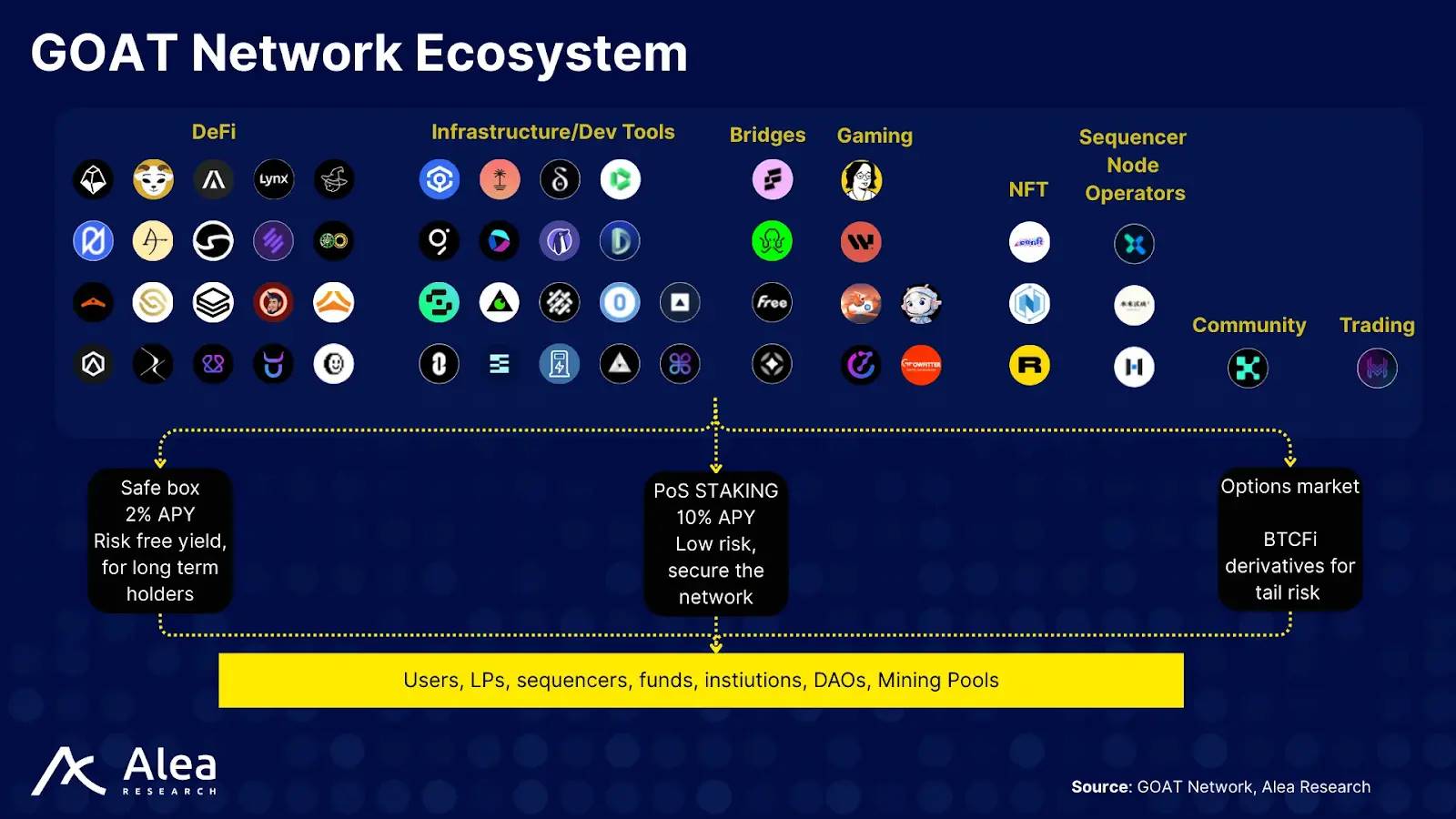
GOAT Network has officially launched a full suite of BTCFi yield products, offering diversified options for users with varying risk preferences. GOAT Safebox, the zero-risk option, allows users to earn approximately 2% on-chain yield by locking BTC for three months to participate in decentralized sequencer incentives—ideal for institutional investors. The BTCB/DOGEB Vault achieves 5% annualized yield through cross-chain bridging and gas fee rebates, targeting conservative users. Sequencer PoS Staking opens a medium-risk path, offering up to 10% annualized yield via multi-token PoS and the decentralized sequencer network. Additionally, the Avalon lending market enables flexible deposit, borrowing, and liquidity configuration of BTC and BTC LSTs on Layer2, bringing Bitcoin into DeFi-level capital efficiency scenarios.
Today, GOAT Network’s ecosystem has taken initial shape, spanning DeFi, infrastructure tools, cross-chain bridges, NFTs, gaming, and sequencer nodes, attracting developers, users, institutions, and communities. As the ecosystem expands, GOAT Network is evolving into a financial operating system characterized by sustainable yield, open collaboration, and diverse innovation.
From "Talk to Walk" to "Industry Baseline"
If technology and economic models represent GOAT Network’s first phase of real-world validation, then its release of the "Native Bitcoin Layer2 Network Benchmark Proposal" signifies its assumption of higher-level ecosystem responsibility—aiming to draw clear boundaries around the chaotic concept of Bitcoin L2. Facing a market flooded with projects falsely branding themselves as L2s while relying on federated multisig or external trust mechanisms, GOAT seeks to establish objective criteria for native Layer2 networks grounded in Bitcoin’s core principles.
The proposal consists of "Core Requirements" and "Optional Enhancements," emphasizing frequent anchoring to the Bitcoin mainnet, on-chain dispute resolution, permissionless forced withdrawals, trust-minimized bridging structures, and system continuity during attacks or outages. Technically neutral, it does not favor any specific architecture—any system meeting these principles qualifies as a native Bitcoin L2.
Unlike most protocols that set their own standards, GOAT positions this as a starting point for industry-wide co-construction, stressing openness and neutrality. This is not only an extension of its engineering philosophy but also a much-needed clarification of the Bitcoin L2 concept amid today’s semantic confusion.
GOAT Network has implemented the first real-time proving system running in a production environment, becoming the first Bitcoin zkRollup project to support instant withdrawal initiation and end-to-end visualizable proof.
GOAT Network states that all peg-out operations are now digitalized, visualized, and on-chain verifiable, with public UI pages providing real-time transparency. The entire system is now fully open-source, operates without trust assumptions, and establishes a complete closed loop from BTC deposit, on-chain interaction, to withdrawal. The team believes this capability will redefine the technical standard for Bitcoin zkRollup and lay the foundation for BTCFi’s practical usability.
After achieving technical deployment and establishing industry baselines, GOAT Network has not limited its focus to engineering breakthroughs but has increasingly prioritized community building. In their view, the vitality of a decentralized network stems not only from code security and model feasibility but also from the ability to cultivate an open and active community ecosystem.
GOAT has launched multidimensional initiatives at the community level. Through the One Piece program, users can engage in social interactions, cross-chain actions, transactions, and mini-games at zero or low cost, earning points redeemable for token airdrops—becoming a primary early-stage distribution channel. Unlike most projects leveraging airdrops for hype, One Piece emphasizes long-term participation and diverse engagement. In August, GOAT Network announced the launch of the GOAT Vanguard ambassador program, recruiting global Bitcoin pioneers, high-quality content creators, and like-minded community leaders to jointly drive BTCFi narratives and advance Bitcoin L2 ecosystem and native BTC yield innovations. Furthermore, the project has cumulatively acquired 34 BTC, formally allocating it as the Ecosystem Pilot Fund—to directly incentivize the Bitcoin ecosystem using Bitcoin itself. Together, these three elements form a second major pillar beyond GOAT’s technology, transforming native Bitcoin Layer2 into a social experiment co-built and co-benefited by global users.
Establishing Order for the Next Phase of Bitcoin L2
Bitcoin’s scaling roadmap stands at a turning point. With its systematic approach to technical implementation, economic modeling, and industry standard-setting, GOAT aims to become an "order-setter" in this space. What defines a truly native Bitcoin Layer2? How do we build trustless execution paths? And how do we establish sustainable, native BTC yield mechanisms?
When the hype fades and buzzwords settle, what will remain are systems with clear standards, verifiable operations, and sustained functionality. What GOAT is building is not just a set of L2 products, but the foundational rules for the entire Bitcoin scaling ecosystem. Through engineering action, it sets order and rebuilds trust—for the next chapter of Bitcoin L2.
Join TechFlow official community to stay tuned
Telegram:https://t.me/TechFlowDaily
X (Twitter):https://x.com/TechFlowPost
X (Twitter) EN:https://x.com/BlockFlow_News
 Foresight News