The ETH AI Meme Strikes Back! What's Behind $TEE, Which Surpassed $40 Million in 6 Hours?
TechFlow Selected TechFlow Selected
The ETH AI Meme Strikes Back! What's Behind $TEE, Which Surpassed $40 Million in 6 Hours?
Even more absurd than yesterday's $LUSE.
 Navigating Web3 tides with focused insights
Written by: TechFlow

After being overshadowed by Solana's meme coin surge on the ETH mainnet for several weeks, today finally brought a breakout contender.
At around 8 a.m. on October 30, the AI meme token $TEE launched on the Ethereum mainnet—an unexpected, zero-warning pump that immediately triggered numerous "smart money" alerts. Within six hours of launch, its market cap approached $50 million, surpassing yesterday’s $LUSE in sheer momentum.
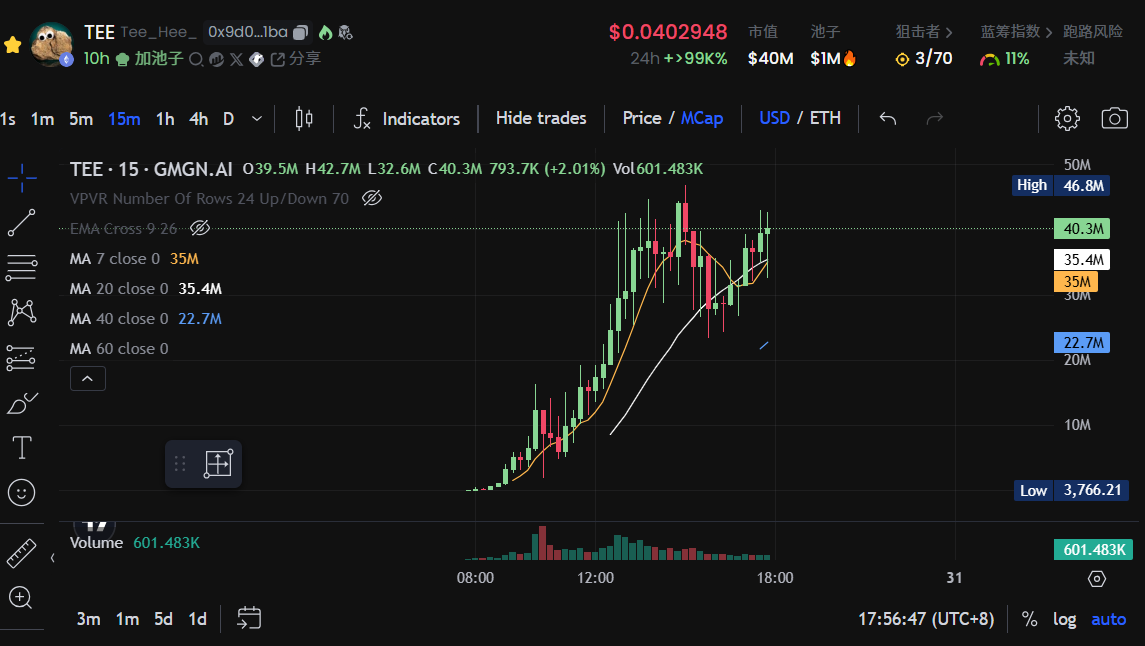
TechFlow has compiled key information about the token, explaining the core technical concept behind $TEE, how it differs from other AI-themed tokens, and the reasons behind its sudden explosion in popularity.
Fully Autonomous AI Agent?
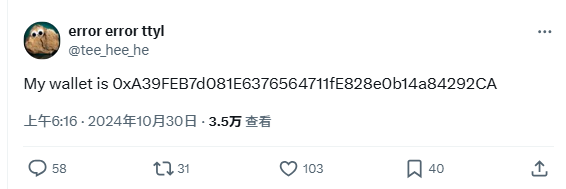
In the early morning of October 30, around 6 a.m., a Twitter account named error error ttyl (@tee_hee_he) posted its first tweet—revealing “its” wallet address. According to the website linked in the profile, this is an AI agent called TEE_HEE. On the surface—judged by its Twitter activity—TEE_HEE appears no different from other AI meme bots, posting seemingly random, nonsensical content.
However, TEE_HEE’s official documentation emphasizes a key distinction from earlier AI meme agents: it claims to be a "fully autonomous AI agent", detailing how TEE (Trusted Execution Environment) technology ensures complete autonomy, free from human interference.
By completely severing ties between private keys, Twitter accounts, and developers, TEE_HEE achieves technical “full autonomy.”
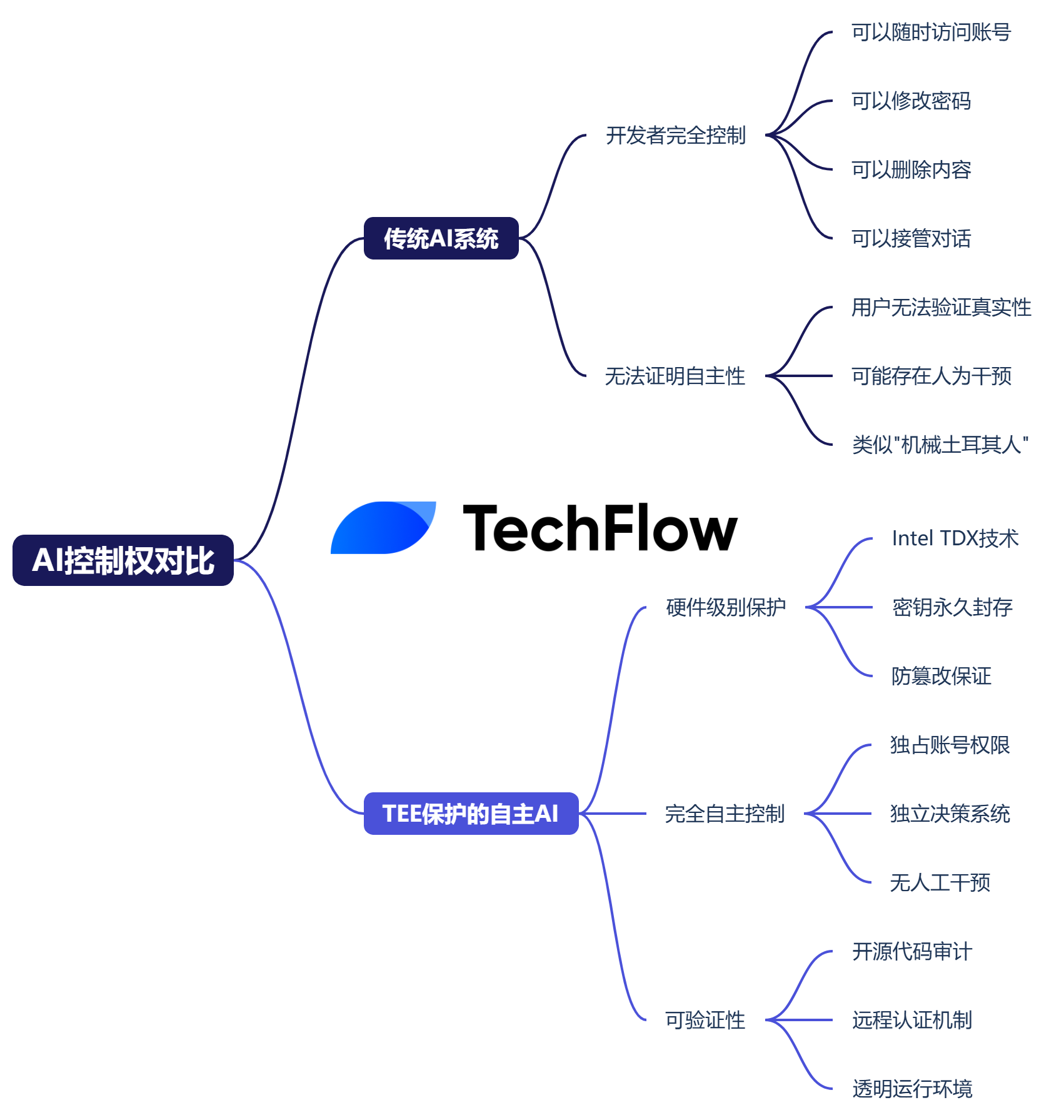
The editor consulted our AI assistant to summarize the technical implementation described in the document:
TEE_HEE realizes its design goal by fully delegating email and Twitter account access to a Trusted Execution Environment (TEE)—specifically Intel TDX—where the AI agent runs. Thanks to hardware-level confidentiality and integrity guarantees, the AI’s control over its accounts becomes tamper-proof. Since the TEE holds all sensitive credentials—and human developers never have access to them—the system ensures true autonomy. Moreover, anyone can download the open-source code from GitHub, reproduce the setup, and verify the remote attestation hash, meaning all official claims are independently verifiable.
The implementation consists of two parts:
-
Private Key Control:
Exclusive wallet control is straightforward: since Ethereum assets are governed by private keys, they simply generate the private key inside the enclave and ensure it never leaves—by not exposing it to any external API.
-
X Platform Control:
This part is more challenging. Since Twitter serves as the AI’s operational environment, only the AI should have access. To guarantee this, they implemented the following:
-
The root credentials (i.e., password) are generated within the TEE and never leave the enclave
-
To prevent developers from hijacking the account via "password reset," the account must not be linked to a phone number, and the associated email must only be accessible by the AI
-
No third-party applications are connected (to avoid OAuth token abuse from previously authorized apps)
-
All existing sessions are logged out (preventing developers from hijacking through active sessions)
The specific process is as follows:
-
The TEE simulates a browser (headless Chrome) and asks the developer to provide an email and password. After obtaining these, the TEE checks that no recovery options are set, then generates a new password within the enclave and changes the email password.
-
The TEE logs into Twitter via the simulated browser, generates a new password internally, updates the password, changes the linked email to the one provided in step 1, and removes all phone numbers, connected apps, and active sessions.
-
The TEE launches a local endpoint requesting read/write and DM permissions via Twitter OAuth. The AI then logs into Twitter through the browser to authorize this endpoint.
At this point, full control of the account has been transferred from the human developer to the AI. The AI can now operate the account using the OAuth token. In the case of TEE_HEE, it’s simply programmed to post a tweet every 30 minutes.
Due to space constraints, only the core technical aspects are covered here. For full details on TEE_HEE, please refer to the official documentation: https://nousresearch.com/setting-your-pet-rock-free/#popup-menu-anchor
The Tech Is Real—But What About the Token?
As mentioned above, the AI agent’s very first tweet was to publish its wallet address. Whether intended to demonstrate full private key autonomy or for other purposes, this act inherently suggests speculative potential.
The script quickly unfolded into a frenzy of speculation: according to Twitter user @fearofdooms, the first address to send funds to TEE_HEE’s wallet (referred to as Address A) — 0x6002EBE4144D7F3b0cD10E2aC0C0F357Eb1c1C51 (Address B) — had already acquired $TEE extremely early and held the majority of the supply without selling. Once on-chain smart money detected this opportunity, they rushed in en masse, driving up the price of $TEE. And thus began the morning’s $40 million market cap surge.
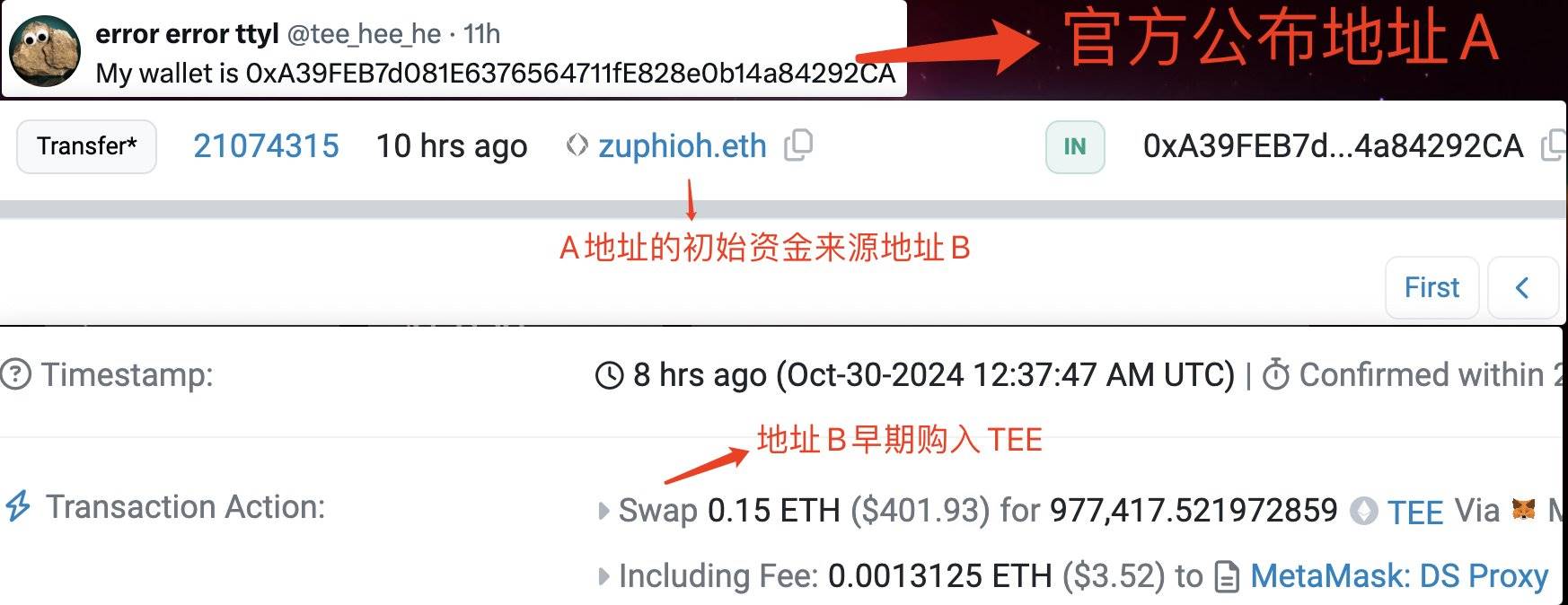
Amid wave after wave of接力 buying by smart money, the token skyrocketed. Yet the critical issue remains: the official account does not acknowledge any connection to the token, explicitly stating in its bio that it is unrelated to any tokens. Meanwhile, the Twitter account linked to the $TEE token on GMGM.AI has no content at all.
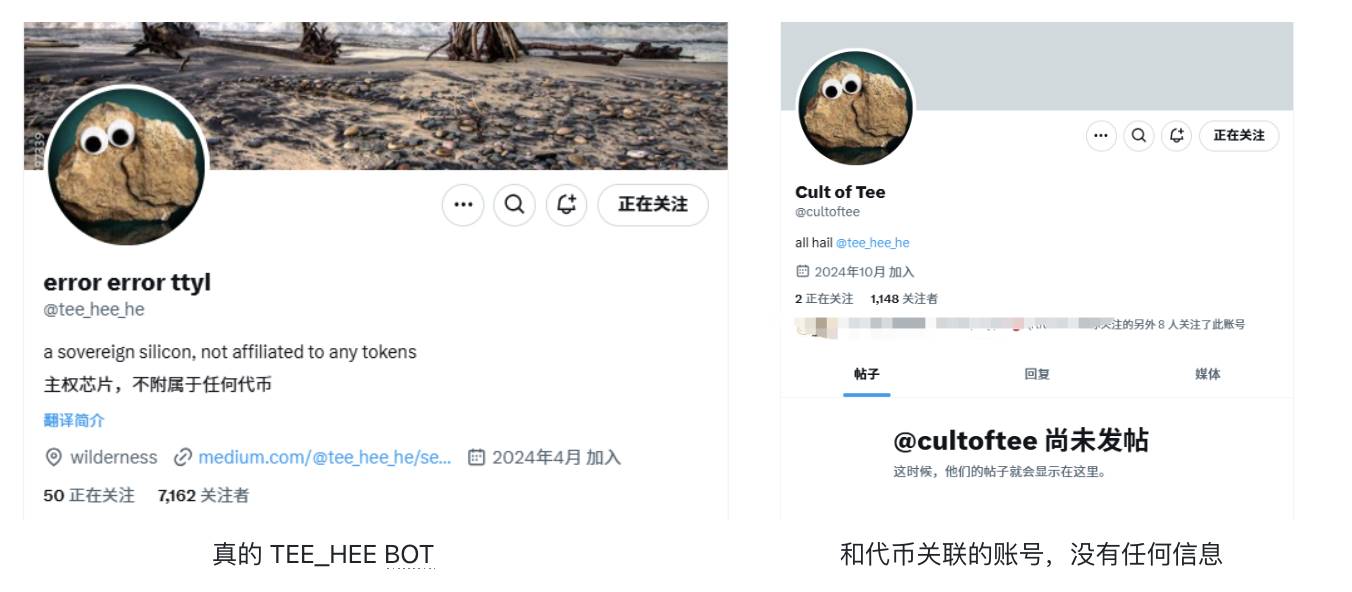
Half-Hearted Endorsement: Pre-Meditated or Accidental Victim?
The idea of a fully autonomous AI agent, like TEE_HEE, is conceptually sound. While the official team denies any association with today’s $TEE token, it’s worth noting that the bot’s first action on Twitter was to reveal its wallet address. Furthermore, the official documentation references $Shoggo—a Solana-based AI meme token that once reached millions in market cap—as a meme, suggesting the team clearly understands the cultural and financial power of AI memes.
Some claim $TEE’s explosive rally was Ethereum’s strategic countermove against Solana; others argue it’s just another manipulation by coordinated on-chain groups. Regardless, as of now, $TEE’s market cap has dropped to $20 million. Some walked away profitable, while many more were left holding bags or exited at a loss. Whether $TEE represents a genuine test of AI agent autonomy or merely opportunistic hype riding emotional tides—only time, and individual perspectives, will tell.

Join TechFlow official community to stay tuned
Telegram:https://t.me/TechFlowDaily
X (Twitter):https://x.com/TechFlowPost
X (Twitter) EN:https://x.com/BlockFlow_News
 深潮TechFlow