De-banking: Personal Insights
TechFlow Selected TechFlow Selected
De-banking: Personal Insights
When financial access is weaponized, who decides who gets to participate in the modern economy?
 Navigating Web3 tides with focused insights
Author: Edward Woodford
Translation: Block unicorn
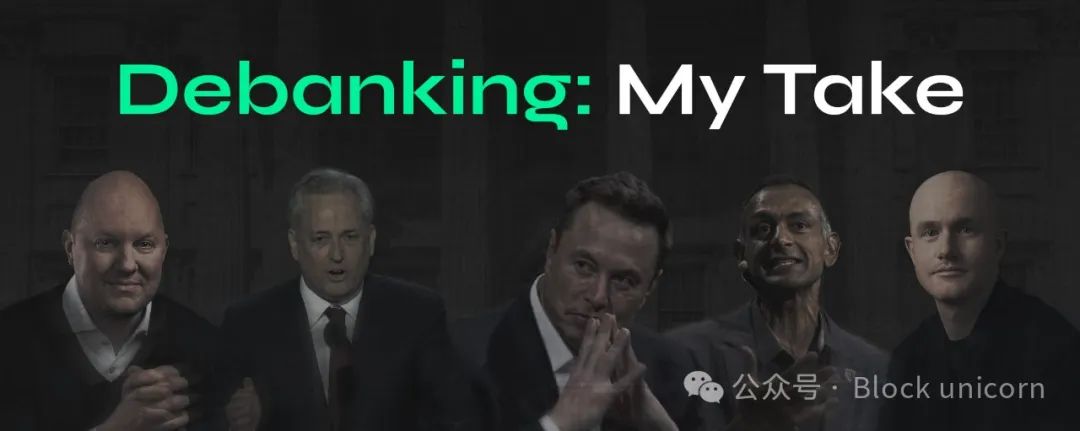
In a recent conversation on The Joe Rogan Experience, Marc Andreessen (@pmarca) highlighted a troubling trend reshaping the financial landscape: debanking. Under pressure from regulators and advocacy groups, financial institutions are increasingly denying banking services to individuals, organizations, and entire industries. I believe several critical points about debanking have been overlooked in the current discourse:
0. Overview
A. Agreeing on a Definition of Debanking
Debanking is not a binary concept. Rather, it refers to a widespread effort to restrict financial services to specific industries, instead of applying risk-based assessments to individual participants within those sectors. The fact that Zero Hash and other top-tier players in the stablecoin and cryptocurrency space have strong banking partners does not negate the existence of "debanking." Specifically, we hold client and operational funds across multiple top 20 banks.
The common rebuttal I hear is that banks have the right to decide whom they serve based on risk assessment. However, the distinction here lies in:
-
The targeting of entire industries directly contradicts guidelines issued by the OCC (Office of the Comptroller of the Currency), which explicitly prohibits broad, categorical discrimination against businesses engaged in legal activities.
-
The FDIC (Federal Deposit Insurance Corporation) has attempted to unilaterally predefine risk profiles for banks, rather than allowing institutions to determine these independently. When regulators set risk profiles for legitimate businesses, they violate longstanding OCC guidance stating that deposit account decisions should be based on each bank’s own risk evaluation of customer accounts. This represents an extreme form of “shadow regulation” (a term I introduced in a recent blog post)—a mechanism where certain activities are flagged for intense scrutiny, creating such a burden that they are effectively blocked despite being legal.
B. Debanking Is Real
-
The impact of debanking is evident. We’ve had bank accounts shut down overnight—including with partners we've worked with since 2017.
-
The scope is staggering. We were nominated for an award whose candidate dinner was sponsored by a bank. I was subsequently disinvited at the bank’s request because “paying for my dinner could create misperceptions.”
-
We operate a business across multiple jurisdictions. The same bank provides services to all our non-U.S. subsidiaries but refuses service to our U.S. entity—same ownership, same risk profile.
-
Over the past 18 months, approximately 80% of the 120+ banks we proactively contacted refused to engage in any meaningful discussion (to review our risk profile in detail), solely due to our industry.
C. Why Should Everyone Care?
-
Is this a rights issue? Banking is essential to modern life—and any business. Arbitrary denial of access raises constitutional and ethical concerns.
-
Higher costs. Reduced competition inherently distorts markets.
-
Creates concentration risk. Fewer banks serving an industry increases systemic risk for customers.
Andreessen used the term “Operation Choke Point 2.0” (originally coined by @nic__carter), drawing parallels to the controversial Obama-era initiative where regulators pressured banks to sever ties with legally operating yet politically disfavored industries. Today, this trend has expanded: sectors like cryptocurrency are being debanked not due to illicit activity, but because of reputational concerns or political pressure.
Banking has long been viewed as a neutral utility, but it has now become a battleground for cultural, political, and economic conflict. The question we must ask is: when financial access is weaponized, who decides who gets to participate in the modern economy?
1. The Rise of Debanking in Public Discourse
Since Andreessen’s appearance on November 26, discussion around this topic has accelerated:
November 29—David Marcus (@davidmarcus), former PayPal president and co-founder of Lightspark, shared a post detailing how political pressure killed Meta’s stablecoin project, Libra.
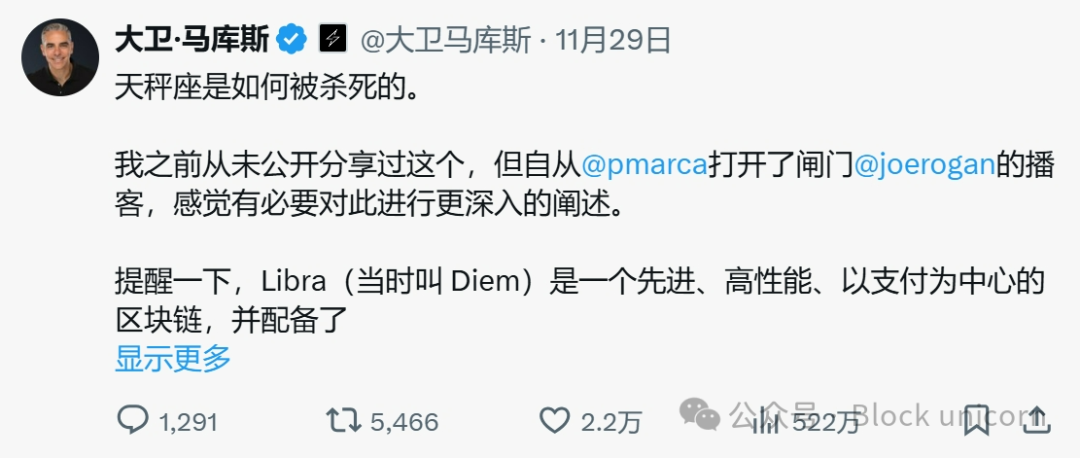
Elon Musk (@elonmusk) reacted to Marcus’s post with “wow.”

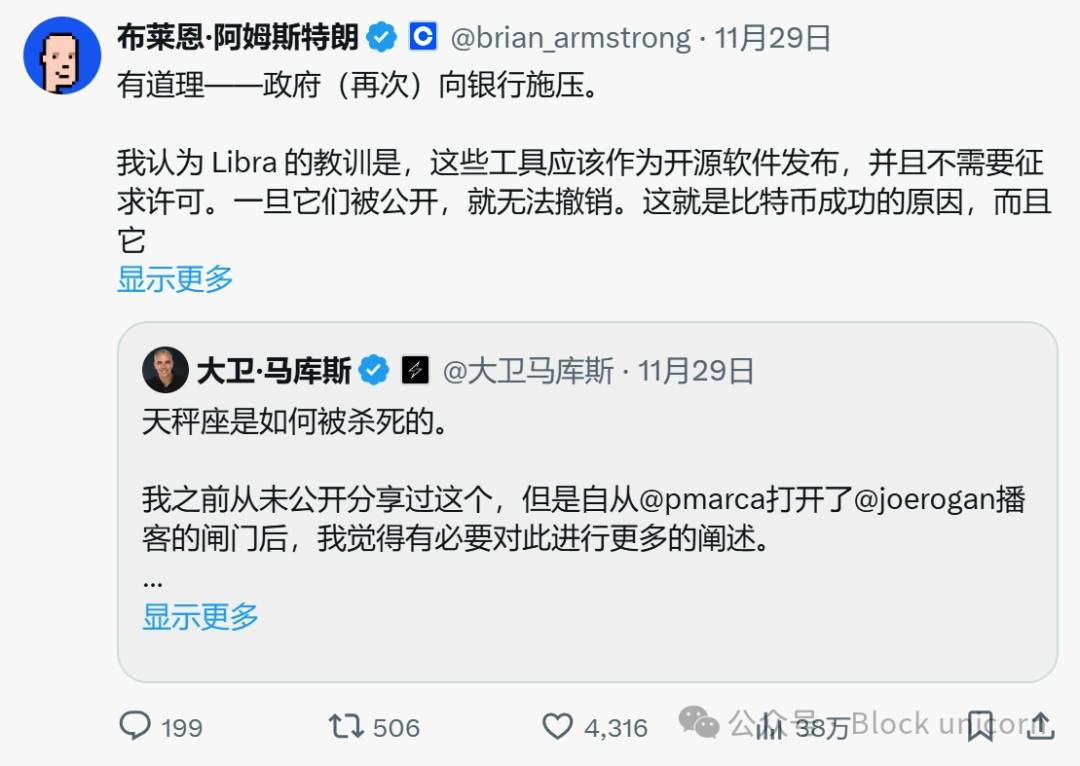
Brian Armstrong (@brian_armstrong), CEO of Coinbase (@coinbase), shared Marcus’s post, adding: “Makes sense—government (again) pressuring banks.”
December 4—Congressman French Hill (@RepFrenchHill) addressed debanking in the crypto industry during congressional proceedings, pledging to “stop, reverse, and investigate Operation Choke Point 2.0.”

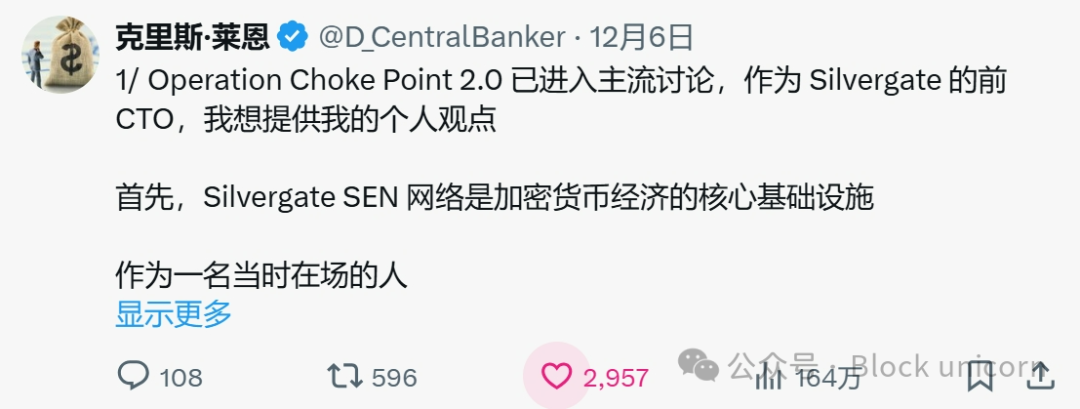
December 6—Chris Lane (@D_CentralBanker), former CTO of Silvergate, shared his experiences with regulatory pressure on crypto banking, catching the attention of David Sacks (@DavidSacks), who reposted Lane’s thread with the comment: “Too many stories of people getting hurt by Operation Choke Point 2.0. Needs investigation.”
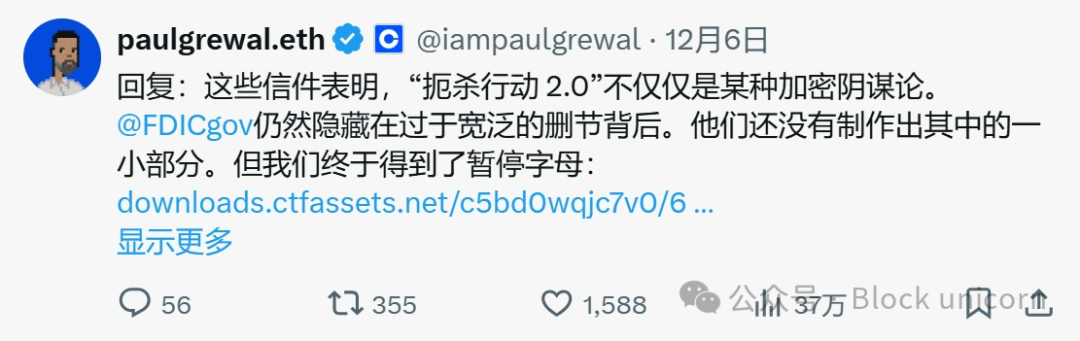
December 6—Court filings in a lawsuit against the FDIC revealed letters from the agency instructing banks to pause crypto-related activities. “These letters show Operation Choke Point 2.0 isn’t just some crypto conspiracy theory,” said Coinbase Chief Legal Officer Paul Grewal (@iampaulgrewal).
December 10—The New York Times published an article by Erin Griffith (@eringriffith) and David Yaffe-Bellany (@yaffebellany) analyzing how debanking has rapidly become a “political weapon.”
December 19—SEC Commissioner Hester Peirce (@HesterPeirce) voted against approving the Public Company Accounting Oversight Board (PCAOB)'s $400 million budget, citing concerns that the board might “use its regulatory authority to prevent regulated entities from serving or otherwise engaging with the crypto industry and its participants.” Despite Peirce’s opposition, the budget was approved by the other three commissioners, including SEC Chair Gary Gensler.
2. Is Banking a Right?
Banking is a service provided by private companies. Yet in an economy where nearly every transaction depends on financial infrastructure, it functions much like a public utility. Without it, participation in modern life—paying bills, receiving wages, accessing credit—is nearly impossible.
In his conversation with Rogan, Andreessen argued that debanking may infringe upon constitutional rights. If banking is essential to economic participation, then denying it without clear justification—or under opaque political pressure—could amount to a deprivation of fundamental rights. While there is no explicit constitutional right to banking, legal precedents have affirmed that financial activity is closely tied to core rights such as free speech and due process.
This debate builds on cases like Buckley v. Valeo (1976) and Citizens United v. Federal Election Commission (2010). Both rulings emphasized that money, as a medium of expression, is protected under the First Amendment. Though centered on campaign finance, these decisions established a principle: the ability to use financial resources is vital to public discourse. Arbitrarily denying financial services equates to silencing lawful voices.
The Fifth and Fourteenth Amendments’ guarantees of due process offer another angle: in Goldberg v. Kelly (1970), the Supreme Court ruled that government benefits critical to livelihood cannot be terminated without due process. While banking is privately operated, its central role in modern life aligns it with utilities, suggesting that arbitrary denial of access may violate due process protections.
The issue of financial neutrality, particularly debanking, was tested this year in NRA v. Vullo (2024). The Supreme Court unanimously ruled that the head of the New York Department of Financial Services could not use her authority to compel banks and insurers to cut ties with the NRA. Justice Sonia Sotomayor stated that while regulators may voice opinions, they cannot force financial institutions to discriminate against lawful entities based on political stance.
These rulings confirm that financial exclusion—whether through direct government coercion or indirect reputational pressure—raises serious constitutional questions. As Andreessen noted on The Joe Rogan Experience, “In five years, the Supreme Court may have a case that retroactively rules all of this illegal.”
3. Legal Businesses Are Legal
At its core, debanking poses a simple question: if an entity operates within the law, should it have the right to banking services? The answer seems obvious—but the trend of debanking compliant businesses suggests otherwise.
This should be a non-partisan statement. The Office of the Comptroller of the Currency (OCC) has issued guidance stating that it does not permit broad, targeted, categorical discrimination against businesses engaged in lawful commercial activity.
Excluding compliant enterprises from essential financial services is a dangerous precedent—one that risks embedding subjective bias into the foundational infrastructure of the modern economy. If the financial system chooses which lawful entities to support, it ceases to be a neutral platform and becomes a tool for enforcing political or cultural agendas.
Fair access is not about forcing banks to take on undue risk. It’s about ensuring the financial system remains inclusive and neutral, enabling all legitimate businesses to operate. Without this neutrality, we risk turning banking into a gatekeeping mechanism that stifles innovation, erodes social trust, and undermines confidence in one of society’s most critical systems.
4. Zero Hash: A Case Study in Overregulation
At Zero Hash, we’ve experienced these challenges firsthand. Despite operating under the highest standards of compliance and regulation—earning the trust of over 75 institutions including Interactive Brokers, Stripe, and Franklin Templeton—we continue to face significant obstacles in securing and maintaining banking relationships.
Our extensive licensing underscores our commitment to transparency and compliance. We are authorized to operate in over 200 jurisdictions globally, including every U.S. state and territory. In the U.S., our licenses include:
-
New York Bitlicenses: among the strictest regulatory frameworks for virtual currency businesses.
-
Money Transmitter Licenses (MTLs): enabling us to operate in all 52 U.S. jurisdictions (50 states plus D.C. and Puerto Rico), meeting state-level requirements for money services businesses.
-
FinCEN registration as a Money Services Business (MSB): fulfilling federal anti-money laundering (AML) and counter-terrorism financing (CTF) obligations.
Despite holding licenses comparable to—or exceeding—those of traditional financial institutions, banks remain reluctant to partner with us. Over the past 18 months, roughly 80% of the 120+ banks we approached refused to engage in any substantive dialogue purely due to our industry. Among those that did engage, only half proceeded to conduct due diligence.
This issue is less prevalent in Europe. International banks willing to collaborate with us abroad explicitly refuse to do so in the U.S. Ironically, it’s the same bank, dealing with the same company, facing identical risk profiles—the difference being U.S. regulatory and political factors creating barriers absent elsewhere. This disparity highlights the chilling effect of ambiguous regulations and overreach, actively discouraging innovation in the U.S. and pushing companies to build the future elsewhere.
5. What’s at Stake for Financial Neutrality
Debanking is more than a logistical hurdle—it directly challenges the principles of fairness, freedom, and trust upon which our financial system depends. This isn't just about cryptocurrency; it's about safeguarding universal access to the infrastructure of modern finance.
Join TechFlow official community to stay tuned
Telegram:https://t.me/TechFlowDaily
X (Twitter):https://x.com/TechFlowPost
X (Twitter) EN:https://x.com/BlockFlow_News
 @BlockUnicorn