








How to unlock Asia's potential in Web3?
TechFlow Selected TechFlow Selected
How to unlock Asia's potential in Web3?
Asia is a key region for Web3 development, thanks to its large population of digital natives, consumer-centric innovation, and robust super-app ecosystems, with on-chain data further revealing its growth potential.
 Navigating Web3 tides with focused insights
Author: Jay Jo
Translation: Baicai Blockchain
Executive Summary:
The Asian market is complex and diverse, with varying regulations and cultures. Participation in the Web3 industry requires deep understanding of each country's unique characteristics.
Asia’s large, young, digital-native population provides significant potential for leadership in the Web3 space—especially in super apps and consumer-facing applications.
On-chain data shows that the Asian Web3 market is growing, reflected in increasing stablecoin usage, developer activity, decentralized exchange (DEX) trading volume, and Web3 social media engagement.
1. Diversity and Complexity of the Asian Market
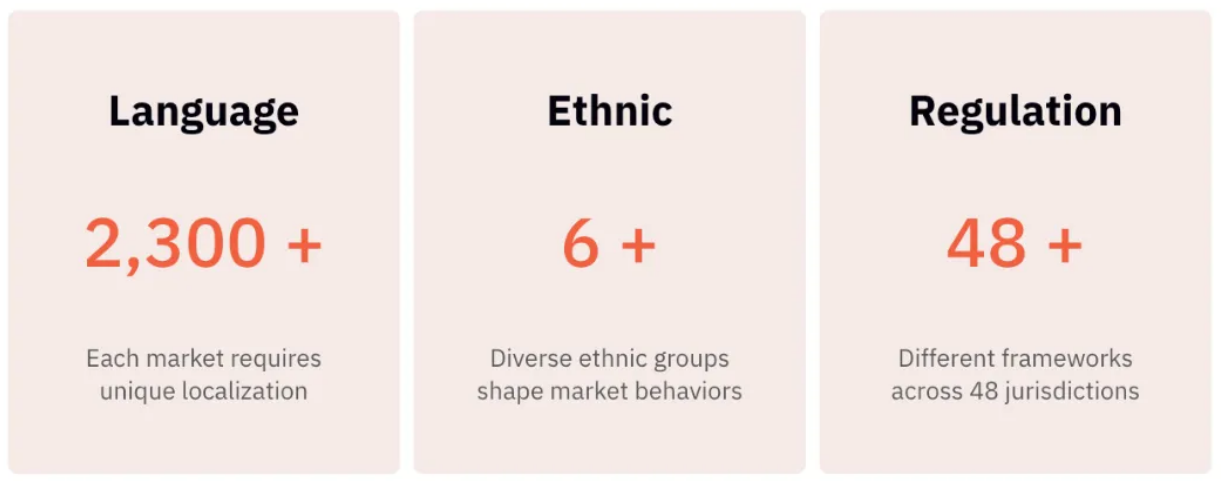
To understand the Asian market, one must first recognize its diversity and complexity. Asia has over 2,300 languages across regions including Northeast, Southeast, Southwest, and South Asia, along with more than 48 distinct regulatory frameworks. Cultural differences within Asia are often greater than those between Western countries.
This diversity profoundly impacts Asia’s Web3 industry. In Northeast Asia, countries adopt different approaches: China enforces strict regulation, South Korea combines oversight with incubation support, while Japan drives Web3 development through government initiatives. This unique combination across Asia demands market-specific strategies and nuanced understanding for success.
2. Strong Growth Foundations in Asia
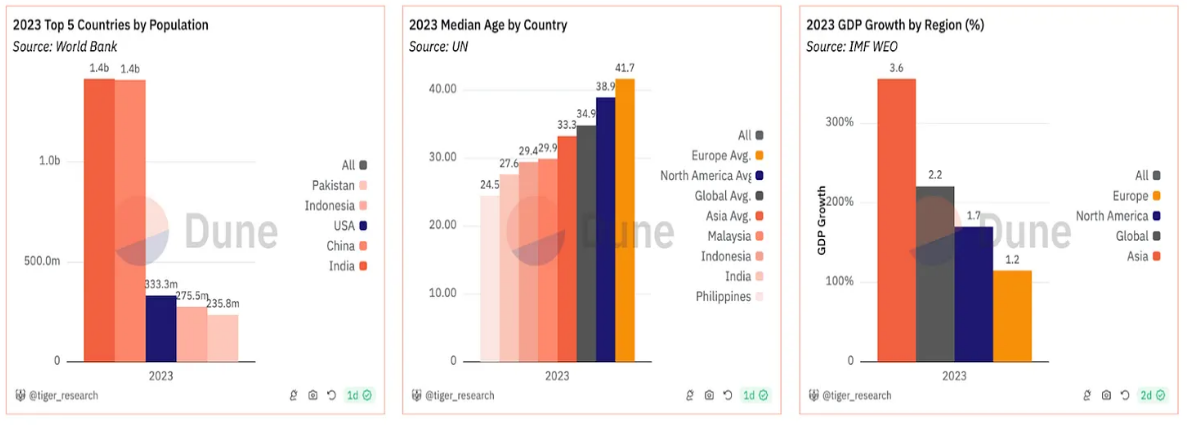
Asia’s diversity presents challenges, but its importance cannot be overlooked. The region accounts for over 60% of the world’s population, contributes 34% of global GDP, and grows at a rate of 3.6%, outpacing North America and Europe.
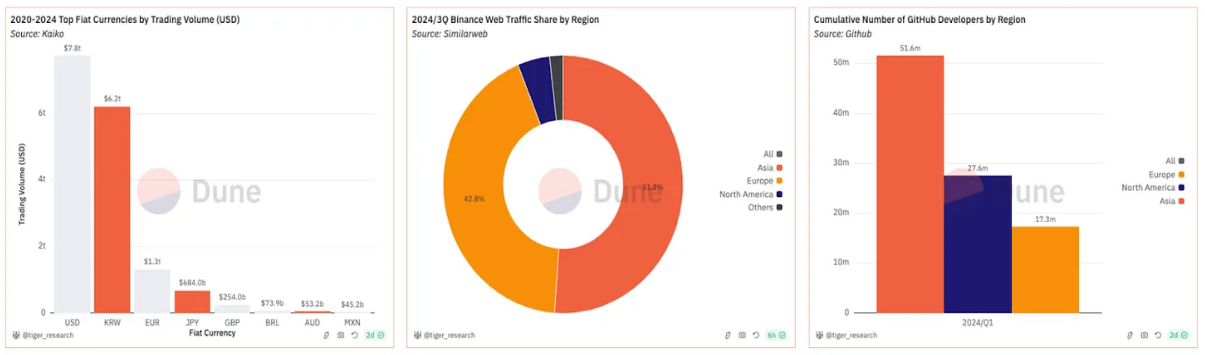
Asia leads in the Web3 sector for three main reasons:
First, Asia hosts a massive cryptocurrency user base—about 60% of global crypto users (320 million people)—driven largely by its young, digital-native population (source: Triple-A).
Second, Asia excels in transaction activity: early in 2024, Korean won-denominated trading volume surpassed USD-based volume, and recently more than half of Binance’s website traffic originated from Asia.
Third, Asia possesses strong technical talent, including 50 million GitHub developers and 40% of global Web3 game developers.
3. Asia’s Web3 Advantages: Consumer-Centric Innovation and Super Apps
For Web3 to achieve mass adoption, the key lies in developing easy-to-use consumer applications—building technical infrastructure alone is insufficient. This mirrors the internet’s historical path, where killer apps like email drove rapid adoption. Similarly, Web3 is expected to gain widespread traction through consumer applications that naturally integrate into daily life.
Asia stands out in two aspects. First, it leads in consumer-centric innovation. As of October 2024, 42% of Asia’s unicorns are B2C companies—higher than North America or Europe (source: CB Insights). This advantage stems from Asia’s vast digital-native population and advanced mobile payment systems. A consumer-driven development model positions Asia as a potential hub for next-generation Web3 applications.
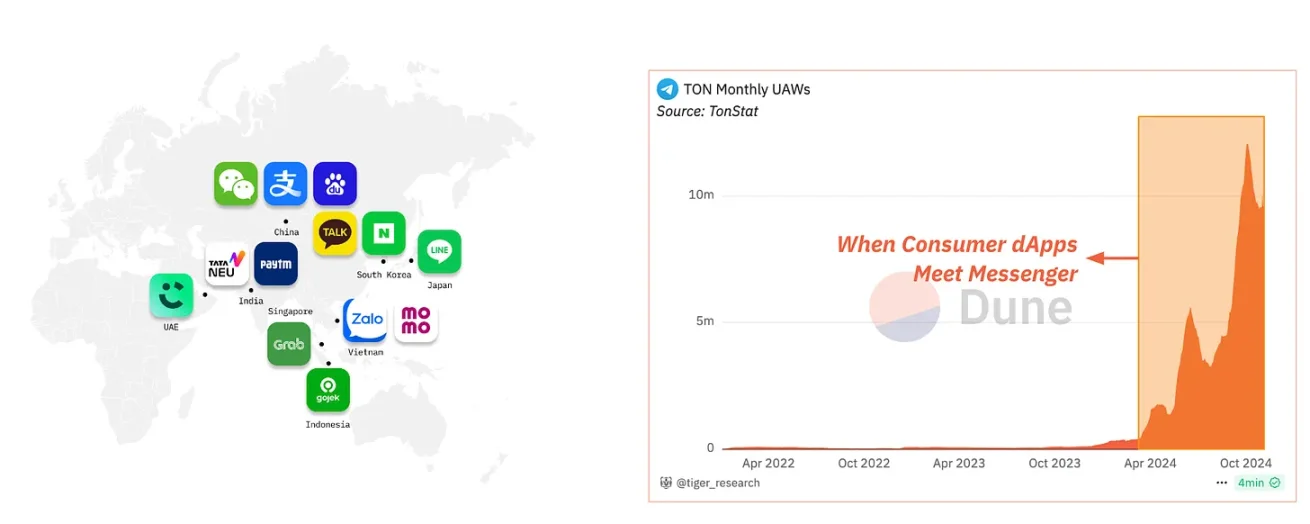
Asia’s second strength lies in its unique super app ecosystem. Leading platforms such as WeChat, Alipay, Kakao, Line, and Grab began as single-service apps but have evolved into comprehensive digital ecosystems. These super apps are now integral to millions of users’ daily lives, offering services ranging from payments and shopping to entertainment.
The TON blockchain demonstrates the potential of integrating Web3 with super apps. By embedding Web3 features within the popular messaging app Telegram, user numbers surged due to convenience. These cases show that super apps can lower the barrier to Web3 adoption. Introducing new services within familiar environments will accelerate Web3’s mainstream uptake.
4. Data-Driven Analysis of the Asian Web3 Market
The Asian market shows strong potential, but relying solely on expectations and high-level indicators may lead to superficial conclusions. On-chain data analysis of real user behavior is essential for deeper market insights.
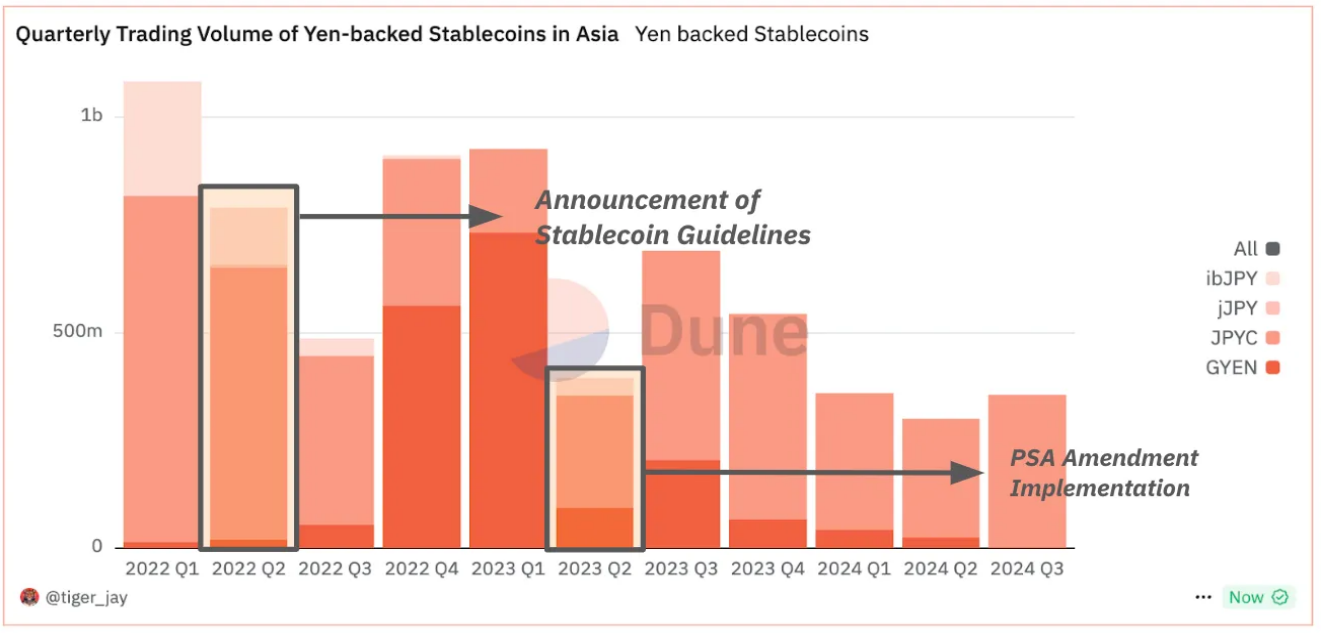
Japan’s evolving stablecoin policy highlights the need for in-depth analysis. Although stablecoin guidelines were issued in June 2022 and legal amendments in 2023 allowed their issuance, there has been no significant on-chain impact so far. This is due to limited use cases and regulatory barriers around issuing trust-based stablecoins on public blockchains. Bridging the gap between policy and adoption requires more granular on-chain analysis.
Next, we assess whether the anticipated growth in the Asian market is materializing through on-chain data.
4.1. Stablecoins in Asia

Stablecoin usage in Asia is steadily increasing. This trend is significant because stablecoins represent one of Web3’s strongest product-market fits. On-chain data shows stablecoin transfer volumes in Asia have surged to nearly $8 billion, with transaction volumes expected to grow further from 2022 to 2024.
Stablecoins pegged to national currencies are creating more real-world use cases. Locally backed stablecoins have emerged, such as Singapore’s XSGD and Indonesia’s XIDR. For example, XSGD integrates with services like Grab, driving practical adoption. This localization strategy and integration with everyday services are boosting stablecoin transaction volumes. Sustained growth indicates structural changes in the Asian market—not just short-term trends.
4.2. On-Chain Activity of Asian Developers
Asian developers are increasingly active in smart contract development. On-chain data from Ethereum mainnet and testnets (Goerli and Sepolia) confirms this trend.

In 2024, Asian developers created approximately 1.7 million contracts on these testnets—far exceeding activity in North America and Europe. Since 2022, growth has been rapid, with similar trends observed on the Ethereum mainnet. Asia’s share of contract creation rose from 4% in 2020 to 40% in 2024.
This shift highlights two trends: first, Asian developers are driving blockchain innovation; second, blockchain development is expanding globally beyond its Western origins. High levels of testnet activity reflect active experimentation and position Asian developers as key contributors to Web3’s future.
4.3. Participation of Asian Retail Investors in Decentralized Exchange (DEX) Trading
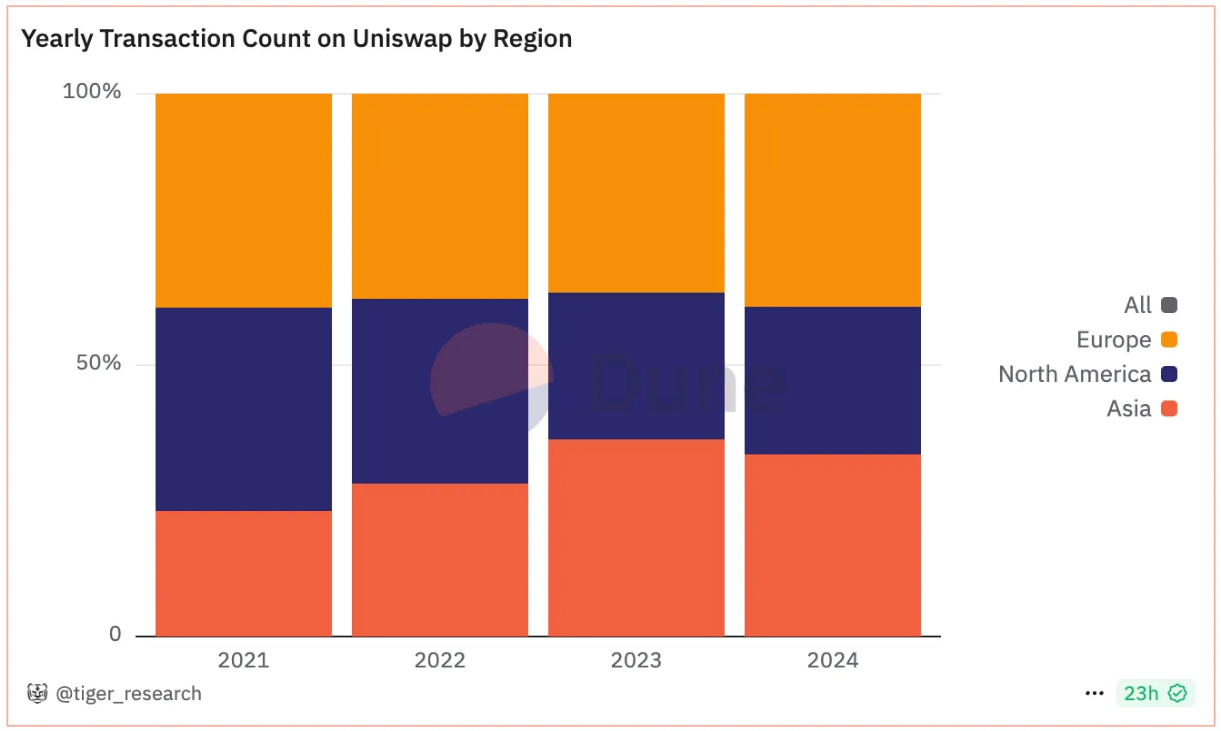
Trading data from Uniswap shows high participation from Asia. From 2021 to 2024, Asia consistently accounted for a significant portion of total trading volume, with steady growth throughout the period.
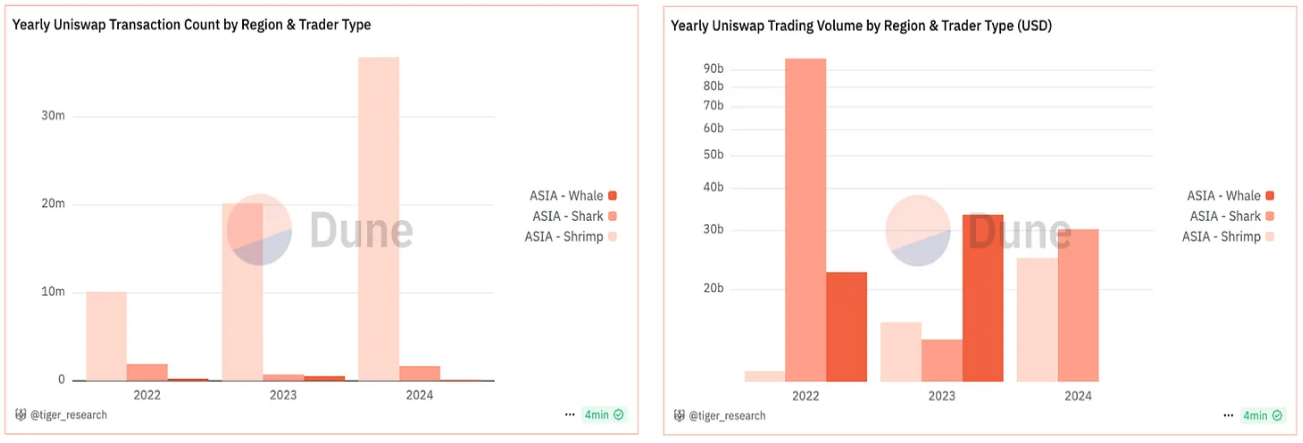
More notably, there are clear differences in participation rates among investor types in Asia. When categorizing trade sizes into whales ($100,000+), sharks ($10,000–$100,000), and minnows (under $10,000), significant shifts emerge. In 2021, minnow investors contributed relatively little to trading volume. However, by 2024, their share in both number of trades and trading volume had steadily increased. This is a positive signal indicating growing adoption of Web3 services among Asian users. They are not only active on centralized exchanges (CEXs), but also increasingly participating in decentralized exchanges (DEXs).
4.4. Activity of Asian Users in the Web3 Social Network Farcaster

Asian user activity on Farcaster is drawing attention in the Web3 ecosystem. Daily active user (DAU) analysis reveals that Asian users are more active than those in North America and Europe. Despite English being the dominant language in Web3, posts in local languages such as Vietnamese, Chinese, Japanese, and Korean are steadily increasing. This indicates that Asia’s Web3 growth is already underway—not merely anticipated. Asia is leading in Web3 adoption.
5. Conclusion
The Asian market is diverse, with unique regulations, cultural differences, and varying national approaches. This complexity brings both challenges and opportunities for Web3. Understanding the distinct role of each country is crucial. On-chain data, by capturing real user behavior, reveals the true potential of Asia’s Web3 market.
Regional analysis based on on-chain data is vital for ecosystem growth. Advances in digital credentials and regional analytics will improve the accuracy of user behavior insights. These tools will help clarify the regional context and preferences shaping the Asian Web3 market.
Join TechFlow official community to stay tuned
Telegram:https://t.me/TechFlowDaily
X (Twitter):https://x.com/TechFlowPost
X (Twitter) EN:https://x.com/BlockFlow_News
 @tiger_research






