October Public Chain Industry Report: Bitcoin Leads Market, Layer2 Competition Intensifies
TechFlow Selected TechFlow Selected
October Public Chain Industry Report: Bitcoin Leads Market, Layer2 Competition Intensifies
In October 2024, Bitcoin's market share rose to 70.1%, while the Layer2 landscape continued to evolve, with Bitcoin L2 growth outpacing that of Ethereum L2.
 Navigating Web3 tides with focused insights
By Stella L
Exactly 16 years after Satoshi Nakamoto released the Bitcoin whitepaper on October 31, 2008, Bitcoin once again demonstrated its revolutionary impact on the financial world. In October 2024, driven strongly by institutional investors, Bitcoin approached its all-time high, while the broader blockchain ecosystem continued to evolve rapidly. The month highlighted a clear market divergence, with Bitcoin leading gains at a 15.9% increase, Ethereum showing more moderate growth, and Layer 2 solutions on both networks advancing steadily in development and expansion. Meanwhile, emerging public blockchains like Sui gained significant momentum, poised to enter the top ten public chains.
This report draws data from Footprint Analytics' Public Chain Research page, which offers an easy-to-use dashboard featuring the most critical statistics and metrics for understanding the public chain landscape, updated in real time.
Market Overview
October 2024 saw notable market divergence, with Bitcoin leading strong gains while other cryptocurrencies showed milder increases. Bitcoin performed exceptionally well, rising from $60,764 to $70,398—a 15.9% gain—and reaching a recent peak of $72,751 on October 29, close to its historical high set in March. In contrast, Ether had a more subdued performance, increasing only 2.7% for the month to close at $2,519.
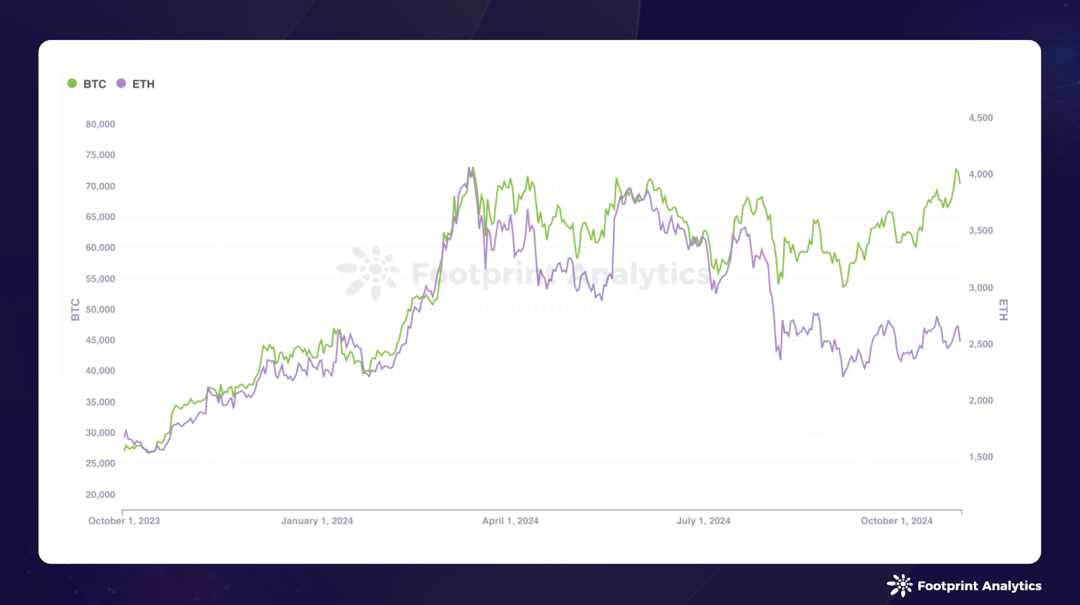
Data source: Bitcoin and Ether price trends
Several macroeconomic factors influenced market movements this month. Shifts in global money markets—particularly the strengthening of the U.S. dollar against major currencies including the Chinese yuan—impacted capital flows into the crypto market. This occurred amid rising bond yields and increasing gold prices, reflecting changing global risk appetite.
Political developments increasingly influenced market sentiment, with the upcoming U.S. election emerging as a key market driver. Investors positioned early for potential policy shifts, accelerating Bitcoin's rally, as the market closely monitors how different electoral outcomes could affect digital asset regulation and broader financial policies.
Institutional participation remained a significant catalyst, evident in substantial inflows into Bitcoin exchange-traded products (ETPs). This trend underscores growing institutional recognition of digital assets as strategic investment tools, even as their positioning remains cautious.
Regulatory dynamics continued shaping the market landscape. The FBI’s undercover operation targeting the NexFundAI token marked a milestone, resulting in market manipulation charges against three crypto firms and 15 individuals. Simultaneously, Crypto.com’s legal battle with the SEC highlighted the ongoing tension between industry participants and regulators.
Layer 1
In October 2024, the total market capitalization of blockchain cryptocurrencies grew 6.7% to $2.0 trillion. Bitcoin's market dominance strengthened from 67.3% in September to 70.1%. Meanwhile, Ethereum’s share declined further from 16.8% to 15.3%, while BNB Chain and Solana maintained relatively stable shares at 4.2% and 4.0%, respectively.
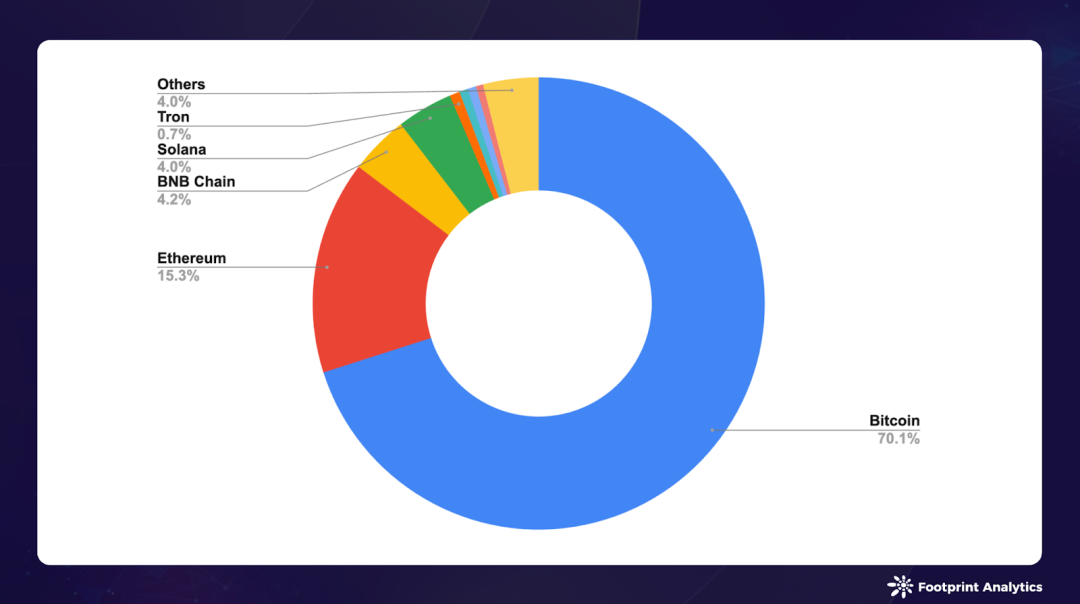
Data source: Public chain token market cap
Market growth was primarily driven by strong performances from established tokens, led by Bitcoin. Bitcoin Cash (up 12.9%) and Litecoin (up 9.5%) also posted significant gains. Solana maintained its status as one of the best-performing altcoins, rising 17.6%. Emerging blockchain Sui continued its upward trajectory with an 11.5% increase.
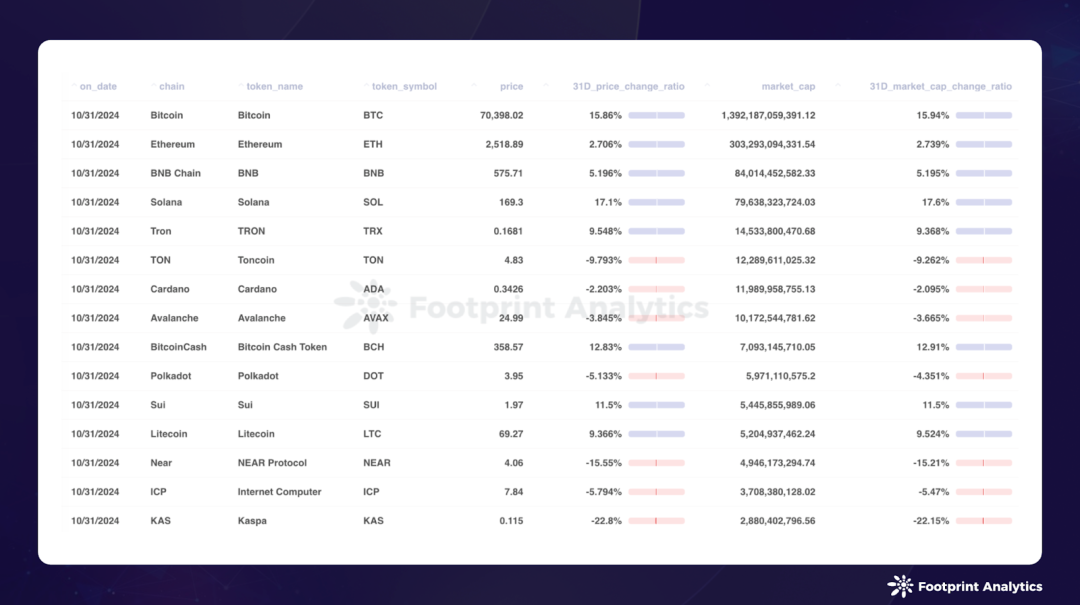
Data source: Public chain token prices and market cap
Sui rose to 11th place in market capitalization rankings. By capitalizing on meme coin trends and Telegram-based gaming opportunities, Sui significantly expanded its DeFi ecosystem. The launch of native USDC on Sui by Circle in October marked another milestone in its development. However, this growth was not without controversy—the October allegations of a "$400 million insider token dump" on Sui, though denied by the Sui Foundation, sparked community debate.
DeFi faced headwinds in October, with total TVL declining 6.8% to $63.5 billion. While the Bitcoin ecosystem performed robustly, DeFi within the Ethereum ecosystem struggled. Notably, Polygon stood out as an exception, with its TVL surging 30.3%, largely driven by heightened activity ahead of the U.S. presidential election that propelled Polymarket to record levels.
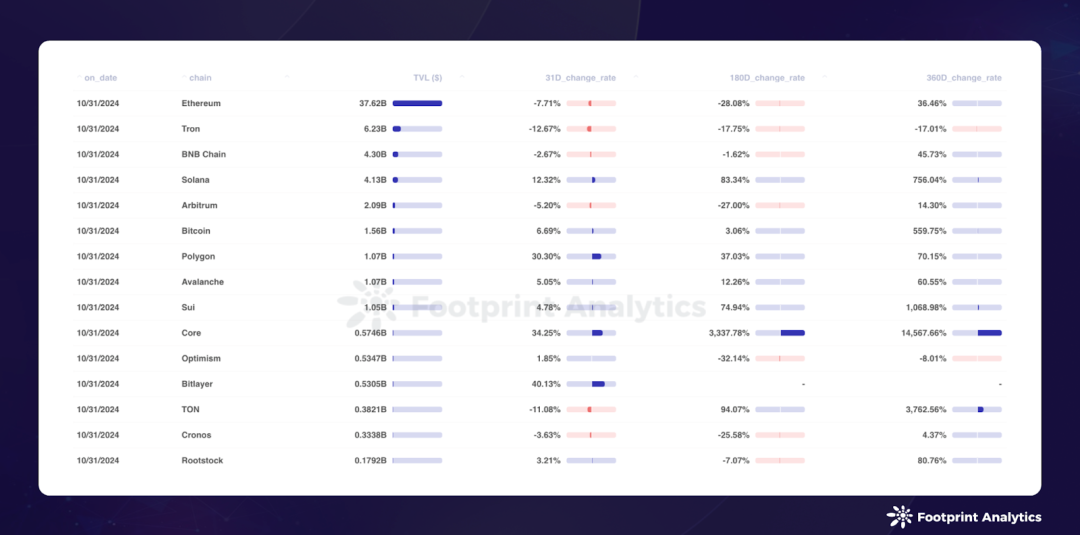
Data source: Public chain TVL
Stablecoins continued to demonstrate their pivotal role in the crypto ecosystem. According to Bitwise Research’s Q3 2024 Crypto Market Recap, global stablecoin transaction volume exceeded $5.1 trillion in the first half of 2024, nearing Visa’s $6.5 trillion. Tether’s profitability surpassing that of BlackRock underscored the sector’s financial clout, intensifying competition among public chains to attract stablecoin deployments.
Bitcoin Layer 2 & Sidechains
In October 2024, Bitcoin Layer 2 and sidechain ecosystems sustained strong growth, with total TVL reaching $1.8 billion—an increase of 22.2% from September.
Core retained its industry leadership, growing TVL by 29.8% to $570 million, capturing a 32.4% market share. Bitlayer solidified its position with a 36.1% TVL increase to $530 million, holding 29.9% of the market. Rootstock ranked third with $180 million in TVL and a 10.1% share, while BSquared emerged as a breakout performer, achieving $170 million in TVL with a 54.4% monthly growth rate, surpassing Merlin to claim fourth place.
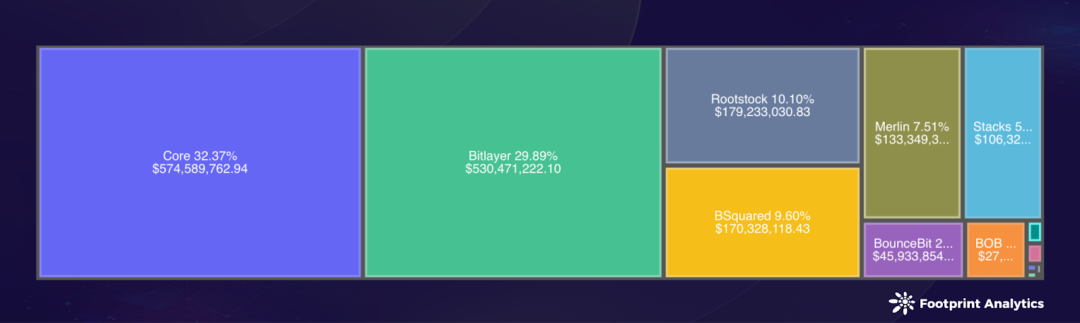
Data source: TVL of public chains in the Bitcoin ecosystem
October brought significant technical breakthroughs in the Bitcoin Layer 2 ecosystem. BEVM launched its innovative "Super Bitcoin" framework, proposing a comprehensive solution to expand Bitcoin’s functionality while preserving its foundational security.
The framework outlines a five-layer architecture built atop the Bitcoin network, leveraging its proven PoW consensus for security. Above it, the stack integrates Lightning Network technology for efficient communication, Taproot consensus for standardization, and a multi-chain fusion layer supporting various virtual machines. This culminates in an application layer enabling developers to build DApps while inheriting Bitcoin’s security.
In a major step toward bridging the Bitcoin and Ethereum ecosystems, the BOB network announced integration with Optimism’s "Superchain." Positioned as a "hybrid layer-2" solution, BOB aims to create seamless connectivity between Bitcoin and Ethereum, placing Bitcoin at the center of DeFi.
Cross-chain capabilities advanced further with Cardano’s integration with BitcoinOS (BOS). This collaboration seeks to provide long-standing public chain Cardano users with direct, trustless access to Bitcoin liquidity.
Additionally, BTCFi continued its impressive growth trajectory, particularly Babylon’s Bitcoin staking program Cap-2. The initiative demonstrated remarkable efficiency, attracting 23,000 BTC while incurring only 1.56 BTC in minimum fees. This successful deployment highlights strong market demand for Bitcoin-based financial products.
Ethereum Layer 2
In October 2024, Ethereum Layer 2 solutions experienced modest growth, with total TVL via canonical bridges reaching $19.8 billion—an increase of 1.2% from September, significantly trailing the growth rate of Bitcoin scaling solutions. The competitive landscape continued evolving, with established leaders maintaining dominance but losing slight market share, while new entrants made notable progress.
Market leaders Arbitrum One and Optimism retained their positions with 45.3% and 17.8% market shares, respectively, despite minor declines. Base saw substantial growth, expanding its share from 8.1% to 13.4%, with TVL increasing 28.5%. This surge was primarily driven by Coinbase’s smart wallet, which simplified dApp interactions and attracted significant capital inflows across lending, derivatives, and DEX protocols. Base’s native DEX, Aerodrome, performed exceptionally during this expansion.
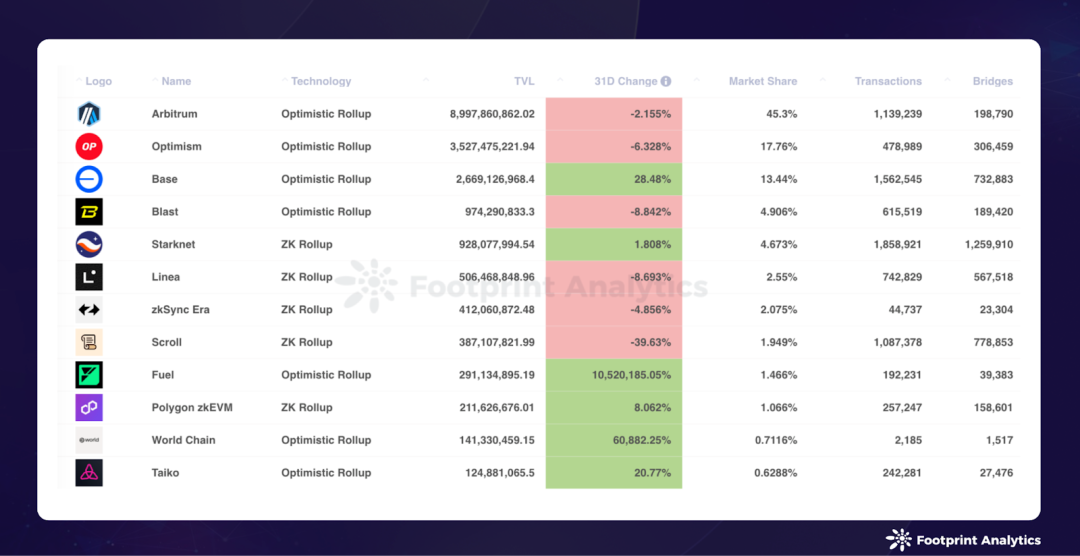
Data source: Ethereum Layer 2 Overview – Rollups (Bridge-related metrics), September 2024
Several new entrants made significant impacts. Fuel Ignition and World Chain saw sharp TVL increases following mainnet launches, while Taiko’s TVL grew 20.8%, fueled by the success of Panko Finance and Avalon Finance.
However, Scroll experienced a 39.6% drop in TVL post-airdrop. Its distribution plan faced community backlash, and similar to prior cases like zkSync and Starknet, activity sharply declined after the airdrop, with its token price falling over 50% from launch.
Beyond market metrics, the industry intensified focus on fundamental ecosystem challenges, particularly user experience and interoperability.
Vitalik Buterin actively engaged with community concerns, publishing a series of comprehensive articles outlining Ethereum’s future direction. On social media, he emphasized cross-Layer 2 interoperability as a top development priority. His proposed roadmap includes standardizing chain-specific addresses, unifying payment request systems, and integrating key storage wallets across Layer 2s—aimed at simplifying cross-chain asset transfers and reducing gas fees for inter-Layer 2 transactions.
Despite ongoing challenges, Ethereum’s Layer 2 ecosystem continues to attract major projects and developments. October saw several notable mainnet launches. World Network (formerly Worldcoin) went live, bringing its privacy-focused identity solution to mainnet. Yuga Labs’ ApeChain launched, leveraging Ethereum’s security for NFT applications, while Eclipse and Fuel Ignition completed mainnet deployments, adding new scaling solutions to the ecosystem.
Another major development came from Uniswap Labs, which unveiled plans for Unichain—a new Layer 2 network built on Optimism’s OP Stack. Given Uniswap’s dominant position in DeFi, the announcement sparked widespread industry discussion. Following major players like Coinbase’s Base and Sony’s Soniem, the launch of Unichain’s testnet signals a potential shift in Layer 2 competitive dynamics, with intensified competition expected in liquidity and gas fees.
Unichain
Blockchain Gaming Chains
In October 2024, the blockchain gaming sector hosted 1,606 active games, with BNB Chain, Polygon, and Ethereum dominating game distribution. OpBNB led in user engagement with 1.2 million average daily active users (DAU), followed by Ronin (886,000 DAU) and Matchain (548,000 DAU).
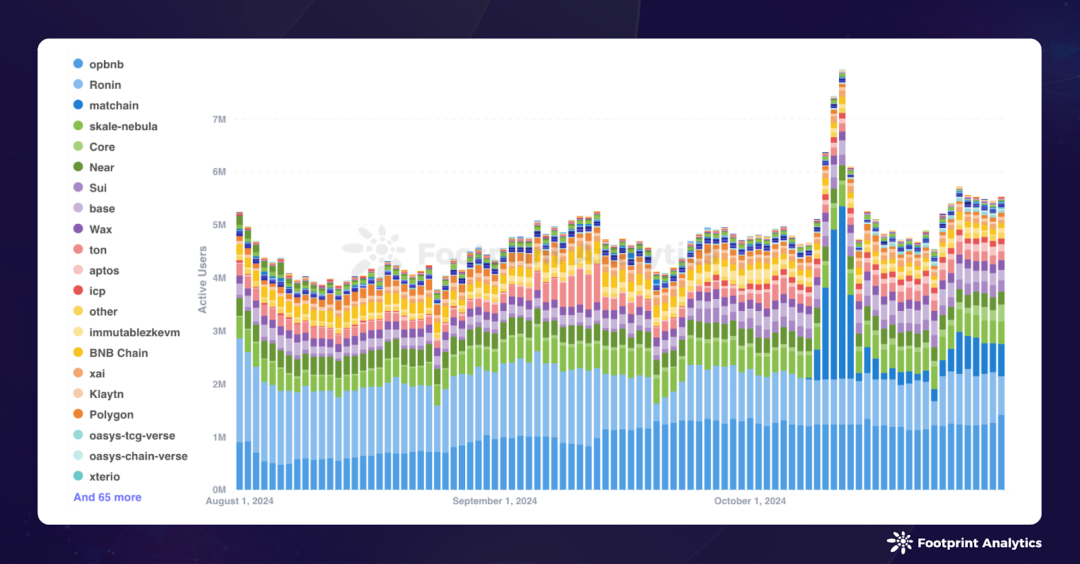
Data source: Distribution of active blockchain games across chains
Matchain achieved a major breakthrough in October, leveraging Telegram-based games to surge from just 78 average DAU in September to 548,000 DAU. The chain peaked at 3.3 million users on October 12 before stabilizing around 615,000 by month-end, demonstrating both the potential and volatility of Telegram-based user acquisition strategies.
Sui and Core showed strong growth, with DAU increasing 105.1% to 190,000 and 75.7% to 109,000 respectively, both benefiting from Telegram-based initiatives. Meanwhile, TON’s DAU dropped 27.7% to 195,000. Despite its pioneering Telegram-integrated approach inspiring adoption across multiple chains—including Sei, Ancient8, and Viction—user retention remains a common industry-wide challenge.
For more insights, see "Blockchain Gaming Report October 2024: Latest Trends in Active Users and On-Chain Game Ecosystems."
Funding Activity
In October 2024, the blockchain sector recorded 12 funding events totaling $104 million, a 40.1% decline from September’s $174 million. Three of these events did not disclose specific amounts.
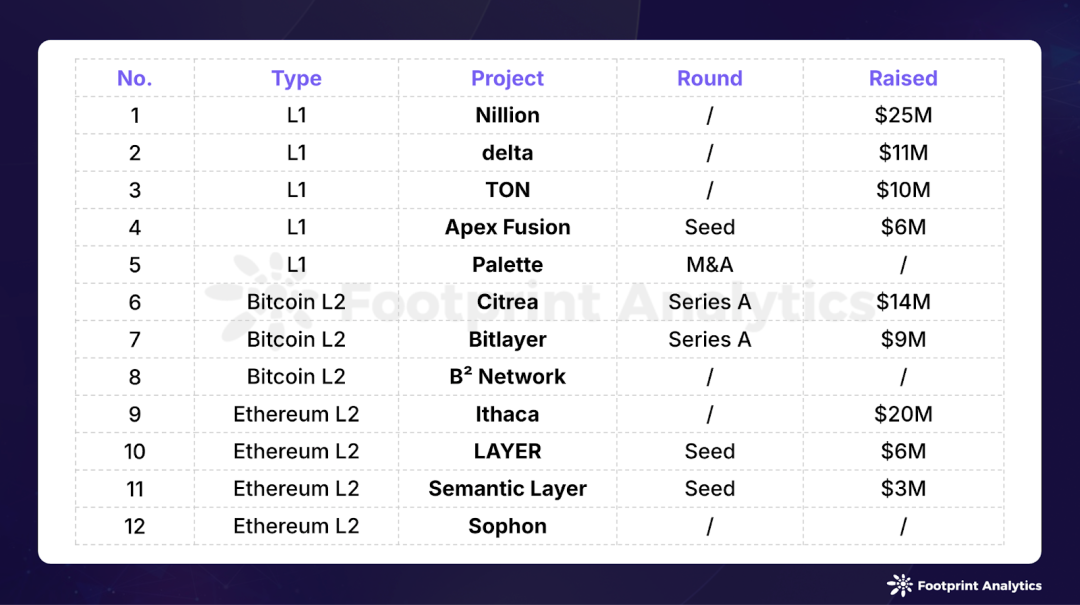
Public chain funding events in October 2024 (Data source: crypto-fundraising.info)
Nillion, a privacy-focused blockchain project, emerged as the largest recipient of funding in October, raising $25 million in a round led by Hack VC. Its innovative "blind computing" approach enables data processing without exposing content, allowing applications to collaborate while preserving data privacy. This breakthrough positions Nillion at the intersection of privacy protection and decentralized computing, addressing the growing demand for secure data processing in Web3 applications.
Following its $30 million raise in September from Bitget and Foresight Ventures, TON maintained its fundraising momentum. In October, TON secured additional funding from Gate.io.
Layer 2 solutions continued attracting investor interest across both Bitcoin and Ethereum ecosystems. Bitcoin Layer 2 platforms Bitlayer and B² Network successfully closed new funding rounds, while Ethereum Layer 2 saw capital flowing into innovative projects such as Ithaca, Semantic Layer, Sophon, and LAYER.
Join TechFlow official community to stay tuned
Telegram:https://t.me/TechFlowDaily
X (Twitter):https://x.com/TechFlowPost
X (Twitter) EN:https://x.com/BlockFlow_News
 Footprint Analytics