Coinbase Ventures: Quickly Understanding L3, the "AWS Moment" for the Crypto World
TechFlow Selected TechFlow Selected
Coinbase Ventures: Quickly Understanding L3, the "AWS Moment" for the Crypto World
This article aims to establish a shared understanding of L3s.
 Navigating Web3 tides with focused insights
Author: Coinbase Ventures & Ryan Y Yi (Coinbase Ventures)
Translation: TechFlow
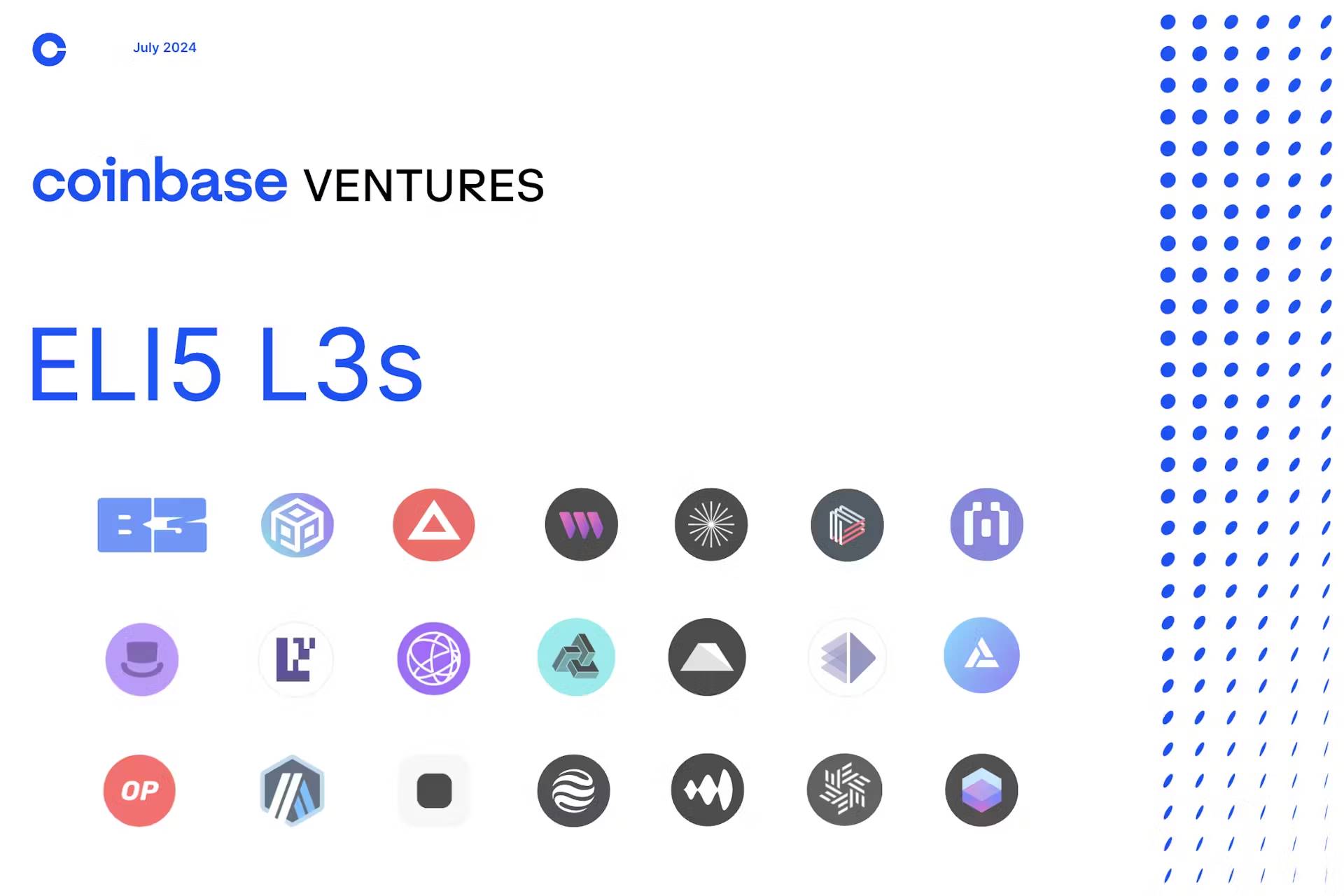
Disclosure and footnotes: This article mentions multiple projects invested in by Coinbase Ventures, including Optimism, Arbitrum, Celestia, Eigenlayer, Stack, ThirdWeb, Syndicate, Conduit, Alchemy, Socket, Everclear, Reservoir, Starkware, and Matter Labs.
L3s (“Layer 3”) are emerging as a new phenomenon in on-chain developer deployments, particularly within the EVM L2 space. This article explains the fundamentals of L3s, their value proposition, and their impact on the broader ecosystem.
Summary:
-
While L2s have become hubs for on-chain activity—driving much of the ETH-based economy through lower gas fees and higher throughput—they may be constrained by the need to maintain decentralization and alignment with ETH L1.
-
Developers who want [1] to experiment and customize applications, and [2] align with L2s for distribution, are now opting to build L3s—application-specific chains that settle to an underlying L2.
-
This article aims to establish a common understanding of L3s.
Key Takeaways
What are L3s?
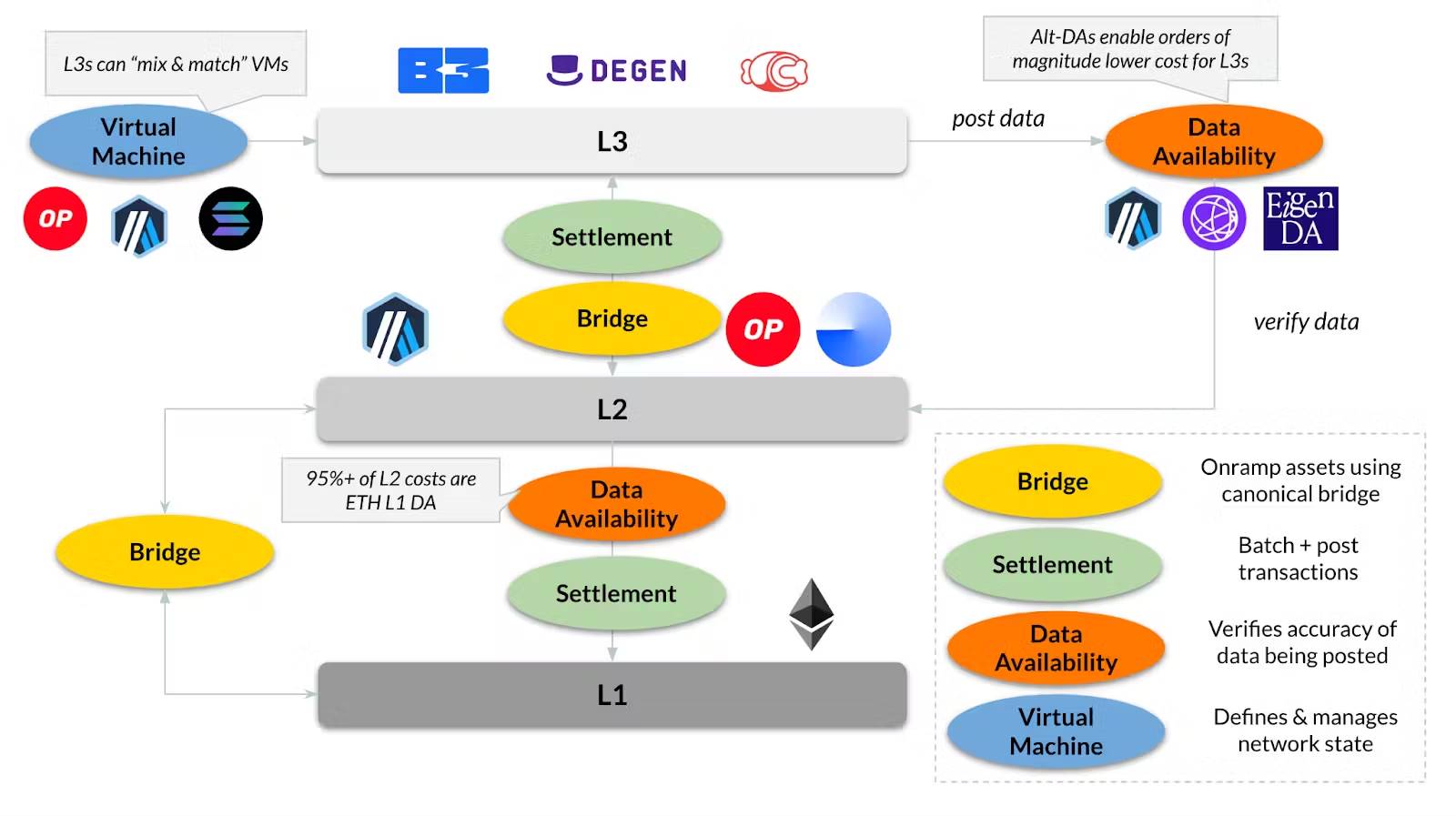
If L2s are the hubs on chain, then L3s can be seen as “on-chain servers”—they have independent state environments and fee markets but settle to an underlying L2 and leverage its uplink/distribution mechanisms. This provides applications with customizable blockspace while still benefiting from the L2’s existing liquidity and user base.
-
Cost: Costs can be reduced by up to 1,000x due to a combination of factors: (1) Lower onboarding costs (direct CEX onramps to L2), (2) Slightly cheaper settlement/execution costs (transactions settle to L2 rather than L1), and most importantly, (3) Alternative data availability (DA)—how the chain verifies data accuracy. For L2s using ETH L1 data, DA accounts for over 95% of total costs. Gas fees are also more predictable since L3s have their own fee markets (e.g., on an L2, a surge in one app’s activity raises fees for all others).
-
Customizability: L3s have lower decentralization requirements than L2s, enabling experimentation with new tokenomics (e.g., custom gas tokens), virtual machines (e.g., Solana VM on an ETH L2), and alternative DA layers (e.g., Celestia instead of ETH L1).
How do L3s differ from L2s?
L3s are rollups, so they share many similarities with L2s.
-
Settlement: Just as L2s settle to L1, L3s settle to L2.
-
Bridging: Just as assets bridge from L1 to L2, they similarly bridge from L2 to L3.
-
Virtual Machine: The software stack used by an L3 does not necessarily need to match that of its underlying L2. For example, many production L3s run on Arbitrum Nitro but settle to Base (which runs on OP Stack). Moreover, most L3 stacks are modified versions of popular L2 stacks. For instance, Arbitrum (Nitro) and OP Stack have already released modified stacks tailored for L3 builders.
-
Data Availability: This is the biggest difference. L3s can choose alternative DA layers (e.g., Celestia, EigenDA, Arbitrum AnyTrust), whereas L2s must use ETH L1 for alignment and decentralization. As a result, L3s achieve extremely low-cost gas environments.
How to launch an L3?
-
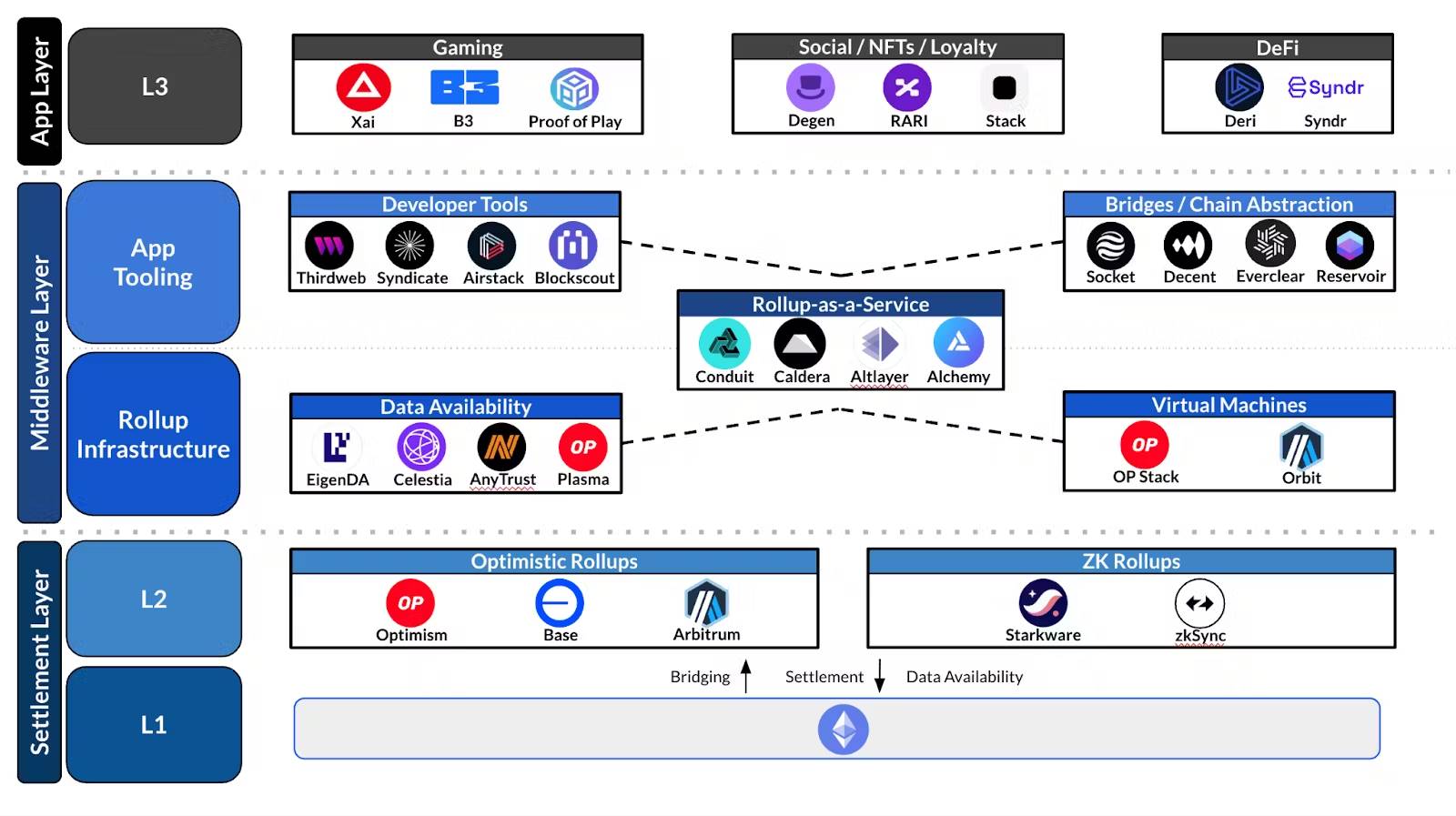
Since L3s primarily leverage permissionless/open-source tech stacks, developers can choose to (1) self-host the stack/infrastructure, (2) use Rollup-as-a-Service (RaaS) providers (like Conduit, Caldera) that offer managed services to deploy and host your L3, or (3) work with white-label providers (like Syndicate) that bundle various infrastructure providers (e.g., RaaS, bridges, dev tools) into a single offering.
Will there be L4s?
-
Because L3s provide dedicated blockspace and enable native bridging to liquid, user-rich L2 "hubs," we believe this will cover all significant on-chain use cases.
-
Even as L2 transaction costs decline, L3s may represent the final frontier of vertical scaling (i.e., no L4s).
-
The core premise of L3s is leveraging the liquidity and users of the underlying L2 hub. Building on an "L4" would move further away, defeating the purpose.
-
Alternative data availability is the source of cost differences. Moving further up the stack won’t significantly change settlement or execution costs.
-
-
If an L3 hits scalability limits, instead of further vertical scaling ("L4"), it may launch another L3 settling to the same L2 (linked via native bridges). The end result could be horizontal expansion of L3s rather than vertical.
Ecosystem Impact
L3s will become another preferred destination for on-chain developers, potentially resulting in a few L2 “hubs” supporting millions of L3 “servers.”
-
L3s represent a potential paradigm shift for on-chain developers by breaking the sub-cent barrier, lowering the threshold for building mainstream-scale on-chain applications, and possibly leading to an “app store” moment with millions of L3s.
-
L3s serve as experimental grounds for developers, ideal for high-throughput, low-cost applications—while still leveraging the liquidity and distribution mechanisms of the underlying L2 hub.
-
A likely outcome is dozens to hundreds of L2 hubs, each supporting millions of L3s.
From a cost perspective, L3s could represent a potential “AWS moment.”
-
L2s are becoming their own on-chain hubs. Due to their proximity to L1, operating an L2 is typically expensive, often costing seven to eight figures annually.
-
In contrast, operating an L3 is far cheaper, with annual costs potentially ranging between $25K–$50K.
L3 developers will drive adoption beyond Solidity/Vyper frameworks, leading to a multi-VM environment.
-
Projects are experimenting with deploying alternative frameworks on Ethereum (e.g., MoveVM, SolanaVM, Arbitrum Stylus). These aim to expand developers’ toolkits while leveraging Ethereum’s existing network effects, liquidity, and uplinks.
-
These frameworks may initially appear at the L2 level, but we expect them to be deployed as L3s, leveraging L2 hubs like Base.
-
Ultimately, L2s can attract the broadest developer TAM at the L3 level while maintaining their own chains on EVM—rather than attempting direct multi-VM integration at the L2 layer.
Value flows in L3s will depend on the application layer
-
The key performance indicators for individual L3s will be users, transactions, and token utility—not sequencer fees. While the average value created by a single L3 may be small, network effects emerge as the number of L3s grows.
-
Growth in L3s will create value in software (e.g., dev tools, Rollup-as-a-Service) and protocols (e.g., data availability, chain abstraction), but only at scale across many L3s.
-
We can expect individual entities or projects to launch multiple L3s, forming their own L3 ecosystems. For example, an on-chain gaming ecosystem might have one L3 per game and launch additional L3s for other games, creating an emerging ecosystem that delivers cumulative value and shares benefits with stakeholders.
L3s require smoother interoperability and chain abstraction to succeed
-
If the goal of L3s is to leverage the user experience of L2 users, and we anticipate increasing numbers of L3s per application use case, interaction with these L3s must become seamless at the user level.
-
Similar to L2s, L3 bridging can be achieved in two ways: native bridging (if the L3 settles to the L2), or via third-party providers. Given the experimental nature of L3 stacks, third-party providers may be better suited, potentially leading to a fragmented and flexible bridging layer (see State of Bridging).
-
Meanwhile, L3s may prioritize interoperability only with their canonical L2 settlement chain rather than aiming for full interoperability with all other chains. Thus, they will focus on enhancing bridging features such as reducing latency and providing one-stop liquidity to improve overall UX.
-
Additionally, ongoing protocol research explores how to introduce native concepts at the sequencer level (see Based Rollups).
Outlook
In summary, the L2 ecosystem should expect growing interest from L3 builders aiming to create isolated on-chain application experiences while leveraging underlying L2 hubs.
Join TechFlow official community to stay tuned
Telegram:https://t.me/TechFlowDaily
X (Twitter):https://x.com/TechFlowPost
X (Twitter) EN:https://x.com/BlockFlow_News
 @paragraph_xyz