








Analyzing the Rivalry Between XAI and B3: The Dual Battle for Gaming L3
TechFlow Selected TechFlow Selected
Analyzing the Rivalry Between XAI and B3: The Dual Battle for Gaming L3
B3 has performed exceptionally well in the Asian market thanks to its multi-chain compatibility and scalability, while XAI has achieved low-latency, high-throughput global expansion leveraging Arbitrum technology and Binance Launchpool.
 Navigating Web3 tides with focused insights
Author: HAMSTER
L3 is a blockchain architecture layer following L1 and L2, specifically designed for targeted use cases such as gaming and social networks, aiming to further optimize performance, reduce costs, and enhance scalability. Compared to L2, the uniqueness of L3 lies in its ability to focus on specific domains to improve the blockchain user experience while maintaining compatibility with underlying L1 and L2 layers. Particularly in gaming, L3 offers blockchain games a more flexible development environment and optimized performance, enabling developers to create more interactive experiences while reducing transaction fees and improving game speed.
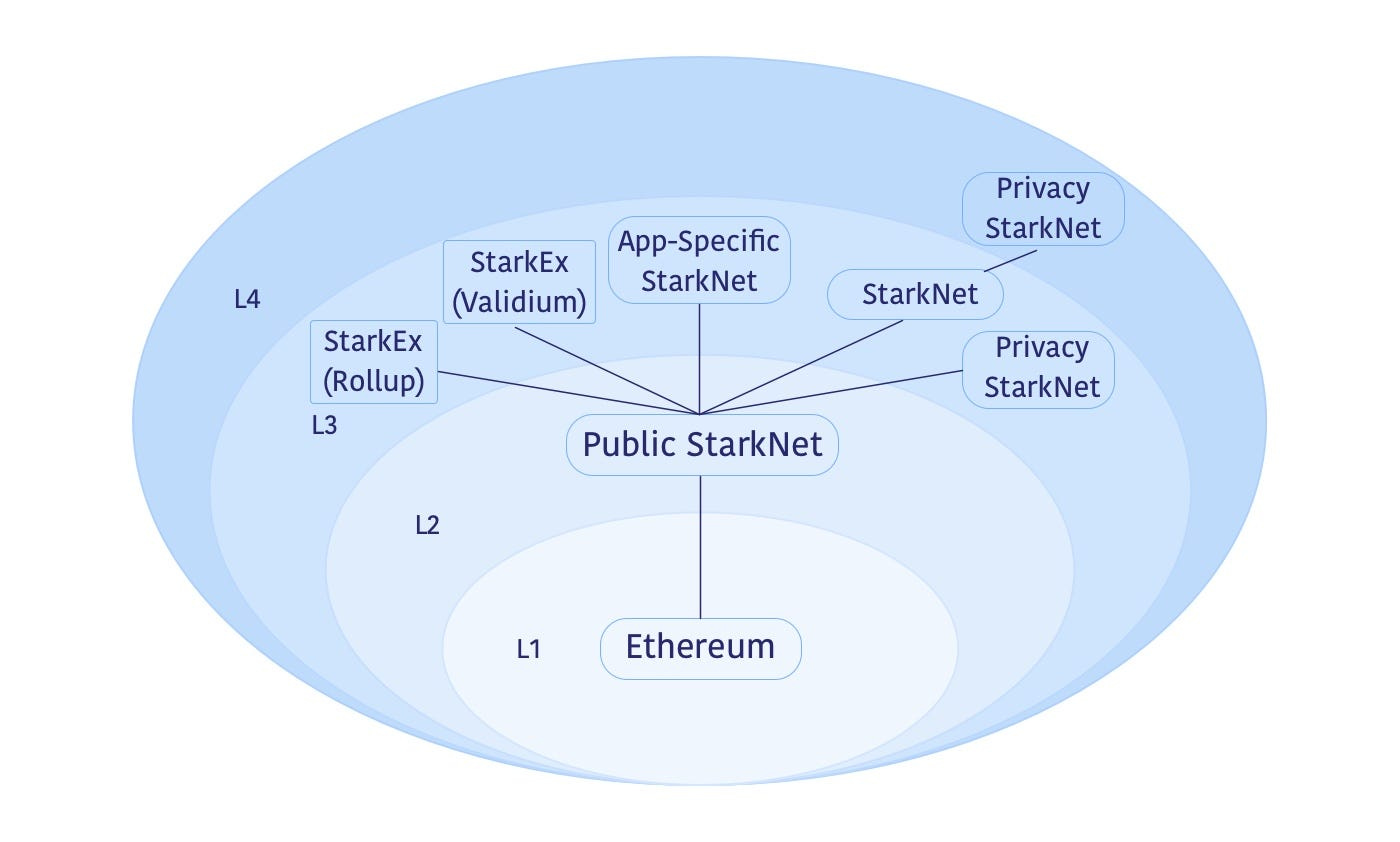
Image source: Starkware
In the Layer 3 space for blockchain gaming, B3 and XAI are two platforms attracting significant attention. Although both aim to enhance on-chain gaming performance and user experience, they differ in their implementation approaches.
B3 emphasizes scalability and multi-chain compatibility, making it suitable for cross-chain game development. However, it relies heavily on the Base ecosystem and may face limitations in non-EVM-compatible environments. XAI, built on Arbitrum’s Layer 3 architecture, focuses on boosting transaction throughput and reducing latency, making it ideal for on-chain games requiring fast transaction confirmation. While XAI is less flexible than B3 in terms of multi-chain compatibility, it achieves higher transaction processing efficiency, better serving high-performance gaming needs. In market expansion, B3 demonstrates strong performance in Asian markets, whereas XAI has rapidly gained global visibility through its collaboration with Binance Launchpool, though it may lag behind B3 in penetration within certain local markets.
How Does L3 Drive Innovation and Development in Blockchain Gaming?
The application of L3 networks in blockchain gaming primarily enhances transaction processing capabilities by optimizing consensus mechanisms and introducing data sharding techniques, ensuring rapid transfer and trading of in-game assets. This improvement effectively reduces transaction latency, allowing players to receive faster feedback during gameplay and significantly enhancing the overall gaming experience.
From a cost perspective, L3 lowers transaction fees by refining consensus mechanisms and economic model designs, easing the burden on both players and developers. Through more efficient smart contracts and virtual machine technologies, L3 improves the utilization of computing and storage resources, further reducing operational costs while boosting system performance. Additionally, L3 provides highly customizable features, enabling developers to tailor smart contracts and application logic according to game requirements, supporting complex game mechanics and interactions. This flexibility also extends to L3’s support for various digital assets (such as NFTs and tokens), offering broader options for managing and trading assets within game economies.
Moreover, L3 boasts strong compatibility, allowing integration with other blockchain networks. This enables existing game projects to smoothly migrate to L3 platforms and achieve interoperability with other blockchain ecosystems—expanding the gaming ecosystem. In practice, L3 can be used to build decentralized in-game economic systems that support asset circulation and trading, increasing transparency and security within game economies.
However, L3 still faces several challenges in blockchain gaming applications. Despite improved scalability, performance bottlenecks may persist under high-frequency transaction scenarios, leading to longer transaction confirmation times and negatively impacting player experience. From a development standpoint, while L3's modular and highly customizable architecture offers flexibility, it also increases development complexity. Developers must master multi-layered blockchain architectures, smart contracts, and cryptographic technologies—a barrier for traditional game developers. Furthermore, user experience remains an obstacle. Due to reliance on decentralized wallets and gas fees, ordinary players may encounter technical difficulties during operations. Such complexities limit the widespread adoption of blockchain games.
Overall, L3 offers a new technological pathway for the development of blockchain gaming. However, before achieving large-scale adoption, issues related to on-chain performance, development complexity, and user experience must first be addressed.
B3 and XAI: The Twin Titans of Gaming L3
B3 and XAI are two prominent L3 projects currently gaining attention in the blockchain gaming space. Both aim to advance blockchain gaming by providing high-performance, low-cost, and customizable blockchain infrastructure.
B3: A Base-Based Layer 3 Gaming Chain
B3 is an L3 blockchain ecosystem specifically designed for crypto gaming, built atop Base and developed by NPC Labs, whose team members come from Coinbase and the Ethereum community. The ecosystem aims to enhance performance through horizontal scaling and reduce transaction fees, delivering a smoother experience for game developers and players. B3 has received backing from Pantera Capital and successfully raised $18 million to fund its development and ecosystem growth.
B3’s technical architecture addresses performance challenges in blockchain gaming with the following solutions:
-
Horizontal Scalability: B3 employs a horizontally scalable architecture that supports multiple game instances running on separate chains, increasing transaction processing capacity and throughput to meet the demands of large user bases.
-
Efficient Transactions and Low Costs: As a Layer 2 network built on Base, B3 reduces transaction fees for in-game asset transfers and interactions, lowering operational expenses.
-
Multi-Chain Compatibility: B3 supports interoperability across multiple EVM chains, allowing game developers to flexibly integrate functionalities from different blockchains. It can operate as an independent game chain or connect with existing blockchain ecosystems to enable functional and asset interoperability.
-
Optimized Smart Contract Execution: B3 refines its smart contract architecture to minimize execution latency for game logic, supporting complex game mechanics and interactions while preserving blockchain security and transparency.
In addition, B3 launched the BSMNT.fun platform, integrating a game discovery engine and social interaction features, allowing players to participate in game decisions and interactions via blockchain. Over 20 game studios have joined the platform, including Mighty Bear Games and Infinigods. B3 provides development tools and documentation to help game developers easily build and deploy on-chain games, simplifying the use of blockchain infrastructure.
B3 is actively expanding its presence in Asian markets, particularly South Korea and Japan, focusing on casual and hyper-casual games, attracting numerous developers and players. On-chain game projects such as DEAR and Dino Runner 3D have already leveraged B3’s high-performance architecture and low transaction costs to deliver rich gaming experiences. Since its mainnet launch, B3 has seen continuous growth in both user and developer numbers, demonstrating its potential for expansion in the on-chain gaming sector.
XAI: An Arbitrum-Backed L3 Gaming Chain
XAI is a Layer 3 blockchain platform based on Arbitrum, purpose-built for game development and designed to provide high-performance, low-cost on-chain infrastructure for Web3 games. Driven by its native XAI token, the platform aims to simplify user experience—especially by reducing the complexity of interaction between traditional gamers and cryptocurrency wallets. XAI has completed three funding rounds, raising a total of $10 million, which will be allocated toward infrastructure development, ecosystem expansion, and developer incentive programs. Additionally, XAI became the 43rd project on Binance Launchpool, leveraging this partnership to gain greater global recognition.
XAI’s Technical Architecture:
-
Arbitrum Technology Stack: Built on Arbitrum Nitro and utilizing Arbitrum’s AnyTrust architecture, XAI ensures high security and low-latency transaction processing.
-
Low Cost and Fast Transactions: XAI supports up to 10,000 transactions per second with near-instant finality, optimized for the high-frequency transaction demands of on-chain games, while maintaining extremely low transaction costs. This enables XAI to handle large-scale asset transfers among players, making it especially suitable for frequently transacting games like RPGs or PvP battles.
-
Smart Contract Support: XAI offers SDKs compatible with Unity and Unreal game engines, enabling developers to seamlessly integrate Web3 features into their games and deploy directly on the XAI network. The toolkit also includes simplified API interfaces.
The XAI platform facilitates in-game asset trading with a streamlined transaction process that does not require cryptocurrency wallets, simplifying item trading and collection. To lower the barrier to entry for Web3 gaming, XAI introduces account abstraction and social logins, allowing players to access games using social media accounts instead of managing crypto wallets directly. This design makes it easier for traditional gamers to participate in blockchain gaming. XAI has also established a $100 million Game Incentives Fund to support innovative game development projects. Furthermore, XAI supports multi-chain interoperability, enabling cross-chain transfer and trading of digital assets, fostering an open marketplace and promoting the growth of on-chain gaming economies.
XAI’s market vision is to build an open ecosystem for game asset trading, attracting more users by lowering entry barriers. Several games are currently in development or already live on the platform, including *Crypto Unicorns*, *Planet X*, *Final Form*, and *Valeria*, spanning genres such as PvP combat and role-playing. The XAI platform has already attracted a cohort of developers and is now operating on mainnet, with future plans to further expand its ecosystem, support more Web3 game projects, and draw in mainstream gamers.
Conclusion
B3 and XAI, as two leading Layer 3 projects in the blockchain gaming arena, each leverage unique technical architectures and market strategies to significantly advance the development of on-chain gaming. B3 stands out with its multi-chain compatibility and high scalability, particularly excelling in Asian markets and showcasing notable strengths in community engagement and social gameplay. In contrast, XAI capitalizes on the Arbitrum technology stack to deliver low-latency, high-throughput gaming experiences and has achieved broad global reach through its partnership with Binance Launchpool.
Join TechFlow official community to stay tuned
Telegram:https://t.me/TechFlowDaily
X (Twitter):https://x.com/TechFlowPost
X (Twitter) EN:https://x.com/BlockFlow_News
 @ChainFeedsxyz






