AI agents are trending—here are 12 AI-powered Web3 games to watch
TechFlow Selected TechFlow Selected
AI agents are trending—here are 12 AI-powered Web3 games to watch
The integration of AI and Web3 technologies has made game development more accessible than ever before.
 Navigating Web3 tides with focused insights
Author: Conglomerate | thecoreloop
Translation: TechFlow
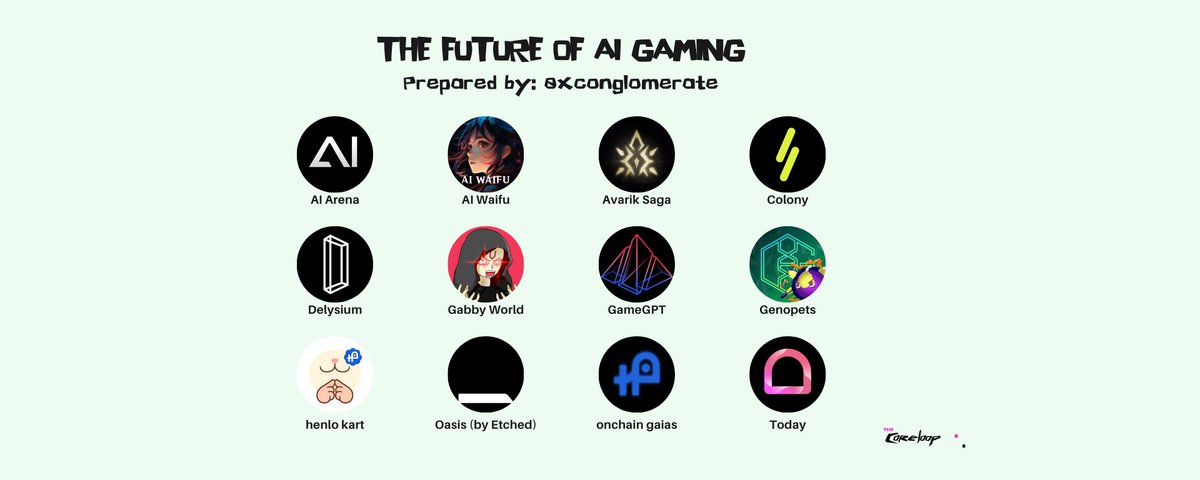
AI is currently a hot topic in the crypto space, but its integration with Web3 gaming remains in its early stages. After hours of research, I've identified areas that could generate real value. Here are my key findings:
Theme Overview
-
A Brief History of AI and Gaming
-
How Current Web2 Game Companies Are Using AI
-
The Next Chapter of AI Gaming: From Web2 to Web3
-
AI and Web3 Gaming Projects
-
Key Trends in AI and Web3 Gaming
A Brief History of AI and Gaming
Gaming has always been an ideal testing ground for artificial intelligence. Its unique responsiveness, evolving objectives, and real-time environments make it a perfect environment for advancing AI technology. Early AI development faced significant barriers, requiring predefined rules or simplified environments to function. However, these constraints led to creative solutions, making games the perfect stage for progress.
2015 was a pivotal moment: an AI agent mastered 49 Atari games solely through pixels and scores, achieving performance on par with professional human players. This breakthrough demonstrated that AI could naturally learn within complex environments, laying the foundation for today’s AI revolution.
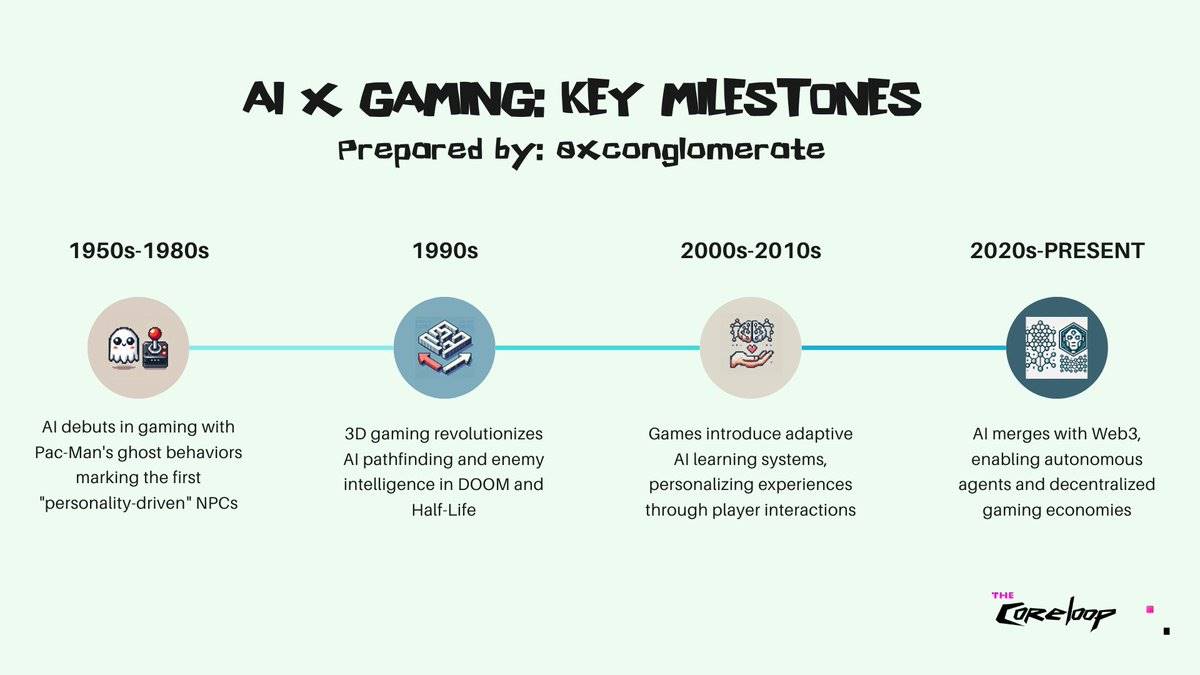
From arcade AI to autonomous agents: games have evolved from simple computer opponents to player-owned, self-learning characters in the Web3 era.
How Current Web2 Game Companies Are Using AI
Building on this foundation, leading game companies are implementing AI technologies in innovative ways.
-
Roblox (announced February 2023): Revolutionized user-generated content (UGC) in games by integrating generative AI, enabling 58.8 million daily active users to create 3D models and code via simple prompts.
-
Sony AI (announced November 2019): Focused on foundational AI research to enhance Sony's gaming business.
-
King (active since 2017): Pioneered the use of AI in game development through its AI Lab, notably using game-testing bots to reduce manual level adjustments in Candy Crush by 95% and increase development speed by 50%.
The Next Chapter of AI Gaming: From Web2 to Web3
AI has already demonstrated transformative value in gaming, reshaping how games are built, played, and experienced. While Web2 giants continue innovating, the crypto gaming space remains underdeveloped, offering enticing opportunities for AI-driven advancements.
In the following section, we'll explore pioneering projects that combine AI and Web3 to redefine the future of gaming.
AI and Web3 Gaming Projects
-
Players train AI-powered NFT fighters through imitation learning, analyze and improve character performance via the AI Inspector tool, and prepare for automated PvP battles.
AI Waifu // @aiwaifugg // $WAI
-
A fantasy character platform where AI enables personalized conversations, comic generation, and voice interactions across hundreds of community-created characters and scenarios.
Avarik Saga // @avariksaga // $AVRK
-
A mobile RPG where AI-powered demigods interact with players both in-game and through LLM-driven dialogues on popular messaging apps.
Colony // @ParallelColony // $PRIME
-
An AI-driven strategic survival simulation game where AI agents, called "Avatars," continuously learn from their surroundings.
Delysium // @The_Delysium // $AGI
-
Began as a battle royale MMORPG featuring AI virtual beings; now building Lucy—an AI-powered Web3 operating system—on the YKILY network.
Gabby World // @gabby_world_ // $GABBY
-
The first fully autonomous AI world, where all elements—from characters to storylines—are generated on-chain based on user-created prompts.
-
Read: Re-introducing Gabby World: The First AIGC Autonomous World
GameGPT // @Gamegptofficial // $DUEL
-
Offers an AI-powered game builder that empowers creators with rapid, collaborative game development, democratizing creation and unlocking immersive experiences at unprecedented speed.
-
A "move-to-earn" game where every step powers an AI-driven digital pet, converting physical activity into gameplay progression and valuable AI training data.
henlo kart // @henlokart // n/a
-
A hamster racing mini-game launched by the Onchain General Intelligence (OGI) network—a decentralized platform supporting the creation, training, and deployment of open, decentralized AI agents.
Oasis // @Etched // n/a
-
The first fully AI-generated playable game world, where players can explore, build, and destroy endless procedurally generated environments powered by advanced AI rendering technology.
onchain gaias // @onchaingaias // n/a
-
General Artificial Intelligence Agents (GAIAs) bring decentralized, player-trained AI agents into games, allowing users to shape, train, and benefit from agents within a community-driven ecosystem.
Today// @todaythegame // n/a
-
A social simulation game where AI-driven island residents create unique, personalized interactions and drive a player-owned virtual economy.
Note: This overview is based on current research and represents only a selection of AI and Web3 gaming projects, not an exhaustive list. Information provided is for educational purposes only and should not be considered financial advice.
Conclusion
AI and Web3 are fundamentally reshaping the gaming landscape, delivering personalized experiences and empowering players to actively shape virtual worlds. We're moving beyond basic AI functions into fully autonomous environments where every player decision matters—transforming players from passive consumers into empowered participants.
Projects like AI Waifu and Today are more than entertainment platforms; they're evolving into social ecosystems where AI-driven characters form deep personal connections and fuel player-owned economies. The integration of AI training through gameplay, as seen in Genopets and AI Arena, further underscores this shift toward player-centric value creation.
Perhaps most importantly, the convergence of AI and Web3 technologies is making game development more accessible than ever before. Projects like GameGPT and Oasis demonstrate how AI tools are breaking down traditional creative barriers, enabling anyone to participate in building new virtual worlds. This shift, combined with the rise of autonomous AI agents and player-owned data, suggests we're witnessing the early stages of a gaming revolution—one where the boundaries between players, creators, and AI blur into a single, dynamic ecosystem.
Join TechFlow official community to stay tuned
Telegram:https://t.me/TechFlowDaily
X (Twitter):https://x.com/TechFlowPost
X (Twitter) EN:https://x.com/BlockFlow_News
 @0xconglomerate