In Conversation with Joey Krug, Partner at Founders Fund: Exploring Entrepreneurial Journeys and Technical Challenges in the Cryptocurrency Space
TechFlow Selected TechFlow Selected
In Conversation with Joey Krug, Partner at Founders Fund: Exploring Entrepreneurial Journeys and Technical Challenges in the Cryptocurrency Space
Successful crypto founders possess strong persuasiveness, enduring perseverance, and an outstanding work ethic.
 Navigating Web3 tides with focused insights
Host: Imran Khan, Co-founder of Alliance
Guest: Joey Krug, Partner at Founders Fund
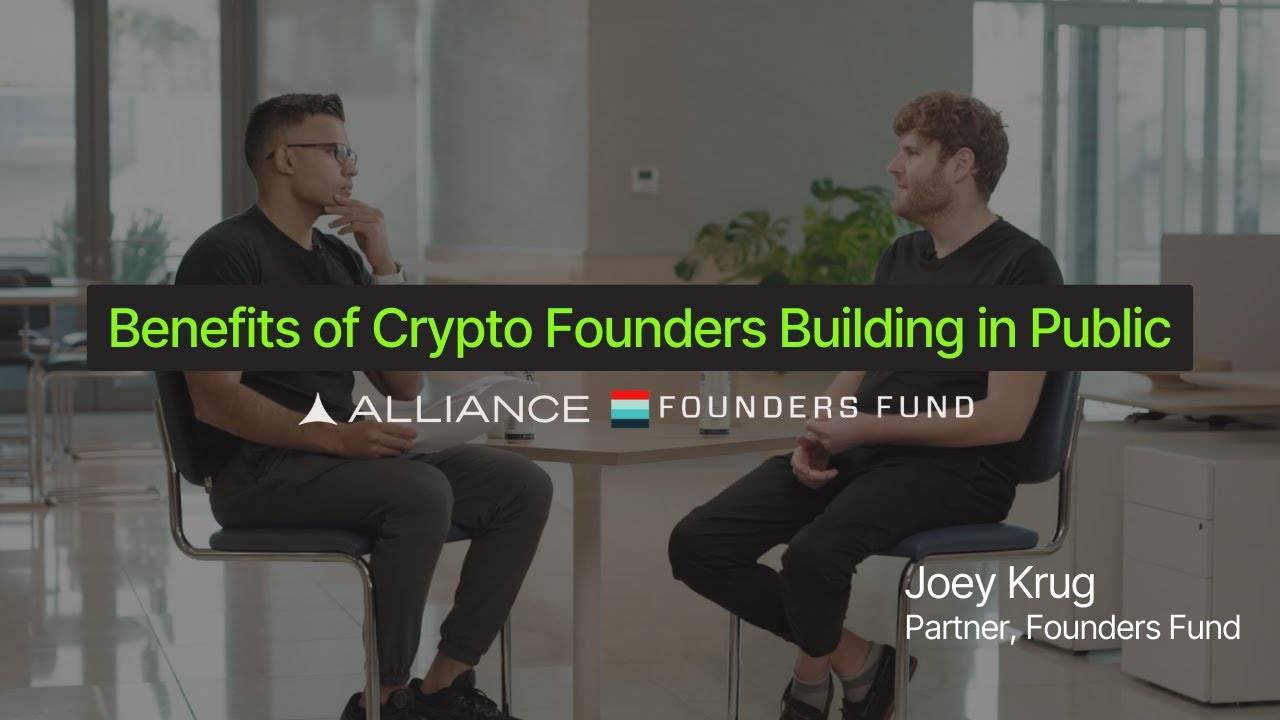
In the world of venture capital, Founders Fund is nothing short of legendary.
In 2002, Peter Thiel, known as the "Godfather of Silicon Valley," sold PayPal—the company he co-founded—for $1.5 billion to eBay. In 2005, he established Founders Fund, primarily investing in consumer internet companies and securing early stakes in now-iconic Silicon Valley firms such as Facebook, SpaceX, Palantir, LinkedIn, and Spotify. Today, Founders Fund manages over $12 billion in assets.
In April 2024, Alliance, the largest accelerator in the crypto space, announced a strategic long-term investment from Founders Fund, with the size undisclosed. As part of the deal, Founders Fund will provide support to Alliance’s portfolio companies.
As a “bonus” to this investment, Imran Khan, co-founder of Alliance, sat down with several partners and the marketing lead at Founders Fund—most of whom have direct startup experience—to discuss how founders can drive sales and growth in startups, build crypto brands, find the right co-founders… condensing years of entrepreneurial wisdom into one conversation.
TechFlow has translated this dialogue series into Chinese for our readers.
Overview
In this interview, Joey dives deep into his experience with the Augur project and his role and investment strategy at Founders Fund. He analyzes the challenges and opportunities in crypto prediction markets, explores how advancements in blockchain technology impact emerging companies’ strategies and operations, discusses leveraging social media platforms like Twitter to promote blockchain projects, and addresses handling potential security risks. The entire conversation offers profound insights into the future direction of blockchain technology, providing high reference value for entrepreneurs and investors alike.
-
Joey's Background: Joey first encountered cryptocurrency in 2014 through building prediction markets on Augur. In 2017, he became Chief Investment Officer at Antera Capital, where he worked for nearly six years before joining Founders Fund, focusing on cryptocurrency and other areas of interest.
-
Advice to His Younger Self: If Joey could speak to his younger self, he would advise staying on his current path of exploration and optimization, focusing on building meaningful subcomponents to support large-scale projects like Augur rather than making drastic changes.
-
Predicting Product-Market Fit (PMF): Prediction markets are challenging both inside and outside crypto, typically succeeding only in specific domains like elections and sports betting. Joey believes crypto-based prediction markets have yet to achieve true product-market fit due to lacking essential infrastructure and tools.
-
Meme Coins: Regarding memes, Joey views them not as real prediction markets but as trend-based trading instruments. These tokens reflect the热度 around certain events or themes but don’t necessarily predict outcomes.
-
The First 100 Users: Joey notes that Augur sees users more as participants than traditional customers. As an open-source project, Augur didn't actively pursue user acquisition; users came organically based on interest in its functionality.
-
Customer Acquisition in Crypto: Joey emphasizes the importance of building publicly in crypto, as transparency and community trust are essential. He highlights using platforms like Twitter to increase visibility and attract users.
-
Building in Public: Open development enhances transparency and earns community support. Though it may invite criticism, it ultimately helps improve and iterate the product.
-
Security First: Security is paramount in crypto projects. Joey recommends rigorous code audits and generous bug bounties to prevent vulnerabilities and strengthen overall security.
-
PMF Before Token Launch: Projects should confirm product-market fit before introducing a token or conducting an airdrop. Joey warns against launching a token too early, which could distort demand signals.
-
Building on Ethereum: For founders building on Ethereum, Joey suggests considering direct deployment on Ethereum, Layer 2 solutions, or rollup-as-a-service options, choosing the technical framework best suited to their project’s needs.
-
Shifts in the Crypto Landscape: Joey discusses major shifts in crypto, such as Alchemy’s pivot from offering data to providing RPC infrastructure—an example of how projects must adapt as market demands evolve.
-
Characteristics of Successful Crypto Founders: According to Joey, successful crypto founders possess strong persuasion skills, relentless perseverance, and exceptional work ethic. They effectively sell their vision to stakeholders and push forward through continuous effort and refinement.
Below is the full transcript of the conversation:
Joey's Background:
Imran: Joey, can you briefly introduce your background?
Joey:
I entered the crypto space in 2014 through the Augur prediction market. In 2017, I served as CIO at Antera Capital for nearly six years. I left earlier this year and joined Founders Fund, spending about 80% of my time on crypto and the remaining 20% on other areas of interest.
Imran: I got into crypto around 2013, and one of the first applications I saw was Augur. A lot has changed since then—back then we didn’t even have enough wallets or computers, on-ramps or off-ramps. If you could go back and talk to your younger self, what would you tell him?
Joey:
I think there are two things I’d say. One is, if you’re just optimizing and building something interesting, don’t change much—you’re already optimizing to build like a startup or valuable company. In hindsight, I might have built smaller subcomponents to make Augur work. Many problems we faced were later solved by others. For example, we had minor node hosting issues—Alchemy emerged and fixed that. Another issue was accessing on-chain data and integrating it into the UI—that’s what The Graph eventually tackled. Another problem was, we needed a decentralized exchange for a decentralized prediction market, so we could’ve built a DEX. In fact, prediction markets were among the earliest AMMs on Ethereum. There were many missing pieces—it was like trying to build an electric car before lithium-ion batteries existed.
Product-Market Fit (PMF) in Prediction Markets
Imran: Even though we now have excellent developer tools and diverse resources, and the Ethereum ecosystem continues to expand and mature, prediction markets today still resemble gambling sites in some ways. But when you look specifically at crypto-native prediction markets, they still haven’t found strong product-market fit. Why do you think that is?
Joey:
I think it’s just a hard product to build, whether in crypto or outside of it. Historically, prediction markets have gained traction mainly in specific areas—like U.S. presidential elections, which happen every four years, or congressional midterms. They’ve also been popular in sports betting. But for everything in between, no one’s really cracked it. The closest thing I’ve seen is what Polymarket is doing—Sam Bankman-Fried’s markets and similar efforts. I think it’s just one of those very challenging markets.
On Memes
Imran: What do you think about the spread—or commodification—of memes? Or whether memes represent certain themes. Recently, Elon Musk had a falling out with Bob Baig, and some themes from that conversation turned into tradable tokens. Do you see this as a form of prediction market, or more of a trend-based trading mechanism?
Joey:
A prediction market pays out based on an outcome at a specific point in time—people get rewarded based on their predictions for that event. Many people trade around memes, but I don’t think they are prediction markets. They’re definitely a strange kind of financial market—another category altogether.
The First 100 Users
Imran: Back to Augur—how did you acquire your first 100 users?
Joey:
We don’t view users as traditional customers—Augur is a decentralized platform allowing users to autonomously create prediction markets. There’s no clear answer to how we got the first hundred users because Augur was more like an open-source project than a startup. We never actively tried to acquire users or run marketing campaigns. We did talk about what we were building, but from a regulatory standpoint, we didn’t want to pay for user acquisition activities. We simply wanted to write the code and release it.
To answer more directly—where did the first 100 users come from? Mostly people interested in prediction markets. Some were traders or bettors who liked sports betting. Those who enjoyed sports betting often liked betting on non-sports topics too. They believed they had an edge. At the time, almost no one else was doing prediction markets, so if you were into this niche area, you’d likely hear about Augur and try it.
User Acquisition in Crypto
Imran: Compared to traditional industries, customer acquisition in crypto is limited in channels—we mostly rely on Twitter. That’s how I discovered Augur. Every crypto founder wonders: how do you manage Twitter effectively to achieve the growth needed for your startup? Maybe we can start from the basics—how did you build those channels on Twitter?
Joey:
When I was working on Augur, early on we publicly released the whitepaper—we posted it on Reddit and Twitter. As soon as we had a codebase, we published it and open-sourced it on GitHub. After building for a few weeks, I just wanted something tangible to compile. Then, whenever we made updates, we posted them on a blog so people knew what developments were happening. Another thing we discussed was interesting potential use cases. Two of my favorites—I used them frequently—were: What’s the probability of Russia invading Ukraine? And will SpaceX’s next rocket launch succeed? Talking about theoretical applications excited people, and then they started using it in their own ways.
Building in Public
Imran: What advice would you give to founders who are hesitant about building a social media audience? Why is this so important for crypto founders?
Joey:
I think building in public is crucial in crypto. If you don’t, people won’t trust you. Some build closed-source smart contract systems, but people don’t truly trust them, and they rarely gain attention. Another reason is that people need to know what you’re building. Crypto isn’t like traditional SaaS startups, where you can hire a sales team and cold-call other companies. Some crypto companies do that, but it doesn’t apply to protocols or end-user-facing products. You can’t acquire users the traditional way. So I believe it’s critical that either you, your co-founder, or someone on the founding team understands how to go to market and promote in the crypto space. I’ve invested in teams that didn’t do this—they either quickly hired someone, brought in someone as a de facto co-founder, or were just lucky with timing and product. Without talking openly, the project simply wouldn’t work.
Imran: What mistakes did you make while building in public?
Joey:
When building in public, people who aren’t closely following the project may not understand what changes or updates have occurred. We had in-depth discussions and consensus-building processes within the community, but occasionally repeated concerns arose—usually already addressed in prior conversations. Most of the time, the best solution is to link people to previous discussions, where most of their concerns were already covered. Occasionally, someone raises a new point no one thought of, which might lead to protocol design changes—this is another upside of public building, strengthening the system.
One interesting thing about Augur is that it’s one of the oldest smart contract systems on Ethereum, and also one of the most complex, with numerous contracts and a high line count. We patched some security vulnerabilities in later versions, but it never suffered a major hack or fund loss. I think public building played a key role—many issues were caught by the community.
Security First
Imran: Is security still the most critical element in crypto? Many compare it to building rockets in public. How do you view the process for new founders building public infrastructure? What security parameters and frameworks should they consider before a beta launch or going live?
Joey:
To ensure security, first have top-tier audit firms review your code. Second, offer generous bug bounties for critical vulnerabilities. Also, pay attention to rare edge cases—they’re often where risks hide. As often seen in post-mortems of security incidents, someone previously raised concerns about a code section. You can patch it and refactor slightly. People often say, “It can’t actually be hacked,” but when you find yourself thinking that, you’re usually wrong. So clean, simple code is extremely important—you can’t underestimate it. Beyond that, for beta releases, consider hard limits on-chain or simply encourage users not to deposit large amounts. Finally, if someone finds a vulnerability, pay the bug bounty. Many projects have a track record of not paying or offering small rewards—and then they get hacked.
Imran: I don’t know if you’ve seen protocols where a startup gets hacked. In such cases, what should they consider? Or if they are hacked, can you offer any guidance?
Joey:
There’s not much you can do after being hacked—everything becomes reactive. First, alert others in the ecosystem that you’ve been compromised. Second, contacting law enforcement is necessary, though they’re slow—they eventually act. I remember someone got hacked in 2016, and it was resolved a year later.
Another thing: if restarting the protocol, proceed cautiously to avoid re-exploitation. Many projects get hacked—sometimes by someone with minimal funds who triggers an attack, or ethical hackers detect the flaw, drain the funds, and return them. Often, they restart quickly—then get hacked again, this time by a malicious actor, and the money disappears.
PMF Before Token Launch
Imran: Now shifting to markets—projects bring elements like crypto tokens. How should founders approach building in public while also having token or airdrop potential? How should token systems be designed?
Joey:
I think the best thing you can do is not mention tokens, airdrops, or anything similar—this way, you’ll know if your product fits the market. Prioritize product-market fit. We invested in a company called Seen Futures—I recall they wanted a certain level of traction before launching a token, so they’d know their PMF was real. But you must be strict—don’t mention tokens. DYDX is a good example. There’s no single right answer, but there’s likely a wrong one: adding a token before achieving PMF clouds your judgment. You need to optimize before launching the token.
Advice for Building on Ethereum
Imran: New founders are looking to build on Ethereum. Since Augur, a lot has changed—what advice would you give to founders wanting to build on Ethereum?
Joey:
From a technical perspective, my advice is there are three main options today. One, you can deploy directly on Ethereum mainnet itself—if your app requires deep integrations or other dependencies, that might be the choice. Second, you can launch via rollup-as-a-service, like Caldera, or arbitrary L3s. This model is useful if your app needs blockchain benefits—say, connecting to USDC or ETH—but once launched, doesn’t need much else. Prediction markets are a great example—if I were building Augur today, I’d probably use Caldera or something similar. The third category involves building natively on an L2, where being on Arbitrum makes sense—say, building a DEX for Arbitrum.
Beyond tech, I think the most important thing is hiring a team—everyone should be highly intelligent, forming a well-balanced team. You need a brilliant engineer, a brilliant marketer. Eventually, you need a strong operator. Make sure you set a very high bar for hires and foster strong cohesion—this is the most important thing.
Major Shifts in Crypto
Imran: You spent six years as an investor. One thing I’m curious about is: what’s the biggest pivot you’ve heard of in crypto? It’s rarely discussed publicly, but I wonder if you’ve seen any major transformation stories in crypto, and what lessons can be drawn from them.
Joey:
The biggest pivot I can think of is probably Alchemy. Alchemy originally provided data to hedge funds, building all the infrastructure to access Ethereum blockchain data and bundling it for sale. Their on-chain analytics offered clustered address data faster. They eventually realized the infrastructure they built for RPCs was far more valuable—many startups struggled with unreliable internal data when trying to build. That’s probably the biggest pivot I can recall.
Imran: When you started building Auger, there were many different directions possible—one of which could’ve solved major pain points for many customers.
Joey:
A great example is Instagram—it started as an app for posting whiskey photos. The founder’s wife said, “That’s silly—let people post photos of anything.” She encouraged adding filters. It began as a niche market, but by adjusting what they built, it became massive.
Traits of Successful Crypto Founders
Imran: You’ve been in this space for over ten years—you’ve seen the good and the bad. What traits do successful crypto founders share?
Joey:
I think outstanding founders share some common traits. One is they’re extremely persuasive. For example, if you ask people about a particular founder, you often hear comments about their persuasiveness. There’s a mental model: imagine someone threatening your life, demanding you drive continuously for 24 hours or more. If you fall asleep, they’ll shoot. Now imagine the company’s founder and CEO sitting beside you—no music allowed, only conversation. Can they talk you awake? This tests their sales ability—can they convey ideas and visions effectively to customers, potential employees, and investors?
Second, great founders have incredible perseverance and work ethic. Like Charlie Munger mentioned in an interview—even with past mistakes, he believes avoiding them could’ve led to even greater success. This mindset reflects truly great founders: no matter their achievements, they always feel they could do more, better.
You can observe these traits in conversations with founders—take Alchemy’s team. I noticed despite a small team supporting customer service, they respond rapidly—messages sent at 3:30 a.m. get replies within five minutes. This on-demand responsiveness reflects not just excellent support but a deep hunger to win. Great founders rarely build companies just to make money or do something—they’re driven primarily by a desire to win. This attitude is the key force behind their business success.
Join TechFlow official community to stay tuned
Telegram:https://t.me/TechFlowDaily
X (Twitter):https://x.com/TechFlowPost
X (Twitter) EN:https://x.com/BlockFlow_News
 Alliance