








Conversation with Wang Qiao: Currently, cryptocurrency tokens don't appeal to me much; I went all in on Google in 2026.
TechFlow Selected TechFlow Selected
Conversation with Wang Qiao: Currently, cryptocurrency tokens don't appeal to me much; I went all in on Google in 2026.
"In terms of health, the most important aspects are still the three fundamentals: diet, sleep, and exercise."
 Navigating Web3 tides with focused insights
Compiled & Translated: TechFlow
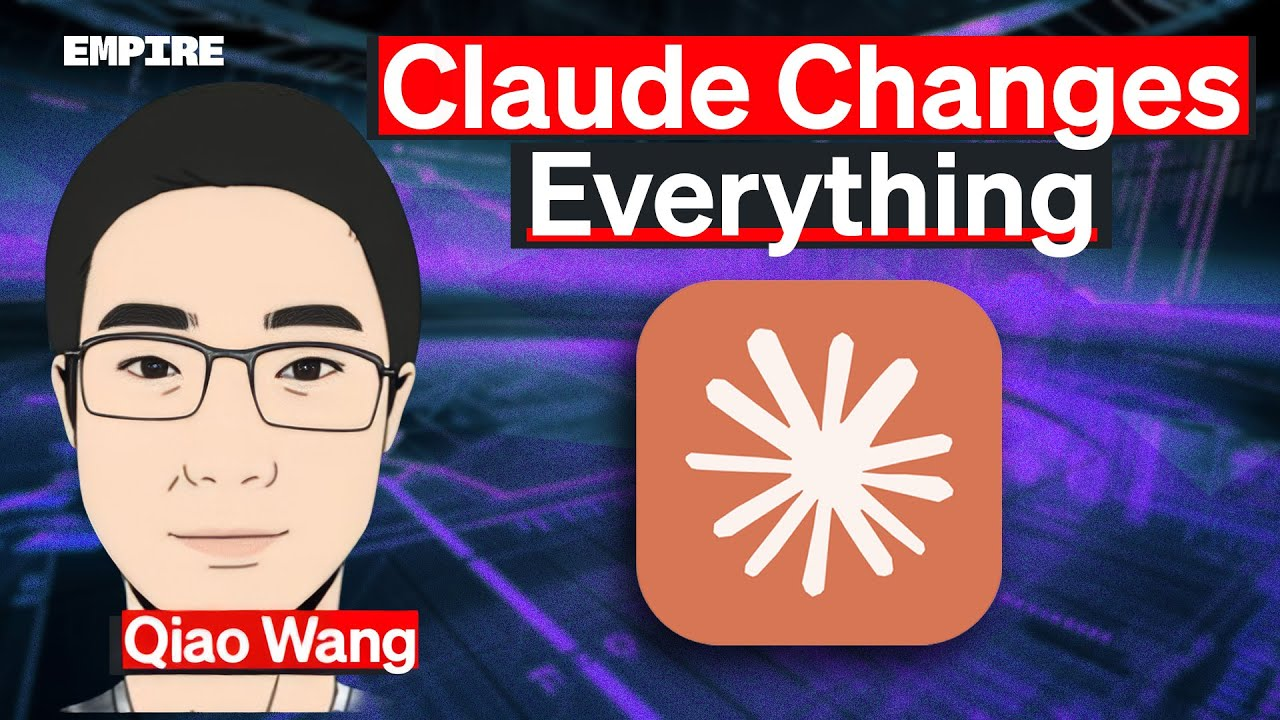
Guest: Qiao Wang
Host: Jason Yano
Podcast Source: Empire
Original Title: Claude Opus 4.5’s Breakout Moment & Investing in 2026 with Qiao Wang
Air Date: January 12, 2026
Key Takeaways
This week, Qiao Wang joined the show to discuss how AI is redefining what it means to be an investor in 2026. We dove into topics such as the breakthrough moment of Claude Opus 4.5, Qiao's rationale for investing in Google, how to build a 2026 investment portfolio, and how to allocate time wisely in the age of artificial intelligence.
Highlights Summary
- Market sentiment is overly optimistic right now.
- "About 40% of my portfolio is in cash."
- Crypto tokens aren't particularly attractive at the moment, but opportunities always exist—focus on analyzing individual assets rather than entire asset classes.
- My allocation between stocks and Bitcoin is roughly 50/50.
- My largest investment is Google; I also hold Tencent stock, which is an excellent company.
- An overlooked area by the market today is AI-driven biotech—the potential of AI in biotechnology is enormous.
- By 2026, we might see unicorn startups with only one or two people.
- Some of the most successful AI startups aren’t companies like ChatGPT or OpenAI, but smaller businesses leveraging AI effectively.
- The essence of company moats hasn’t changed, but software moats are eroding rapidly.
- Code itself is no longer the bottleneck—it's all about crafting the right "prompt".
- Gemini is undervalued by at least two orders of magnitude. “I’d happily pay $2,000 per month for Gemini.”
- I think Adobe could be this year’s Google—its valuation is very cheap, and market perception resembles that of Google back then.
- Everyone should learn to code—and must learn—using automation tools to optimize parts of their life and work.
- These AI tools make already efficient and capable people even more effective and smarter.
- In terms of health, the three fundamentals remain paramount: diet, sleep, and exercise.
Qiao’s 2026 Investment Portfolio
Yano: About a month ago, you mentioned your concerns about current market conditions and referenced the dot-com bubble era—for example, someone predicted in 1996 that the market was peaking, yet it continued rising for another three years.
Also, I saw one of your tweets discussing the relationship between forward P/E ratios and next decade returns. You presented counterarguments, but ended with: “I’m still scared.” I’m curious—what’s your current view on the market?
Qiao:
The reason I feel afraid is because market sentiment is overly optimistic right now. I can’t say everyone feels this way, but you can see many people on social media boasting about their investment gains, especially after last week’s volatility—the mood is clearly evident. Quantitatively, valuations are near historical highs. Of course, some argue that corporate earnings power is stronger, competitive advantages deeper, economic structures more solid, and monetary easing supports higher valuations. But regardless, we can’t deny that valuations are historically elevated. That’s why I haven’t fully committed to risk assets. In fact, about 40% of my portfolio is in cash. While I may miss out if the market keeps climbing, at least I can sleep better at night.
Yano: I listened to DeRooke and Muller’s interview where he said: “In my 50-year investing career, this is the hardest time I’ve ever had predicting the market.” If even DeRooke can’t predict it, how can ordinary investors possibly do so?
Qiao:
That’s exactly why I focus more on individual stock picking. The overall market may look expensive, but when you examine individual companies one by one, sometimes you find highly attractive opportunities. This reduces your fear even if the broader market declines. During the 2000 tech bubble, while tech stocks performed poorly over the next decade, small-cap and value stocks did well, averaging around 10% annual growth. I believe this is the golden era for stock pickers.
Yano: What’s your take on investing in stocks versus crypto tokens today?
Qiao:
Right now, I don’t find crypto tokens particularly attractive, but opportunities do arise—like in 2022, when there were many compelling investments. So I remain focused on analyzing assets individually rather than judging whole asset classes. Overall, few assets look appealing now except the US dollar. But when analyzed individually, some opportunities emerge. As for crypto, I still hold Bitcoin and a small amount of tokens, but the total allocation is tiny.
Yano: If we break down your portfolio—40% cash—how much of the remaining 60% goes to stocks versus crypto? And within crypto, what’s the split between Bitcoin and other assets?
Qiao:
Between stocks and Bitcoin, it's roughly 50/50. I still hold a significant amount of Bitcoin, though this isn’t my ideal portfolio—if I sold, I'd face high taxes. Token exposure is minimal, less than 1%.
Yano: Which stocks do you currently hold?
Qiao:
My biggest investment is Google. I also own shares in Tencent. Tencent is an outstanding company—low-key in operations but fundamentally strong.
Yano: Do you prefer Tencent over Alibaba?
Qiao:
Yes, currently. Alibaba has strengths in AI, but its e-commerce business faces fierce competition. I also hold some Amazon stock. Last year’s sentiment toward Amazon was negative—all major tech stocks rose except Amazon. Plus, I’m bullish on Amazon’s robotics initiatives. All these are long-term holdings—my horizon is ten years.
Yano: Amazon is indeed leading in robotics—they might become the first large company with more robot workers than human ones.
Qiao:
Over the past five years, Amazon’s human workforce has stayed flat, but robot headcount grew 20–30%. They’ve significantly improved margins despite modest revenue growth.
Yano: What about healthcare—Eli Lilly or others?
Qiao:
I own some Eli Lilly stock, but it’s a short-term trade, not a long-term bet—I lack deep pharma knowledge. I don’t know who’ll dominate in ten years. I know I’ll likely still use Amazon then, but pharma has too many competitors. Even though Eli Lilly has strong patents, there are cheap and effective gray-market Chinese peptides competing directly.
I believe an underappreciated area today is AI-powered biotech. Everyone focuses on robots, drones, chatbots—but the potential of AI in biotech is massive.
Yano: How about automotive and fintech? Do you hold Tesla or Rivian?
Qiao:
No—Tesla’s valuation is too high. I don’t know enough about Rivian.
Yano: What about fintech—Robinhood or Coinbase?
Qiao:
Valuation-wise, Coinbase looks more attractive, but neither is a truly great investment. I own Coinbase, while Robinhood is overvalued.
Yano: Do you think the West will develop a super app like 'Wanshitong'?
Qiao:
You mean an all-in-one app like WeChat combining messaging, payments, social? There are trends in finance—like Robinhood. But a full-spectrum lifestyle super app? I don’t see that happening yet.
The Breakthrough Moment of Claude Opus 4.5
Yano: Let’s talk about Claude and Opus 4.5. A good starting point is your tweet saying “Oh my god, this ends it.” Over recent years, a few moments gave me that same feeling: ChatGPT’s launch, the first reasoning model, and Tesla FSD V13. Why was Opus 4.5 a ‘holy shit’ moment for you?
Qiao:
I can’t explain what happened under the hood, but I can share my user experience. The last time I wrote code seriously was three years ago—before that, from 2010 to 2017, before entering crypto, I worked in quant trading, coding daily—from low-level C++ to advanced Python data science. I spent seven years doing this, plus front-end and back-end. After leaving Messari, I stopped writing serious code—only occasional personal projects once a year.
With Opus 4.5, it’s different. Before, you could quickly prototype something, but the final 5% always required an expert engineer to fix bugs and edge cases. Now, with Opus 4.5, I just tell it in plain English what I want, give a clear and comprehensive spec, and if the spec is good enough, it delivers in one shot.
Claude and Opus might be going through a Twitter hype cycle—I have engineer friends saying OpenAI’s latest GPT-5 Pro is nearly as good as Claude.
Yano:
I’ve used both, but Opus was the first tool that made me switch from ChatGPT. ChatGPT’s memory feature made me dependent—I thought I’d stick with it forever since it knows everything about me. But now, Opus 4.5 surpasses it for me.
There’s a new way of working now—I’m not sure whether to call it a chatbot anymore, as the line blurs. For example, I recently used Opus 4.5 to solve a problem: At Blockworks, our eight-person sales team needs to assign accounts and prioritize them—Tier 1, Tier 2, etc. Each rep has preferences—say, 10 Tier 1s, 30 Tier 2s, 100 Tier 3s. It’s messy. So I handed it to Claude, feeding in relevant data. I told it: if a token’s FDV exceeds $1B, boost its priority; even better if the project is public.
Claude pulled data from CoinGecko, CoinMarketCap, ranked accounts, analyzed eight years of each rep’s transaction history with Blockworks, understood what products they sold, and assigned accounts based on likelihood of closing deals.
Qiao:
I noticed the same during holidays—the boundary between general chatbots and traditional coding is fading. When you talk to a general chatbot, it generates code on the fly based on your needs. Now, when you need code, you don’t write it—you express your needs in simple natural language and get results. The functions of code assistants and chatbots are converging.
Yano: Exactly. Then why not use Replit or Lovelace for your Vibe coding tasks? Why choose Claude?
Qiao:
I think they target different users. I haven’t tried the latest Lovelace, but it seems geared toward users wanting quick, visually appealing demos or simple apps—great for front-end, though I haven’t tested it myself. I started with Cursor + Opus 4.5, then tried Claude + Opus 4.5. Honestly, in productivity gains, I didn’t notice a big difference—they perform similarly for me, but that’s just personal experience.
How AI Is Transforming Startups
Yano: You've seen thousands of crypto startups grow—how is AI affecting them now?
Qiao:
AI’s impact on startups is huge—especially evident in the past three years. I routinely ask every group, especially technical co-founders of startups: Since ChatGPT launched in 2022, how much has your productivity increased? The answer keeps getting higher. Recently, one team said 3x to 4x gains.
This effect is stronger in early-stage startups than in large late-stage firms, due to the “context window” limit of code assistants. Say Claude handles a million tokens—it excels at launching new projects efficiently. But asking it to modify Google’s entire codebase? Nearly impossible. So these tools benefit small startups far more than big corporations.
In large companies, the best way to use code assistants is by establishing clear abstraction layers between departments. Break complex tasks into chunks, narrow context scope, feed into AI—making it easier for the system to understand.
Yano:
But I think calling it “productivity” undersells AI’s impact, especially for early startups. For a 100-, 200-, or 1000-person company, 3x–4x productivity is transformative. But for early startups, they don’t even think in those terms. Their mindset is: Why hire more people? I see this often in companies I invest in and friends’ startups.
They realize, with AI, we don’t need to hire anyone else. It’s fascinating. Recently, I built two sales tools: One is a sales commission calculator. Sales reps kept asking how much they’d earn. Previously, we needed finance help—tedious for them. Now the tool solves it instantly.
The second is a sales dashboard estimating cost. Previously, we relied on data teams—whether using Dune or Gold Sky to index data. If not, extra fees applied. Now I built a dashboard cost estimator across all platforms.
Why does this matter? It means we don’t need to hire a dedicated sales support person. By 2026, we may see unicorns run by just one or two people. Such startups may already be underway—not yet $1B valuation, but growing fast.
Qiao:
Absolutely. I know many individuals running subscription businesses with $10M annual revenue—often ex-Meta or Uber engineers tired of corporate bureaucracy, now building solo.
Yano:
But here’s an interesting trend: some of the most successful AI startups aren’t giants like ChatGPT or OpenAI, but small companies quietly leveraging AI. They avoid disclosing core operations. Usually, if a startup thrives with fast-growing revenue, founders shout it from rooftops—to raise funds or gain social media traction.
Do Moats Still Exist?
Yano: What’s your view on company moats? Will the definition evolve?
Qiao:
The essence of moats hasn’t changed, but software moats are eroding fast. Early startups have almost no moat. Giants like Facebook, Google, Microsoft, Apple still have strong ones. AI code assistants won’t destroy these. Apple’s moat is its developer ecosystem. Microsoft’s is the high switching cost from PCs. In cloud, AWS, Azure, and Google GCP benefit from costly migrations. Platforms like YouTube possess vast proprietary data to train powerful video models. Microsoft’s enterprise software—tools like Office—are mission-critical. Sure, you can replicate Office features, but will enterprises actually switch? No—the cost is too high.
But I’ve noticed one of the biggest undervaluations in financial markets today: Adobe. Photoshop and Creative Suite are iconic. Some believe new video and image generation models will replace Adobe. I think that’s completely wrong—Adobe’s real moat lies in enterprise integration. Many pro users store images and videos in Adobe Cloud. Switching away is extremely costly for creative professionals.
Plus, creatives have used Photoshop for years—muscle memory is deeply ingrained. Switching tools is painful. Hence, Adobe trades at just 12x P/E—a shocking undervaluation for such a high-quality business.
Yano: Suppose you’re at a mature startup—500 employees, operating for ten years. How should the company adapt? Young entrepreneurs may grasp these tools quickly, but established firms struggle. Employees might just dump things into ChatGPT and send automated emails.
Qiao:
You can’t force adoption—you must let teams discover AI applications that deliver immediate, visible impact. By the way, that’s exactly what we did at Alliance over the past three years. We knew AI would be big, declared ourselves “AI-first,” but didn’t impose AI everywhere.
Instead, we used AI to automate specific processes. For example, we receive thousands of applications yearly. Three years ago, I personally reviewed ~5,000 annually—exhausting. Now, AI automates about 50% of that work.
Yano: How did you do it? Did you use Opus 4.5? How was the system built? Inputs? Outputs? Why only 50%? Why not 99%?
Qiao:
Yes, our engineers built the software. Today, code itself isn’t the bottleneck—the key is designing the right “prompt.” I won’t call it a secret weapon—everyone knows traits of great founders.
I converted those heuristics into prompts to screen applicants. Currently, the system mainly filters out clearly unqualified candidates—not identify top talent, which still requires human judgment. AI isn’t there yet. But I believe by year-end, AI and AI-driven venture investors will outperform humans in this area.
Yano: I feel these tools are ridiculously underpriced—like Uber charging $5 from Wall Street to Upper East Side. You knew the price was wrong, but they subsidized via VC funding.
How valuable do you think these tools really are? How much are they undervalued? For instance, how much would you pay for Opus 4.5?
Qiao:
For Opus, I’m not sure yet—it depends on what I can build. But for Gemini, I believe its value is underestimated by at least two orders of magnitude. Right now I pay $20 for the pro version, and I haven’t even upgraded to Pro Plus.
Yano: If Gemini charged $2,000/month, would you pay?
Qiao:
Yes, because its capabilities are that powerful. I tweeted that it acts as a research assistant, junior researcher, junior coding helper, decent medical advisor (to cross-check doctors), and competent legal aide. Altogether, $2,000/month would be a bargain.
The Decision to Invest in Google
Yano: How much time do you spend daily on tools like Gemini and Claude? Where do you free up this time—from fewer Zoom calls? Less social media?
Qiao:
Half a year ago, I analyzed my time usage—that analysis led me to invest in Google. I checked my iPhone usage stats and found my top three apps were Chrome, YouTube, and Gemini—all Google products.
Initially, I worried ChatGPT might threaten Google Search, so I discussed it with my wife. She pointed out her main Google use case is shopping—and ChatGPT won’t displace that anytime soon. Research confirmed over half of Google’s search revenue comes from shopping ads—so its core business remains solid.
No one can challenge its position short-term. Plus, Google has GCP, TPUs—technical advantages I later recognized. All signs point to a robust moat. So last year, I decided to invest in Google—it was nearly my only major investment that year.
Yano: On New Year’s Eve, I dined with a Google employee—we discussed these topics. Everyone talked about their go-to tools. The Googler noted a widely overlooked fact: Google owns massive shopping data, and the market hasn’t fully priced this in. Are there similar opportunities?
Qiao:
I think Adobe could be this year’s Google—its valuation is cheap, and market perception mirrors earlier views of Google. I’ve never used it myself, but I know its use cases are broad.
Yano: No new users adopt Adobe. Like Google—my top apps are YouTube and Gemini. But Adobe? I don’t use it, so I assume new users won’t either.
Qiao:
But all new users use Google. A common misconception is that Adobe isn’t consumer-facing—it’s an enterprise product.
Yano: True, it’s B2B, but my company wouldn’t consider Adobe—Figma is more popular.
Qiao:
Figma and Adobe serve different markets. Adobe lost the battle for new project demos and web design—Figma dominates there. What about Canva?
Yano:
Canva targets the low end—amateurs. Adobe serves high-end enterprise users. So yes, Adobe’s user growth has stalled for years, but its pricing power is strong—subscription fees keep rising.
Time Allocation in 2026
Yano: As a Google user, I want to talk investing—but more importantly, how should we allocate our time in 2026? How will AI reshape time management?
Qiao:
I believe everyone should learn to code—and must learn. Not doing so risks falling behind. But “coding” here doesn’t mean traditional programming—it means using automation tools to optimize personal and professional workflows. I expect many B2B SaaS tools—Gmail, Zoom—will continue to be paid staples. Yet, everyone has unique workflow needs—too niche for third-party vendors to address.
Yano: Like our custom commission calculator at Blockworks—perfect example. No SaaS vendor would build that.
Qiao:
And when I say “learn to code,” it shouldn’t scare people. Technology now lets you skip complex coding. Just converse in natural language with the system to achieve automation.
So I strongly recommend trying tools—even simpler ones. Replit, for instance, was where I first grasped AI’s potential. That’s when I realized AI isn’t just a chatbot—it can build anything. This tech will transform our world. Try Replit—it’s really cool.
Yano: What impact will this gap have on the labor market?
Qiao:
It’ll be like the internet—these tools will make already efficient, capable people even more productive and intelligent, while less efficient individuals fall further behind. AI is an incredibly powerful lever for efficiency, but ultimately, it depends on how actively you embrace it.
Using AI Models for Investing
Yano: In a sense, playing devil’s advocate—was spending time building your Warren Buffett stock tracker really worth it?
Qiao:
Yes, it took considerable time. The outcome was decent, but more importantly, the process deepened my understanding of the technology.
The tool is essentially a digital clone of investment legends—Buffett, Munger, Howard Marks, Peter Drucker, Bill Miller. It scans thousands of stocks regularly, conducting deep research to simulate Buffett and Munger’s investment logic.
The coding part was simple, but designing the prompt took months of iteration. I created a detailed prompt simulating Buffett and Munger’s thought process when evaluating investments.
The process has six steps. First, a deep research model gathers information across six key areas they’d care about. Then, another API triggers a reasoning model for analysis. Deep research and reasoning are separate stages.
The deep research model excels at gathering facts and data. The reasoning model occasionally hallucinates but outperforms in logical inference. Once accurate data enters the reasoning model, its analytical power surpasses the research model.
In stage two, the reasoning model simulates a “digital Buffett and Munger” investment committee deciding whether to buy. It outputs a concrete recommendation—completing the loop.
Have you heard the theory that Renaissance Technologies discovered LLMs long before others and kept it secret—possibly explaining their stellar returns? My motivation for building the Buffett-Munger model was partly to avoid competing with Renaissance. They excel at short-term trading—day or weekly moves. On such timescales, cutting-edge AI models still struggle to compete.
Yano: Are you competing with firms like Susquehanna then?
Qiao:
Yes, but my model leans long-term. Today, almost no one holds a stock beyond five minutes—that’s where language models shine.
Yano: How do you reconcile conflicting advice from different gurus? Howard Marks vs. Peter Drucker, whose logic differs sharply from Buffett’s?
Qiao: I apply weighted averaging across their recommendations.
Yano: Did they all recommend buying Adobe?
Qiao:
Yes. Interestingly, if you run the same prompt multiple times, the model may give different answers. But if repeated runs consistently suggest buying a stock, confidence in that signal increases significantly.
It recommended about ten stocks—four were already in Berkshire Hathaway’s portfolio, like Chubb, an insurer, and Google.
How AI Will Change Branding and Distribution
Yano: How will AI change brand communication and content distribution? Take Delphi—we mentioned OpenAI’s new Sora tool. With Sora, you can clone someone’s likeness into your video. This ties into marketing and branding shifts. Soon, brand marketing will become hyper-personalized.
Qiao:
This trend has already begun. The other day, I saw a LinkedIn ad: “Hey Jason, as co-founder of Blockworks, I think you’d love Rippling.”
Yano:
AI makes ad algorithms smarter—ads become extremely precise. A few days ago, I searched “High Rocks” online. It’s a marathon-style fitness event similar to CrossFit—I’ve been training for it lately. I searched for High Rocks apps on the App Store and found several specialized training apps. But High Rocks is super niche—there shouldn’t be so many dedicated apps.
I found it suspicious, so I checked whether these apps were truly designed for High Rocks or merely targeted users searching “High Rocks.” Turns out, they’re generic fitness and nutrition apps with laser-focused advertising, so I believe this kind of customized advertising will become increasingly common.
Health and Longevity
Yano: What’s the most impactful change you’ve made for health?
Qiao:
Ultimately, it comes down to three fundamentals: diet, sleep, and exercise. Back in 2021, I obsessed over optimization—supplements, saunas, etc. But after four or five years of personal experimentation, reading studies, and listening to countless podcasts, I realized nothing beats getting eight hours of sleep, eating well, and exercising consistently.
Yano: How do you structure your diet and workouts?
Qiao:
To be honest, I no longer obsess over perfect dietary optimization. It stressed me out. I just aim for healthy eating without burdening myself.
Yano: This reminds me of a neuroscience meme—one guy prepares elaborate meals and takes 17 supplements every morning. Your current attitude is “eat healthy, don’t overthink it.”
Qiao:
Yes, I found that trying to optimize everything—like Bryan Johnson (note: entrepreneur known for extreme health regimens)—creates immense stress. And stress raises cortisol, which harms longevity.
Join TechFlow official community to stay tuned
Telegram:https://t.me/TechFlowDaily
X (Twitter):https://x.com/TechFlowPost
X (Twitter) EN:https://x.com/BlockFlow_News
 深潮TechFlow


