








Interview with Michael Saylor: Why Hasn’t BTC Reached $120,000? Unveiling the Truth Behind the $2 Trillion Liquidity Crisis and Price Suppression
TechFlow Selected TechFlow Selected
Interview with Michael Saylor: Why Hasn’t BTC Reached $120,000? Unveiling the Truth Behind the $2 Trillion Liquidity Crisis and Price Suppression
Bitcoin is digital capital—I’ll spend 1,000 hours explaining it to you until you finally understand, yet you’ll still have to endure a 45% crash.
 Navigating Web3 tides with focused insights
Compiled & Translated by TechFlow

Guest: Michael Saylor, Executive Chairman and Co-Founder of Strategy Inc.
Host: Natalie Brunell
Podcast Source: Natalie Brunell
Original Title: Michael Saylor Responds to Bitcoin Critics
Air Date: February 23, 2026
Key Takeaways
Michael Saylor returns to answer *all* of Natalie Brunell’s questions—including those most people dare not ask.
Topics covered in this episode include:
- Why Bitcoin failed to break above $126K—and what he believes is *really* happening;
- Is price suppression real?
- What is the strongest criticism leveled against Bitcoin?
- Bitcoin’s mention in the Epstein files;
- Does quantum computing pose a real threat to the Bitcoin network?
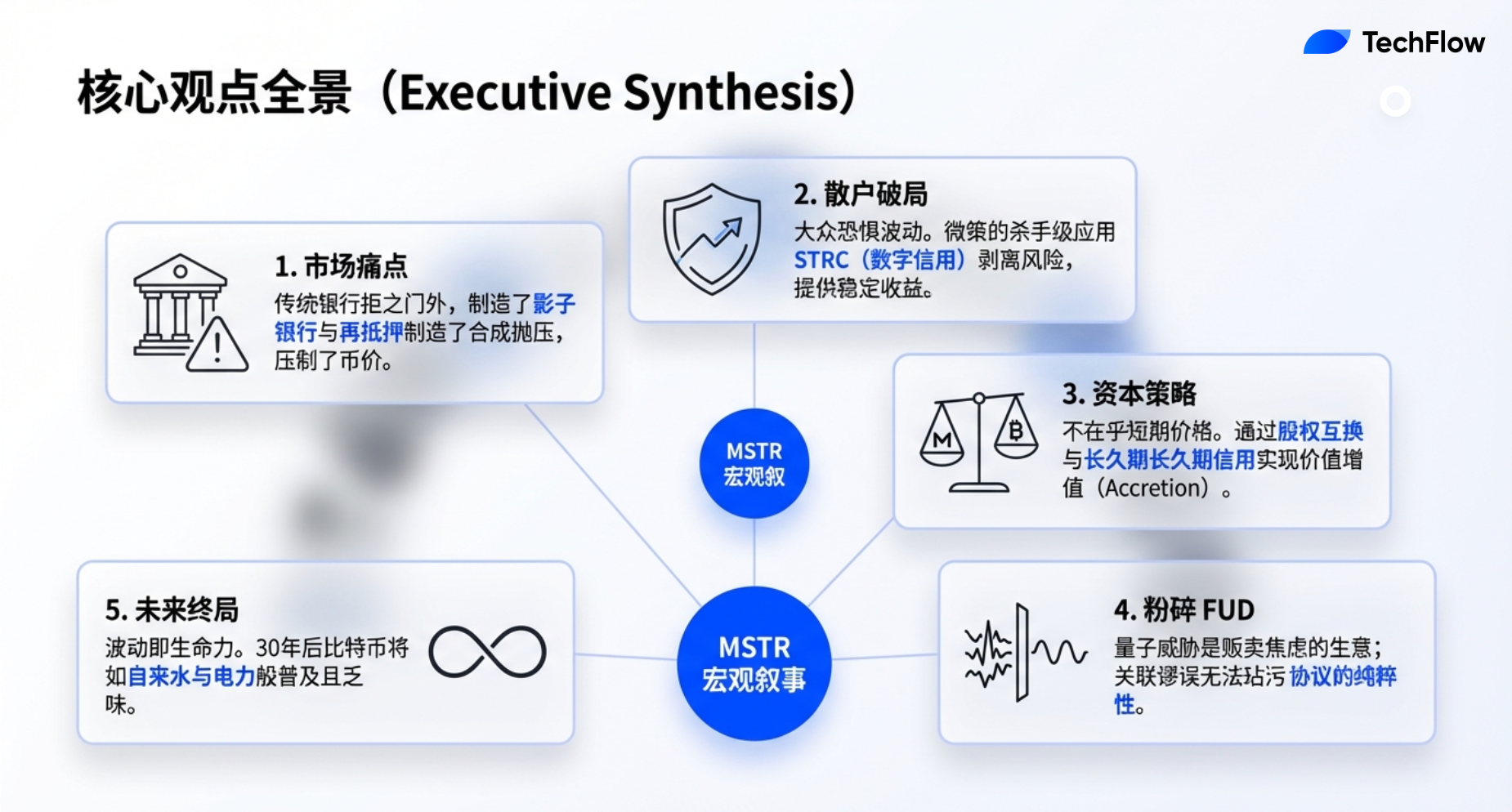
Highlights of Key Insights
The Truth About Price Suppression: Shadow Banking and Rehypothecation
- Approximately $1.8–2 trillion worth of Bitcoin is currently held by retail investors or offshore investors who cannot access traditional banking systems—leaving them trapped in the shadow banking system. Without a robust, non-rehypothecated credit infrastructure, these assets remain price-suppressed.
- What truly suppresses asset prices? I believe it is the absence of a complete, non-rehypothecated credit system. Your $10 million Bitcoin holding may be sold three or four times over—creating $30–40 million in selling pressure—as shadow banks liquidate your pledged collateral.
Why Retail Investors Haven’t Entered: From “Rollercoaster” to “Digital Credit”
- Dedicated retail investors have already entered the market. To attract the broader public, we must offer digital credit products (e.g., STRC) that strip away volatility while delivering stable yields.
- Most retail investors want something two to four times better than bond funds—or an S&P 500-like instrument with no drawdowns. STRC strips out 80–90% of Bitcoin’s risk and volatility, offering investors a 4–5x over-collateralized product with double-digit yields and tax-deferred benefits. This is the killer app for digital capital.
Commercialization: One Thousand Hours vs. Ten Seconds
- Bitcoin is evolving from a “tech enthusiast” phase into a “mass-market product” phase. The core of commercialization lies in packaging complex technology into an ultra-simple user experience.
- Bitcoin is digital capital—I’ll spend one thousand hours explaining it to you, and eventually you’ll understand—but you’ll still endure a 45% crash. Or would you prefer a bank account paying 11%, with tax deferral? Choose STRC. The former takes one thousand hours; the latter takes ten seconds. The world doesn’t need to read ten thousand pages of history—the world needs products, just like the iPhone.
Capital Swap Logic: Why Entry Cost Doesn’t Matter
- MicroStrategy deploys equity and long-duration credit—not short-term debt. As long as the swap is “accretive,” short-term price fluctuations have no material impact on the company.
- Retail investors’ only source of credit is “margin credit”—a one-minute credit line. If they’re wrong, they get liquidated over the weekend. We use credit that allows us to be wrong for thirty years. When swapping equity for Bitcoin, price is irrelevant; what matters is the premium or relative valuation at entry. Our average cost makes no substantive difference.
Countering the “Doom Narrative”: 99% of These Narratives Are Just Business
- Crisis narratives about Bitcoin (e.g., quantum threats, quantum FUD) are largely commercial efforts leveraging fear to gain influence. Investors should maintain constructive optimism.
- 99% of these narratives are simply business. If you buy insurance against every minor possibility, your income will be fully depleted—and you’ll end up bankrupt. In reality, ten years from now you might resolve the issue with a single tap on your iPhone’s “software update.” Don’t panic.
Saylor’s Response to Bear Markets, Price Crashes, and Negative Sentiment
Natalie Brunell: Bitcoin’s price has fallen and sentiment is negative. Critics claim Bitcoin’s thesis is collapsing. What do you think they’re overlooking?
Michael Saylor:
First, we must adopt a longer-term perspective on markets. It’s been only 137 days—about four and a half months—since the last all-time high. During this period, Bitcoin experienced a 45% drawdown—a common occurrence in tech investing.
Look at Apple’s history: when it launched the iPhone in 2007, the market dismissed it. Recognition didn’t come until the iPhone 3 launched in 2009. Even then, Apple’s stock plunged 45% between 2012 and 2013—identical to Bitcoin’s current drawdown. Its P/E ratio dropped from 30 to 10, and it took a full seven years—from 2013’s lows—to return to a P/E of 30. Similarly, Amazon was once deemed unprofitable, yet it became the world’s highest-revenue company—its influence surpassing even Walmart’s.
So where does Bitcoin stand? At what point can you declare it global digital capital? Aren’t the signs already evident? The U.S. President tells you. Kevin Walsh of the Federal Reserve tells you. Scott Bessent of the Treasury tells you. Even the SEC, CFTC, and other cabinet members tell you. BlackRock tells you. And MicroStrategy’s enterprise value has increased 100-fold—it tells you too. In the history of capital markets, has any company ever purchased $55 billion worth of a commodity and loudly declared it “digital capital,” “the world’s new currency”? Never.
So the question becomes: Is $1 billion enough? $5 billion? When will we develop deep enough understanding? You already had sufficient information to know Amazon was unstoppable—*ten years before* global consensus formed. For Apple, you likely knew it was unstoppable in 2009—*seven years before*, possibly even ten years before, global recognition arrived. You already have sufficient information to know Bitcoin is unstoppable.
Global consensus will ultimately emerge, and Warren Buffett and Carl Icahn will be the ones who cement it. They won’t be first—they’ll be last. They won’t make outsized gains—perhaps only 2–3x—entering when the P/E rises from 10 to 30. But if you think independently and withstand volatility, your investment could yield 10x, 20x, or even 30x returns.
In fact, no successful tech investment avoids a 45% drawdown and passage through the “valley of despair.” Our current drawdown has lasted 137 days—but it could take two, three, or even four years. If recovery takes seven years, congratulations—you’re witnessing the decade’s greatest success story, just like Apple.
Why Bitcoin Hasn’t Reached Predicted Prices
Natalie Brunell: For those disappointed by this bull run—e.g., Bitcoin failing to exceed $126,000—what do you attribute this to?
Michael Saylor:
I believe the market is evolving and the ecosystem maturing. Observing all dynamics reveals derivatives markets shifting from offshore to onshore—a hallmark of maturity. As U.S.-regulated derivatives markets grow, they absorb part of Bitcoin’s volatility, but also dampen upside potential—flattening both peaks and troughs. Instead of 80% drawdowns and 80% volatility, you now see 40–50% drawdowns.
But the more critical issue is: Banking adoption of Bitcoin is progressing—but slower than those with short attention spans expect. Banks may require 4–6 years to genuinely embrace an entirely new asset class, yet people demand recognition within four months. Reality check: if banks aren’t yet offering banking services, credit lines, custody, or trading—what does that mean?
It means that at market tops, roughly $2 trillion—possibly $1.8 trillion—of Bitcoin is held by retail or offshore investors unable to access traditional banking systems, leaving them in the shadow banking system. If you hold over $1 trillion in capital but no one will lend to you, how do you monetize it? If I pledge $10 million in Apple stock to JPMorgan Chase, I receive a $5 million loan at extremely low interest—but you can’t yet pledge $10 million in Bitcoin to major banks for a loan.
So you resort to shadow banking or offshore channels. The only “safe” way to monetize is to sell—suppressing price appreciation. A third option has emerged: convert Bitcoin into IBIT (spot ETF). Some banks now offer credit against it—broader and cheaper than direct Bitcoin credit—but we’re only in the first 12 months, with extremely limited capacity.
A fourth option: approach crypto exchanges or OTC desks, which may even offer loans at 1% or 0% interest. But there’s a catch: they require you to transfer your Bitcoin to them—enabling rehypothecation. That means your $10 million Bitcoin could be resold three or four times—generating $30–40 million in selling pressure, as shadow banks liquidate your pledged collateral.
So, what truly suppresses asset prices? I believe it’s the lack of a complete, non-rehypothecated credit system. When you mortgage your house to a bank, the bank doesn’t resell ten houses on your street—if it did, your home’s price would fall. Rehypothecation in crypto flattens price performance and leverages both sides of market volatility.
We’re in a phase where rehypothecation suppresses prices—and we must wait for this process to reverse itself.
Bitcoin’s Long-Term Returns: What Lies Ahead
Natalie Brunell: You often say “volatility is vitality.” Do you worry your forecast of 40% annualized returns for Bitcoin could change?
Michael Saylor:
Over the next 21 years, I project an average annual return (ARR) of approximately 29%. I’ve always expected rebounds and drawdowns—so I view this as a serpentine upward trajectory, averaging slightly below 30% long-term, punctuated by surges and lulls.
If you listen to chatter, someone says: “The Middle East could erupt this weekend—if it does, Bitcoin is the only asset you can sell, so price could collapse—we’re worried.” I reply: If the Middle East erupts, Bitcoin is indeed the only asset you can sell—but it’s also the only asset you can hold. That means many weekend traders shift funds to crypto exchanges. If you’re a trader, it’s the world’s most fascinating asset; if you’re a four-year investor, what happens this weekend—buying, selling, crashing—is irrelevant.
In fact, the distinction is: “Hot money” flows into this ecosystem that wouldn’t otherwise allocate here. For example, a trader with $20 billion can park it in a bank earning base interest—or deploy it in crypto exchanges. When Bitcoin drops 5%, someone sells—and someone buys. Someone wakes up at 4 a.m. Sunday to buy at that 5% discount.
This capital isn’t flowing into New York real estate, gold, traditional derivatives, or NVIDIA stock. Why? Because those markets don’t permit such wild, panic-driven, rage-quit, or capitulation-based volatility operations. Bitcoin is the most volatile because it’s the most useful.
Nature knows no “fairness.” Ten thousand ants attacking a centipede is acceptable—just as using 50x leverage on Bitcoin or cross-staking garbage tokens is permitted. Is it smart? 99% of the time, no—you’ll go broke. But crucially, those doing foolish things get washed out of the market; if they don’t profit, free markets separate them from their capital.
Bitcoin represents global capital markets—someone will always do what you won’t, and won’t do. This utility creates volatility—but also creates gravity or magnetism, attracting all financial, political, and digital energy worldwide. You must reconcile with it. If you fret over Bitcoin’s performance in the next four days, weeks, or months—you’re a trader, and you’d best possess an exceptional trading methodology. Otherwise, you’re an investor with a four-year horizon—then volatility is irrelevant. You only need to know that it’s precisely those manic traders who flood this space with massive capital and attention.
Why Retail Investors Haven’t Participated in This Bull Run
Natalie Brunell: Though Bitcoin is primarily held by individuals, Lynn Alden notes retail investors haven’t meaningfully participated in this bull run. Why?
Michael Saylor:
I believe retail investors deeply passionate about digital capital and Bitcoin entered years ago—over the past decade. If you sought a non-sovereign, digital store of value, you discovered it during prior waves (2010–2015) and bought as much as possible.
But to attract the next wave of retail investors, they don’t want a 40% volatile, 40% annual return asset. They want 10% volatility, ~10% yield—or zero volatility, 8% yield.
The path to mass retail adoption is offering products like STRC. We say: “This pays 11%, tax-deferred, and we’ve stripped its volatility.” STRC’s one-year volatility is lower than Nasdaq, S&P 500, and even gold. I offer you an asset less volatile than traditional stores of value—with clear 10–11% monthly payouts.
Test it yourself: walk down the street and ask 100 people: “Do you want 30% annual returns for 20 years—but endure 40% drawdowns and triple the S&P 500’s volatility? Or a bank account paying 10% annually, redeemable anytime?”
I’d wager 95% of the market wants the 10% bank account. Believing 5% of retail would hold Bitcoin and accept double-S&P volatility for 30% returns is overly optimistic—actual figures may be just 1–2%.
Most retail investors want something 2–4x better than bond funds—or an S&P 500 without drawdowns. Only by combining equity, credit, and crypto can we attract them.
This means equity’s advantage is double-digit yields and tax deferral; credit’s advantage is price stability, principal protection, low volatility, and predictable cash flow; crypto’s (Bitcoin’s) advantage is digital innovation, transformative capability, and productivity 3–4x higher than traditional economies.
Currently, retail must choose between “Bitcoin rollercoaster” and “S&P 500 with 10% annual yield but volatility risk”—or settle for Apple bonds yielding ~2% after tax.
That’s why my passion over the past year centers here: Can engineering extract 80–90% of Bitcoin’s risk and volatility—starting from a 45% volatile asset—and deliver investors a 4–5x over-collateralized, double-digit-yielding, tax-deferred product?
You receive monthly cash dividends; reinvest for compounding. Need tuition or taxes? Withdraw or sell. To achieve this, you cannot tolerate Bitcoin-style drawdowns. You need a credit instrument—an issuer willing to over-collateralize and actively manage it for price stability. That’s STRC or digital credit. Through this, we can attract 10–100x more retail investors. If our first wave captured only 2–4%, digital credit could reach 20–40%—the killer app for digital capital.
How Is STRC Performing?
Natalie Brunell: Among all preferred shares you’ve issued, you seem most excited about Stretch (STRC)—and you’ve used it to accumulate more Bitcoin. What’s the strategy behind this?
Michael Saylor:
We’re stripping Bitcoin’s volatility, extracting yield, eliminating currency risk, and removing capital risk. Bitcoin’s volatility over the past year was ~45%. Via Strike, we reduced it to ~38%; via Stride and Strife, to ~20%; via Stretch, to ~10%—even dipping into single digits. All this stripped volatility flows into MSTR’s common stock, pushing its volatility to 80%.
What people truly want is 10% stable yield with zero volatility. Personally, I seek zero volatility, zero interest-rate risk (zero duration), and returns several multiples of money-market rates.
To achieve this, we tested nearly 20 fixed-income structures. Most existing products—even with 10x or 20x over-collateralization—trade like triple-junk bonds. Credit markets are distorted: even with $70 of assets backing $1 of liabilities, credit spreads look like those of a dying company. This business resembles 16 people trading in a back alley—bid-ask spreads of 300 bps, opaque and inefficient.
You might ask: Why not list debt instruments publicly? Listing traditional term bonds is pointless. Sell a 5-year bond, and after 4 years it has only 12 months left—its “non-perpetual” nature erodes value over time. Since it’s destined to expire, why bother listing it as a public security? So we created a perpetual instrument for listing—that’s why we issued preferred stock.
Initially, our thinking was simple: pay 10% dividends—or 8% plus conversion rights. Strike and Strife succeeded wildly, selling 10x better than other preferreds. But soon we realized: ordinary people hate complexity—and hate interest-rate volatility even more.
If you ask retail: “What’s a 10% perpetual preferred share worth?” They can’t calculate it. Using bond math, its “duration” (price sensitivity to rates) is ~10 years—equivalent to 15–18-year Treasuries. Natalie, can you follow this math? It’s convoluted: if sensitivity is 10, a 1% rate drop theoretically lifts price 10%; conversely, a 0.5% rise drops value 5%.
This means every time Fed Chair Powell speaks, this instrument’s theoretical value swings 10%. How many retail investors want their “stable asset” shrinking 10% after one Fed press conference? So we created STRC. While long-term positioning offers massive capital appreciation for professional Bitcoin credit investors (e.g., rate declines compress spreads, doubling asset value), explaining this requires discussing yield curves, rating agencies, and Bitcoin’s future—too complex.
From retail’s perspective, the conversation takes 12 seconds: —“I want to deposit money in a bank, earn 10% annually, and avoid taxes.” “Done.” No need to track rate changes, corporate credit shifts, or whether Bitcoin doubled or halved—none matter. The sole fact is: You earn 11.25%—tax-free.
Risks remain: If Bitcoin goes to zero, it’s existential. Global credit markets total $300 trillion—but everyone’s in trouble: chasing 5% yields demands junk-bond risk, illiquidity, or century-long waits. What do retail investors want? No duration risk, no currency risk, no credit risk, no volatility—just instant liquidity and yields several multiples of money-market funds, tax-free.
Traditional bond models are obsolete—they’re for professionals. Retired Air Force chief master sergeants want steady monthly cash flow. Why monthly? Because conventional markets don’t support weekly or daily payouts. If Nasdaq supported hourly payouts, we’d adopt that. So we built the most efficient, tax-advantaged, simplest fixed-income stream. The company’s five-year vision: Bitcoin is digital capital—I’ll spend one thousand hours explaining it to you, and you’ll eventually grasp it—but you’ll still endure a 45% crash and global ridicule; or would you like a bank account paying 11% with tax deferral? Choose STRC.
The former takes one thousand hours; the latter takes ten seconds. The world doesn’t need to read ten thousand pages of history—the world needs answers, or better yet, products—like the iPhone. You use air conditioning, running water, light bulbs daily—do you study their physics? No. You need one pill to solve your problem. If I could cast a spell making you instantly happy and wealthy, you’d sign up immediately. STRC is that spell: You buy it, it pays double-digit, tax-free dividends, and your heirs enjoy tax benefits—nothing else required.
Like Standard Oil—which earned its name by guaranteeing kerosene lamps wouldn’t explode—it delivered safety and trust. Consumers need brand trust. Bitcoin is evolving from “amateur radio enthusiasts” to mass adoption. Radio once required physics knowledge; today, six-year-olds use radio tech on TikTok without caring how it works. Bitcoin will follow. Ultimately, 8 billion people will manage digital capital on phones—seamlessly switching between savings coins, stablecoins, and securities. Like my viral video saying “everyone will want an iPhone,” STRC solves the market’s ultimate pain point: eliminate volatility, retain cash.
Media Sentiment and Volatility Cycles
Natalie Brunell: We see extreme media euphoria when Bitcoin hits new highs—and gloom when it corrects, with excessive negative forecasts. Do you feel anyone is rooting for your failure? How do you handle such emotional whiplash?
Michael Saylor:
This struggle is real—but volatility drives engagement, interest, and speculation. When Bitcoin falls, everyone talks about us—while non-volatile assets like Upper East Side Manhattan real estate or lumber prices garner zero coverage. No news, no interest.
I’ve run public companies for years—traditional firms report quarterly, and investors make decisions yearly. Entering Bitcoin revealed our holdings trigger website updates every 15 seconds—we shifted from updating financial markets every 12 weeks to every 15 seconds.
Every $10,000 Bitcoin move earns or loses us ~$7–8 billion. Previously, our company worked a full year to earn $70 million; now, every $100 Bitcoin move equals a year’s prior work. We directly plugged an energy source—a volatility generator—into our balance sheet, fueling a continuous news cycle. Even on TV, skeptics consider shorting us, while bulls hunt for entry points. Without this volatility, neither short- nor long-term players would engage so deeply.
Once, the Wall Street Journal covered only public companies—private firm stories were irrelevant to ordinary readers’ buying/selling. Now, we made a company “interesting” by loading Bitcoin onto its balance sheet and letting it vibrate—making it 10,000x more interesting.
This toxicity and extreme evaluation stem from genuine Bitcoin interest—crypto’s breakthrough is creating a globally 24/7 operating, intensely engaging financial asset. Conversely, I’ll tell you how to kill a financial asset: ban foreign purchases, restrict trading to 9:30 a.m.–4 p.m., mandate three-month account approvals, and impose a $100 million minimum. Add more restrictions, and the asset dies—even a hard-to-remember six-digit ticker weakens appeal.
Yet crypto went the opposite direction: anyone, anywhere, downloads an app and trades in 60 seconds. During bank holidays, you move $1 billion Bitcoin in minutes for 44 cents. This is a digital revolution—money demands light-speed, 24/7 movement. Waterfalls don’t pause on bank holidays; electricity, gravity, and light speed don’t either. Bitcoin wins because this AI-programmable, million-vibrations-per-second digital capital will brutally Darwinistically replace slow, clunky legacy finance.
Does Quantum Computing Threaten Bitcoin?
Natalie Brunell: We often say “don’t trust, verify” in Bitcoin circles—but most people lack technical capacity to verify. Is quantum computing a true existential threat? I saw MicroStrategy recently issue a statement ensuring Bitcoin’s “quantum resistance.” Can you explain why you don’t view this as a risk already priced in?
Michael Saylor:
First, the broad cybersecurity consensus is that quantum risk—if it exists—is at least a decade away; it’s not a concern for this decade. Whether quantum threats exist remains unresolved, but certainly no imminent threat exists. If quantum risk emerges, we’ll see massive software upgrades across global banking, internet, consumer devices, AI networks, and all encrypted networks—including Bitcoin. We’ll adopt “post-quantum resistant cryptography.” This isn’t sudden—we all foresee it.
Bitcoin’s software constantly evolves—we’re now discussing upgrading from version 29 to 30. Nodes, hardware, wallets, and exchanges will all upgrade. In ten years, global consensus on Bitcoin’s optimal response will naturally emerge. Why am I unconcerned now? Because every stakeholder—Google, Microsoft, Apple, Coinbase, BlackRock, the U.S. government, China, JPMorgan—must address the same issue.
Indeed, the crypto community is the world’s most advanced cybersecurity community. Mobile crypto asset security protocols (multi-factor authentication, hardware private keys) are orders of magnitude stronger than bank transfers or stock trading protocols. I believe the crypto community will be the first to detect and respond to threats. We’ve announced our Bitcoin security plan—and early donations to MIT funded Bitcoin security research. Quantum narratives aren’t Bitcoin’s biggest current threat.
We still discuss quantum threats because other alleged risks failed to materialize. A decade ago, the Bitcoin community fought the “block size war,” with some claiming Bitcoin would fail due to bandwidth constraints. Yet a decade later, free markets solved it.
In fact, “doom narratives” permeate human history. Whether alarmists, ambitious speculators, or idealistic intellectuals, they often fabricate crises to gain influence, capital, or power. If I don’t promote a “doom narrative,” how do I get rich? Get elected governor? 99% of these narratives are just business. Like selling “back injury insurance” or “autism vaccine insurance”—events with 0.01% probability—but insuring against every minor possibility drains your income, leading to bankruptcy. Reality? In ten years, you’ll fix it with one tap on your iPhone’s “software update.”
Quantum computing threat is the latest “quantum FUD.” When proven baseless, someone will likely claim we need nanobots in our brains—and Bitcoin isn’t ready. This isn’t just Bitcoin’s story—it’s humanity’s. Facing such alleged crises, maintain constructive optimism. You can believe humans are too foolish to handle technological change—and hand money to doom-sellers—or believe we’ll upgrade software, using new tech to improve life.
Remember the back cover of The Hitchhiker’s Guide to the Galaxy: “Don’t Panic.” Even if real cybersecurity threats emerge, your banks, governments, and business software will force upgrades to respond. Recall Y2K? Global panic erupted—but nothing happened. Humanity has overcome thousands of similar “non-events”; quantum threat will join them.
What’s the Strongest Objection to Bitcoin?
Natalie Brunell: I have an intriguing question: What do you consider the strongest current objection to Bitcoin—and why do you reject it?
Michael Saylor:
The strongest current objection is that Bitcoin is “too new.” As a novel invention, it hasn’t existed long enough—perhaps I need to see it persist longer before trusting it with my lifetime.
Humanity embraced electricity over 30 years—Bitcoin is only 17 years old. Someone might ask: “How many people flew jet aircraft 17 years after the airplane’s invention?” Airplanes debuted in 1903; by 1920, they remained nascent. The world teems with profound innovations eventually embraced universally—but often requiring >17 years.
The answer is “time.” Early pioneers are always few—like automobiles, which only achieved mass adoption after the Ford Model T, followed by decades until universal ownership.
This is fundamentally natural: converting innovative technology into consumer or industrial equipment—and building sufficient track records for people to stake their lives or reputations on it. I believe we’re squarely in this “commercialization” phase.
Does MicroStrategy’s Bitcoin Cost Basis Matter?
Natalie Brunell: Before your closing thoughts, I’m curious—you seem utterly indifferent to cost basis. Many now hunt for bottoms, clearly watching technical charts—but you appear unaffected, buying at any price. Can you explain to those thinking, “If it might go lower, why not accumulate at a lower cost?”
Michael Saylor:
You can view us as practicing dollar-cost averaging (DCA), but the key is: we use equity, not debt. When we buy Bitcoin, if we sell equity to purchase it, whether at $100,000 or $200,000, it’s a perpetual, risk-free swap—exchanging equity for Bitcoin. When should you swap equity for Bitcoin? As long as it’s “accretive.”
If Bitcoin rises 10% but our equity rises 25%, the swap is profitable. If Bitcoin later falls 20%, will you regret it? No—because without the swap, you wouldn’t own the Bitcoin at all.
By then, you’ve actually reduced equity risk. Placing a stable asset beneath equity lowers risk—especially when swapping at a premium. So the sole real question is: Does this swap benefit shareholders? At certain levels, swapping preferred stock for Bitcoin is advantageous; at others, common stock is.
Once executed, Bitcoin’s future trajectory matters little. If swapping common stock for Bitcoin, it’s irrelevant—because you face no ongoing liabilities for millennia.
Theoretically, a scenario exists: If swapping preferred stock, dilution may occur. E.g., paying 10% preferred dividends while Bitcoin yields only 5% over 100 years dilutes common shareholders. So swapping “digital credit” for Bitcoin involves complex calculations—but swapping common stock is straightforward.
If swapping debt—e.g., a 10-year, 5% debt instrument for Bitcoin—you need Bitcoin’s 10-year return to exceed 5% to avoid dilution.
If swapping “margin debt”—e.g., borrowing outright with 10x leverage—buying $1 billion Bitcoin with $100 million collateral—Bitcoin falling 10% triggers liquidation, losing your entire $100 million. Why dangerous? Because you borrowed for “one minute.”
So the core question is: What’s the swap’s duration? Are you executing a “one-minute flash loan”? Then entry price versus current price is critical. Did you borrow for ten years? Its importance manifests a decade later. If borrowing perpetual, never-repayable funds, entry price’s importance fades.
Financial math varies widely. Simplest framing: If swapping equity for Bitcoin, price is irrelevant—what matters is the premium or relative valuation at entry. If swapping preferred stock, Bitcoin’s 30-year performance matters somewhat—but even if Bitcoin yields <10% annually while we pay 10% dividends, scenarios exist where it still benefits common shareholders.
In fact, when selling digital credit to buy Bitcoin, we have 20–30 years to prove ourselves right. Selling corporate bonds or convertibles—shorter durations, e.g., 3–4 years—demands faster validation.
Most retail investors miss this: their sole credit source is “margin credit”—a one-minute credit line. If wrong, they’re liquidated over the weekend. Our credit allows being wrong for thirty years.
I could sketch various scenarios: paying 10%, Bitcoin yields 8%, we’re wrong for 30 years—but it’s still sound for common stock. Explaining this takes hours—another podcast entirely, diving into first-, second-, third-order financial dynamics and “harmonics” of monetary networks.
But the truth is: If it’s common stock, and we have a 10–30-year horizon to prove ourselves, Bitcoin’s path over the next 100 years is irrelevant. We avoid other short-term debt types—so (short-term price) truly doesn’t matter. That’s why our average cost makes no substantive difference.
What truly matters is the nature of our securities swap. Selling $1 billion of STRC (monthly variable-rate), $1 billion of STRF (perpetual 10% dividend), or $1 billion of common stock—each entails completely distinct dynamics. The underlying math is vastly more complex than a single tweet can convey. I guarantee any critic of this operation has never considered its second-order consequences—let alone our third-, fourth-, or fifth-order harmonics.
Bitcoin Mentioned in Epstein Files
Natalie Brunell: Some worry deeply about Bitcoin and core developers appearing in Epstein’s files. People are furious about the Epstein documents. Is this a concern for you?
Michael Saylor:
It’s not a concern at all—I suspect they’re tired of “quantum threats” and pivoted to “Epstein FUD.” Mainstream media claims Epstein tried influencing Bitcoin. Clearly, Epstein likely used iPhones, ordered from Amazon, used Linux, funded Democrats or Republicans. If Epstein interacted with Democrats, Republicans, Apple, or Google—or used Google Search—so what? Should I sell my Google stock? If you’re a Democrat, you remain one; if Republican, you remain one. This “guilt-by-association” is pure clickbait to boost engagement.
Bitcoin is Bitcoin. It’s auditable, code-verifiable. Just as you needn’t know Satoshi, do you need to know Prometheus to decide not to set yourself on fire? Who Prometheus was doesn’t matter. Fire is fire—a chemical reaction. You can study chemistry, thermodynamics, to understand it.
Bitcoin is a natural force—anyone can use it. Fundamentally, it’s a protocol. Just as fraudsters use Arabic numerals, criminals speak English. Every movie features car chases—sometimes you hope the fugitive escapes, sometimes gets caught—but you still drive, right? So I see this as mere noise. We shouldn’t dwell on such distractions but laser-focus on the big picture.
Bitcoin is digital capital—a revolution in capital markets. It’s a rare, profound human innovation enabling tight coupling of economic energy with individuals, companies, or any entity.
This ability to tightly bind economic energy to individuals carries significance comparable to fire’s discovery, electricity’s harnessing—or mammals evolving fat storage: a fundamental building block of life. Upon Bitcoin’s foundational capital, we build digital credit (e.g., STRC), and further, true “digital currency.” Imagine a bank account paying 8% annually with zero volatility—who owns it now? No one. Who wants it? Everyone.
Conservatively, this is a $300 trillion opportunity. Existing traditional credit markets suffer low yields, heavy taxation, and myriad credit, duration, and currency risks. 20th-century financial assets and protocols no longer serve today’s world—we’re entering a new era driven by digital assets, digital capital, digital credit, and digital currency.
Will this solve all problems? Clearly not—many global challenges remain beyond digital currency’s reach. But ask 100 people on the street if they want more money—everyone says yes. Thus, this is undeniably a pragmatic opportunity.
Money won’t self-repair. Bitcoin is merely capital’s foundation—we must build credit atop it, then currency atop credit. We must market it, secure regulatory approval, package it into ETFs, crypto tokens, private funds, or public funds.
You must win approval from Japan, the UAE, the U.S., Europe. You must argue fiercely with regulators in China, Australia, Canada. Then people stare and say: “This seems too good to be true—I don’t trust it.” So you must explain why it’s trustworthy—then they oppose you, and you return again and again to explain—because that’s how the world works.
Thirty years after this podcast ends, everyone will treat digital currency as mundane—as we now view electricity, cars, fire, antibiotics, or airplanes. Historically, all great inventions endured infamy, intense panic, and skepticism.
This is merely the latest technological shift. As William Gibson said: “The future is already here—it’s just not evenly distributed.” Thirty years hence, this will be societal consensus. But then, you and I will face unemployment—because when something becomes as routine as tap water, it ceases to be interesting or offer excess opportunity. No one interviews a company installing plumbing in its headquarters, right?
So I believe we’re extraordinarily fortunate to live at this volatile inflection point—witnessing a monumental opportunity—let’s keep climbing, never stopping.
Join TechFlow official community to stay tuned
Telegram:https://t.me/TechFlowDaily
X (Twitter):https://x.com/TechFlowPost
X (Twitter) EN:https://x.com/BlockFlow_News
 深潮TechFlow


