Conversation with Founders Fund Partner: Common Mistakes and Lessons Learned by Entrepreneurs
TechFlow Selected TechFlow Selected
Conversation with Founders Fund Partner: Common Mistakes and Lessons Learned by Entrepreneurs
Timing is very important.
 Navigating Web3 tides with focused insights
Host: Imran Khan, Co-founder of Alliance
Guest: Delian Asparouhov, Partner at Founders Fund
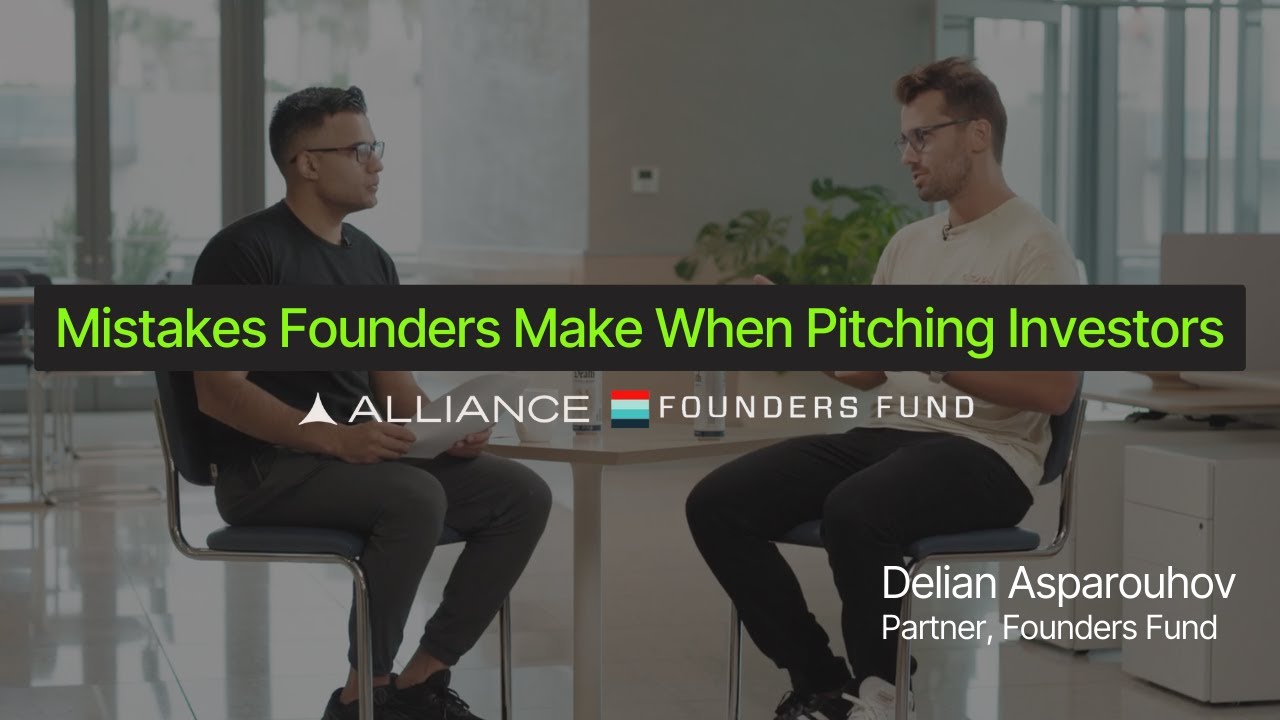
In the world of venture capital, Founders Fund is an undeniable legend.
In 2002, Peter Thiel, known as the "Godfather of Silicon Valley," sold PayPal—the company he co-founded—for $1.5 billion to eBay. In 2005, he established Founders Fund, which primarily invests in consumer internet companies and has backed iconic Silicon Valley startups such as Facebook, SpaceX, Palantir, LinkedIn, and Spotify. Today, Founders Fund manages over $12 billion in assets.
In April 2024, Alliance, the largest accelerator in the crypto space, announced a strategic long-term investment from Founders Fund. The size of the investment was not disclosed. As part of the deal, Founders Fund will provide support to Alliance’s portfolio companies.
As a "bonus" from this partnership, Imran Khan, co-founder of Alliance, sat down with several partners and the marketing lead at Founders Fund—most of whom have direct founder experience—to discuss how founders can drive sales and growth in early-stage startups, how to build a cryptocurrency brand, and how to find the right co-founders… distilling essential entrepreneurial insights.
TechFlow translates this conversation series into Chinese for our readers.
Overview
In this interview, Delian Asparouhov and Imran Khan dive deep into several key topics related to entrepreneurship.
-
Delian’s Background: Delian focuses on seed and Series A investments at Founders Fund, particularly in areas combining hardware and software or operating in highly regulated industries. He shares his unique journey from founder to investor and back to founder again, along with his passion for space manufacturing.
-
The Right Timing for Entrepreneurship: Delian discusses the importance of timing when launching a startup, especially how technological cost curves and market readiness impact success. He emphasizes that founders must ensure their idea is both unique and well-timed.
-
Finding the Right Co-Founders: On choosing co-founders, Delian stresses the need for complementary skills and shared vision. He used a precise filtering method—listing desired traits and searching globally—to ensure each team member was the best possible fit.
-
Equity Distribution Strategy: Delian highlights the importance of creating an equity structure that satisfies everyone now and in the future. At Varda, part-time contributors received less equity than full-time employees due to the greater commitment and contribution of the latter.
-
Key Lessons Learned from Founding Companies: Delian summarizes three major lessons: 1) the importance of talent; 2) the value of extreme focus; and 3) the necessity of achieving product-market fit.
-
Commitment to Continuous Learning: Delian believes continuous learning is crucial for entrepreneurs. He shares two pivotal experiences: a coffee meeting with Sam Altman and working alongside Vinod Khosla, both reinforcing his belief in stepping outside comfort zones and exploring new fields for personal and professional growth.
-
Pivoting Strategically: Delian talks about the importance of strategic pivots during a startup's journey. Using Slack’s origin story and his own company’s shift in market positioning, he illustrates how adapting business strategies to changing markets and technologies can unlock new growth opportunities. His experience underscores the need for founders to be adaptive and forward-thinking.
-
Framework for Evaluating Startup Investments: Delian outlines two criteria he uses when assessing investment opportunities: first, the founder’s deep connection to the mission; second, identifying a “spark” in the founder—something exceptional that signals top-tier potential.
-
Contrarian Views on Startups: Delian challenges prevailing views in startup and venture capital circles. He argues that the highest-return companies over the next decade will likely be capital-intensive, hardware-software integrated businesses solving real-world problems—not just software/GPT-layer tools to help workers process documents faster. He critiques the overemphasis on zero-marginal-cost software and high gross margins, emphasizing instead the value of physical products and tangible problem-solving.
-
Mentoring Founders: Delian shares his experience mentoring founders at YC. From it, he gained two key insights: first, mentorship isn’t pure altruism—it often leads to valuable future relationships; second, he realized how much he enjoyed guiding others, a realization that profoundly influenced his career path.
-
Compounding Effects in Life: Delian emphasizes the power of compounding in personal and professional life, advocating for long-term thinking and sustained effort. Many apparent overnight successes are actually the result of consistent work over ten years. Yet, many people fail to harness compounding because they lack persistence and continuity.
Highlights from the Conversation:
Delian’s Background
Imran: Delian, could you briefly introduce your role at Founders Fund and your professional background?
Delian:
Sure. I’m an early-stage partner at Founders Fund, focusing on seed and Series A investments, especially in companies that combine hardware and software or operate in heavily regulated domains.
I was a co-founder of Varda Space Industries, which I started about three years ago. It’s rare to go from founder to investor and then back to founder. Honestly, a twisted fascination with pain brought me back—especially my passion for space manufacturing. I initially wanted to approach it as an investment and seriously explored it as an investment thesis, meeting many founders in the field. But I didn’t find the right team. Eventually, I decided to build the company myself.
The Right Timing for Starting Up
Imran: How important do you think timing is when starting a company? For someone considering entrepreneurship, how should they evaluate market timing? What signals should they look for?
Delian:
Timing is extremely important. Look at the history of technology. Often, great ideas emerge at completely wrong times—even Varda is a good example. In the 90s, 2000s, and 2010s, people tried to launch space manufacturing startups, but picked the wrong moment. As a founder, you need to make sure your idea is correct and launched at the right time. You can analyze factors like launch costs, battery energy density, solar power costs—variables that follow near-perfect mathematical curves—to forecast when your business model becomes viable.
Even in other industries, there are clear inflection points. Take Uber: when everyone had an internet-connected device with GPS, it fundamentally changed how people thought about urban transportation—making it possible to summon a car on demand. So you need perfect timing to launch such a business. The mobile revolution sparked a wave of startups; AWS eliminated the need to build data centers; blockchain enabled decentralized companies; AI and GPT improve existing operations. But part of being a founder is spotting that moment when you can ride the wave instead of fighting the wind—when building a company suddenly becomes easy.
Finding the Right Co-Founders
Imran: You mentioned finding co-founders as a critical point—but it’s notoriously hard, especially in crypto. How did you find yours? And how did you ensure they met your standards?
Delian:
Finding the right co-founders is absolutely critical. I look for people whose skills complement mine, who share the same vision and goals. When I decided to restart my entrepreneurial journey, I wasn’t just looking for partners—I needed individuals capable of excelling in highly technical domains. We carefully selected team members, ensuring each person was the ideal fit. I listed 30 traits I wanted in a co-founder and searched globally for candidates matching those criteria. It’s like being a sniper—very precise. For every role, we had a clear checklist of required skills, so we could ensure each team member made a pivotal contribution to the company’s success.
Equity Distribution Strategy
Imran: How do you handle difficult situations like equity distribution?
Delian:
On equity, I believe you need to achieve two things: first, reach an agreement everyone is happy with today; second, one that still feels fair years down the line. You must assess who the most critical people are, how decisions will be made in the future, whether all co-founders are truly equal, or if one person holds final decision-making authority. At Varda, our equity strategy was relatively straightforward: it wasn’t purely equal split. I serve as Chairman without being a full-time employee, so my colleagues who work full-time receive more equity because they recruit core team members and possess deeper expertise in certain areas than I do. Very few companies can pull off perfectly equal splits—maybe Airbnb is a good example, where all three co-founders were deeply involved in daily operations. That’s extremely rare.
Key Lessons Learned from Founding Companies
Imran: As an entrepreneur, what are some of the most important lessons you’ve learned over the past few years?
Delian:
First, the importance of talent. At my first company, perhaps because I was young, I underperformed in hiring top-tier people. Now, when I face a challenge, my immediate instinct is to identify the best person globally to solve it—and bring them in as an advisor or full-time hire. Second, the importance of extreme focus. At my first company, I often focused on urgent but unimportant tasks. Now, I can identify what truly matters—even if it’s not immediately pressing. For example, in summer 2022, I realized we needed an experienced business development leader to negotiate contracts with pharma companies, even though it wasn’t an urgent issue at the time. Finally, product-market fit isn’t discovered—it’s forged. We need to proactively engage with the market, test whether our value proposition resonates with customer needs, understand market trends, and align with priorities of defense and commercial clients to build something we know will strongly resonate.
Commitment to Continuous Learning
Imran: In your recent writing, you emphasized continuous learning—I think this is vital for founders who must constantly absorb new knowledge.
Delian:
Early in my career, two experiences shaped my mindset around lifelong learning and ultimately motivated me. One was having coffee with Sam Altman—he was about to become president of YC while also running a nuclear energy company. His involvement across multiple cutting-edge fields made me realize I was falling behind. Though I knew computer science, I saw I needed broader knowledge to make a wider impact. That feeling pushed me to keep learning and exploring new domains. Years later, at Coast Ventures, I worked closely with Vinod Khosla, who excelled in over 20 different fields. He reinforced the importance of continuous learning. I began studying aerospace—an area I’d never worked in—reading every press release, attending conferences, meeting founders. At first, it felt overwhelming, but eventually, it gave me invaluable knowledge that deeply influenced my founding of Varda and my aerospace-related investments.
Strategic Pivoting
Imran: With six years of investing experience, what’s the biggest pivot you’ve seen in a startup? Could you share key lessons for founders?
Delian:
In Silicon Valley history, a classic example is Stewart Butterfield and Slack. They started as a game studio, built an internal chat tool, and ended up creating Slack. That’s the gold standard of pivoting. My company’s pivot was more about geographic market expansion or small feature launches. But Stewart had the courage to use his raised venture capital and assembled team to make a massive shift—from gaming to enterprise communication. Varda also evolved: initially, we strongly believed the main market would be fiber-optic cable manufacturing in low Earth orbit. But reality turned out differently. Over the past three years, especially after China tested a hypersonic missile in summer 2021, hypersonics moved from academic exercise to operational priority. This allowed us to generate enough revenue and scale to tackle a bigger opportunity—pharmaceutical manufacturing in space. So while Varda’s core mission stayed the same, our target market segment underwent a significant transformation.
Framework for Evaluating Startup Investments
Imran: When founders pitch to you, do you have a fixed evaluation framework?
Delian:
I generally use two criteria, everything else is case-specific. First, why is this founder the superhero of this story? Why is this their life’s mission? Let me give a vivid analogy: Elon Musk and Mark Zuckerberg—both extraordinary, world-class founders. Both highly capable. But if you put Mark Zuckerberg in charge of a rocket company, you’d get engineers wandering around, never launching a rocket. If you put Elon Musk in charge of a social media company, it would be an outright disaster. Second, I look for a certain spark in them. This spark often comes from non-professional achievements. For instance, I’ve noticed I’m drawn to investing in former D1 athletes or professional athletes. If you can manage the academic load of a top university while competing at the D1 level, that discipline often translates into extraordinary entrepreneurial success. So identifying people who’ve reached the top 0.1% in any domain is crucial.
Contrarian Views on Startups
Imran: Founders Fund had a very clear stance on remote vs. in-office work in 2020, which wasn't mainstream then. What are some widely accepted beliefs among founders or VCs today that you think are wrong?
Delian:
In this high-interest-rate, high-capital-cost environment, the venture market has indeed shrunk compared to 2021. But I still believe that if you look at companies founded in 2024, the ones likely to generate the highest returns over the next decade will be capital-intensive, hardware-software integrated companies solving real-world problems—not just software/GPT-layer tools that help employees process documents faster. Fundamentally, a VC’s job is about long-term outcomes. If you look at the four most valuable companies on Nasdaq, three—Nvidia, Apple, Tesla—are deeply rooted in U.S. hardware. That’s exactly what investors should aim for. So I still think the obsession with zero marginal cost software and high gross margins is misguided.
Mentoring Founders
Imran: What was your experience like mentoring founders at YC? Why did you do it? And why do you think it matters?
Delian:
At the time, I wanted to pay back the guidance I’d received from my mentors—it felt like charity. I went all in—I conducted around 100 such sessions in one or two weeks, scheduling them back-to-back—three per hour, 20 minutes each, for four or five hours straight.
I wasn’t an exceptionally strong founder, but I got into YC. So I felt I had something valuable to offer future founders. Looking back, I drew two main conclusions. First, this wasn’t charity. By helping these founders, many of whom later became investors or colleagues, I eventually benefited in return. Second, I wish I’d realized earlier how much I enjoyed mentoring and working with other founders. Years later, when I considered going full-time into venture capital, I reflected on this. I loved doing mock YC interviews. I loved helping friends solve their challenges. If you turn what you love into your career, you’re far more likely to reach the top 0.1%—because it won’t feel like work.
Compounding Effects in Life
Imran: Among the five lessons you mentioned, one is that everything in life compounds. I feel people often forget this. In a world full of distractions and endless ideas, the ability to focus on one thing seems lost. What have you learned from this? And why should every founder consider it?
Delian:
I’ve been in Silicon Valley for nearly 12 years. Looking back, I see friends jumping from one trend to another, never giving compounding time to work. Their careers rise initially, then they get frustrated and move on. They don’t realize that what looks like an overnight success is usually the result of letting the curve compound over ten years.
I think this applies to many other areas—like personal finance. Investing $25,000 in a company and watching it grow all the way to IPO. The same goes professionally. Like with aerospace: I attended conferences knowing nothing, knowing no one, and the meetings weren’t productive at first. But I didn’t get overwhelmed. I was willing to focus on something few cared about and keep pushing the curve upward. Same with personal relationships. Many people frequently change friends or seek only those who can advance their careers.
I think I’ve done well cultivating close friendships—people I’ve known since arriving in Silicon Valley over a decade ago. No matter their profession, I’ve maintained these bonds. Personally, I’ve been with my wife for four and a half years. In some ways, the depth of this relationship only grows with time. The joy, stability, and knowing I have someone who truly understands me is incredibly valuable. At the final moment of deciding whether to launch Varda, I felt fear—my investing career was going well, why take such a big risk, especially when investing is already hard? My wife’s response was firm: This is your life’s work—you must do it. Imagine if I hadn’t nurtured that relationship, missed those late-night conversations, panicked, and abandoned Varda. Varda wouldn’t exist.
So I believe people underinvest in compounding. Compounding doesn’t happen automatically—you have to keep feeding it, with small, consistent efforts, year after year.
Join TechFlow official community to stay tuned
Telegram:https://t.me/TechFlowDaily
X (Twitter):https://x.com/TechFlowPost
X (Twitter) EN:https://x.com/BlockFlow_News
 Alliance