Understanding TTP (Trac-Tap-Pipe) means understanding the development direction of inscriptions.
TechFlow Selected TechFlow Selected
Understanding TTP (Trac-Tap-Pipe) means understanding the development direction of inscriptions.
Understanding TTP means understanding the future direction of inscriptions: inscription infrastructure, the growth and expansion of ordinals, and new Layer 1 blockchains distinct from ordinals.
 Navigating Web3 tides with focused insights
Author: Shu Tong
After publishing "First Heard of BRC-20, Felt Like That Summer Again" in early May 2022, the Bitcoin ecosystem went through a brief lull before bursting back to life—only this time, the "summer" had turned into "winter."
Understanding TTP (Trac-Tap-Pipe) means understanding the development direction of inscriptions and the key turning point as meme culture evolves into a full-fledged ecosystem.
Benny launched three protocols within the BTC ecosystem: trac core, tap, and pipe—collectively known as Trac Systems (Figure 1). My first impression? Messy—what the hell is this? Second look: Benny minted so many tokens, must be a scammer. But curiosity got the better of me for a third glance—and damn, Benny has incredible vision. The strategic positioning is brilliant.
Below, I'll first clarify what each of these three protocols does, then explain the logical relationship between Benny’s multiple tokens and the protocols, and finally discuss why we should pay attention to the TTP suite (a term I learned from Web3Bird1, aka “Brother Bird” online).

1. A Plain-Language Introduction to TTP
Trac Core: In one sentence: Trac Core is an oracle and decentralized indexer for Bitcoin inscriptions, solving issues related to data indexing, retrieval, and price feeding in the inscription ecosystem.
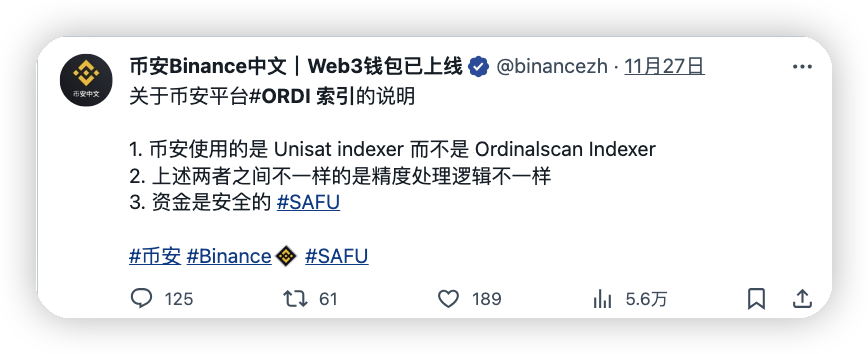
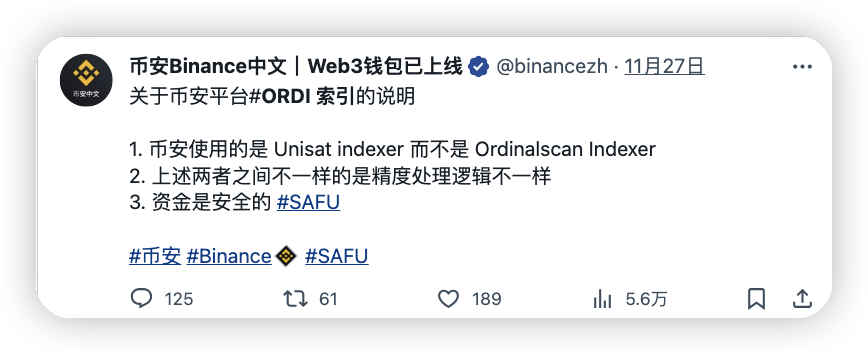
For example, while inscription data is stored on-chain via Bitcoin, that only serves as raw proof. Actual data updates and account reconciliation still rely on third-party centralized indexers—raising ongoing security concerns (e.g., Binance's ORDI indexing error in late November sparked market FUD). Trac enhances the inscription ecosystem’s inheritance of Bitcoin’s security by collecting, organizing, and sequencing all data on Bitcoin, with plans to eventually include hundreds of indexing nodes.
And since the nodes are already running, might as well make them do more work—so Trac Core also integrates oracle functionality, pulling reliable external data onto the blockchain. This forms the foundation for future native DeFi and other upper-layer protocols on inscriptions. Notably, Trac’s oracle API is free to use. Thus, Trac Core’s dual role as both a decentralized indexer and Bitcoin oracle positions it ahead of most other inscription projects.
Tap: In one sentence: Tap is an extension—not a fork—of the Ordinals protocol, meaning it maintains seamless compatibility with BRC-20.
As shown in Figure 2 (courtesy of @GloryYeh), Tap belongs under the Ordinals umbrella and introduces the concept of “ordiFi,” aiming to enhance liquidity and enable efficient trading within the BRC-20 and Ordinals ecosystems. It supports complex financial operations such as swaps, staking, and Liquidity Pools, and can even tokenize Ordinals-NFT assets directly to unlock liquidity. Additional features like token distribution and batch transfers may benefit project teams deploying contracts, distributing, and retaining tokens—after all, projects need to generate revenue too.
I strongly agree with Benny not abandoning the Ordinals ecosystem. Ordinals remains the home base for inscription users and liquidity. In crypto, we often see inferior but innovative products built atop dominant yet outdated platforms—not because the new protocols are bad, but because existing liquidity and user bases provide fertile ground for innovation. Compared to Trac Core, Tap builds directly on top of Ordinals, while Trac acts as the bridge connecting Ordinals and its extensions.

Pipe: In one sentence: Pipe is a new protocol forked from Ordinals, offering more advanced functionality—but requiring liquidity to be rebuilt from scratch.
As shown in Figure 3 (again courtesy of @GloryYeh), the Pipe protocol leverages the UTXO architecture, bringing advanced digital art and NFT capabilities to Bitcoin while fully inheriting Bitcoin’s UTXO characteristics. From my understanding, although both Pipe and Ordinals store data on the Bitcoin chain, they use different storage locations—designed to significantly alleviate network congestion and optimize minting fees and transfer experiences.
Credit where it’s due—Benny moved fast. The idea behind Pipe originated from Casey, who deployed the original Ordinals protocol. But since Casey didn’t profit much from Ordinals, he decided to launch a new protocol called Runes. Benny, however, beat him to the punch. Notably, Pipe retains the fairmint feature, whereas Runes does not. Unisat and other infrastructure providers can easily integrate with Pipe, though Pipe will have its own wallet and marketplace.
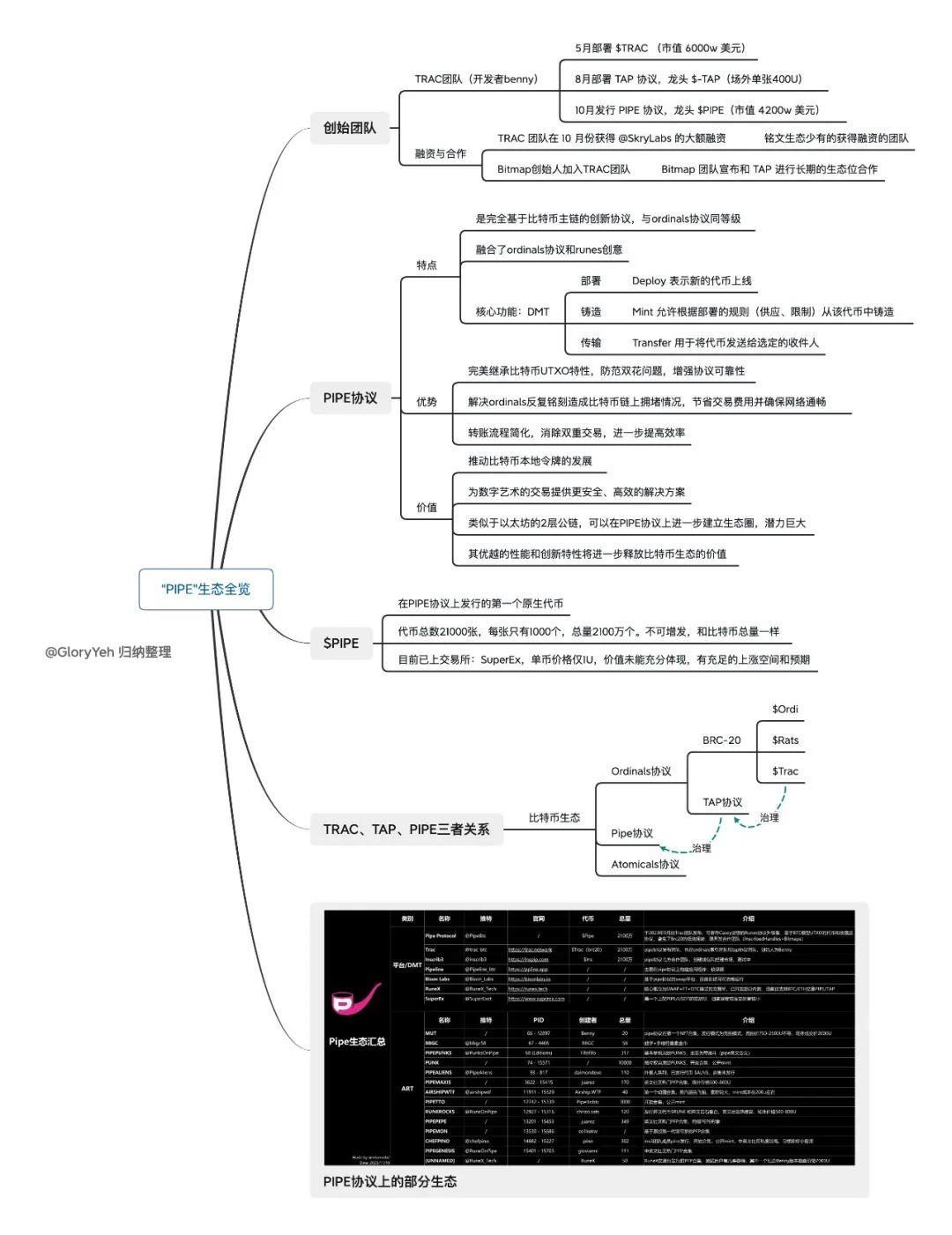
2. The Relationship Between These Tokens: Nested Governance, Shared Fate
-
Trac Token:
Deployed on the ordinals-brc20 protocol; will later serve as the governance token for the Tap protocol.
-
TAP and -TAP Tokens:
Deployed on the ordinals-tap protocol; -TAP was deployed 30 minutes earlier than TAP. TAP was deployed by Benny with zero current circulation and will act as the governance token for the Pipe protocol, with future airdrops planned for holders of Trac and Pipe. However, @Carrot_BTC notes that -TAP holders will not receive future airdrops.
-
Pipe Token:
Deployed on the Pipe protocol—the first token on this protocol. Future TAP token airdrops will go to Pipe holders, similar to ORDI’s status within Ordinals. The team has indicated further utility will be added down the line.
3. Trac Systems’ Positioning: A Full-Scale BTC Ecosystem
From this, we can see that Trac Systems is actually a comprehensive Bitcoin ecosystem—essentially positioned as foundational infrastructure for the broader Bitcoin ecosystem, with strong internal logic among the three components.
First, Trac Core strengthens security through decentralized indexing—making the recorded data more trustworthy—while also introducing oracle functions to allow data to flow in and out. Once the foundations of security and data interoperability are laid, the Tap protocol further unlocks liquidity for BRC-20 and NFT assets on Ordinals, enabling DeFi features and NFT tokenization. Finally, despite extending Ordinals, functional limitations remain—so to explore more powerful inscription protocols, a next-generation alternative was needed, leading to the Pipe protocol fork. And crucially, these three protocols are interconnected through nested token relationships.

So can we really say Benny is just randomly launching tokens? Probably not. As illustrated in Figure 4 (kudos to @binance for the clear and concise diagram), if we consider Ordinals as Bitcoin’s L1 (perhaps an imperfect analogy), then Trac Core builds infrastructure around this L1, Tap captures and channels liquidity from top-tier BRC-20 and NFT assets on L1, while Pipe pioneers new L1 directions. In the adult world of crypto, Benny chose not to pick sides—he wants it all.
Current FUD around the TTP trio mainly centers on two points: 1) Benny is recklessly launching too many tokens; 2) token concentration (TRAC held by ~2.6k addresses, TAP dominated by Benny, PIPE by ~1k addresses). The first concern has been addressed above. Regarding the second: meme holders *are* the project team—but “value-bearing tokens” require actual work. Someone has to build, right? Most of the market currently overlooks the TTP suite, partly due to continued obsession with meme speculation, and partly because the interrelationships among Trac, Tap, and Pipe are inherently complex—creating a natural barrier to entry that causes many to miss the bigger picture, especially given how many tokens Benny has launched. It feels chaotic!
But that’s precisely the opportunity—early cognitive arbitrage. Returning to the title: 1) Understanding TTP means understanding the future trajectory of inscriptions: inscription infrastructure, growth and expansion of Ordinals, and new L1 alternatives beyond Ordinals. 2) The Trac protocol marks a pivotal turning point as inscriptions evolve from memes into full ecosystems. Meme-focused inscriptions will likely consolidate toward top players, while application- and infrastructure-oriented inscriptions will attract increasing capital attention. Trac Systems is one of the few projects combining compelling narrative with storytelling potential comparable to ORDI. This article does not mention prices and is not investment advice—strictly for educational discussion.
Join TechFlow official community to stay tuned
Telegram:https://t.me/TechFlowDaily
X (Twitter):https://x.com/TechFlowPost
X (Twitter) EN:https://x.com/BlockFlow_News
 7UpDAO