Why Nostr Matters: Freedom from Server Rule
TechFlow Selected TechFlow Selected
Why Nostr Matters: Freedom from Server Rule
The server's (Relay) power is weakened, while the client's rights are amplified.
 Navigating Web3 tides with focused insights
Thank you to Nostr for giving us this opportunity to come together and share some thoughts about social networks. I'm Digi Monkey, the author of the Nostr client flycat.club Digi Monkey. Flycat is a Nostr client offering features such as Relay Group Switching, long-form and short-form content feeds, Communities, JoyID login, MetaMask login, and more.
Today, I want to talk about my perspective on Nostr, and why it matters for cyberspace.
Back to 1996
I’d like to start by sharing a quote:
We will create a civilization of the Mind in Cyberspace. May it be more humane and fair than the world your governments have made before.
Some of you may recognize this line. It’s from the closing of "A Declaration of the Independence of Cyberspace", an open letter written by John Perry Barlow on February 8, 1996. In 1996, the internet was still very new—Netscape Navigator had only launched two years earlier. The concept of cyberspace was still hazy to most people. Yet this declaration confidently articulated a highly idealized, utopian vision for online communities.
The Declaration proposes two foundational ideas:
1. Cyberspace and physical reality are dualistic and entirely independent. There are no borders, no discrimination, and no material constraints in cyberspace.
2. Cyberspace does not require governance from the real world or coercive laws. Instead, order and social norms emerge through unwritten "codes"—shaped by code itself, ethics, self-interest, and collective welfare.
Today we mostly refer to broad social networks—the digital realm, a new continent of information, the entirety of online life—as a large community where people exchange information and services.
This is exactly what the Declaration describes. Let’s take a closer look at how people imagined this new space back then. Here are some excerpts:
Cyberspace consists of transactions, relationships, and thought itself… Our world is both everywhere and nowhere at all, but it is not where bodies live.
We are creating a world where anyone, regardless of race, economic power, military might, or birthplace, can join without privilege or prejudice.
We are creating a world where anyone, anywhere, can express their beliefs without fear of being silenced or forced into compliance, no matter how unconventional those beliefs may be.
Your legal concepts of property, expression, identity, and movement do not apply to us. These concepts are rooted in material reality, which we do not inhabit.
Our members have no physical bodies, so unlike you, we cannot achieve order through physical coercion. We believe our governance will arise from ethics, enlightened self-interest, and the common good. The only law recognized across our cultural space is the “Golden Rule.” We hope to build unique solutions upon this foundation.
As you can see, the original vision was highly idealistic. Its conception of governance was vague. Compared with today's internet—a deeply integrated part of our daily lives—it has clearly diverged. Many in the web3/blockchain communities argue that the internet took a wrong turn, straying from its original ideals.
The Current State of Cyberspace
The modern internet violates both core principles outlined in the Declaration:
1. Today’s internet is powerful precisely because it is tightly woven into the physical world—not separate from it. Services like food delivery, ride-hailing, and home rentals permeate everyday life. The digital now invades and even directs the physical. In contrast, early visions saw the internet as a pure, new continent of thought—a place where humanity could freely build a mental homeland.
2. That homeland was meant to be self-governed, free from state control and legal jurisdiction. Today, this idea has been overturned. Governments actively regulate the internet through telecommunications laws based on territoriality: wherever a service’s entity, servers, or data reside, local authorities assert jurisdiction over it.
I’m not judging whether overturning these principles is right or wrong, nor claiming the Declaration’s vision was inherently correct. My point is simply that there’s a significant gap between the original ideal and current reality.
The question I’m interested in is: how did this shift happen?
1. From the mainstream narrative, this is a cyberpunk scenario: big corporations, governments, and runaway technology have created a “high tech, low life” reality.
-
Example 1: Delivery riders resemble sci-fi bounty hunters—employed by systems, living under algorithmic management. Some try to escape, but most remain dependent.
-
Example 2: Life on social media mirrors this. On Twitter, you don’t even own your account—you merely have temporary usage rights. Free speech? That’s controlled entirely by Musk and Twitter Inc.
2. Another perspective—from the human-machine relationship—is that this shift represents a power struggle between humans and machines.
a civilization war between machines and humans
Here, “machines” refers mainly to servers. Online services—especially platforms—are typically composed of servers and clients. Servers are controlled by private companies or developers, accessible only via authorized APIs. Clients are the software users interact with—whether a web browser or mobile app. Users access servers through clients to read/write data, perform computations, and consume services.
In this setup, servers hold nearly all the power:
-
Identity (names, accounts, “Who am I, and how do I prove it?”), along with a byproduct: social graphs
Your identity is granted by the server when you register. They decide who gets which name. For example, on Weibo, usernames must be unique—who gets the good ones? The server decides. And since the server defines “who you are,” your friend list—your social graph—becomes another asset controlled by them. WeChat’s contact book is perhaps the clearest example.
-
Data (the means of production—where it’s stored, who controls it, whether it can be forged, ownership and usage rights)
Although users generate most data, it’s stored on servers. Who produced what—and whether data can be forged—is attested by the server. Typically, users only have usage rights; ownership belongs to the platform.
-
Transactions (the relations of production—who provides/consumes services, what rules apply, whether fees are taken)
Rules are coded into the server, which can change them anytime. Since the server also controls the data, rule changes often involve adjusting how data is accessed or used—and they can implement any changes unilaterally.
The process of servers providing services to users resembles how a state governs its citizens.
Registering on Twitter is like registering your household with the police—they issue you an ID number. This ID becomes your passport to rent, work, and consume within the nation. Your behavior is constrained by laws and moral codes.
Twitter has “Terms of Service”—similar to laws. If your behavior violates them, Twitter revokes your account. But online, this system is far worse than real-world law. Citizens in democratic societies can participate in lawmaking and have judicial systems and lawyers to defend them—ensuring due process. Online, none of that exists. Twitter rules unilaterally.
So we must recognize: basic human rights in cyberspace—digital “human rights”—are even weaker than in the physical world. If real-world societies have evolved into modern, sovereign states, cyberspace remains somewhere between slavery and feudalism. The server is king, monarch, emperor.
Where Does Nostr Fit Into This Shift?
Nostr occupies a unique position. I like to map it on a spectrum from centralized (left) to decentralized (right). Nostr sits slightly toward the decentralized side:
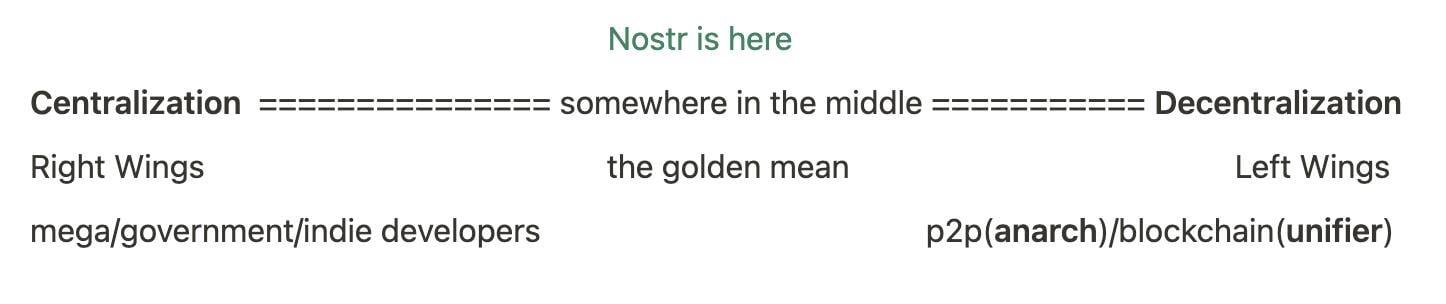 Note: This spectrum describes different technical architectures for delivering services in cyberspace—it’s not about political ideology. “Left” and “right” are just metaphors.
Right Wings (Centralization)
At the extreme of centralization, we find the server-maximalist model described above. Let’s call this the “right wing”—conservative. It includes:
-
Corporations (mainstream forces: big tech, startups)
-
Individuals/small groups (geek self-hosters, indie developers)
-
Governments (e-government portals, public institutions, digitized services)
Right Wings builds a lot of servers, and lots of machines, and we live under the rule of those machines.
Notably, some right-wing actors are admirable indie developers who offer unique software in a craft-like manner. Still, they follow the same server-maximalist model—one developer, one ruler.
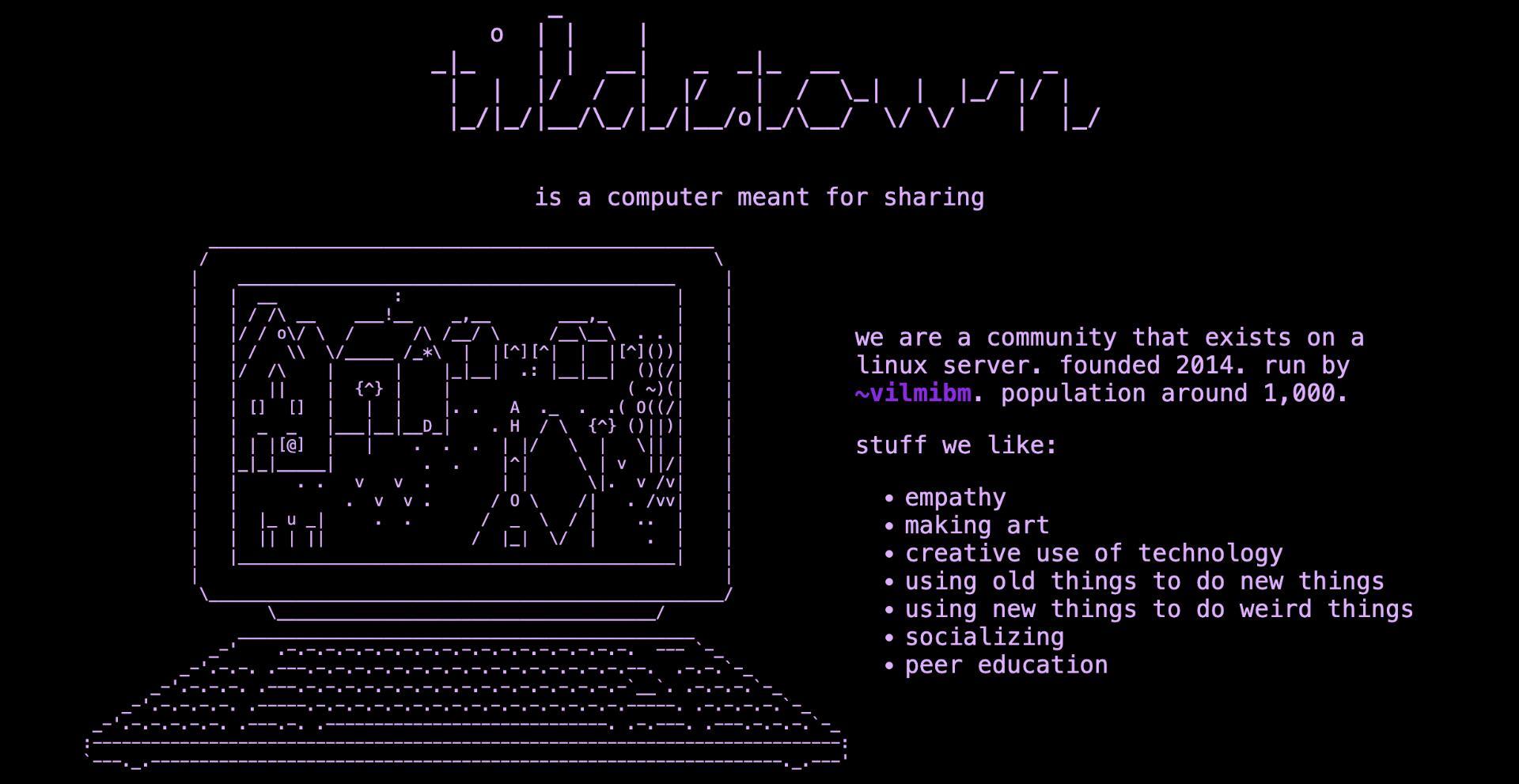
Take https://tilde.town/ as an example: a Linux-based community where the founder hosts the server. You apply to join, get SSH access, and can write, draw, or build things—all shared among residents.
This is classic human governance: the founder manually approves entries and can kick out bad actors. With nearly 1,000 members, it’s a small, beautiful community—but still operates under the centralized model.
 So right-wing approaches are often reasonable. As long as community members consent to server rule and development isn’t hindered, replacing centralization with decentralization isn’t always necessary. Centralized services have legitimate use cases. This is why I reject the idea that “blockchain eats everything.”
Left Wings (Decentralization)
The left wing represents radical decentralization. It includes:
-
P2P networks (volunteer nodes: BitTorrent, Tor, SSB)
-
Blockchains (code as enforced law, requiring incentives and consensus)
-
Free software (no services, only open source and donations)
Left Wings actually wants everybody to run their little homebrew machines, and unite all the devices from people under one global cyber law. That is the code of the law, the so-called consensus layer in the blockchain network.
The left wing is a major force today. Take blockchains: they aim to build fair, inclusive systems governed by strict rules—like Bitcoin’s fixed supply of 21 million coins, each mined through proof-of-work, with every node enforcing the same code.
How are these rules changed? There are meta-rules—for example, some blockchains use DAO voting to add proposals to consensus. Bitcoin relies more on off-chain governance, with upgrades driven by miner adoption.
So blockchains are building highly idealized systems—akin to ancient Athens’ detailed, participatory democracy. By contrast, Nostr has no such ambition. It adopts a loose structure, defining only a few core rules and leaving the rest open—closer to modern liberalism, where personal and political life are clearly separated, and law doesn’t interfere beyond that line.
Let’s examine Nostr’s differences more closely.
Nostr: A Pragmatic Middle Path
Nostr’s protocol is minimalist and uniquely positioned—not leaning fully left or right, but taking a moderate stance. Let’s compare it across three dimensions: ID (identity), data (means of production), and transactions (relations of production).
-
ID (identity): Just a public-private key pair, fully user-controlled. Servers cannot strip your identity—they can’t make “I am not I.” Only “I” can prove “I am I.”
-
Data (means of production): Nostr defines data format (a simple JSON) and propagation (client-server communication standards)
-
Data format: Must follow a standard. Crucially, every message must be signed.
-
Data propagation: Hardcoded to use WebSockets for client-relay communication, with defined message formats. Why hardcoded? To bootstrap easily—a pragmatic choice.
-
Transactions (relations of production): Can embed Bitcoin’s Lightning Network for native crypto payments—but it’s optional (crucially). Beyond that, no restrictions: whatever is not forbidden is allowed.
In Nostr, servers are called Relays. User data is only temporarily stored on Relays. Because every piece of data is signed, relays cannot forge data or deny authorship.
Data retrieval works by requesting a user’s data from public relays. Data can exist on multiple relays, and users can query multiple relays for redundancy. This allows users to freely switch and choose relays. As a result, relays lose the power to define identity, control data ownership, or set transaction rules. Their role reduces to temporary data storage—like a networked hard drive charging for storage space. The server becomes a simpler, more neutral actor.
Conclusion: Server (Relay) power is diminished; client power is amplified.
One might worry: could clients become too powerful? Could a dominant client lock users in? The answer is likely no. Since server power has already been dismantled, switching clients is cheap and easy. This risk is minimal.
However, one concern remains: clients might introduce excessive customizations beyond the Nostr protocol under the guise of “caching” or “optimization.” Too many such optimizations could trap users in a single client’s ecosystem, violating protocol neutrality. This would mean the ecosystem is captured by a product rather than the protocol.
But currently, with near-zero switching costs, the bigger challenge is how client developers can differentiate their products (while staying compatible) and discover viable business models—perhaps even harder than for relays. That’s a separate topic for now.
On the other hand, I believe Nostr’s relay-client architecture better reflects how human societies actually function.
- Relay as a free-cache or paid-long-term-storage
In Nostr, relays act as free caches or paid long-term storage (free to cache, pay to save). New users often ask: what if a relay goes offline? Will my data be lost? Yes, it will. But that may not be a problem.
Using Nostr is like having a conversation in a café. Public relays are like air—freely carrying your voice during the discussion. Once the conversation ends, everyone leaves, and the words vanish into thin air.
If you think your words are valuable, you can run your own relay to store them permanently—like writing a diary after returning home. Most won’t. Or you can use a paid relay to preserve your data—like renting a storage unit when your house is full.
- Relay as a localized autonomous community
Today’s social networks are global—and globalization brings problems. Human brains aren’t built to process global-scale information. We evolved in villages of a few hundred. When flooded with global news—wars, trade conflicts, tech rivalries—we feel anxious. Nostr’s relay model offers a return to small, self-governing communities. Each relay is a community. You can freely switch between them.
Why do I find Nostr pragmatic? Precisely because it takes a step back—abandoning P2P’s pursuit in favor of “multi-centered, small-scale community autonomy.” Why abandon P2P? Because P2P won’t work (Fiatjaf’s words, which I agree with). Despite decades of effort, P2P hasn’t become usable as a mass social network. It’s just not user-friendly. So pursuing multiple relays with free switching is more practical—and already functional.
A common misconception: people think Nostr is decentralized and censorship-free. But each relay is a center—it chooses what data to host, which is itself a form of censorship. However, I find this acceptable. Relays bear real-world legal risks. A person runs each relay, paying real costs. They have the right to choose whom to serve and what data to accept. What we oppose is being forced to obey one universal server’s rules. With Nostr, you can always switch relays.
Nostr vs. Blockchain Ecosystems
Blockchain is an expensive, rigid system. Data must reach consensus across nodes, achieving eventual consistency. Blockchains provide trust: e.g., a smart contract on-chain will execute exactly as coded. For users, this means trusting that Bitcoin’s ledger accurately records balances. But this trust comes at high cost—every Bitcoin miner burning electricity during PoW pays that price.
In contrast, Nostr is cheap and flexible. It only guarantees that messages are signed by their owner—providing a thin layer of trust: “Is this message truly from this public key?” Beyond that, Nostr makes no promises—relay availability, message order, consistency—all unguaranteed.
But this looseness brings advantages: Nostr’s flexibility creates space for organic growth. This freedom allows Nostr to easily integrate with other systems and potentially become a standard layer for decentralized identity (DID)—thanks to its simplicity. Unlike blockchains, it carries no inherent bias (e.g., BTC vs. ETH tribalism).
Methodologically, Nostr differs fundamentally from blockchain. Blockchains require meticulous upfront design—defining protocols, modeling participant behaviors, designing economic incentives, and upgrade mechanisms. Nostr, instead, sets only a few core rules and lets the ecosystem evolve organically. How relays monetize? Not the protocol’s concern. Let the ecosystem figure it out. Only relays delivering real value will survive and find sustainable models.
In sum, blockchain is great—it might solve 5% of humanity’s hardest problems: money, finance. But it’s too costly to scale to the remaining 95%. Not every problem needs blockchain-level trust. In contrast, Nostr might address 80% of other use cases—those needing only lightweight trust. The final 15% can stay centralized, handled by right-wing approaches.
For me, what’s most fascinating about Nostr isn’t just the protocol—but the “ecosystem” around it. No matter how elegant a protocol is, without a community building on it, it won’t grow. Nostr’s greatest asset isn’t the protocol itself, but the people gathered around it. Many are Bitcoin maxis, but many others care little for blockchain. Dive into Nostr’s ecosystem, and you’ll be amazed by its vitality—an energy that echoes the ethos of the early TCP/IP standard-makers (IETF):
We reject: kings, presidents and voting.
We believe in: rough consensus and running code.
That is, our credo is that we don't let a single individual dictate decisions (a king or president), nor should decisions be made by a vote, nor do we want decisions to be made in a vacuum without practical experience. Instead, we strive to make our decisions by the consent of all participants, though allowing for some dissent (rough consensus), and to have the actual products of engineering (running code) trump theoretical designs.
That is, our credo is that we don’t let a single individual dictate decisions (a king or president), nor should decisions be made by a vote, nor do we want decisions to be made in a vacuum without practical experience. Instead, we strive to make decisions by the consent of all participants, allowing for some dissent (rough consensus), and let engineering results (running code) outweigh theoretical designs.
The Nostr ecosystem shares similar traits:
-
Organization structure: no official organization, light funding by individuals like Jack
-
NIPs: loosely joined, everything optional, openly debated, founders unafraid of subjectivity
-
Developers ship fast: everything happens publicly on the Nostr protocol (launch/discussion/feedback/debate)
Most new features in Nostr follow this path: first, client or relay developers introduce a feature and deploy it to users; users give feedback; other developers notice, start discussions; someone drafts a NIP; debate ensues; eventually, NIPs are merged—this is what true “rough consensus and running code” looks like.
Conclusion
The original vision of cyberspace has diverged from reality. Technological advances—both P2P and blockchain—have prompted renewed reflection on that original dream. In this context, Nostr offers a pragmatic, middle-ground alternative. At its core, Nostr is a compromise: P2P and blockchain are too heavy for many lightweight-trust scenarios. Nostr’s unique ecosystem thrives on rough consensus and running code. Its minimalist protocol leaves room for organic growth, potentially becoming a foundational layer connecting diverse systems.
This article shares fragmented thoughts. Time limits prevent deeper exploration, but I look forward to discussing Nostr’s challenges and opportunities in the future.
Join TechFlow official community to stay tuned
Telegram:https://t.me/TechFlowDaily
X (Twitter):https://x.com/TechFlowPost
X (Twitter) EN:https://x.com/BlockFlow_News
 @crypcipher