Decentralized Social Protocols: Nostr to the Left, Farcaster to the Right
TechFlow Selected TechFlow Selected
Decentralized Social Protocols: Nostr to the Left, Farcaster to the Right
Nostr is more like Bitcoin, Farcaster is more like Ethereum.
 Navigating Web3 tides with focused insights
By 0xOrange
On February 1, Twitter co-founder Jack Dorsey tweeted that Damus and Amethyst—social apps built on the decentralized social protocol Nostr—have officially launched on Apple’s App Store and Google Play Store. Unsurprisingly, both WeChat Moments and Twitter feeds were flooded with strings of public keys. Decentralized social networking has once again become a hot topic.
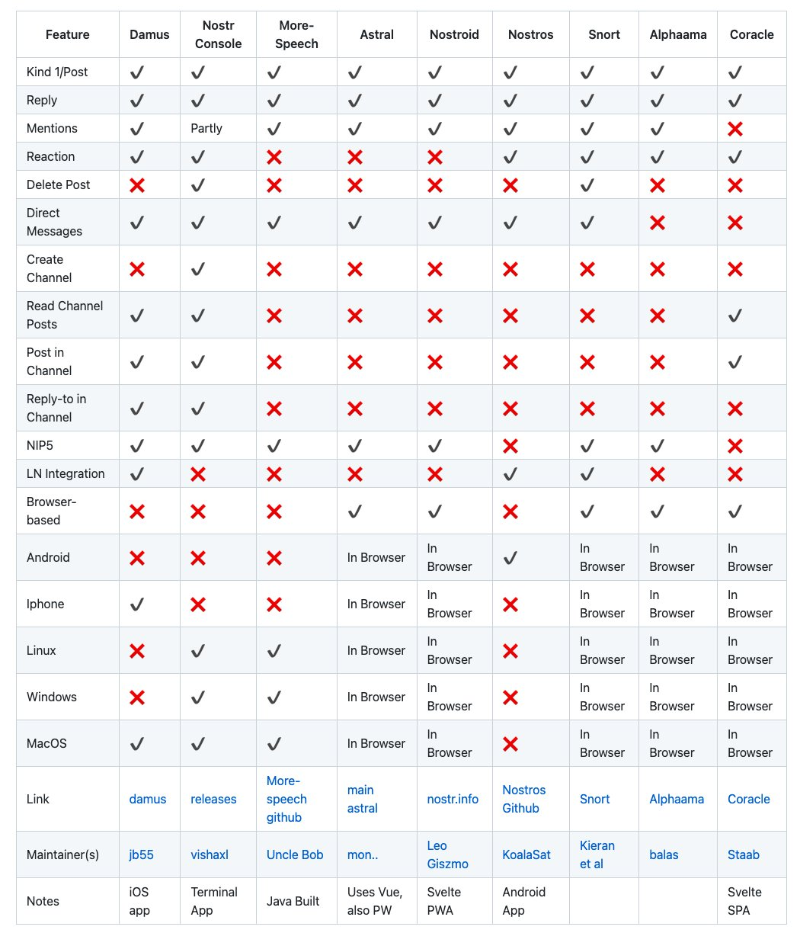
At the same time, people inevitably compare it with classic Web2 platforms like Twitter. However, some make incorrect comparisons—such as equating Twitter directly with Nostr or treating Damus as synonymous with Nostr. The misunderstanding lies in the fact that Nostr is fundamentally a protocol, while Damus is a third-party application built on that protocol. There are many other applications similar to Damus; below is a comparison of different client implementations on Nostr.
Nostr is a minimalist protocol designed to create a censorship-resistant global "social" network—an ambition rooted in today's social media challenges: Social networks are censored and unfree.
The most commonly cited example is Twitter. But did Twitter do anything wrong?
Not necessarily. As a privately held company registered in the United States (formerly publicly traded), it must comply with regulations, answer to shareholders, and maintain a profitable business model... It is a commercial enterprise, not a guardian of free speech.
As a company, it has every right to define its own boundaries for content moderation. When child pornography, incitement to violence, racial hatred, and other toxic content flood the platform, they drive out quality users and harm advertiser confidence. Moreover, pressure from governments, public opinion, and even internal employees can influence content policies.
Who should protect freedom on social networks? I believe this responsibility shouldn't fall solely on companies or applications. Instead, it should be entrusted to protocols like Nostr and Farcaster—code ensures freedom.
To use a common analogy, Nostr and Farcaster are like Layer 1 for social media—a truly open and free “public square.” Developers and private companies can build applications atop this foundation. In theory, even traditional Web2 platforms like Twitter could be rebuilt on top of Nostr. At Layer 2—the application layer—competition revolves around UI/UX, content curation, and operations. Different apps may enforce varying levels of content moderation, but this doesn’t erase the underlying data. Even if certain information is blocked on one app, it remains accessible on another. This empowers individuals to freely choose the applications they prefer.
Nostr and Farcaster are two representative examples among decentralized social protocols. Others include Lens Protocol and DeSo. They share the same ultimate goal, but differ significantly in technical approaches and even their “protocol personalities.”
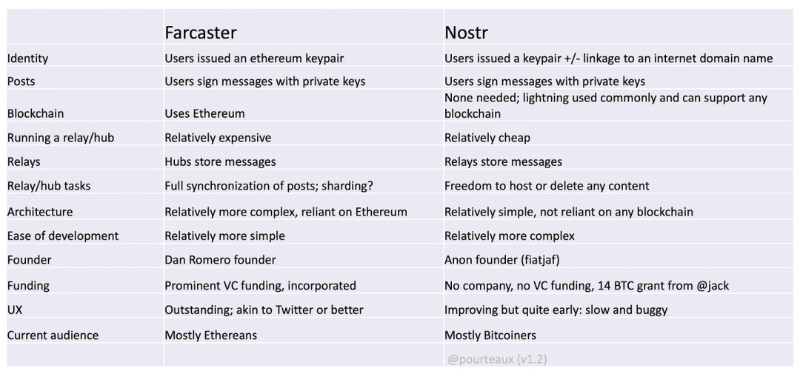
In summary, a simple conclusion when comparing Nostr and Farcaster is: Nostr resembles Bitcoin, while Farcaster resembles Ethereum.
At its core, Farcaster is a company funded by venture capital, founded by Dan Romero, former executive at Coinbase. In July 2022, it raised $30 million in funding led by a16z.
Farcaster’s early invitees were primarily VCs, startup founders, and members of the Ethereum community.
Architecturally, Farcaster leverages Ethereum’s infrastructure. Creating a profile on Farcaster generates a recovery phrase and an identity on the Ethereum Goerli testnet. Farcaster chooses to host user identity information on-chain—essentially functioning as a global data registry.
Because storing data on-chain is expensive, Farcaster makes a trade-off: user identities and permissions to read/write data are stored on-chain, while other data (like private messages) are stored off-chain on servers called Farcaster Hubs. This design ensures users retain full control over their identity, social connections, and personal data.
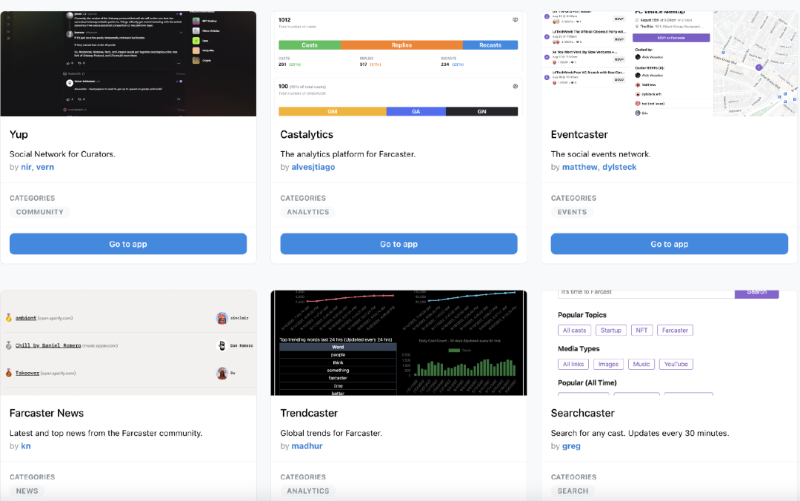
Currently, over 30 applications have been built on the Farcaster protocol.
Compared to Farcaster’s multi-million-dollar funding, Nostr appears modest. It was created by a group of anonymous developers without external funding, later receiving only a single donation of 14 BTC from Twitter founder Jack Dorsey.
Early supporters of Nostr were mainly Bitcoin enthusiasts led by Jack himself—including Martti Malmi, core developer who originally hosted Satoshi Nakamoto’s Bitcoin forum, who built the iris.to client based on the Nostr protocol.
Like Bitcoin, Nostr values simplicity. Each user’s identity is simply their public key. The system relies on just two core components: clients and relays (also known as forwarders).
Every individual runs a client. To publish content, you sign it with your private key and send it to multiple relays (servers hosted by others or yourself). To receive updates from others, you query multiple relays to see if they have the latest data.
Anyone can run a relay, and crucially, you don’t need to trust them—signatures are verified client-side.
As BTCStudy Ajian put it succinctly: Nostr is a public-key-based, minimal, censorship-resistant information transmission protocol.
Beyond Nostr and Farcaster, the hottest decentralized social protocol currently is Lens Protocol—a decentralized social media protocol built by Stani Kulechov, founder of the DeFi lending project Aave, deployed on Polygon.
The core innovation of Lens Protocol is fully leveraging the potential of NFTs to construct a social graph.
For instance, when you create a Lens profile, an NFT is minted in your Ethereum wallet. When you follow someone on Lenster, you mint a “follower” NFT (Follow NFT) on-chain, each with a unique ID recording the order of follows.
Thus, under Lens Protocol, social relationships are not merely data—they become transferable, tradable assets.
From an ecosystem development perspective, Lens Protocol is currently the most vibrant social protocol—partly due to its modular architecture.
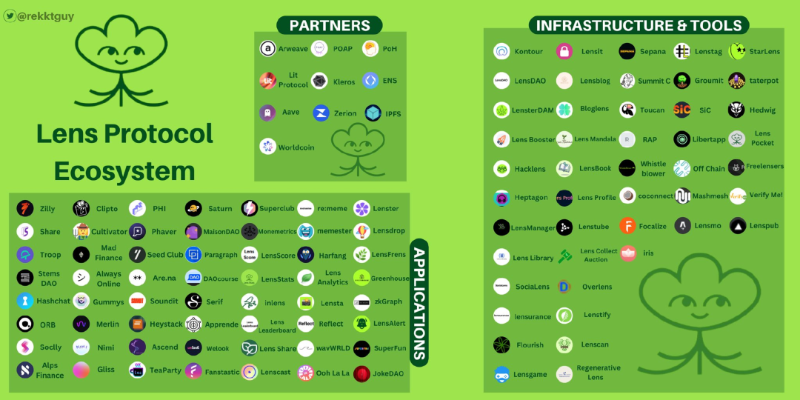
Lens Protocol is exceptionally developer-friendly, allowing developers to freely assemble their own social apps using modular components. It integrates numerous Web3 and Web2 tools, combining on-chain and off-chain data—all unified through the LensAPI. For example, for data hosting, apps can choose decentralized storage like IPFS and Arweave, or traditional solutions like AWS. They can use XMTP or Dialect for direct messaging, Push or Notify for notifications.
In traditional internet domains, social networking is the crown jewel due to powerful network effects. The resulting oligopolistic dynamics are evident—most social apps, including Tantan and Momo, ultimately lead users to WeChat, whose entrenched social graph makes it nearly impossible to leave.
Without debating whether decentralized social networks can overthrow traditional social graphs, here’s a critical question: Do decentralized social platforms still benefit from network effects? Who will emerge as the winner?
The network effects and monopolistic advantages of traditional social platforms largely stem from being closed and permissioned—creating walled gardens where, after time, the cost of leaving becomes prohibitively high because users cannot take their social relationships and data with them.
But in decentralized social ecosystems, openness and permissionless access—combined with true user ownership of social relationships (assuming real control)—drastically lower exit costs, making network effects harder to accumulate.
Put differently, decentralized protocols may accumulate some network effects, but individual applications will struggle to do so.
Perhaps this is what crypto freedom truly means.
Just throwing out some ideas—for discussion and reflection.
Join TechFlow official community to stay tuned
Telegram:https://t.me/TechFlowDaily
X (Twitter):https://x.com/TechFlowPost
X (Twitter) EN:https://x.com/BlockFlow_News