Analyzing the Orderbook-Native Chain Pioneer Injective: A Custom Chain Designed for High-Performance Order Requirements
TechFlow Selected TechFlow Selected
Analyzing the Orderbook-Native Chain Pioneer Injective: A Custom Chain Designed for High-Performance Order Requirements
The implementation of frequent batch auctions has made Injective a naturally institution-endorsed decentralized trading platform.
 Navigating Web3 tides with focused insights
Author: Yilan, LD Capital
Landscape of the Public Chain Order Book赛道
When it comes to DEXs, most people immediately think of AMMs. AMMs are highly useful and represent a foundational mechanism in DeFi. While onchain LOB (on-chain order book) systems are often criticized for lacking an LP ecosystem and for replicating centralized exchange regulatory arbitrage behaviors, they still play a significant role within the broader DEX landscape—particularly as a crucial niche for professional traders and institutional participants.
Overall, order book exchanges can be categorized into four types. The first type consists of high-performance but highly centralized CEXs with superior trading speed and throughput, which dominate current market preferences—examples include Binance and OKX. The second type is Ethereum L1 on-chain order books, such as Gridex, achieving strong decentralization. However, due to direct on-chain execution, these suffer from performance limitations and require users to pay high gas fees. The third type comprises high-performance off-chain order books built on Rollups, where matching occurs off-chain to reduce gas costs while settlements are batch-processed on-chain for security—examples include dYdX v3, Vertex, and Zigzag. Recently, ETH L2 Base has called for onchain order book DEXs to become part of its ecosystem fund and deploy within its network, providing fertile ground for onchain orderbooks across various L2s. The fourth category includes high-performance DeFi-native chains or custom chains optimized for order book performance, such as Injective and upcoming mainnet projects like Sei and dYdX V4.
Among this fourth category of DeFi-native order book chains, notable examples include Injective, dYdX V4 (currently in testnet), SEI, along with Osmosis, Kujira, and Crescent. Currently, dYdX and Injective lead in scale and development. Benefiting from the Ignite consensus framework (formerly Tendermint—a proprietary Byzantine Fault Tolerant (BFT) PoS architecture), IBC, and customizable SDKs, nearly all native order book chains are built on the Cosmos ecosystem. However, Injective stands out as the pioneer in implementing on-chain order books on Cosmos.
This article focuses on Injective within the context of DeFi-native order book blockchains, exploring whether Injective holds fundamental advantages over competitors regarding core strengths, moats, and competitive positioning in the public chain order book DEX space.
Injective is a DeFi-optimized, interoperable Layer 1 blockchain. Prior to announcing integration with Cosmos, Injective was initially perceived as an Ethereum L2/sidechain. However, after gaining consensus layer sovereignty on Cosmos, Injective evolved into a plug-and-play financial infrastructure platform featuring high-performance decentralized exchange infrastructure, decentralized bridges, oracles, and a composable smart contract layer powered by CosmWasm. Protocols within the ecosystem can leverage Injective’s on-chain order book to launch liquidity and matching services, adding another layer of composability.
The architectural components of Cosmos Tendermint/Ignite, SDK, and IBC enable Injective to support its order book functionality with high finality and low transaction costs, further enhancing capital efficiency and mitigating liquidity fragmentation—all while maintaining interoperability with Ethereum. Using an FBA (Frequent Batch Auctions) order matching engine and an OME (Order Matching Engine) design that aggregates all orders at the end of each block and executes market orders at a uniform price, Injective prevents frontrunning. This gives Injective a unique moat as a decentralized financial infrastructure—offering decentralization, high-speed trading, fast finality, and MEV resistance—setting it apart from both traditional finance order books and AMM-based models.
Injective Architecture
The Injective Chain is the core component of Injective. Built using the Cosmos Tendermint/Ignite standard, the Injective Chain inherits decentralization, security, and high performance.
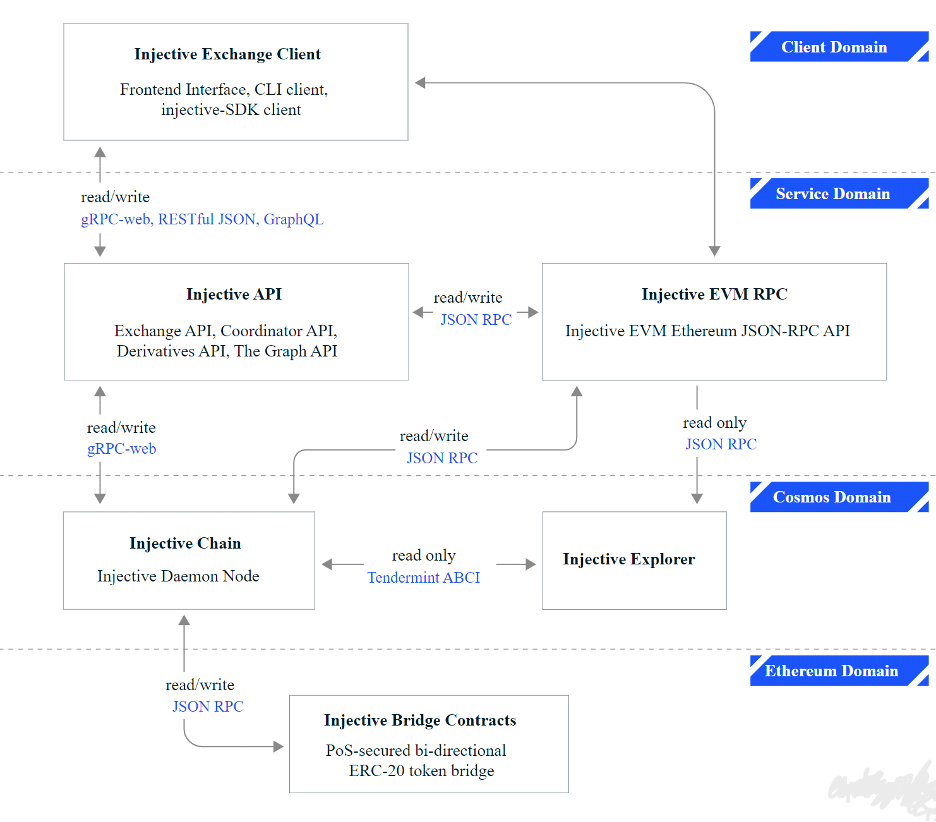
The diagram above illustrates the entire Injective Stack
Service Domain
The service layer acts as a bridge connecting exchange DApps (such as Helix) with the underlying blockchain layer. It consists of multiple APIs including Exchange API, Coordinator API, Derivatives API, and The Graph API. These APIs play a critical role in enabling seamless communication between different components of the Injective ecosystem, helping users trade and access various DeFi services. The modular API design allows Helix to interact with both Tendermint/Ignite-based Cosmos chains and the Ethereum blockchain, offering greater flexibility and scalability—ensuring Injective can continue evolving to meet the changing demands of the DeFi space.
Cosmos Layer
The Cosmos layer forms the foundation of the Injective Chain, built on Tendermint/Ignite, responsible for executing various types of spot and derivatives transactions. This layer includes the Injective API and Injective EVM Remote Procedure Call (RPC), enabling connections to the Injective Chain and Injective Explorer. The EVM (Ethereum Virtual Machine) is a decentralized, Turing-complete virtual machine used to execute smart contracts on the Ethereum blockchain. The Injective Explorer is a tool for tracking all transactions occurring on the Injective Chain, providing users with valuable insights into platform activity and performance. Tendermint's instant finality makes it ideal for supporting the Injective Chain, enabling rapid transaction execution and settlement. The Cosmos layer also offers security and performance benefits, including the Tendermint/Ignite consensus mechanism, horizontal scalability, and a powerful application framework for building custom blockchain applications.
Importance of Consensus Mechanism
Tendermint/Ignite was selected as the consensus mechanism for the Injective Chain because it delivers near-instant finality, high fault tolerance, and support for horizontal scaling. In the context of trading platforms, near-instant finality is particularly important—it ensures transactions are executed quickly and efficiently without risk of rollback or double-spending. This enables Injective to maintain high performance even as trading volume increases. Tendermint’s PoS consensus algorithm also provides strong fault tolerance, ensuring the Injective Chain continues operating correctly even if malicious or faulty nodes exist.
Specifically, the Tendermint/Ignite protocol uses multiple rounds to propagate blocks to network validators via proposal messages. For a block to be accepted, it must receive votes from multiple proposers and be signed with the private keys of corresponding validators. Validators communicate over peer-to-peer (P2P) gossip protocols on Tendermint/Ignite. A block is considered valid only when more than two-thirds of validators accept it—this is known as the Byzantine Fault Tolerant (BFT) Proof-of-Stake (PoS) consensus mechanism.
Ethereum Domain
The bridging layer is essential for cross-chain interoperability and communication between Injective and the Ethereum network. It consists of Injective Bridge smart contracts, which rely on Wormhole, Peggy, IBC, and Axelar. The bridge layer interacts with the Injective Chain, Ethereum network, and other supported blockchains. The Injective Bridge uses Peggy to enable bidirectional transfers of ERC-20 tokens and assets between Injective and Ethereum. Cross-chain interoperability enabled by Wormhole, Axelar, and IBC is vital for decentralized blockchain infrastructure, allowing different networks to seamlessly share data and assets. Through the Injective Bridge, Injective—and the broader Cosmos ecosystem—can inherit some of Ethereum’s vast liquidity by leveraging Ethereum’s network and DApp ecosystem.
Project Background
Injective was incubated by Binance and was one of eight projects in Binance Labs’ first cohort, receiving support from numerous investment institutions. Although Binance has recently faced significant pressure from the SEC, the impact on the decentralized exchange Injective remains limited.
Eric Chen, Co-founder and CEO of Injective Protocol, graduated from NYU’s Computer Science School. The core team has strong professional backgrounds, with prior experience at well-known organizations such as OpenZeppelin, Amazon, and hedge funds. Key team members hold degrees from top universities like Stanford.
On July 29, 2020, Injective raised $2.6 million in a seed round led by Pantera Capital, with participation from QCP Soteria and Axia8 Ventures.
On April 20, 2021, Injective raised $10 million in a “party round” financing, with investors including Pantera Capital, Mark Cuban, and Hashed.
On August 10, 2022, Injective raised $40 million in a funding round involving Jump Crypto and BH Digital.
In January this year, Injective announced a $150 million ecosystem fund to drive growth. Over 20 projects—including Astroport, Celer Network, and Helix—are now live in the Injective ecosystem. In April, Injective partnered with Tencent Cloud to support developers building on its platform.
Tokenomics
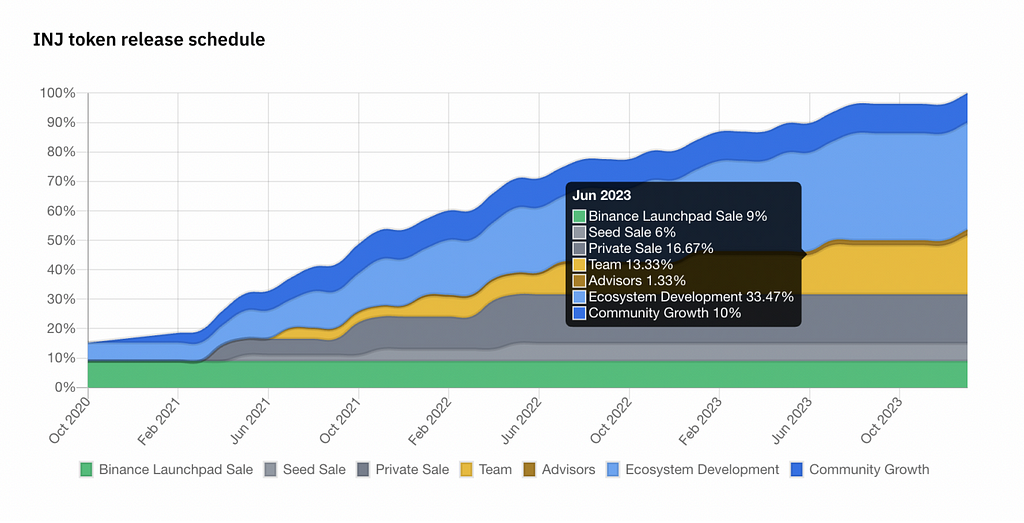
INJ has a total supply of 100 million. Block rewards are compensated through new token minting, creating inflationary pressure. The target inflation rate starts at 7% and gradually decreases to 2%. However, 60% of transaction fees are used to buy back and burn INJ, placing the token in a deflationary state. Over 90% of the tokens have already been released, with approximately 5% scheduled for release in the near term (June–August), mostly from Team, Advisors, Ecosystem Development, and Community Growth allocations. Tokens from the Team and Advisors may create potential sell-side pressure, while others will feed into APY incentives within the Injective ecosystem—generating some selling pressure but driving higher ecosystem engagement and data growth.
INJ is deflationary: 60% of dApp-generated fees go toward on-chain INJ buybacks and burns (60% of trading fees are auctioned off; bidders use INJ to bid, and the winning bids result in INJ being burned). Weekly supply reductions create deflationary effects that partially offset inflation caused by token minting. More precisely, 39.78 million staked INJ face a 5% annual inflation rate, equivalent to 2 million newly minted INJ per year. To date, cumulative burns have reached 5.32 million INJ, representing 5.32% of total supply.
Figure: INJ Burn
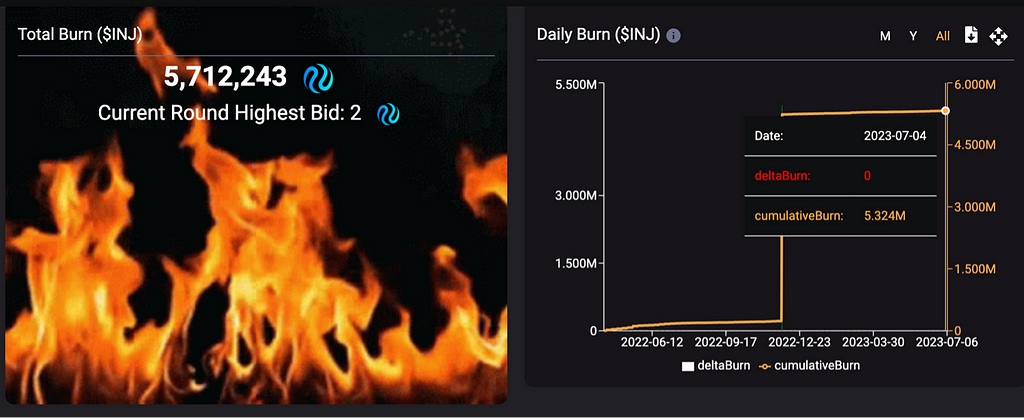
Figure: INJ Staking Status

Value Capture
1) Protocol Fee Value Capture
After allocating 40% of trading fees to exchange DApps, Injective uses the remaining 60% for buybacks. The protocol conducts weekly auctions where participants bid in INJ for that week’s fee revenue. Winning bidders gain arbitrage opportunities and profit from a basket of tokens, while the protocol uses proceeds to purchase and burn INJ, preserving its deflationary nature.
2) Security via Tendermint-Based Proof-of-Stake (PoS)
The INJ token secures the Injective blockchain through a PoS mechanism. Both validators and delegators can participate in staking.
3) Developer Incentives
40% of fees generated by users on Injective-based dApps are directly allocated to incentivize new developers to build applications on Injective, fostering continuous growth in developer participation.
4) Protocol Governance
INJ tokens govern every aspect of Injective, including upgrades to the chain itself.
Token Allocation
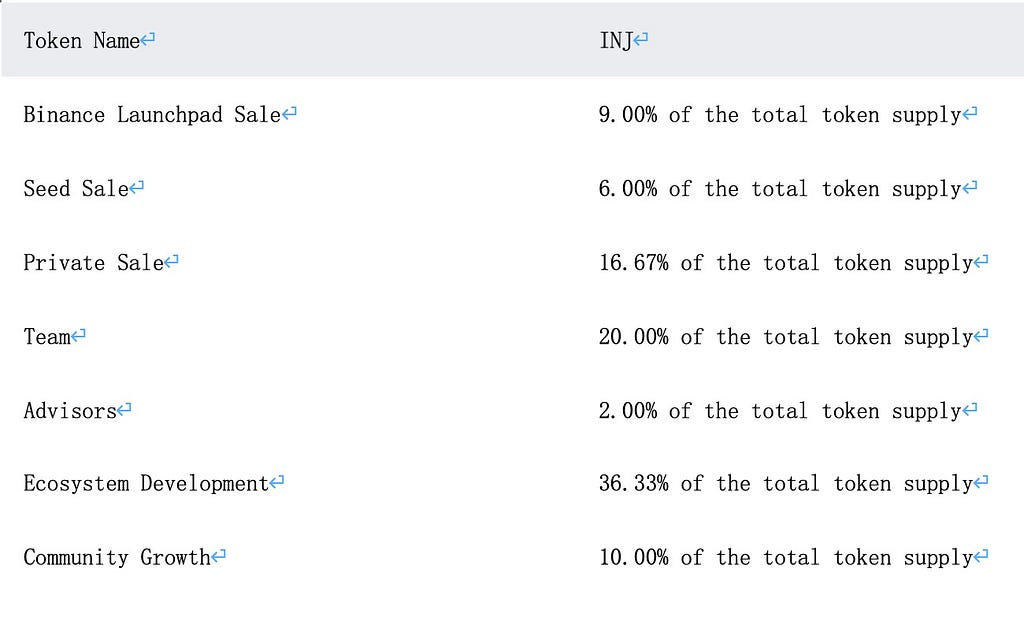
Token Sales Data
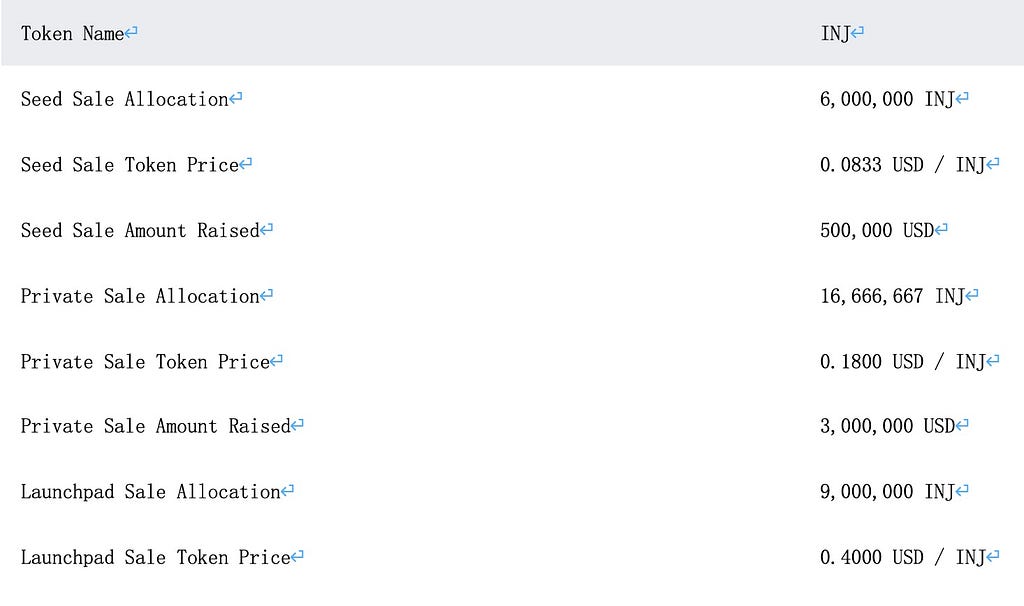
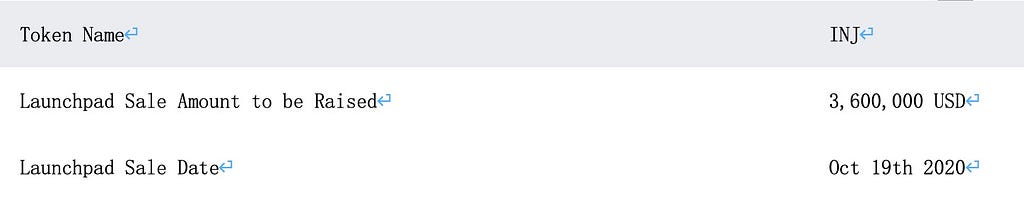
Source: Binance Research
Ecosystem Projects
There are currently 24 DApps live on the Injective mainnet, primarily focused on DeFi, though some are building infrastructure for communications, information protocols, NFTs, and more.
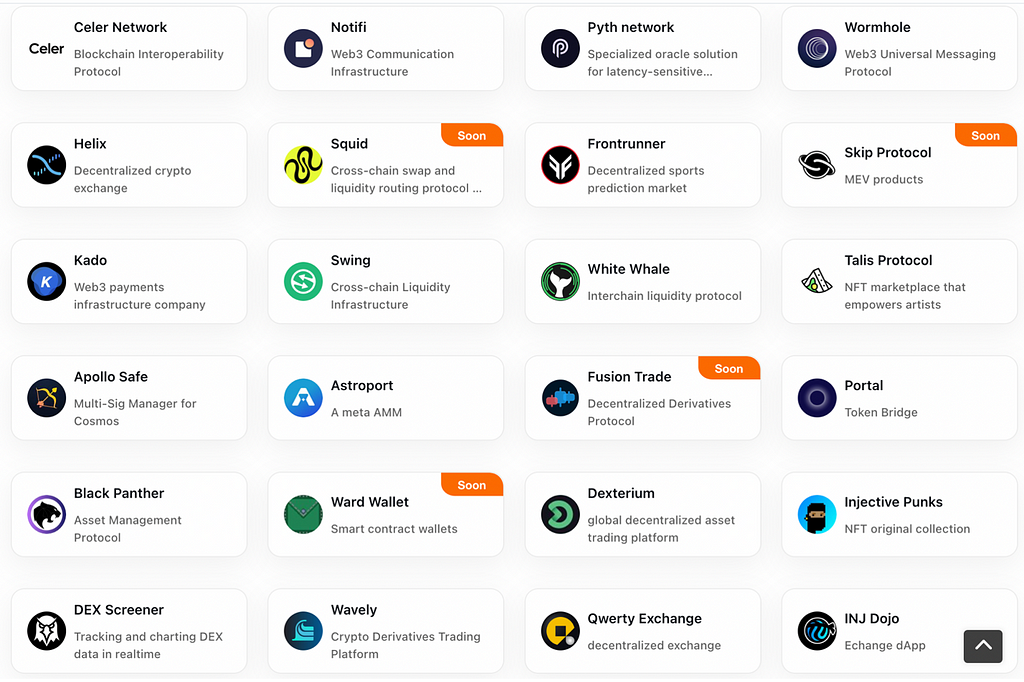
Main DApps on Injective
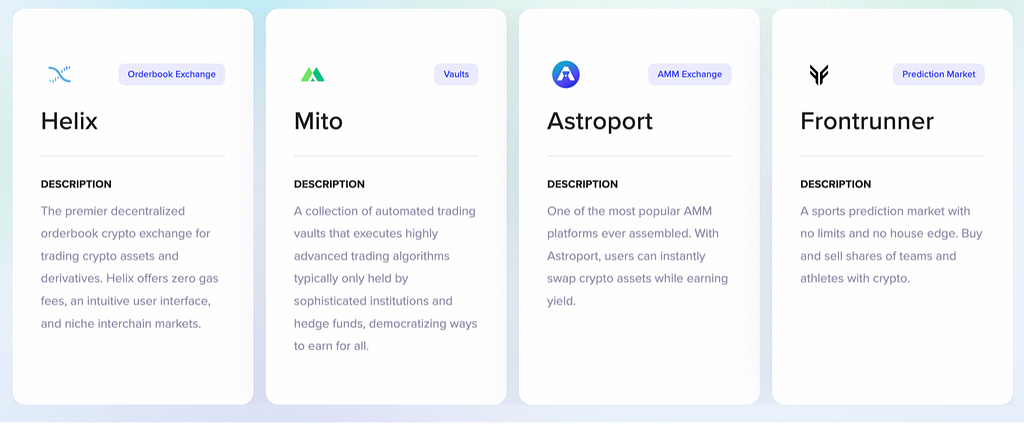
Source: Injective Official
Helix
Helix is the front-end interface for Injective’s order book trading, formerly known as Injective Pro. It aims to provide cross-chain spot and perpetual markets, enabling users to trade various cryptocurrencies. Helix supports zero gas fees, reducing user trading costs.
Mito
After long anticipation, last month Injective Labs officially unveiled Mito—previously known as “Project X”—and launched closed testnet access. Mito is a protocol composed of smart contract-driven automated trading vaults, each executing advanced trading algorithms typically accessible only to institutions and hedge funds. It is currently in early access. Mito features two key components: automated strategy vaults for easy yield generation and a sophisticated token launch platform. Through this innovative platform, users can access diverse trading strategies and generate returns while exploring new tokens in the crypto space.
Astroport
Astroport is an AMM protocol allowing any user to swap crypto assets or provide liquidity (LP) using various pool types, including Curve-style stablecoin pools and Uniswap V2-style constant product pools. Astroport leverages Injective’s interoperable network to enable asset swaps bridged from Cosmos or Ethereum, as well as from Solana, Aptos, and Avalanche via Injective’s recent Wormhole integration.
Because Astroport is built on Injective, users can bridge assets via Injective Bridge and then create liquidity pools on Astroport, earning yields as liquidity providers and accessing new markets.
Astroport brings significant advantages to the Injective ecosystem. Originally built on Terra, Astroport’s contributors spent considerable time analyzing major L1 networks before selecting Injective as the host chain for its V2 version. Astroport has now officially migrated its mainnet to Injective, becoming one of the largest AMMs in the Injective ecosystem.
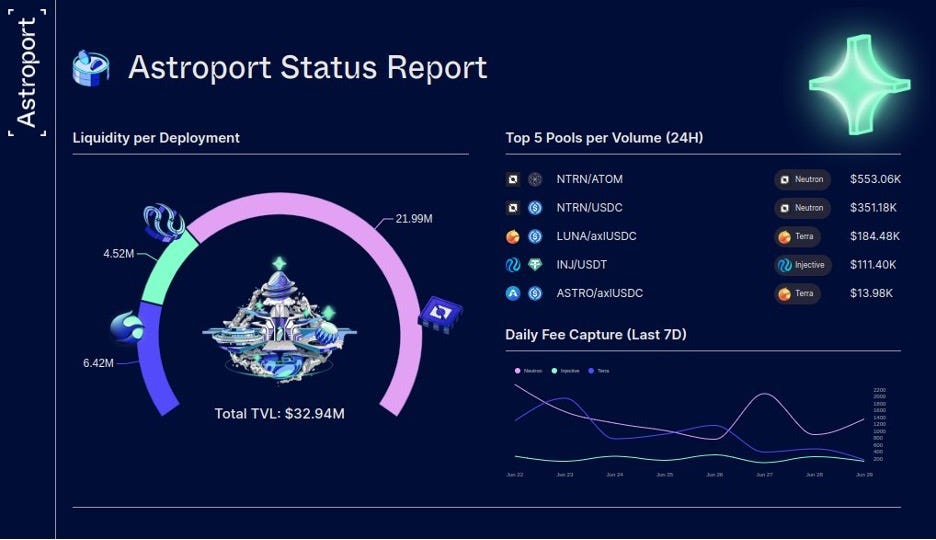
Source: @astroport_fi
As of end-June, Astroport’s total TVL was $32.94M, distributed across Neutron ($21.99M), Terra ($6.42M), and Injective ($4.52M).
Competitive Landscape
SEI is a comparable protocol to Injective in terms of consensus foundation, OME type (FBA), and FDV. There are nuanced differences in their OME mechanisms, detailed below.
dYdX is preparing to migrate from Ethereum to launch the dYdX Chain (dYdX V4) on Cosmos. V4 is currently in testnet. Once dYdX V4 launches, it could encroach on Injective’s market share—the extent depending on trading incentives and institutional preferences. From a token release standpoint, Injective has already released 90% of its supply, whereas dydx—and the yet-to-launch SEI—may have more room for token-based incentives.
In valuation, SEI completed its last round at an $800 million valuation with a $30 million raise, backed by Jump Capital and Distributed Global. Injective’s valuation is currently under $800 million, compared to dYdX’s $1.9 billion—indicating room for growth. However, Injective lags significantly behind competitors in key business metrics like trading volume (Helix’s 24-hour volume: $22M vs. dYdX’s $600M). This gap stems largely from Injective’s focus on Cosmos-native assets.
Compared to other blockchains on the Cosmos network, Injective is currently the fastest, with an average block time of about 1 second. The chart clearly shows Injective’s block production speed surpassing other chains.
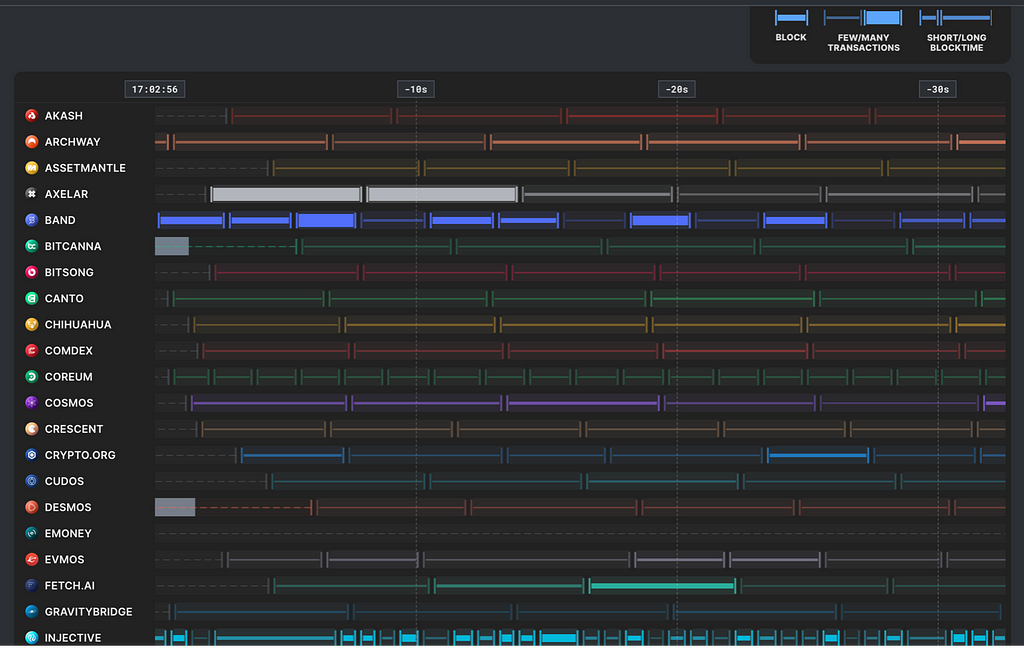
Order Matching Engine (OME) Comparison
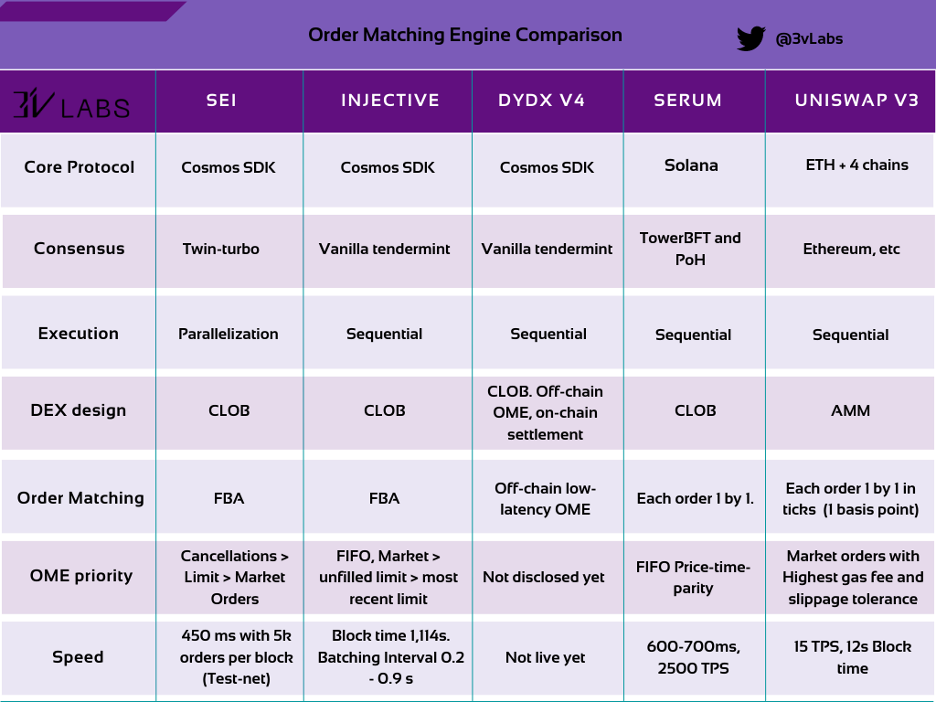
Source: OME Comparison by 3V Labs
The chart above compares order matching mechanisms across SEI, Injective, dYdX V4, Serum, and Uni V3, courtesy of @3V Labs.
Resisting MEV is crucial for handling large-scale institutional order flows. Most order book DEXs today mitigate harmful MEV using Frequent Batch Auctions (FBA). Besides FBA, dYdX V4 employs an off-chain, low-latency OME model.
For Injective, the FBA matching mechanism is a key upgrade based on the frequent batch auction model. It maintains fast trading speeds, improves liquidity depth near market prices, and narrows spreads.
So what exactly is FBA? To understand FBA, we must first grasp Continuous Double Auction (CDA). FBA effectively solves inefficiencies inherent in CDA.
Problems with CDA (Continuous Double Auction)
Centralized exchanges in both crypto derivatives and traditional financial markets use the Continuous Double Auction (CDA) model. In this model, orders are processed as soon as they arrive at the exchange—either executed immediately against opposite-side orders or left on the book until matched.
CDA’s order processing incentivizes speed, and volatile markets create substantial arbitrage opportunities. Market makers (MMs) follow asset prices and provide depth by placing orders on both sides of the book. As prices move, MMs must cancel and re-place orders accordingly.
However, during the interval between external price updates, high-frequency traders (HFTs) can exploit stale MM orders before MMs can cancel them. Thus, HFTs capture arbitrage profits. This stale-order sniping game is so profitable and persistent that HFTs invest heavily in microwave towers and FPGAs to compete at nanosecond speeds, putting MMs at an insurmountable disadvantage.
Due to these clear issues, MMs are often forced to invest in competing tech solutions—an indirect cost ultimately borne by traders through higher fees. Additionally, MMs tend to become more risk-averse when providing deep liquidity near market prices. This harms retail traders seeking fair executions and introduces high volatility within spreads, destabilizing markets at small time scales. Retail traders are frequently forced to enter positions at unfavorable prices.
CDA matching engines require high-throughput processing at unpredictable intervals, while demand is minimal otherwise. Even when built by centralized entities, CDA-based exchanges rarely achieve 100% uptime demanded by markets. On blockchain networks, the challenge worsens. Decentralized exchanges thus have far less flexibility than even the most modular centralized exchanges in solving these problems.
Minor modifications to CDA designs in DEXs have proven unsatisfactory, often harming retail traders. For example, prioritizing orders not by submission time but by higher gas fees paid, ignoring others with reasonable fees.
Any user attempting aggressive trades on AMM protocols has likely experienced bots profiting at the margin of their slippage tolerance by paying higher gas fees. While AMMs aim to eliminate reliance on institutional MMs, the capital inefficiency costs associated with CDA are directly passed onto retail traders.
Now Consider FBA Advantages and Injective’s FBA
Injective’s Frequent Batch Auctions (FBA) are widely proposed as a definitive solution to the capital inefficiencies of CDA. One benefit of FBA is eliminating frontrunning, thereby improving market fairness and liquidity.
Injective’s FBA is defined by three characteristics:
1) Discrete Time: Orders are accepted during discrete time intervals called auction windows. At the end of each window, crossed orders are filled in the following priority:
Market orders first, then unfilled limit orders from previous auctions, and finally new limit orders from the current auction. If buy and sell quantities differ, the smaller side is fully filled, and the larger side is proportionally filled (uniform partial fill).
2) Uniform Clearing Price: Limit orders are filled at a single clearing price that maximizes the number of crossed orders. If buy and sell volumes match, the midpoint price becomes the clearing price.
3) Closed Bidding: Orders remain hidden from the order book until the auction window closes and batch execution begins. This eliminates frontrunning and negative spreads.
In frequent batch auctions, longer auction intervals give market makers sufficient time to cancel stale orders before HFTs can act. This removes the risk of frontrunning, eliminating the need for MMs to invest capital in cutting-edge technology.
Market makers are incentivized to provide deeper liquidity and tighter spreads near market prices—benefiting retail traders aiming to fill orders fairly and reducing volatility linked to potential price drops.
Frequent batch auctions aggregate orders across auction intervals for state changes or order book updates. Transactions are queued and written into sequentially produced blocks in batches. The optimal batch interval for FBA remains debated but academic reports suggest 0.2 to 0.9 seconds—consistent with Injective’s block interval. Batch auctions execute at the end of each block.
SEI, another Cosmos-based protocol using FBA for order matching, differs from Injective in several technical aspects:
1) SEI implements parallel block processing instead of sequential transaction ordering. It can process multiple transactions involving different markets simultaneously, boosting performance. Recent load tests show 75–90% reduction in block time compared to sequential processing, with parallel latency ranging from 40–120ms versus 200–1370ms;
2) SEI integrates a price oracle that streams off-chain price data directly on-chain. All validators must submit price proposals when committing blocks. A block is only created if validators agree on a common price. Validators who miss voting windows or deviate too far from the median price are penalized;
3) Transaction bundling allows market makers to cancel and create multi-market orders in a single transaction (e.g., combining all BTC perpetual orders into one smart contract call).
Injective runs on Tendermint/Ignite’s BFT-based PoS consensus, featuring instant finality, which aligns perfectly with FBA execution at the end of each interval. Since FBA does not prioritize orders by time within an auction window, it matches seamlessly with blockchains operating on similar principles. Tendermint/Ignite is a BFT consensus engine using a pre-selected validator set to reach agreement through voting rounds. Its design emphasizes high security and determinism, making it ideal for applications requiring strong consistency and finality—a perfect fit for Injective’s architecture.
By replacing Continuous Double Auction (CDA) with Frequent Batch Auctions (FBA), Injective adopts a technically robust market design capable of competing with centralized exchanges. Injective eliminates frontrunning that harms traders and enables market makers to offer deeper liquidity and tighter spreads. The implementation of FBA positions Injective well to compete with institutional-grade centralized exchanges in trading volume.
Conclusion
Injective boasts advantages in trading speed, instant finality, near-zero gas fees, and MEV resistance, stemming from:
1) Fast block confirmation based on Tendermint BFT consensus (though relatively more centralized) with immediate finality;
2) Exchanges—not traders—pay all on-chain interaction fees, as exchanges broadcast signed messages to Injective Chain nodes rather than individual traders doing so;
3) Use of Frequent Batch Auctions (FBA) as the clearing mechanism. Orders submitted to the mempool execute at the end of each block (~1-second block time) and remain hidden until the auction completes, effectively preventing MEV bot frontrunning.
Compared to AMMs, Injective’s on-chain order book design is more favorable for regular users—especially institutions—for strategic order placement (e.g., stop-loss orders, which AMMs generally cannot support—though UniV4 might offer limited capabilities). AMMs benefit from massive TVL, with LPs forming an organic part of the market. In contrast, LOB systems naturally skip the step of staking assets on-chain, requiring external subsidies to attract market makers, making it difficult to cultivate an LP ecosystem or capture value chains derived from it. That said, AMM products can still be built on Injective—but currently, most of Injective’s trading volume occurs on the order book front-end Helix.
Until rollups significantly boost LOB DEX performance, building native chains on Cosmos remains the best solution for high-performance LOBs. The launch of dYdX v4 may slightly erode Injective’s market share, depending on trading incentives and institutional preferences. LOB DEXs on rollups will also compete, but due to their non-sovereign, dApp-level status, their valuation frameworks differ fundamentally from native order book chains. Both LOB DEXs and AMMs employ decentralized approaches. At this stage, there’s no need to define a final winner—diverse solutions are essential for the market.
Injective uses LOB as its core trading model, featuring “MEV protection.” By building on Tendermint, it offers a highly decentralized, high-performance, and reliable environment suitable for trading cross-chain derivatives, forex (FX), synthetic assets, and futures. It provides institutions and market makers with a secure and efficient platform, eliminating risks of market manipulation and exploitation by high-frequency traders. The implementation of frequent batch auctions prepares Injective to compete with institutional-grade centralized exchanges in trading volume, making it a natural choice for institutional adoption. However, this also means Injective’s price trajectory is closely tied to institutional capital support. In the next cycle, high-performance chain-based trading engines, one-click chain deployment, and engineering advancements will further empower professional market makers to establish liquidity on DEXs, working alongside AMMs to gradually shift pricing power from CEXs to DEXs.
Join TechFlow official community to stay tuned
Telegram:https://t.me/TechFlowDaily
X (Twitter):https://x.com/TechFlowPost
X (Twitter) EN:https://x.com/BlockFlow_News
 Cycle Capital Research