








Understanding NounishDAO: DAO, Governance, and the Proliferation of Cultural Symbols
TechFlow Selected TechFlow Selected
Understanding NounishDAO: DAO, Governance, and the Proliferation of Cultural Symbols
Nouns is a very special DAO.
 Navigating Web3 tides with focused insights
Author: lilping
Over the past period, I've been invited by various Chinese Web3 crypto organizations and projects to share the story of NounsDAO.
Nouns is a very special DAO. Unlike typical NFT projects with a fixed supply of 10K, Nouns auctions one NFT per day. Since its launch, there has never been an interruption or failed auction. In nearly two years, its treasury has accumulated over 62,000 ETH solely through auctions. How was this achieved?
Even more remarkable is that Nouns has inspired many outstanding builders to come and contribute. Excluding minor contributions, there have been over 300 creative on-chain proposals alone, spanning marketing, development, charity, and local events. Organizing contributors effectively is a classic governance challenge—how does Nouns manage it?
Here, I’ve compiled the questions people frequently ask during my talks into this written piece, focusing primarily on factual (What) aspects. I'm still exploring deeper into this rabbit hole, and I hope in future presentations, I can enrich these foundations with more interesting details, new clues about crypto’s evolution, and deeper discussions on Why and How.
Let the story begin!
I first seriously looked into Nouns in June 2022, around the time LilNouns launched. Back then, OG superbro from the DAO mentioned casually: "Hey, I noticed many folks changing their profile pictures to LilNouns…"
(LilNouns is a fork of Nouns—“Lil” meaning “little,” so LilNouns are essentially mini-Nouns. A fun detail to distinguish them just by eyes: LilNouns have more black than white in their eyes, whereas Nouns have equal black and white eye areas ⌐◨-◨).
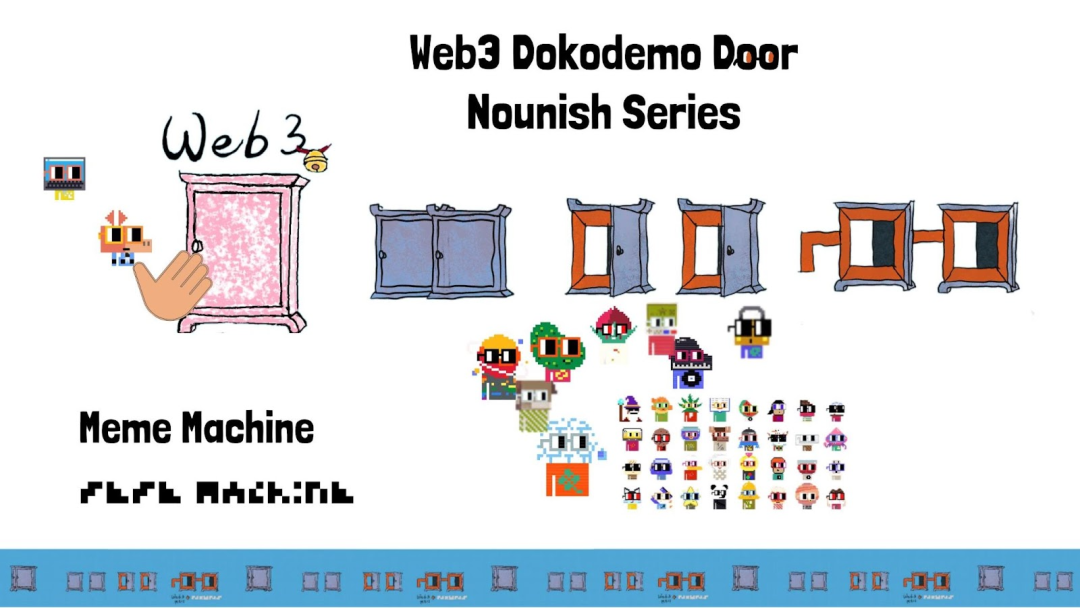
Curious, I began exploring both Nouns and LilNouns, eventually turning this journey into the “Nounish” series on the Web3 Anydoor podcast (since our host uses a LilNouns avatar, we called it the LilNouns series). As the story unfolded, I met all kinds of fascinating Nouners and LilNouners. Among them, Da Miao and Lucio—the hosts of the “Art Ride Together” segment on Anydoor—created an Anydoor*Nouns emoji pack: one door splits into two, and when opened, reveals the iconic Nouns glasses!
What is Nouns?
We can explain it using three keywords:
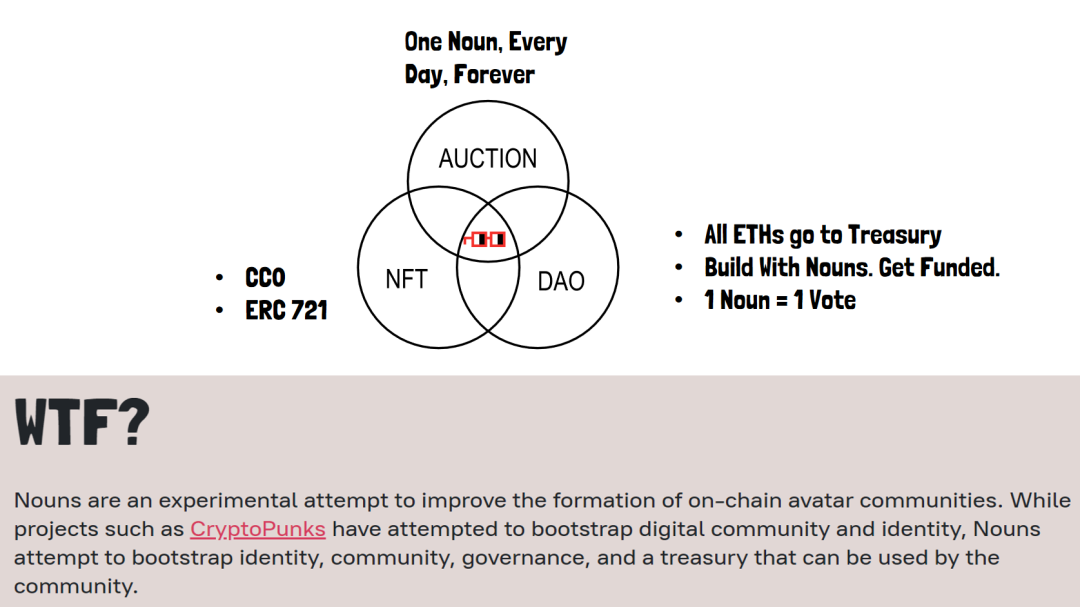
Auction, NFT, DAO
Nouns auctions one NFT every day. All ETH proceeds go into a transparent DAO treasury. Community members submit proposals to spend treasury funds promoting the Nouns glasses culture symbol ⌐◨-◨. Proposals are voted on by NFT holders—one Noun equals one vote.
Definition from the Nouns website:
Nouns is an experimental effort aimed at improving the formation of on-chain avatar communities. Projects like CryptoPunks attempted to shape digital communities and identity, while Nouns aims to shape identity, community, governance, and a shared treasury for the community to use.
This definition positions Nouns in contrast to CryptoPunks. Nouns builds upon CryptoPunks by adding two key elements: governance and a treasury.
Before BAYC acquired CryptoPunks, its intellectual property (IP) rights were highly restrictive. Nouns seeks to break such restrictions—anyone can create derivative works based on Nouns, freely sharing and even commercializing them. Furthermore, sales revenue (from auctions) doesn’t go to the founding team but into the community treasury for members to apply for funding.
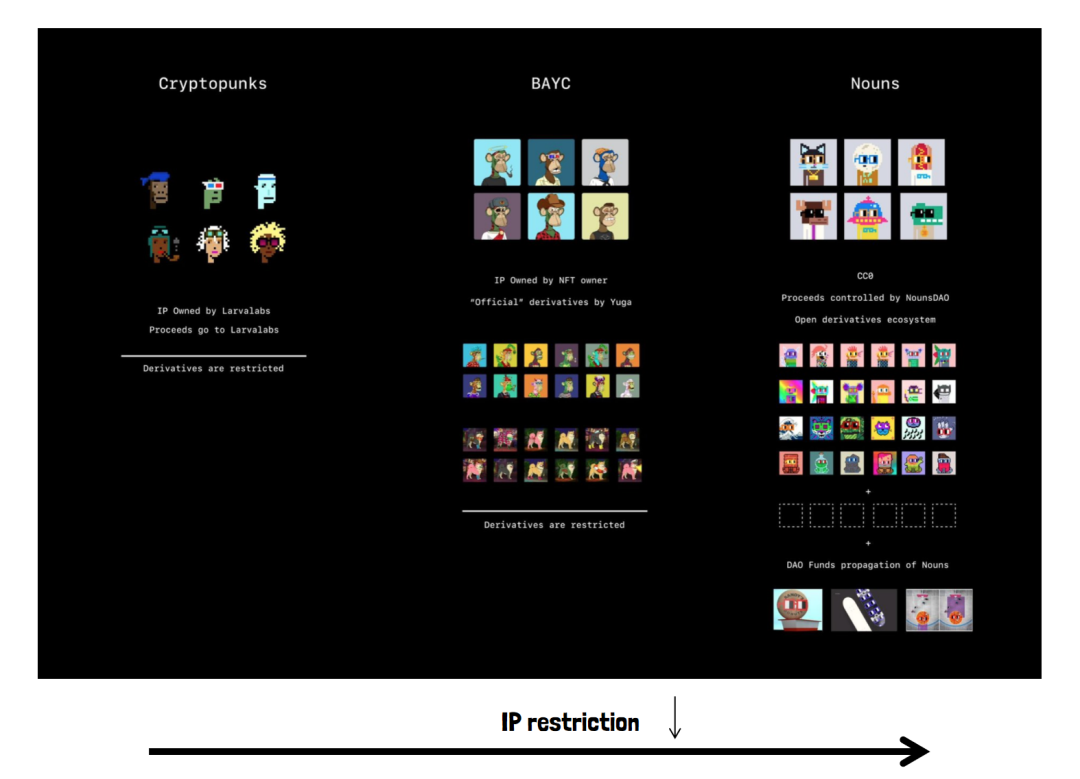
From left to right, copyright restrictions gradually weaken. Initially, Punks' IP was held by Larvalabs; BAYC's IP resides with NFT holders; Nouns adopts CC0, meaning no copyright restrictions.
Auction
Nouns auctions one NFT daily. In the first half of 2023, average auction prices ranged between 20–30 ETH.
The first Noun (Noun 1) sold for 613.37 ETH on August 8, 2021.
Nouns began on June 2, 2021, when co-founder Punk4156 posted a tweet that sparked interest. He then formed a 10-person founding team and set up a Discord server to coordinate. Within 24 hours of launching the Discord, three members—@gremplin, @timpers, and @eBoyArts—had built a prototype. Over the next two months, they refined it, officially starting the auction on August 8. About a month later, on September 2, the first on-chain proposal passed—to donate 5 ETH each to six charities.
(To celebrate its 2nd anniversary, the founders opened access to their private Discord, allowing us to revisit how they collaboratively launched the project.
Link: Join here)
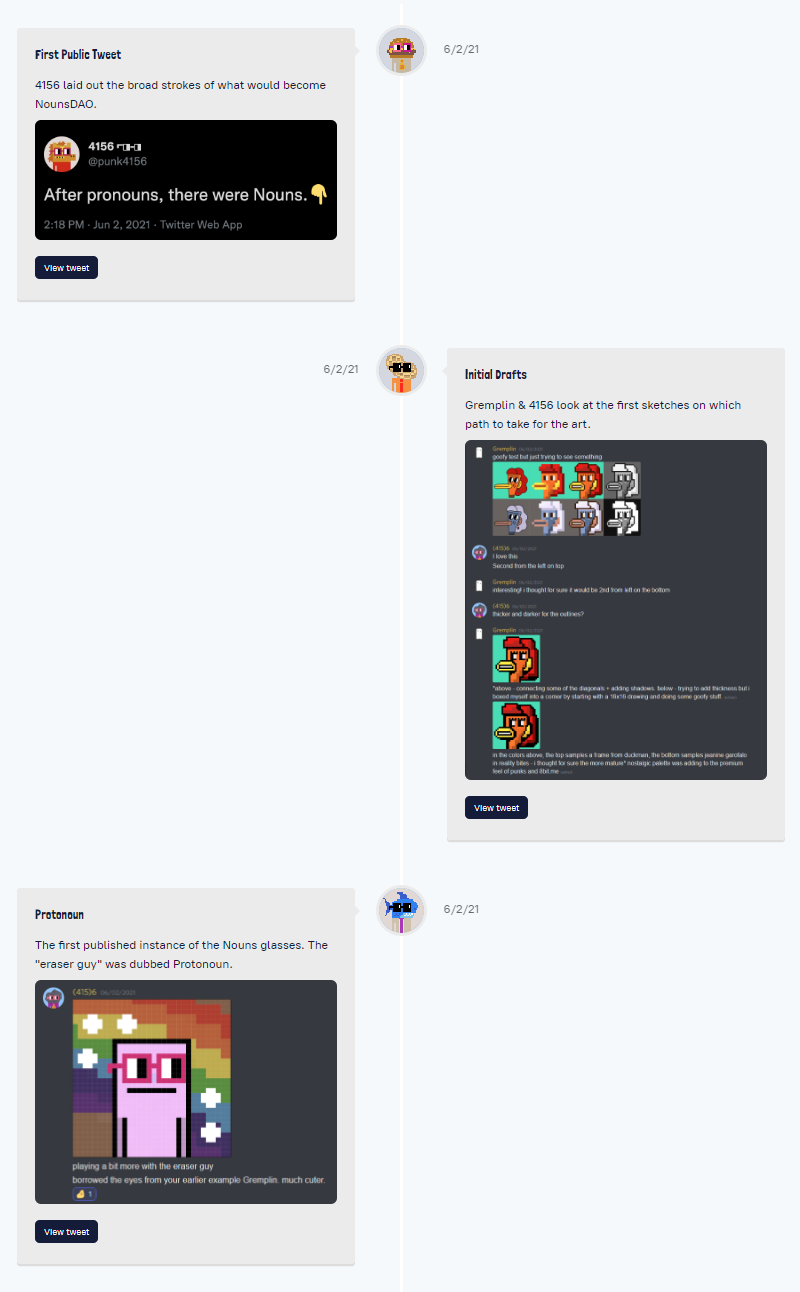
nouns.center showcases a simple history of Nouns’ founding
Nouns forked Compound Governance for its governance layer and Zora’s auctionhouse.sol for its auction mechanism. Interestingly, Zora later 'forked' Nouns back, creating Nouns Builder—a one-click tool to launch Nouns-style projects—contributing to a virtuous cycle of “forking back and forth.”

A small but important note about the auction: for the first five years, every tenth Noun (those ending in 0) goes to the founding team as a reward for creating NounsDAO. Beyond that, they do not receive any portion of auction proceeds.
According to Dune Analytics, approximately 35,000 ETH has been spent from the treasury, leaving around 28,000 ETH remaining. (For real-time data, see Dune dashboard: https://dune.com/aaaaaaaaaa/NounsDAO)
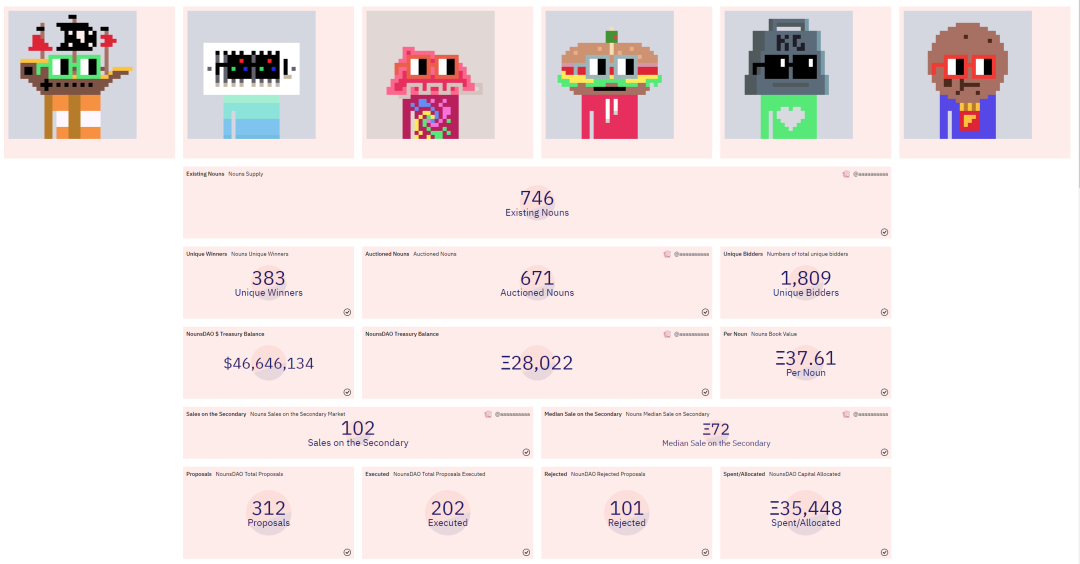
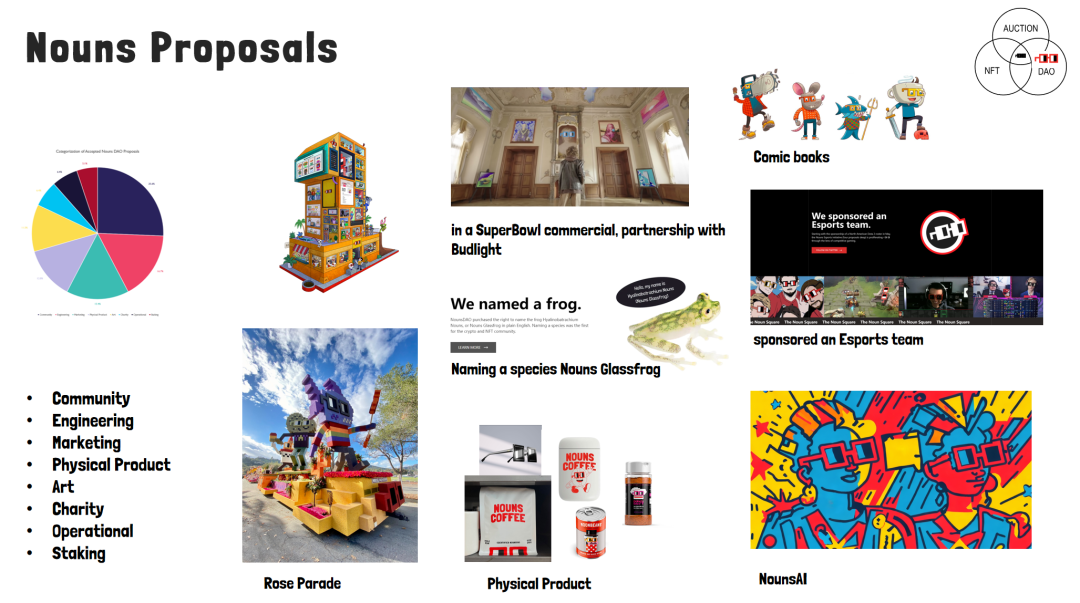
Funds are spent via proposal applications. Major types of on-chain proposals include: community, engineering, marketing, physical product production, art, charity, operations, and staking (depositing ETH into Lido for staking rewards).
Some fun proposal examples:
Bud Light beer team requested one Noun to produce an ad video aired during the Super Bowl, featuring the Nouns glasses;
Nouns funded a rainforest research team that discovered a new species of glass frog, which was named NounsDAO;
Sponsored a Dota esports team, which placed second in competition;
Developed its own AI model—Nouns AI pod explored AIGC image generation and GPT bots.
For more fun proposal highlights, check out this explainer video: Video link.
As more such proposals boost Nouns’ visibility, the Nouns brand and its glasses symbol become more widely recognized, attracting more bidders. This increases treasury funds, enabling further funding for new proposals and amplifying Nouns’ reach. It creates a strong impression: Nouns has achieved a flywheel effect.
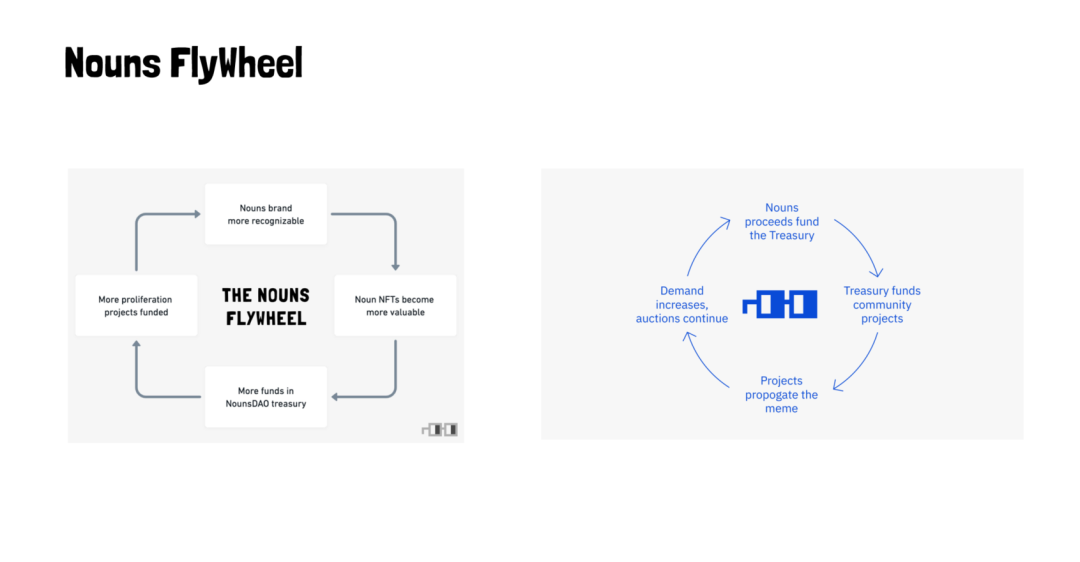
Two key factors enable this positive feedback loop: simple layered governance and meme (cultural symbol) propagation.
Simple Layered Governance
In every talk, someone asks: “Can only Nouns NFT holders submit proposals and apply for funding?”
The answer is no.
Initially, there was only one channel: on-chain proposals (shown in red on the far right of the diagram below). These are large-scale proposals displayed on the Nouns DAO page, typically requiring significant funding (with a threshold of 10 ETH, according to nouns.center). Such major on-chain proposals are voted on by Nouns holders, with dynamic voting thresholds shown on each proposal page. The current submission requirement for these large proposals is holding at least two Nouns.
However, the community later introduced two additional channels, allowing non-NFT holders to submit creative ideas: Prop House and Small Grants.
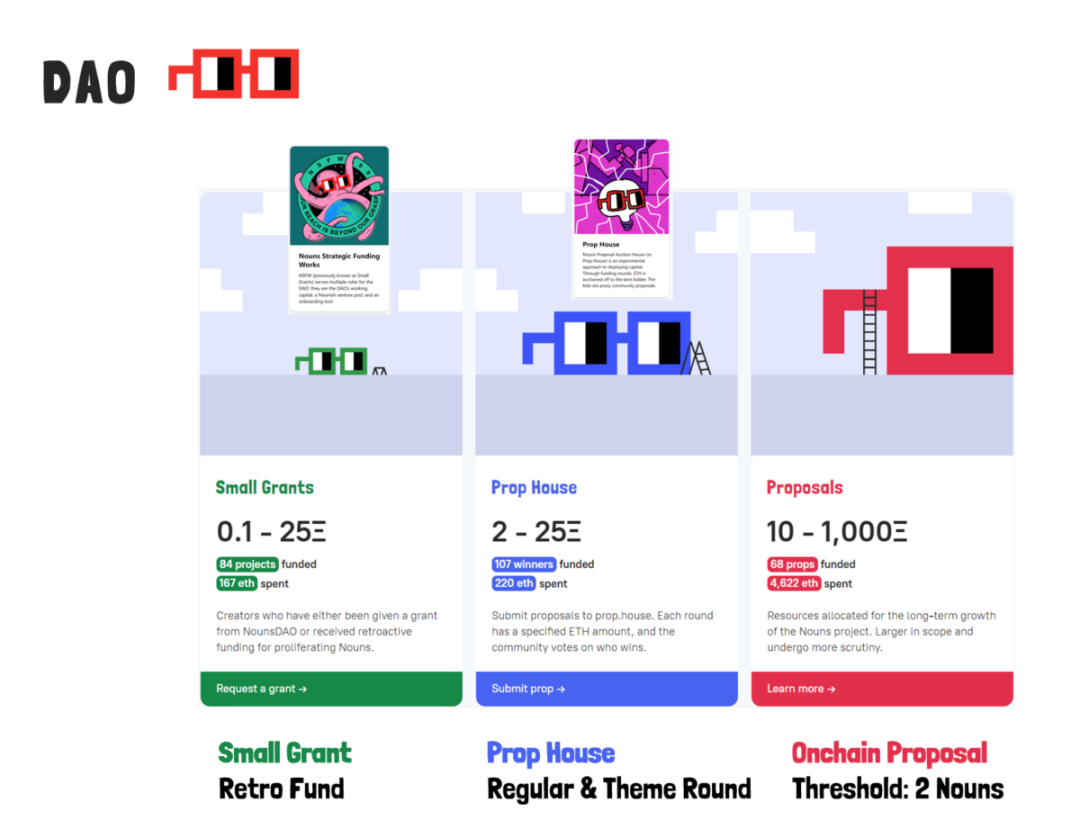
Nouns’ layered governance structure
Prop House is a community funding allocation tool proposed and created by co-founder Seneca via on-chain Proposal #23. Through different funding rounds, the community allocates fixed capital to the most promising builders.
How does Prop House work? Taking NounsDAO as an example (see diagram below), each box represents a round. There are two types of rounds in Nouns:
Open Round: No theme restrictions. Typically two rounds occur per month (based on current observation). Each Open Round offers 2.5 ETH in total prizes. This could mean one winner gets 2.5 ETH (e.g., Rounds 21 and 20), or five winners get 0.5 ETH each (e.g., Rounds 18 and 19)—details vary per round. Anyone with an Ethereum address can submit. Nouns holders vote, and the top-ranked proposal(s) win.
Themed Round: The Nouns community launches topic-specific rounds based on current needs. For instance, the "$200K Video Contest Final Vote" round focused on video submissions, offering 50K USDC across four winning proposals, with ten total submissions.
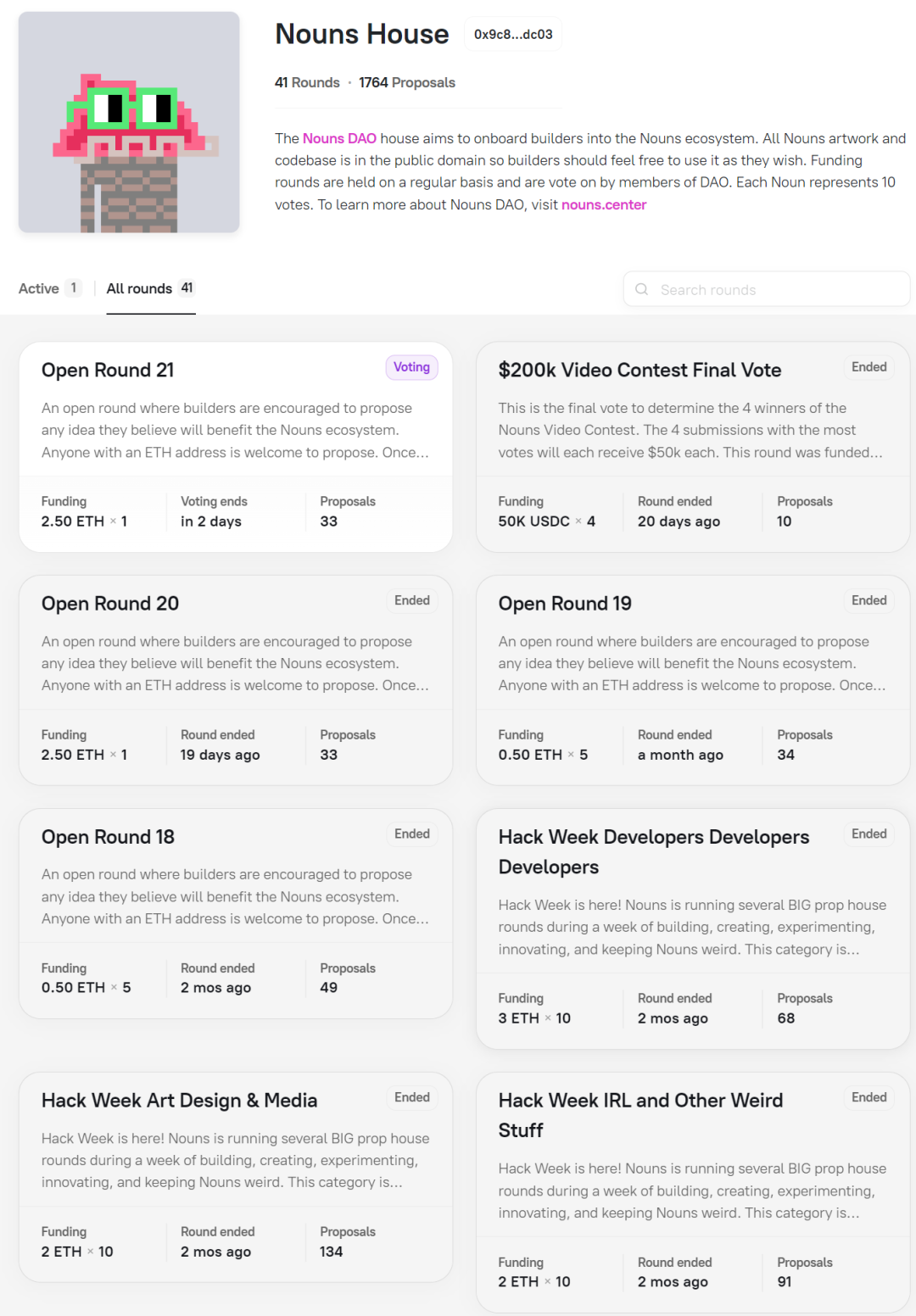
NounsDAO’s Prop House page
Small Grants offer retroactive rewards for small, completed contributions—such as writing high-quality articles promoting Nouns or building a Dune dashboard for Nouns. Contributors can describe their work and request compensation on Nouns’ Discourse forum. A dedicated multi-sig wallet team reviews these requests.
Small Grants also have a playful nickname: NSFW—not “Not Safe for Work,” but short for Nouns Strategic Funding Works. NSFW even has its own section on Prop House. At the end of 2022, they ran a special retroactive funding round called What Did We Miss: “If you contributed but were overlooked, please submit now!”
As the community evolves, retroactive funding mechanisms grow richer. Beyond classic NSFW, a new format emerged this year: Infinite, initiated by three Nouners—Wilson, Onion, and Seneca—with a 20 ETH fund pool. Each applicant can request up to 3 ETH, reviewed by three judges. If two approve, the proposal passes.
I submitted a proposal under the name “Anydoor” titled *Nouns x Chinese Participatory Media Co-Creation Experiment*, which was approved.
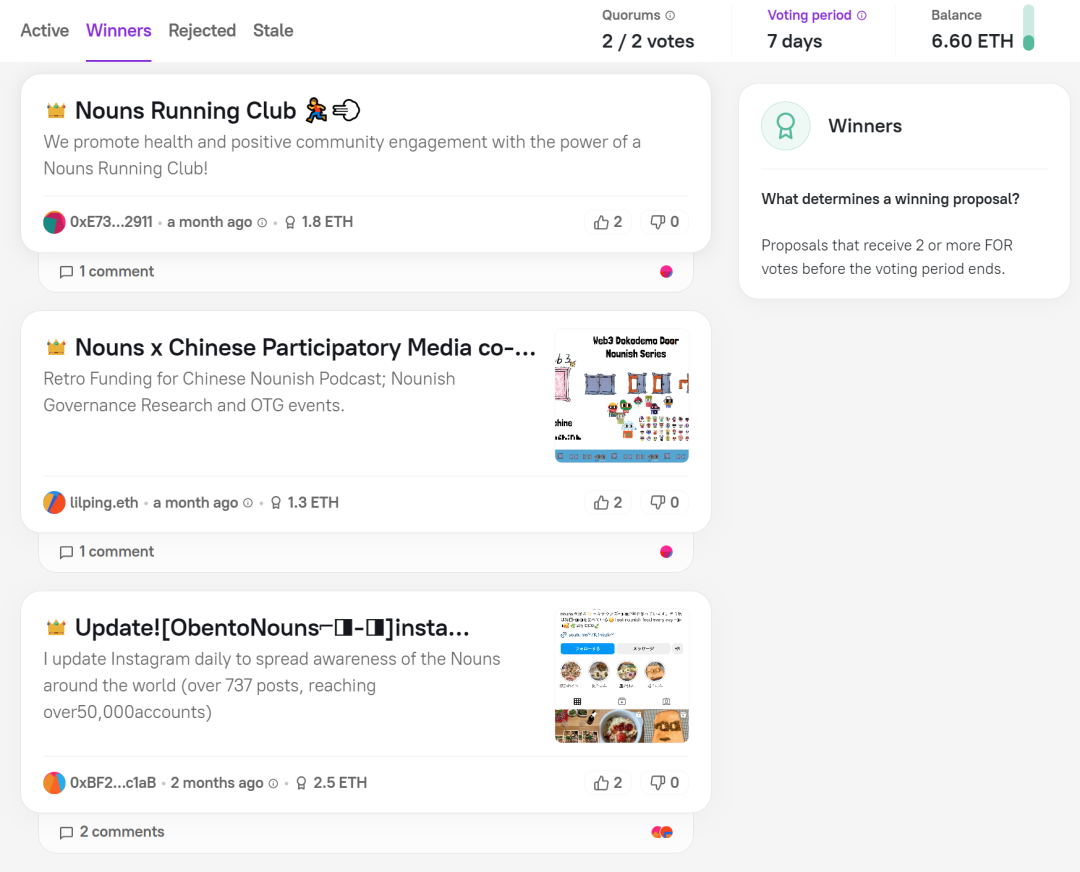
With that, we’ve covered Nouns’ three-layer governance structure. Large on-chain proposals and Prop House proposals are both decided by Nouns holder votes—determining whether treasury funds flow to proposers—while Small Grants are reviewed by designated community stewards.
With the recent proposal for a new tool called Prop Lot, Nouns’ governance continues to “descend” and refine further—not only tangible outcomes or full plans count as contributions. Even raw ideas are encouraged. Through community sentiment testing, wild thoughts evolve gradually into formal proposals.
Cultural Symbol Propagation
As Nouns grew from a niche group to global influence, a crucial factor has been audience willingness to embrace and voluntarily spread the symbol. This includes direct promotion of NounsDAO, derivative creations, tool development (Build), or simply forking it (Fork)—using the glasses motif, tweaking parameters, and launching new Nouns-style DAOs.
About Forking
Nouns is a CC0 project, encouraging derivatives and forks. According to incomplete stats on nouns.center, there are already 158 projects in the Nouns ecosystem.
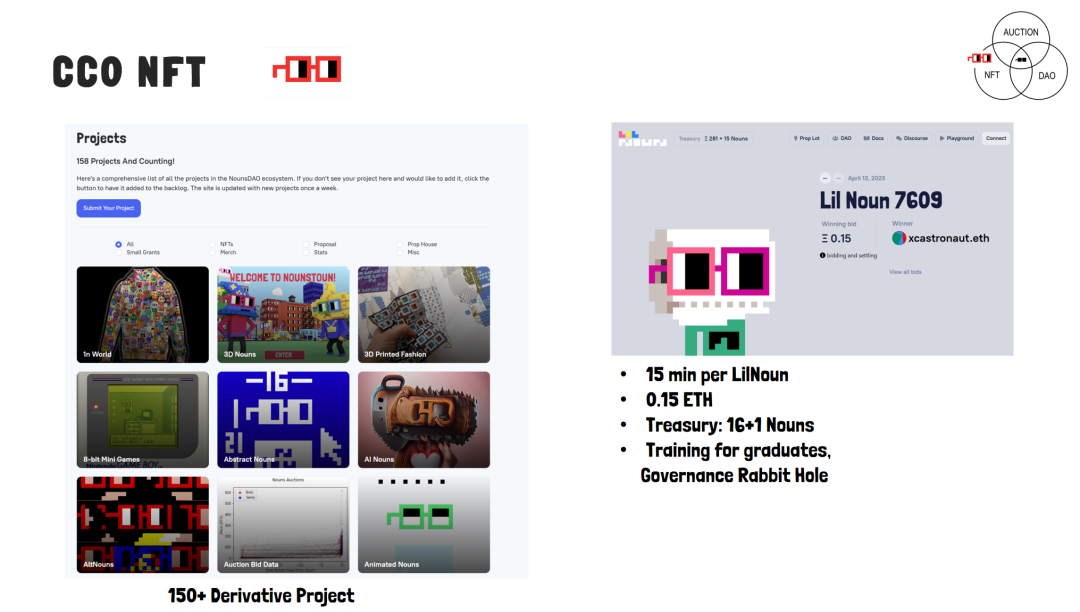
A notable fork is LilNouns. Aside from parameter differences, LilNouns follows nearly identical rules to Nouns. Its auction cycle is 15 minutes, starting price 0.15 ETH—set after a proposal passed (initially there was no minimum). LilNouns aims to lower barriers, bringing more participants into the Nouns ecosystem. Newcomers who learn governance through LilNouns and eventually succeed in proposing to NounsDAO are affectionately called “graduates.” LilNouns currently holds 17 votes: 16 Nouns bought using treasury funds, and one delegated by Noun557 (“Noun557: Why I Delegated My Nouns to the LilNouns Community”).
https://zora.co/collect/eth:0x1735d9094fa019197f1b998d337ffb8d0c5c02e8
These 17 votes from LilNouns participate in every Nouns proposal vote. How they vote is determined by LilNouns NFT holders through their own voting process. Members can practice proposing and voting within LilNouns—making it a true rabbit hole for governance learning.
For more interesting ecosystem projects, see: “Exploring the Ecosystem of Nouns Derivatives.”
https://gnars.com/ecosystem-of-nounish-derivatives/
About Build
Nouns attracts many hardcore builders. The image below lists several DAO tools developed within the community, many creators having backgrounds at Coinbase or backed by top-tier firms like Paradigm.
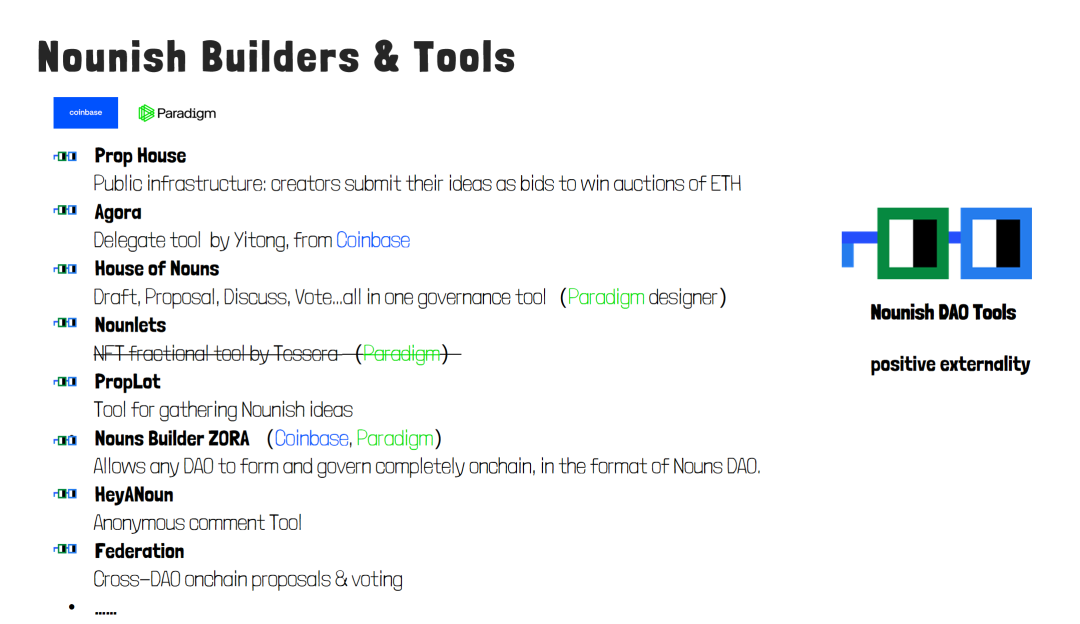
Today, more and more Nouns ecosystem DAO tools demonstrate positive externalities: initially built for Nouns’ needs, they’re now adopted by other DAOs and projects. Classic examples include Prop House and delegation tool Agora, discussed earlier.
Tool—Agora
Agora first won 20 ETH funding in Prop House’s “Nouns Governance Client” round (theme: build a client to improve Nouns governance), receiving the highest vote. Later, it received further funding via on-chain Proposal #154 to continue development. Nouns holders can delegate their NFT voting power to others via Agora. The platform also shows how community votes are distributed.
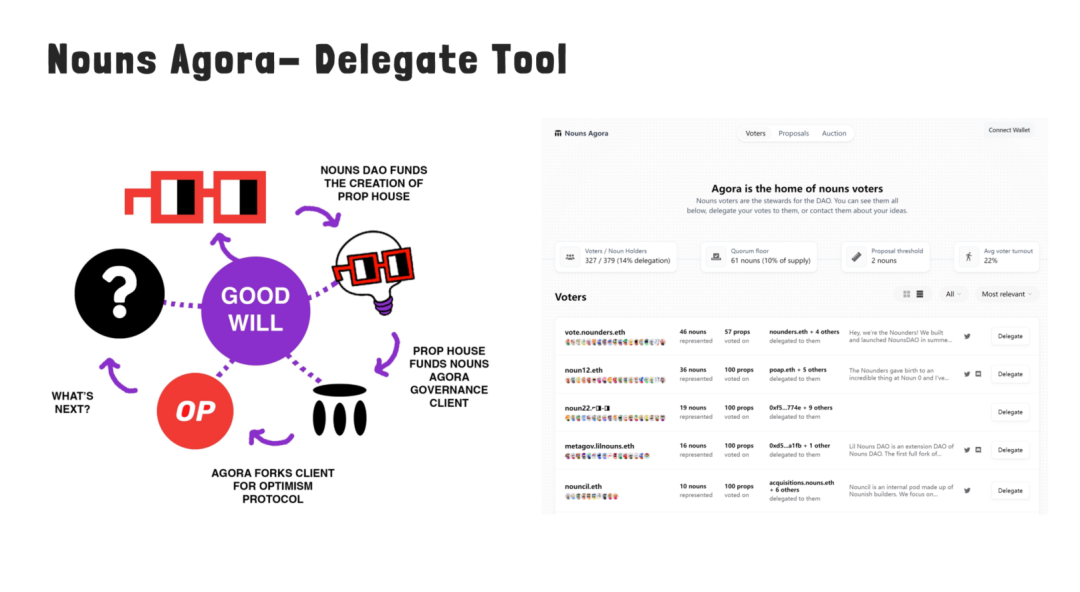
One answer to “what’s next”: Uniswap Agora
Later, Optimism (Layer 2 network) forked Agora’s client, allowing OP token holders to delegate votes. On May 2 this year, the Agora team launched Uniswap Agora—an integrated delegation-focused governance interface allowing delegates to build detailed profiles and voters to easily find aligned representatives.
Tool—Prop House
Prop House mechanics were explained earlier. This competitive proposal system, proven through multiple open and themed rounds, works well for Nouns-style DAOs. Soon, other Nounish DAOs—and even unrelated DAOs—began adopting Prop House. Currently, over 60 projects use it.

Tool—Nouns Builder
Nouns Builder is a “one-click Nouns creation” tool. Non-coders can set auction parameters (duration, starting price, veto rights, reserved NFT allocations, etc.) and launch a Nouns-structured DAO.
Currently, 111 DAOs (data subject to update) have been built on Nouns Builder. The team behind it is Zora, which used the tool to create BuilderDAO. They passed Proposal #167 to allocate 1,000 ETH to BuilderDAO’s treasury.
BuilderDAO used this seed funding to incubate more creative Nounish DAOs, spreading the Nouns model. Its first initiative allocated 270 ETH via Prop House to fund DAO creation tools, distributing funds as follows: 8 DAOs (20 ETH each, totaling 160 ETH), art packs (40 ETH), website customization (50 ETH), meme campaigns (10 ETH), and idea sourcing (10 ETH). Art packs and website tools further lowered entry barriers, letting DAO builders focus purely on ideas without worrying about NFT or web design.
BuilderDAO set a precedent: DAOs spun off from Nouns Builder can use other Nouns tools (like Prop House) for growth. As they scale, they might adopt delegation tools like Agora. These new Nounish DAOs expand use cases for Nouns tools, highlighting their public-good nature.
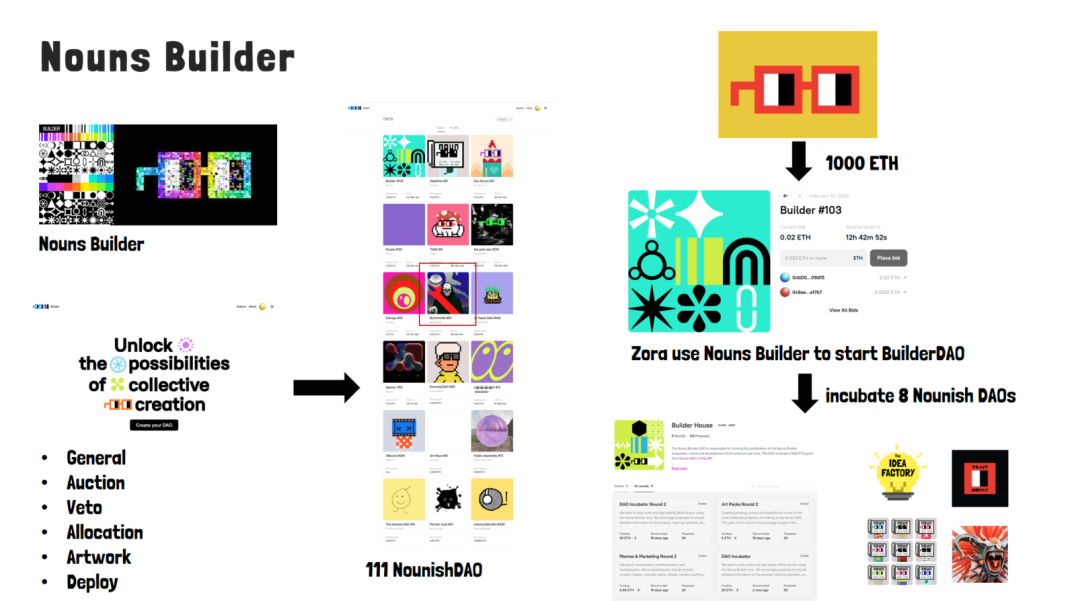
Among these Nounish DAOs, a few stand out personally:
PurpleDAO: Launched by decentralized social protocol Farcaster via purple.construction, aiming to expand Farcaster’s ecosystem. PurpleDAO also uses Prop House and has run four rounds. At one point, its weekly auction revenue ranked second only to NounsDAO across the entire ecosystem.
HeadlineDAO: A Nounish media outlet with no full-time journalists or editors. Recommended reads:
“HeadlineDAO: A Crypto Media Outlet Without Journalists or Editors” https://xiaobot.net/post/3a86cbb2-095c-4902-80db-d7ec04ed31cc,
“What We Can Learn From HeadlineDAO’s Launch Process”
https://xiaobot.net/post/3a86cbb2-095c-4902-80db-d7ec04ed31cc
Other interesting Nounish DAOs worth exploring: BLVKHVND (esports), The Park DAO (music), Spores (music + visual interaction + AI), and more.
Beyond builders, Nouns has also drawn attention from major investment firms like Variant, 1kx, and 1confirmation. These institutions not only buy Nouns but sometimes participate in governance votes. Their voting patterns reveal insights—for example, on the controversial Proposal #271 (funding a children’s novel), Variant voted no. Their rationale: Nouns should fund public goods with self-sustaining mechanisms. A novella doesn’t meet that bar and offers little meme value. They hope Nouns funds larger, more ambitious projects.
Funny Chinese Nouns Memes and Activities
While Nouns forking and building thrive in the English-speaking world, how is Nouns doing internationally? Observing on-chain and Prop House proposals, we see vibrant local events in places like Brazil, Seoul, Mexico, and Japan. Examples: Seoul hosted a Nouns sailing event, with boats bearing the Nouns glasses forming a striking fleet; in Mexico, delicious pizza slices arranged into Nouns shapes sparked a fun eating contest…
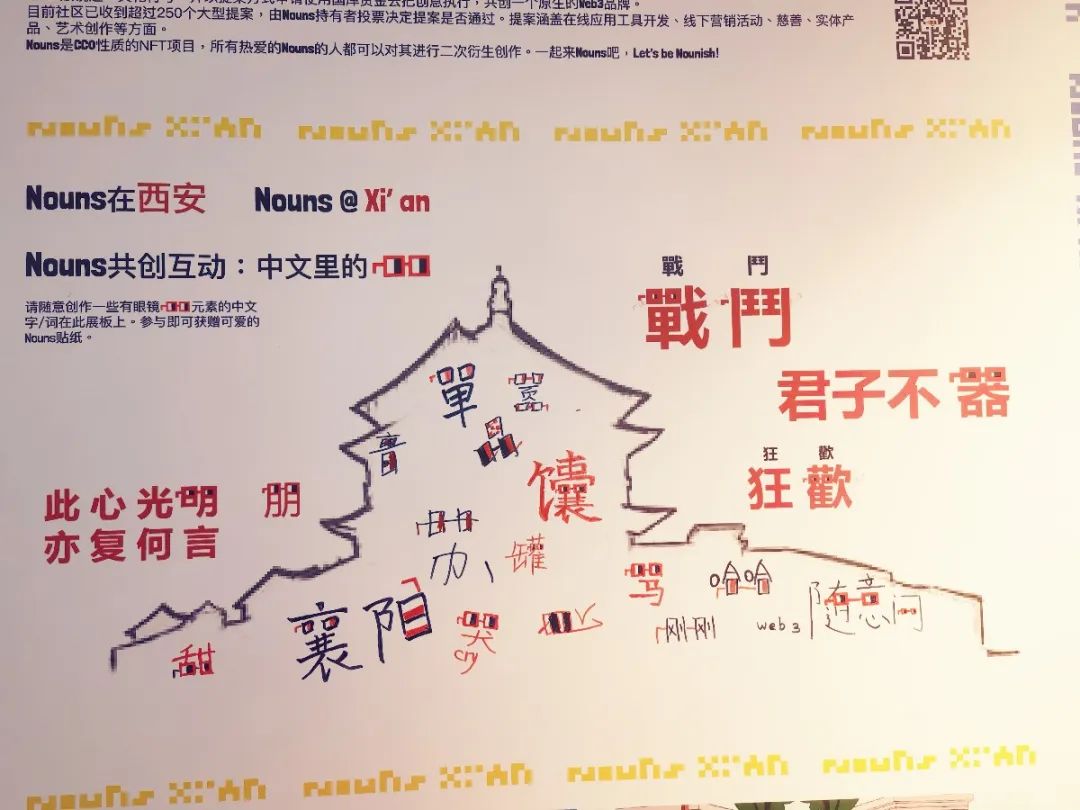
What creative ideas could emerge if Nouns embraced Chinese culture? Look closely at Chinese characters—you’ll find the Nouns glasses hidden within! Characters with two “口” components, like the “器” in “君子不器”, resemble the iconic Nouns eyewear.
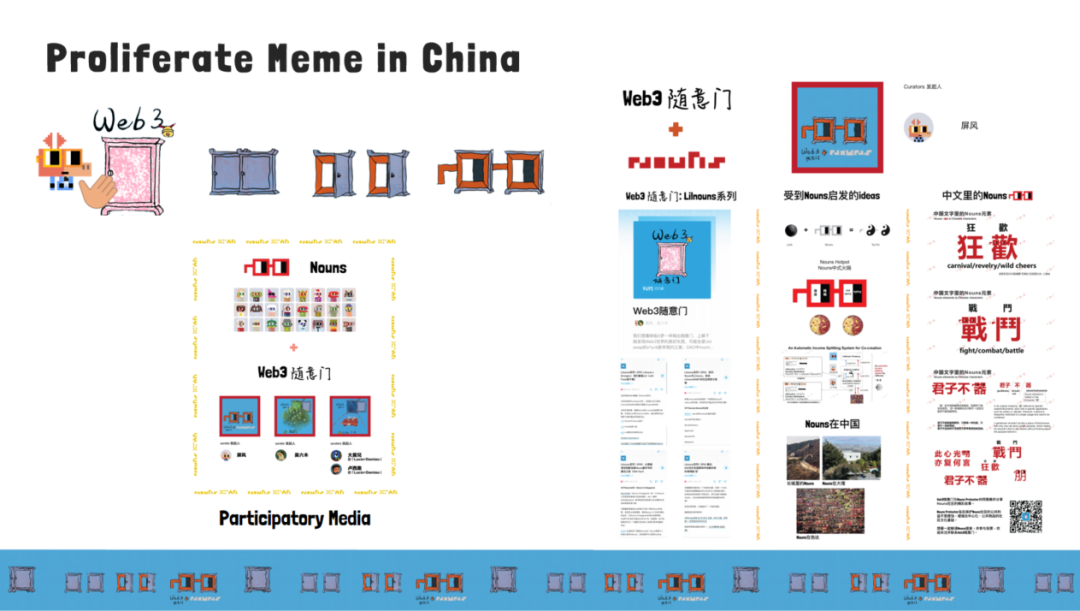
We brought this idea to a Web3 art exhibition in Xi’an, hosting a collaborative activity inviting people to discover more Nouns in Chinese characters:
https://zora.co/collect/eth:0xa415cf2ce35fea7804d4e657f442f85ce122c8c0
Beyond cultural creativity, some Chinese Nouns builders focus on public goods, launching a bold governance experiment: Nouns Protector. They deeply study Nouns’ on-chain proposals and participate in governance votes—currently casting only “oppose” or “abstain” votes. Final decisions are made via quadratic voting among Protector members. Some voices in the Nouns community once claimed, “Nouns is famous for wasting money.” Protectors believe good proposals will naturally gain support, while wasteful ones need scrutiny and oversight.
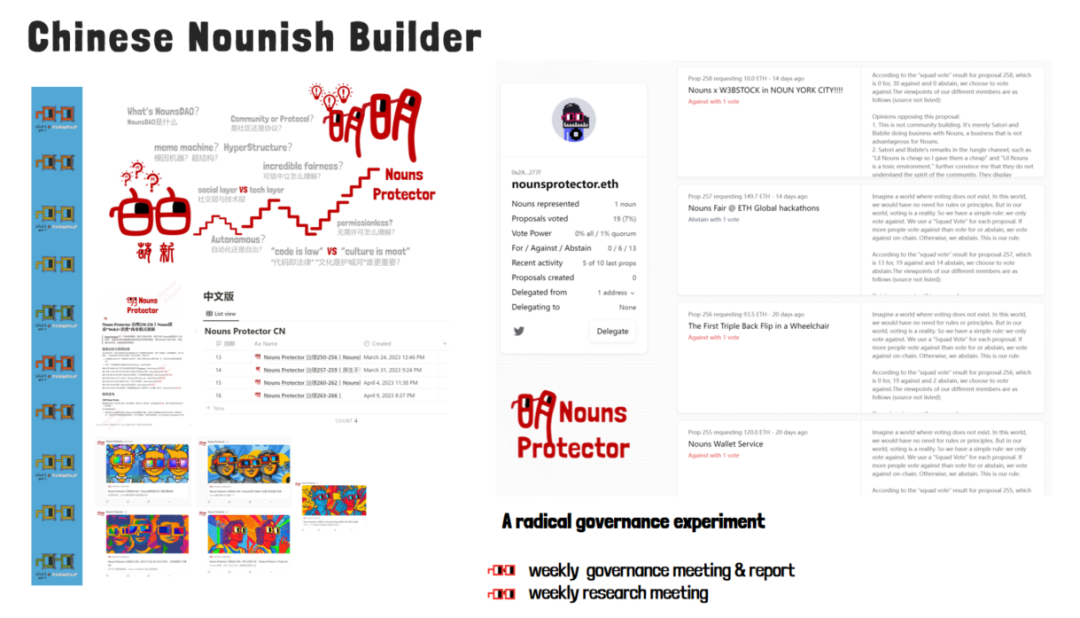
Proposal discussion meetings happen every Tuesday at 8 PM Beijing time. Since each proposal involves specific contexts and proposer track records—which often weave into fascinating stories—the group affectionately calls it the “Nouns Storytime.” The meeting is open for observers—feel free to reach out if interested. Weekly proposal summaries are published as Twitter threads (@nounsbuilderscn)—follow along!
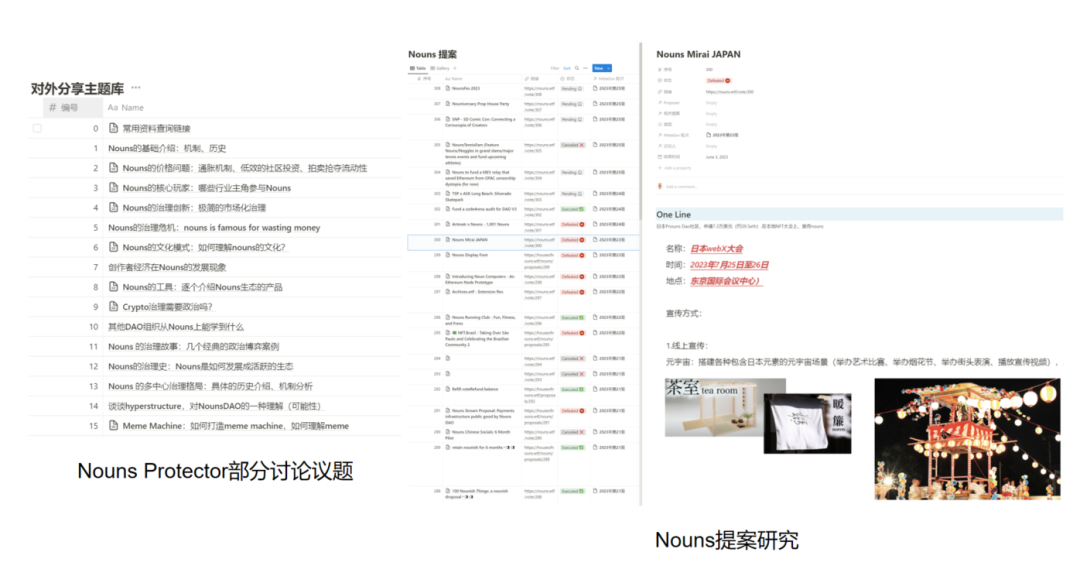
Even more fun: Nouns Protector integrates traditional Chinese culture into its thinking:
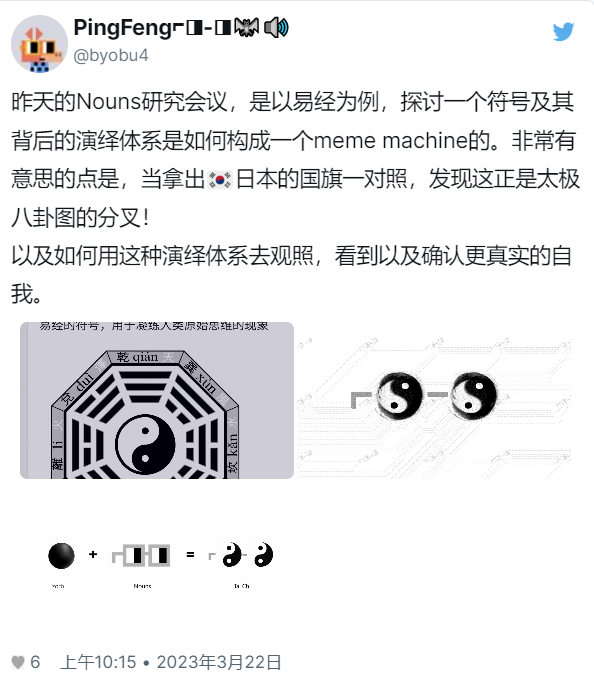
Memes are worth pondering deeply. My understanding of the Nouns meme remains at a surface level—akin to System 1 thinking in “Thinking, Fast and Slow”—a quick cultural symbol. But what deeper spirit or philosophy does this symbol convey? That may require more experiments and activities to infuse it with soul and narrative.
Punk4156, one of Nouns’ founders, said: “Do good things without asking about outcomes, create positive externalities, embrace absurdity and diversity, and teach others everything about Nouns and crypto.” Another active community member, Gami—the extreme sports enthusiast behind GnarsDAO—said: “Nouns is about finding your tribe, discovering new places, and creating something uniquely yours.” These interpretations of Nouns’ spirit are great, but each participant can form their own view and craft their personal Nouns story.
This brings us back to how we perceive Nouns. Members of Nouns Protector offer a compelling perspective: Nouns members are like the Medici family of the crypto world—thinkers, artists, and entrepreneurs gathering to collaborate and create.
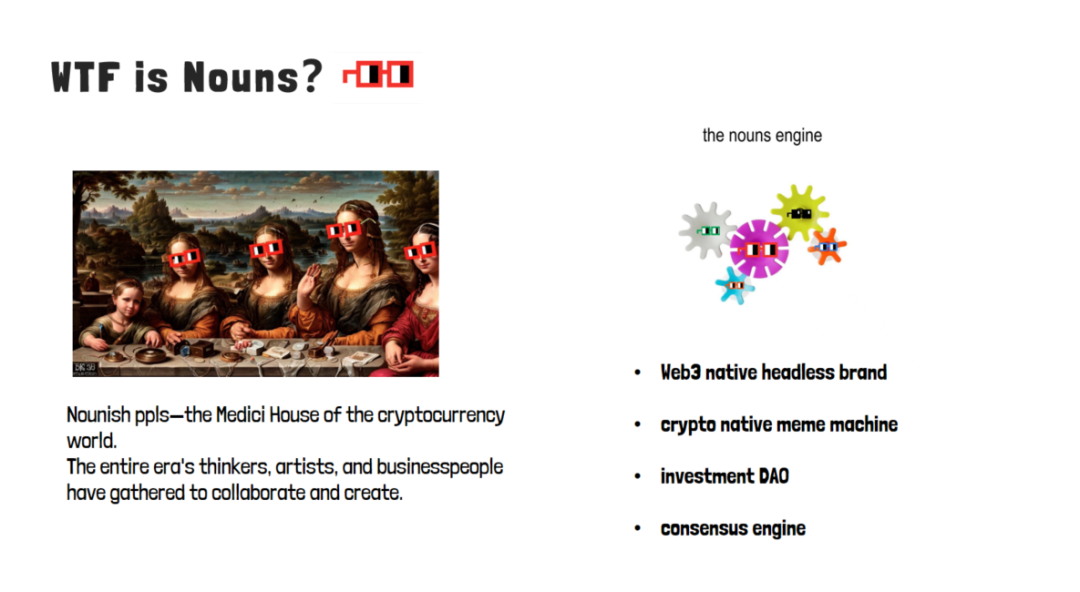
Others describe Nouns as: a Web3-native headless brand, a crypto-native meme machine, an engine for consensus, a public goods funding pool…
Meanwhile, some Web3 players analyze Nouns as an investment vehicle—calculating NFT profit expectations, book value per Noun, and value backing. Those viewing Nouns through an investment lens often ask: Most spending appears to be “no-return” donations to public goods—doesn’t that raise sustainability concerns? Besides auctions, does Nouns have other income sources? Three potential revenue streams have emerged:
ETH Staking: On-chain proposals involved include #18, #22, #30, #52, #217, #222, #227
Investments: e.g., Proposal #107—NounsDAO investment in Verse
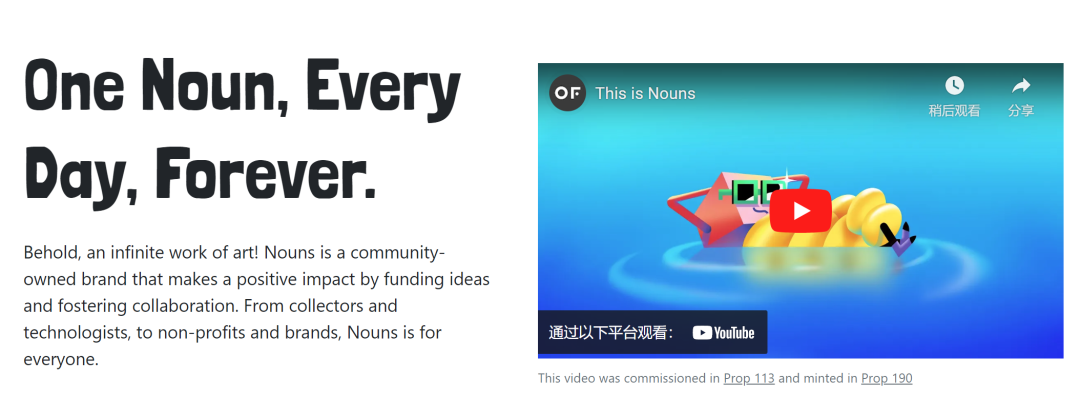
Operating revenue: Usually from community creations, where final products are minted openly, with proceeds split between creators and the treasury. For example, the promotional video “This is Nouns,” funded by Proposal #113 (125 ETH), was later minted as an open edition via Proposal #190, generating 176.3 ETH. If operating revenue explodes, it could signal a new era of creator economy prosperity.
Looking at Nouns’ global spread, we see its organizational footprint worldwide. From virtual subDAO clusters, the Nouns ecosystem has spawned influential branches like LilNouns, GnarsDAO, and NounsJapan. Could Nouns pioneer a unique Network State innovation path?
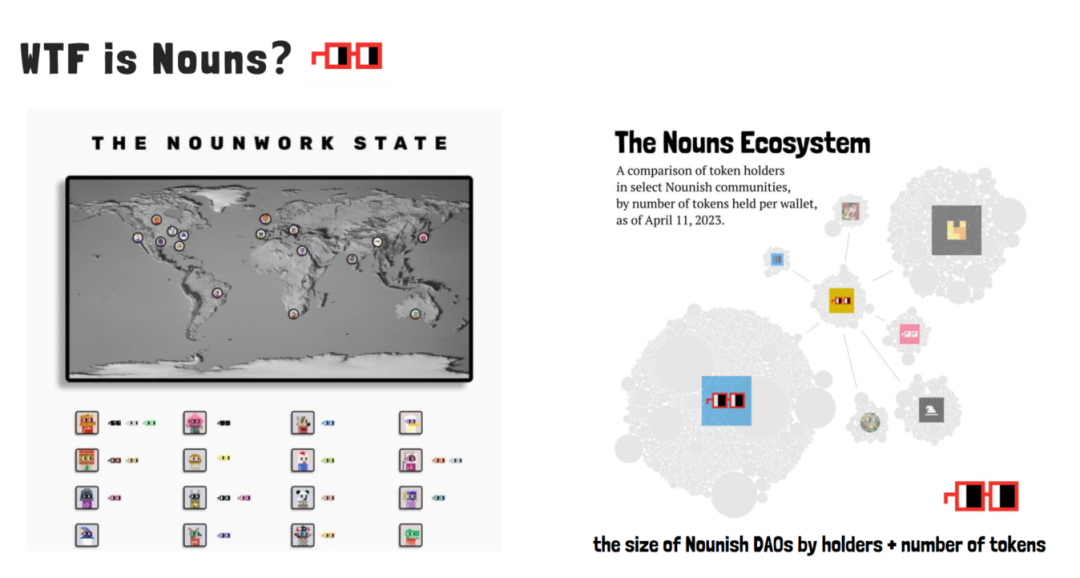
After nearly two years of experimentation, Nouns stands as one of the most successful CC0 projects in terms of community vitality, creative output, and treasury growth. Yet, it faces challenges:
Lack of proposal execution oversight—e.g., the oft-mocked “soft rug” canned beans proposal resurfaces periodically on Twitter;
Too loose treasury management, sparking community frustration and even Proposal #248—“Angry Exit” (holders wanting to leave could reclaim ETH based on book value and return NFTs to treasury), which ultimately failed. However, across repeated talks, I’ve noticed on-chain proposal approval rates gradually declining—from over 70% early this year to around 65% now—indicating holders are becoming more cautious.
Finally
Despite these concerns, I don’t know how long this experiment will last. But through participation, I’ve deeply felt Nouns’ vitality. Earlier this year, during a dramatic incident, I received help from Chinese-speaking builders. With their support and encouragement, I dove into the community, collaborating on research, gaining vast firsthand knowledge of DAO governance—sometimes amazed by brilliant ideas, sometimes uncovering subtle strategic thinking, even applying real governance insights to improve Chinese DAO rules (e.g., Nouns’ dynamic voting thresholds). Along the way, I earned holders’ trust—they’ve delegated their Nouns and LilNouns to us; I’ve experienced the joy of successfully proposing and earning grants; I’ve conceived product tools like a co-creation revenue-sharing system based on real scenarios. This journey has been rich and meaningful—interacting with fascinating people, forming genuine connections. As an INTP, finding real joy in human interaction—truly, the journey is the reward!
Join TechFlow official community to stay tuned
Telegram:https://t.me/TechFlowDaily
X (Twitter):https://x.com/TechFlowPost
X (Twitter) EN:https://x.com/BlockFlow_News


