Zuzalu Travelogue: A Dream of a Digital Nation
TechFlow Selected TechFlow Selected
Zuzalu Travelogue: A Dream of a Digital Nation
Zuzalu is more than just a large social meetup; it is a social experiment exploring how blockchain can build digital nations.
 Navigating Web3 tides with focused insights
What is Zuzalu?
Zuzalu is a neologism. Searching for "Zuzalu" on Google Maps yields nothing, yet in the memories of some, it distinctly refers to the Chedi Hotel on the Lustica Peninsula in Montenegro.
The birth of Zuzalu is deeply intertwined with Vitalik Buterin, co-founder of Ethereum, and has even been called Vitalik's second startup. On its official website, Vitalik describes it as an IRL (in real life) town integrating cryptography, life sciences, and philosophy.
Ethereum is a virtual decentralized network, while Zuzalu is a physical crypto city.
As early as 2021, Vitalik demonstrated deep insight into physical crypto cities. He closely followed initiatives such as Reno, Nevada’s blockchain-powered urban upgrade, CityCoins.co’s innovative municipal governance economic model launched on Bitcoin’s Stacks ecosystem, and CityDAO’s blockchain-based urban development proposal. However, Vitalik found that past experiments with crypto cities, though intriguing, struggled to scale.
In subsequent writings, he proposed two ambitious hypotheses about applying blockchain technology to urban governance and operations—Zuzalu being Vitalik’s initial attempt to test and implement these ideas in practice.
-
Using blockchain technology to make existing processes more transparent, trustworthy, and verifiable—such as tracking government financial systems via stablecoins, recording issued certificates on-chain, registering assets on-chain, and using on-chain fair random number generators in lottery-based democracy;
-
Leveraging blockchain to experiment with novel forms of ownership over land and other scarce resources, along with innovative democratic governance models—like city tokens, quadratic voting, and fundraising mechanisms.
At Zuzalu, residents could register for a “passport” through ZuPass—a credential generated using zero-knowledge proofs that enhances identity transparency, trustworthiness, and verifiability. The establishment of a town hall was a practical implementation of the second hypothesis, promoting participatory democratic governance.
Over this two-month-long crypto city experiment (from March 25 to May 23), researchers, scholars, and founders gathered to deeply explore topics including longevity, public goods, zero-knowledge proofs, artificial intelligence, and philosophical reflections on coordination and network states. Filled with innovation and exploration, this experiment illuminated numerous possibilities for real-world blockchain applications.

Philosophical Reflections on Coordination and Network States
Coordination and network states represent advanced philosophical concepts within digital nationhood and serve as core ideological pillars throughout Zuzalu.
What is a network state?
When people hear this term, most think of former CTO Balaji’s book titled *The Network State*, where he defines it as: a highly aligned online community capable of collective action, raising funds globally to acquire territory and eventually gain recognition as a sovereign political entity.
Coordination, by contrast, is somewhat more abstract. To Vitalik, coordination refers to the ability of large groups to cooperate for mutual benefit—it is what enables companies, nations, and any social organization beyond a few individuals to exist.
On societal, national, or global scales, collusion can generate massive negative effects. Vitalik cited several concrete examples:
-
On an economic level, all sellers colluding to simultaneously raise prices across the market.
-
On a national level, citizens heroically sacrificing themselves for their country—such as during WWII in Germany or Japan.
-
On a political level, lobbyists bribing politicians to adopt preferred policies.
Blockchain can rebalance coordination through decentralized networks, fork mechanisms, and market designs—enabling faster information dissemination, better norms for identifying cheating behavior, and more effective punishment mechanisms, thus building stronger organizations and tools.
At Zuzalu, I met a Ukrainian guy named Vitaly. Since the outbreak of the Russia-Ukraine war, he has become a crypto digital nomad, relocating with his Russian wife to Thailand.
He misses living in Ukraine. Likewise, ordinary Russians abroad, also punished due to the war, live displaced lives—wrongfully stigmatized and scorned simply because of their nationality. This made me aware of the dark side of coordination and gradually understand the significance of the network state concept.
There was also a discussion at Zuzalu about network states and coordination, mostly framed around questions aiming to distinguish the two concepts and imagine their real-world manifestations.
That night, about twenty people gathered in a room—Vitalik happened to be there too, sitting beside us with a cup of hot tea. Also present was French blockchain scholar Primavera De Filippi.
During discussions on ideal forms of network states, participants shared various utopian visions: fairer resource distribution, more efficient use of social capital, transparent supply chains, alongside concerns about personal security and climate change mitigation. The ideas and solutions generated reflected optimism about future societal development.
Whether Zuzalu will validate these ideas as a model for digital nations remains an exciting prospect.
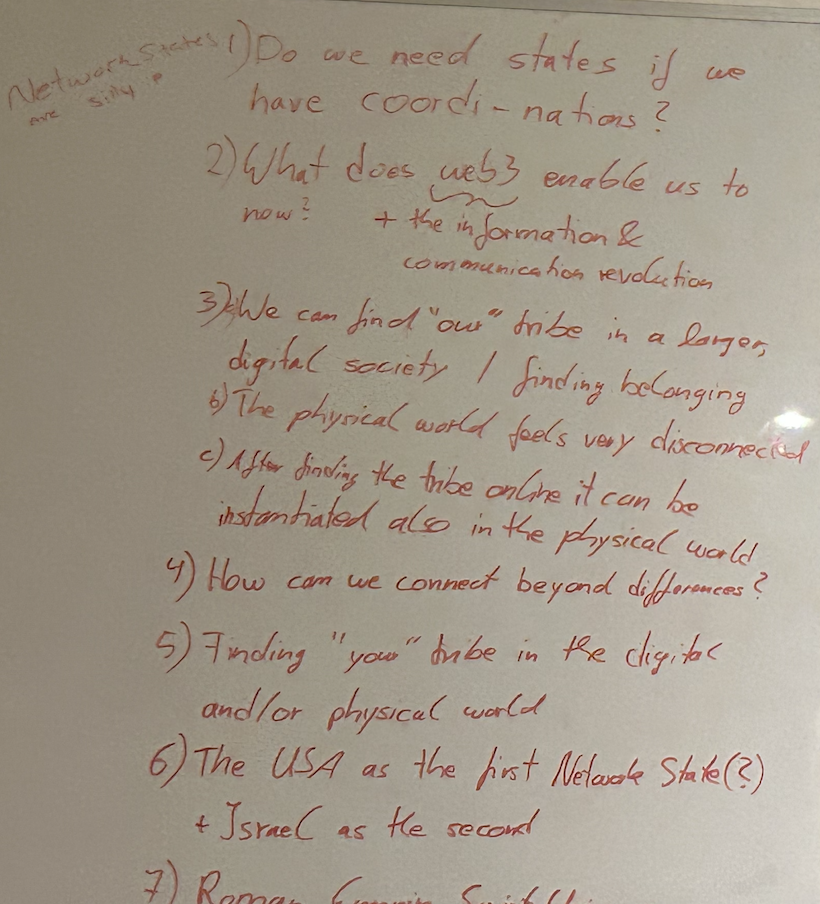
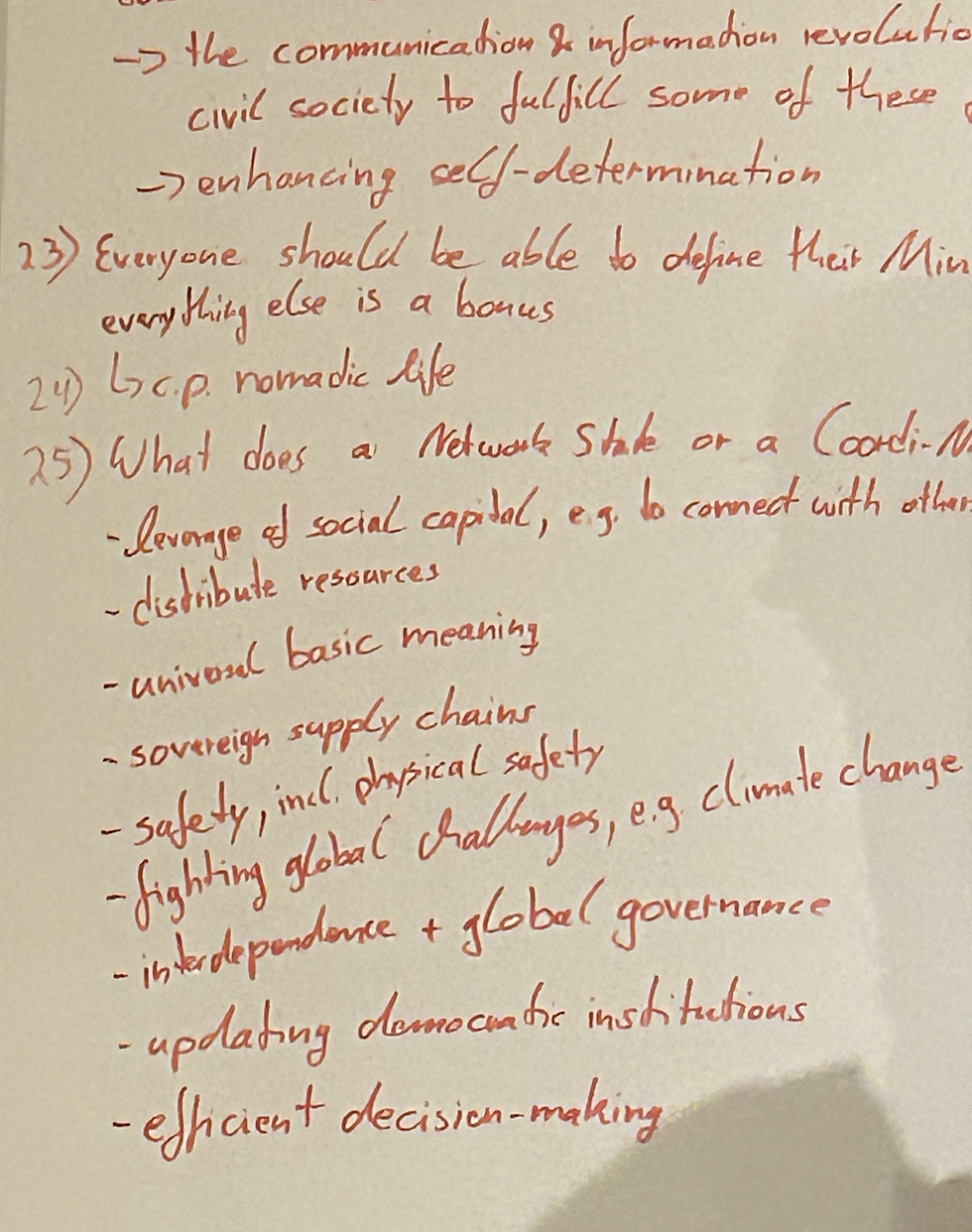
Brainstorming notes
Longevity and Life Sciences Research
Recently, longevity has become a hot topic. Amazon’s Jeff Bezos actively invests in human aging research, while OpenAI founder Sam Altman invested $180 million into Retro Biosciences, a Silicon Valley biotech startup focused on anti-aging.
It's said that Hal Finney, the first person to receive Bitcoin, was also a passionate advocate and believer in life extension.
At Zuzalu, longevity is another major theme.
Even Aubrey de Grey, a pioneer in the longevity field and Chief Science Officer at SENS Research Foundation, was a resident at Zuzalu. Additionally, Jason Kelly, CEO of Ginkgo Bioworks—one of the world’s leading synthetic biology firms—was invited to speak.
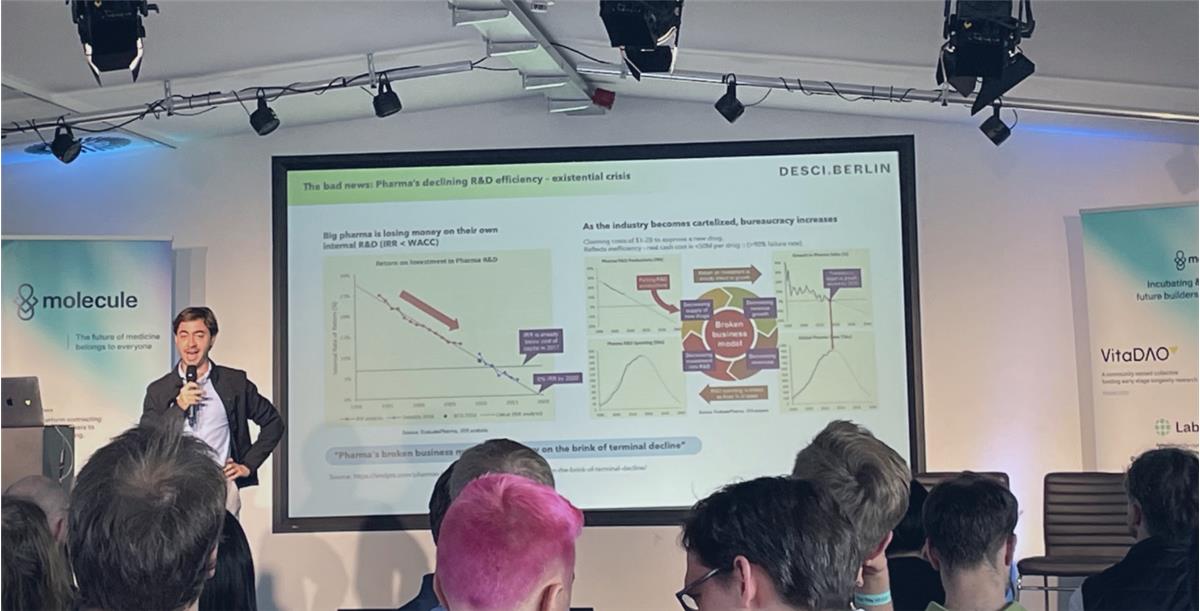
To Vitalik, defeating aging is a human rights issue that must be addressed.
“If we are open to novel ideas, may I propose anti-aging research? Aging is a humanitarian disaster—claiming lives equivalent to World War II every two years. Before death, it weakens people and burdens healthcare systems and families. Let’s end aging.”
Why would a blockchain-based social experiment treat longevity/life sciences as a central theme?
Almost everyone agrees we’re entering the age of biotechnology, yet foundational life science research faces many challenges. Blockchain technology holds potential to enhance efficiency in life sciences through data standardization and interoperability.

Blockchain solutions for the life sciences industry help address key challenges in scientific research—including data management, intellectual property protection, trial transparency, cross-institutional collaboration, patient privacy, and fundraising—thereby improving research efficiency, reliability, and innovation capacity.
The application of blockchain in scientific research is known as decentralized science (DeSci). Startups like Molecule aim to solve core issues caused by lack of standardization through tokenizing intellectual property (IP-NFTs). Thanks to blockchain’s transparency and standardization, scientists can build a more efficient knowledge graph system for researchers. Similarly, VitaDAO, a decentralized organization funding aging research, aims to tackle funding gaps in this domain.
If decentralized science is one of blockchain’s most natural applications, then longevity represents the perfect go-to-market strategy for science in the crypto space.
How Can Blockchain Address Extreme Risks from Superintelligent AI?
Since ChatGPT exploded onto the scene earlier this year, attention toward Web3 appears to have waned. Recently, prominent crypto venture firm Paradigm has increased its investment focus on artificial intelligence.
Though blockchain and AI belong to different technological domains, many practitioners are now exploring intersections—such as federated learning, zero-knowledge machine learning, and identity verification.
Just as blockchain governance faces significant challenges, AI confronts extreme safety risks threatening human survival.
In blockchain, the complex and intelligent system is decentralization itself—making governance and regulatory compliance a central topic in cryptoeconomic research communities.
In AI, robots or superintelligent systems could achieve cognitive levels far beyond human imagination. Once realized, superintelligence would render humans non-unique—the robot becoming the highly complex, self-evolving intelligent system.
So what are the simple, dumb systems meant to control each?
In blockchain, the answer lies in disintermediation—delegating decision-making to simple algorithmic agents, i.e., smart contracts. Superintelligent AI is also an algorithmic agent—but far more complex, intelligent, and potentially uncontrollable. Could immutable on-chain smart contracts serve as the simple, dumb system to mitigate existential risks posed by superintelligent AI?
During Zuzalu’s AI Week, residents and guests discussed this question. Speakers drew analogies between miner-extractable value (MEV) in blockchain and AI coordination, or used philosophical frameworks like John Rawls’ veil of ignorance to consider AI alignment. Yet many questions remained unresolved:
Will AIs use cryptocurrency to coordinate among themselves, increasing equilibrium payoffs? Will their equilibria align with human values (alignment)? Can cryptocurrencies act as commitment devices to keep AI aligned with humanity? After all, some argue AI lacks agency and will remain a “tool of humans” for the foreseeable future. If so, is AI coordination merely a shadow of human coordination? What unique properties does this shadow possess? If human alignment is achieved first, can cryptocurrency exert a kind of “magic” over human coordination—jointly shaping AI (e.g., via order-flow auction mechanisms to solve data privacy in training)? Before AGI emerges, can we leverage cryptocurrency to coordinate humans or secure the online world against AGI risks? ——— Flashbots team
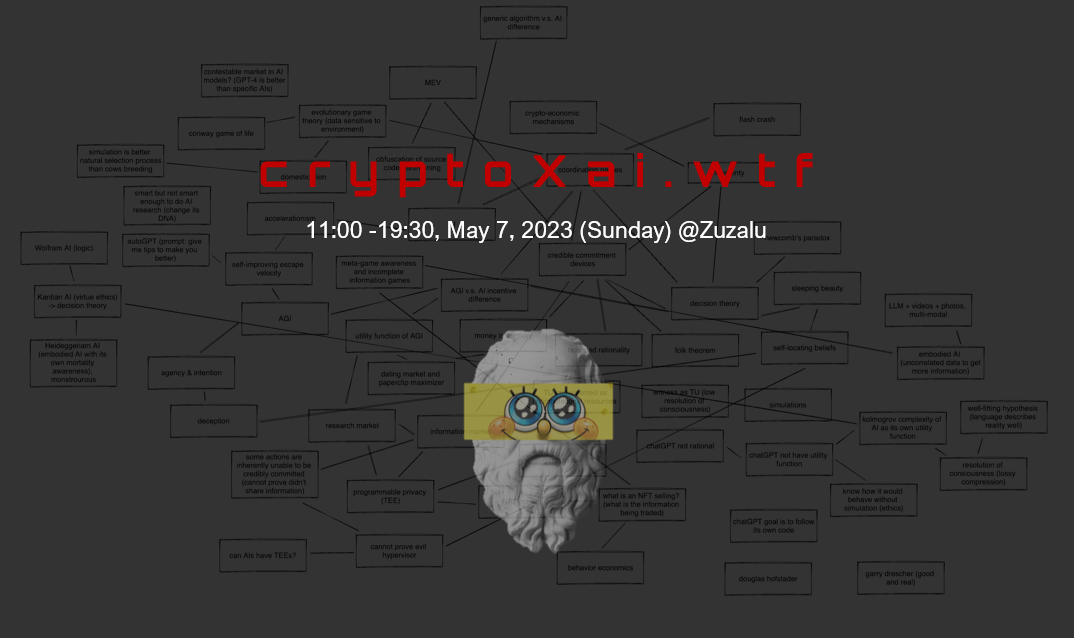
In fact, even before ChatGPT went viral, the online AI community LessWrong had already debated the possibility of using blockchain governance to resist superintelligent AI. In 2016, Vitalik proposed using simple blockchain agents to counteract superintelligent AI. Time flies—and AI progress has outpaced Moore’s Law in terms of chip development speed.
The AI questions raised at Zuzalu will continue to be explored.
Deconstructing Zuzalu
Returning to the original question: What is Zuzalu?
Zuzalu is a real-world community; a summer camp centered on crypto, longevity, and philosophy; a carefully designed social experiment…
Zuzalu allows us to envision, through philosophical reflection, what blockchain might achieve in the future, while also making clear how nascent the industry still is.
Where will the next Zuzalu take place?
Some say Chiang Mai, Thailand—truth unknown. But we look forward to meeting again, not saying goodbye.
Special thanks to Attila, the philosopher from Vienna; Esha, the public health scholar from Austin; Vitaly, the digital nomad from Ukraine; Miracle, the crypto entrepreneur from Shanghai; and Anton, the bioinformatics scientist from Russia—for offering fresh insights, perspectives, and creatively imaginative ways to experience Zuzalu.
Finally, special gratitude goes to Vitalik Buterin, founder of the Ethereum Foundation, for turning Zuzalu from imagination into reality—opening the first door to a “digital nation” on the shores of Lustica Bay in Montenegro.
Join TechFlow official community to stay tuned
Telegram:https://t.me/TechFlowDaily
X (Twitter):https://x.com/TechFlowPost
X (Twitter) EN:https://x.com/BlockFlow_News
 深潮TechFlow


![In-depth Analysis of Trade[XYZ]: How Were 92 Markets and 98% HIP-3 Trading Volume Established?](https://upload.techflowpost.com/upload/images/20260716/20260716061117965147.jpeg?x-oss-process=image/resize,p_50/quality,q_80)