Developer Beginner's Guide: Understanding Smart Contracts and Their Full Development Process
TechFlow Selected TechFlow Selected
Developer Beginner's Guide: Understanding Smart Contracts and Their Full Development Process
Since the launch of the "Developer Beginner's Guide," we've received very positive feedback and strong support from developer friends. We've also noticed a significant number of aspiring developers who are eager to enter Web3 and quickly grasp the industry's fundamentals and development landscape. TinTinLand will continue updating this series.
 Navigating Web3 tides with focused insights
As a foundational term in the industry, smart contracts are well known among developers. Today, we’ll summarize the practical use cases, application value, and full development and deployment process of smart contracts. Experienced smart contract developers are welcome to share more insights and suggestions via private messages to our backend.
What Are Smart Contracts?
Smart contracts are agreements between two or more parties stored on a blockchain (such as Ethereum or EOS). Each contract contains a set of predefined rules and conditions designed to automatically control, enforce, and record events when triggered according to the agreement terms. Changes to the data state within these contracts are secured by consensus across the entire blockchain network. No one can alter them unless the entire network approves the change. This makes smart contracts one of the most secure and powerful tools for creating agreements among parties. Smart contracts are essential for DApp development. Moreover, they are also key components in building decentralized networks.
Smart contracts on Ethereum (though not limited to this platform) are fundamental elements of decentralized finance (DeFi). The term "smart contract" was coined as early as 1994 by cryptographer Nick Szabo—long before Web3—but gained widespread adoption with the rise of Web3, where smart contracts were seen as "a set of digitally encoded commitments."
Current State of Smart Contract Development
In terms of current smart contract deployment, North America leads the market with a 43% share, followed by Europe and the Pacific region. According to an analysis and forecast by Transparency Market Research on the smart contract market from 2020 to 2030, the global smart contract market is expected to grow from $315.1 million in 2021 to $1.4603 billion by 2028, representing a compound annual growth rate of 24.2% from 2022 to 2028. This indicates that the smart contract market will continue to expand over the next decade, offering boundless potential for smart contract developers.

The Smart Contract Development Process
Pre-Deployment
Before deploying a smart contract, business logic and requirements must be clearly defined—that is, all involved parties define the specific business conditions of the smart contract, which developers then implement. Developers design the contract architecture based on this logic, including structuring the data within the smart contract and coding the methods related to changes in data states.
During Development
The development phase primarily involves writing smart contract code for the chosen blockchain platform (e.g., Ethereum, EOS, etc.). This step also includes unit testing to verify whether the contract behaves as intended. One of the main programming languages for developing smart contracts is Solidity. Solidity is a high-level, object-oriented language heavily influenced by mature programming languages such as JavaScript and C++. Instead of binary numbers/code, programmers use alphanumeric characters to write smart contracts for the blockchain world.
To monitor code quality, there is a two-part internal review process during development. Prior to formal audits, internal contract developers or auditors conduct preliminary testing on the contract code. The first stage is automated, using workflows and pipelines to perform automatic linting and unit/integration tests to ensure all tests pass. Storage and security scanners are also integrated into the workflow to prevent future issues such as insufficient storage, storage overwrites, or introducing common security vulnerabilities. Commonly used tools include hardhat-storage-layout, MythX, and Slither.
The second stage of the review process is manual, where senior smart contract engineers on the project review all pull requests, provide feedback and flag issues, and ensure the code is ready to be merged into the main or staging branch.
Security Audit
Auditing is a critical part of the smart contract lifecycle and often requires significant time, manpower, and financial investment. It is typically conducted by trusted third-party auditors. The cost of a smart contract audit varies depending on the scale and complexity of the application. Generally, third-party smart contract audits range from $5,000 to $15,000, though larger or more complex contracts may incur higher fees.
Step One: Gather Relevant Documentation. The first step in auditing is collecting all relevant documents. This includes whitepapers, code repositories, and any other documentation or materials related to the smart contract. By reading design documents, external auditors gain deeper insight into the blockchain application. At this stage, auditors define the scope of code to be reviewed, and developers and auditors must agree on a code freeze for the portion under review.
Step Two: Run Tests Using Tools. Once auditors have a solid understanding of the code and application, they run automated tests using various tools. This is currently the easiest way to detect potential issues. Auditors take a series of steps, including integration testing across large sections of code, unit testing individual functions, and penetration testing to probe for security vulnerabilities.
Line coverage is an effective metric for measuring how thoroughly tests cover the code; high line coverage indicates that tests are effectively exploring all lines of code in the application. After automated testing is complete, auditors proceed to manual testing.
Step Three: Manual Code Review. Although automated tests can identify possible vulnerabilities in the code, automated programs cannot fully understand what blockchain developers aim to achieve with their applications. Therefore, manual code review is essential. By discussing design intent and business logic with the development team, reading through the code, and understanding how everything fits together, auditors can identify potential issues missed by automated testing. While analyzing the code, auditors can refer to project specifications and supporting documents to verify whether the code performs as expected. A combination of manual and automated testing is crucial for ensuring comprehensive audit results.
Finally, receive the audit report. Upon completion of the audit, the auditor provides a report detailed findings. This report becomes a valuable resource for the project team and smart contract developers.
Post-Deployment
After deploying the contract on the blockchain, the smart contract development team works closely with the frontend team to integrate the smart contract with the frontend interface on the testnet, and eventually deploy it on the mainnet. Once live, ongoing monitoring of the deployed smart contract is essential. Continuous post-deployment monitoring helps prevent blockchain security attacks such as common scams.
Overview of Smart Contract Advantages
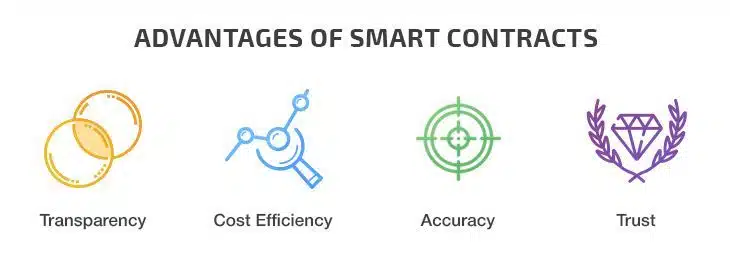
Like traditional contracts, smart contracts are rule-based agreements that define relationships among parties. Due to their inherent properties and technical characteristics, smart contracts offer the following advantages:
Autonomy: Participants arrange agreements themselves, eliminating the need for intermediaries.
Reliability: Contracts are securely stored on a distributed network, making them nearly impossible to alter or forge.
Security: Contracts are replicated across all nodes in the distributed network, ensuring they cannot be lost.
Cost Savings: Reducing intermediaries and commissions lowers costs for all involved parties.
Accuracy: These contracts reduce the possibility of errors in terms or processing to zero.
Sustainability: Contracts eliminate paper usage in offices, notaries, and registries, reducing pollution due to fewer official trips.
Smart Contract Use Cases
Smart contracts have applications in every field where traditional contracts are currently used:
Healthcare
In healthcare, patient medical records are highly valuable. Using blockchain and smart contracts, health records can be securely stored and encrypted, with access granted only to specific, pre-approved individuals. Additionally, processes like prescription fulfillment can be automated, reducing processing times and improving patient experience. Beyond storing health data, applications in this field extend to drug traceability, cold chain management, health passports, and clinical research.
Finance
In investment banking, loan settlement cycles can be cut in half thanks to faster processing enabled by smart contracts. Meanwhile, increased efficiency reduces operational costs for investment banks themselves. For both institutions and users, the use of smart contracts creates a win-win scenario.
Supply Chain
IoT devices can be used throughout the supply chain to record every step of a product’s journey, enhancing traceability. In this way, errors, theft, and loss can be eliminated.
Real Estate Market
Smart contracts can efficiently register property ownership, extending beyond apartments, buildings, or land to include all types of assets. The contract executes only when the seller transfers ownership and the buyer releases payment. This offers a transparent, secure, and fast method of transferring asset ownership.
Insurance
The insurance industry spends millions annually on claims processing. Smart contracts can automatically determine payout amounts based on policy types.
Beyond the above industries, smart contracts can also be applied in human resources to record individuals’ education, certifications, and work experience; in intellectual property to protect and clarify patent usage; and in elections within political systems or civil organizations, where smart contracts can verify voter identity and reliably record votes.
Conclusion
Since its launch, the “Beginner's Guide for Developers” series has received overwhelmingly positive feedback from developer communities. We’ve also observed a substantial number of aspiring developers eager to enter Web3 and quickly grasp industry fundamentals and development practices. TinTinLand will continue updating this series, providing comprehensive beginner guides for developers and supporting newcomers on their Web3 journey.
In this series, we’ve compiled a comprehensive overview of the Web3 tech stack and industry salary data—“Beginner's Guide for Developers: Web3 Tech Stack & Average Salaries”; we’ve also summarized the skills required for blockchain developers and common job-seeking channels from learning and career perspectives—“Beginner's Guide for Developers: Essential Skills Before Entering Web3”; and to help Web3 developers better build and deploy projects, we’ve gathered commonly used development tools—“Beginner's Guide for Developers: A Complete Overview of Web3 Development Tools”. After new developers understand market salaries, equip themselves with development skills, and select appropriate tools, learning about and developing smart contracts becomes the next milestone toward becoming a DApp developer.
Join TechFlow official community to stay tuned
Telegram:https://t.me/TechFlowDaily
X (Twitter):https://x.com/TechFlowPost
X (Twitter) EN:https://x.com/BlockFlow_News
 @OurTinTinLand