Exploring Solidity 1.0.0: A Key Milestone for Smart Contracts
TechFlow Selected TechFlow Selected
Exploring Solidity 1.0.0: A Key Milestone for Smart Contracts
Upcoming 0.9.0 and 1.0.0 releases will introduce several highly anticipated enhancements.
 Navigating Web3 tides with focused insights
Author: Adam Boudjemaa
Introduction
After extensively analyzing sources such as the Solidity GitHub repository, Solidity's development roadmap, community discussions on Twitter, active Pull Requests, and Issues, this article dives into where Solidity is headed in the future.
This leading smart contract programming language is preparing for the upcoming 0.9.0 and 1.0.0 upgrades, which will introduce several highly anticipated enhancements.
This article aims to introduce readers to the latest developments and improvements in Solidity, driven by community input and ongoing debates. While the information provided is not yet finalized, it reveals potential directions for technical advancement.
1. Revolutionary Integration of require() with Custom Errors
Current approach (0.8.x):

Expected in 0.9.0 or 1.0.0:
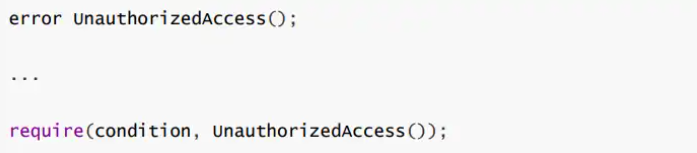
Compared to using numerous if conditions that throw errors with string messages or custom errors, integrating require() with custom errors will make code cleaner and more gas-efficient.
2. Optimized Intermediate Representation (IR): Unlocking Efficiency
The Intermediate Representation (IR) process in Solidity plays a crucial role in translating smart contract source code into executable instructions for the Ethereum Virtual Machine (EVM).
IR simplifies and standardizes complex code, making the translation into machine-level language more efficient. The upcoming improvements in Solidity 0.9.0 aim to make this compilation process faster and more efficient, ultimately reducing costs and improving developer productivity.
3. Enhanced Error Handling: Clarifying and Simplifying Code
Future updates are expected to enhance error handling in Solidity, resulting in clearer error messages and easier debugging.
This enhancement is especially useful for developers working with complex contracts, saving time and minimizing potential errors.
4. Fixed-Point Arithmetic: High Precision and High Performance
[Translator’s note: Fixed-point numbers are a data type used in computing to represent decimals, in contrast to floating-point numbers. Both integer and fractional parts have fixed lengths, making them safer than floating-point numbers. Currently, Solidity does not natively support any decimal data types. Developers often need to manually scale raw values by large factors to reserve space for decimals, requiring constant attention to decimal placement during calculations—an inconvenient process.]
Currently, external libraries such as ABDKMath64x64 and DSMath implement fixed-point arithmetic in Solidity.
The 0.9.0 update is expected to integrate native fixed-point arithmetic, eliminating the need for external libraries and simplifying decimal calculations.
5. EVM Object Format (EOF): Structuring Smart Contract Bytecode
Solidity’s upcoming EOF upgrade will introduce structured and version-controlled bytecode for smart contracts.
This improvement is expected to make future contract upgrades easier, maintain backward compatibility, and enable more effective analysis at compile time.
While this won’t change the direct coding experience for smart contract developers, the compiler output will be more gas-efficient.
6. Transient Storage: Temporary and Efficient Data Handling
A new feature in Solidity, transient storage proposes a method to temporarily store data during contract execution without permanently recording it on the blockchain. This approach is expected to be more gas-efficient.
Transient storage code similar to the following may appear in Solidity 0.9.0 or Solidity 1.0.0.

7. Native Reentrancy Protection
Before version 0.8.0, the SafeMath library was a common tool developers used for arithmetic operations to prevent overflow and underflow issues. With the release of Solidity 0.8.0, these safety checks were built directly into the language.
Similarly, Solidity versions 0.9.0 or 1.0.0 are expected to integrate native reentrancy protection. This feature aims to simplify the implementation of security protocols to prevent reentrancy attacks.
You might see something like this:

8. Restructured Inheritance and Storage Layout
In Solidity, inheritance allows creating a new contract that adopts the properties and functionalities of existing contracts. The planned updates aim to improve the linearization of inheritance and storage layout, enhancing the predictability and organization of contract architecture. This can improve storage efficiency and reduce confusion in multiple-inheritance scenarios.
For example, a Child contract inheriting from ParentA and ParentB would have an optimized storage layout with contiguous variable storage, reducing the cost of storage operations.
9. Enhanced Compilation Flags and Configuration Options
Solidity’s development includes expanding the range of compilation flags and configuration settings, giving developers greater control over the compilation process. These enhancements could lead to more customized contract deployments, enabling fine-grained control over gas optimization, security checks, and debugging features.
New compilation flags may allow developers to toggle specific optimizations or security checks:
For instance, a new flag --enable-loop-optimization would focus on optimizing loops to improve gas efficiency, while another new flag --strict-security-checks would introduce rigorous security analysis during compilation.
10. Improved Debugging Tools and Error Messages
Enhanced debugging tools with more detailed error messages can significantly streamline the development process, especially for complex contract structures. Improved error reporting helps developers gain deeper insight into code issues, while advanced debugging tools assist in identifying and fixing problems more efficiently.
11. Support for Advanced Data Types and Structures
Introducing complex data types and structures in Solidity could unlock new possibilities for contract design and functionality. This may include support for more sophisticated numeric types, enhanced data structures, or improved methods for handling large datasets within contracts.
Solidity might introduce a new data structure such as TreeMap, which organizes data in sorted order for efficient retrieval. This could be particularly useful in contracts requiring ordered data, such as voting systems. [Translator’s note: Similar to a red-black tree.] Another advancement could be support for more complex numeric types like fixed-point numbers, enabling precise mathematical operations directly within contracts.
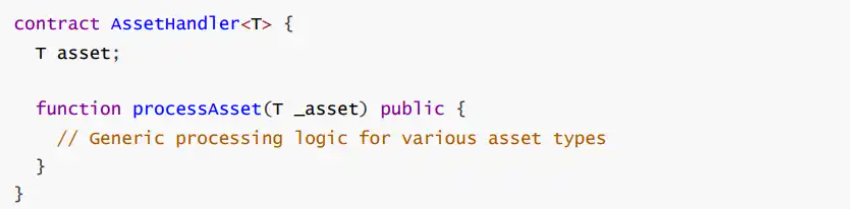
12. Introduction of Generics and Templates
Generics and templates in Solidity would enable more adaptable and reusable code. For example, a generic function could handle different types of assets (such as ERC20 tokens, NFTs, etc.) in a standardized way, without needing to rewrite the function for each specific asset type. This would improve contract design and development efficiency, as a single function could apply across various scenarios.
Outlook: The Road to Solidity 1.0.0
Across various platforms such as GitHub, Twitter, Ethresearch, and Reddit, discussions within the Solidity community about the 0.9.0 development roadmap are heating up.
A central debate is emerging:
Should there be a cautious direct transition to Solidity 1.0.0, signaling the full maturity of the language, or should progress gradually advance through version 0.9.0 toward more advanced capabilities?
Influenced by community feedback and innovative ideas, the anticipated debut of Solidity 1.0.0 may align with major Ethereum upgrades, reflecting the growth and stability of the entire ecosystem.
1. Evolution of the Type System: Increasing flexibility and security. An upgraded type system inspired by functional programming languages like Haskell or Scala is expected. This evolution aims to enhance both safety and flexibility in contract development.
2. Native Oracle Integration: Simplifying external data interaction. Plans include built-in support for decentralized oracles within Solidity, enabling safer and more direct interactions with external data sources.
3. Improved State Management: Refining blockchain interactions. Enhancements to state management are under discussion, possibly introducing elements like state channels or sidechains as built-in constructs, aiming to optimize on-chain interactions and reduce gas fees.
4. Modular Approach to Contract Design: Enhancing reusability. A shift toward modular contract architectures is being envisioned, allowing the use of interchangeable components. This could significantly simplify development and improve code maintainability.
5. Integrated Formal Verification Tools: Ensuring contract reliability. There is an expectation to integrate formal verification tools directly into Solidity, ensuring contracts meet specific standards and behaviors, thereby reducing the likelihood of bugs and vulnerabilities.
6. Cross-Chain Capabilities: Enabling interoperability across blockchains. Future updates may introduce native cross-chain compatibility, allowing Solidity contracts to operate seamlessly across various blockchain protocols.
7. Advanced Privacy Measures: Strengthening data security. Plans are underway to integrate advanced privacy tools—such as zero-knowledge proofs or homomorphic encryption—directly into the language, aiming to strengthen data security and user privacy.
8. Quantum-Resistant Cryptography: Preparing for future challenges. Given the emergence of quantum computing capabilities, implementing quantum-resistant cryptographic methods is being considered to protect Ethereum contracts against future threats.
Conclusion
By exploring potential trajectories for Solidity, this article combines community insights, current developments, and community forecasts to provide a comprehensive understanding of the subject. While we have delved into the possibilities for versions 0.9.0 and 1.0.0, the actual path and feature set may evolve as Solidity continues its development journey. Stay tuned to see how these discussions and concepts materialize in the ever-evolving world of smart contract programming.
Join TechFlow official community to stay tuned
Telegram:https://t.me/TechFlowDaily
X (Twitter):https://x.com/TechFlowPost
X (Twitter) EN:https://x.com/BlockFlow_News
 Adam Boudj


![In-depth Analysis of Trade[XYZ]: How Were 92 Markets and 98% HIP-3 Trading Volume Established?](https://upload.techflowpost.com/upload/images/20260716/20260716061117965147.jpeg?x-oss-process=image/resize,p_50/quality,q_80)