After Ordinals and Runes, how will Alkanes expand the Bitcoin smart contract ecosystem?
TechFlow Selected TechFlow Selected
After Ordinals and Runes, how will Alkanes expand the Bitcoin smart contract ecosystem?
The Alkanes meta-protocol introduces the capability to create applications, NFTs, and tokens on Bitcoin. Will this trigger a new wave of innovation on Bitcoin?
 Navigating Web3 tides with focused insights
Author: Erika Lee
Translation: TechFlow
Summary
-
Alkanes is a new meta-protocol on Bitcoin that enables the deployment of smart contracts and tokens.
-
Similar to Ordinals, BRC-20, and Runes protocols, it's expanding the potential of Bitcoin.
-
If you've been following recent Bitcoin developments, you may have already seen the term "Alkanes" mentioned in discussions among Ordinals and Runes enthusiasts. But what exactly is it?
Alkanes is a new Bitcoin meta-protocol that brings trustless smart contract functionality natively to Bitcoin’s base layer—without relying on bridges or external execution layers. Developers can use it to build applications and issue tokens directly on Bitcoin, extending the capabilities of this original blockchain.
Developed by Oyl Corp after two years of infrastructure research, Alkanes aims to enable advanced programmability directly on Bitcoin. Decrypt spoke with Alec Taggart, co-founder and CEO of Alkanes, to learn more about the project’s origins, goals, and future plans.
What Is Alkanes?
Alkanes is a Bitcoin meta-protocol founded by Alec Taggart, Cole Jorissen, and Ray Pulver. It is a framework that allows developers to embed smart contracts directly into Bitcoin's data layer using a WebAssembly (WASM) virtual machine.
Smart contracts are core pieces of code powering decentralized applications (dApps), commonly found on blockchains like Ethereum and Solana. However, Bitcoin does not natively support smart contracts—a limitation that has historically constrained its decentralized finance (DeFi) potential. Now, developers are exploring new approaches, and Alkanes makes more advanced functionality possible on Bitcoin.
Alkanes operates in a compact and efficient format, leveraging Bitcoin's witness data and OP_RETURN fields to execute and track state changes. Its operation is similar to Ordinals (NFTs on Bitcoin) and Runes (fungible tokens), but adds support for WASM-based smart contracts. Execution and state transitions are handled through an indexing framework tied to Bitcoin block finality.
While standards like Runes and BRC-20 are largely limited to issuing and transferring fungible tokens, Alkanes offers rich programmability—including automated market makers (AMMs), staking contracts, free mints, NFT swaps, and more—all executed trustlessly on Bitcoin.
The Alkanes protocol isn't meant to compete with Ordinals or Runes; rather, it's designed to coexist alongside them. Ordinals ignited cultural momentum on Bitcoin, while Alkanes provides the engine to drive it forward.
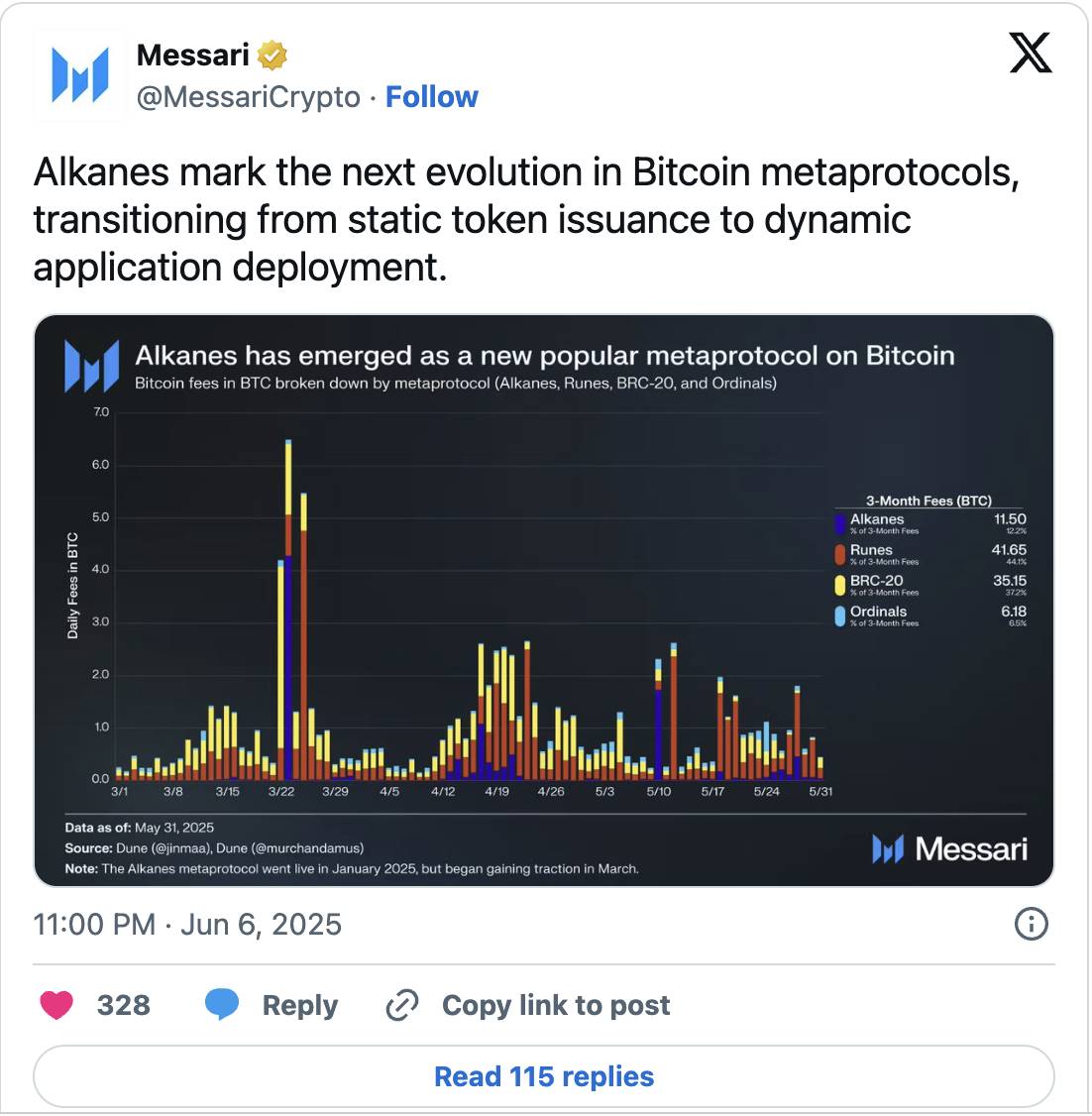
Alkanes is designed with interoperability in mind—for example, if you own an Ordinal, you can use it to mint a new Alkanes asset. This feature positions Alkanes as a neutral yet extensible foundational layer, opening up broader possibilities for innovation and development on Bitcoin. The protocol requires no cross-chain bridges or separate execution layers—developers gain direct access to Bitcoin's native data while unlocking new use cases.
The founding team at Oyl brings extensive experience from the Ethereum DeFi ecosystem. They see Bitcoin not only as a store of value but also as a settlement layer capable of supporting fully expressive applications. While the launch of Ordinals in 2023 sparked cultural and economic activity on Bitcoin, co-founder Taggart says true composability has only become feasible now.
"Alkanes is the result of years of deep research and strong conviction," Taggart said. "It proves that Bitcoin can evolve without imitating Ethereum. This is a native system built for those who believe Bitcoin itself is powerful enough."
How Alkanes Works
Alkanes introduces a new data primitive called "protostones," analogous to runestones in Runes. Each protostone can carry multiple messages, enabling complex operations beyond simple token issuance—such as creation, exchange, minting, and burning—all encoded and executed via a WASM runtime.
In Alkanes, every asset is treated as both a token and a contract. The platform uses a factory model for efficient contract deployment. Instead of redeploying contracts for each new asset, developers simply pass new parameters to a template—significantly saving block space and fees.
Within Alkanes, both fungible and non-fungible tokens (NFTs) are considered tokens. NFTs are referred to as "Orbitals," a standard developed by the community after the protocol's launch. Alkanes' fungible tokens are similar to Ethereum's ERC-20, supporting full smart contract functionality and composability.
The first token launched on Alkanes is Diesel, which follows Bitcoin's emission schedule. Minted through Bitcoin blocks, Diesel uses an opcode to track block rewards, directly linking its issuance to Bitcoin's halving cycles.
Unlike Runes and BRC-20, ticker names in Alkanes are not globally unique. Each token has a unique identifier, meaning the same name (e.g., "Methane") can exist under different IDs—eliminating common name squatting issues seen in other standards.
Popular NFT collections on Alkanes include Alkane Pandas, backed by a strong and dedicated community, and Oyly on Alkanes, the first free-mint NFT collection on the Alkanes network.
What’s Next?
The Alkanes team is developing a native automated market maker (AMM) for its ecosystem and building partnerships around stablecoins (Bound), block explorers (Ordiscan, Unisat), wallet libraries (LaserEyes), and DeFi protocols. These components will allow developers to build complete full-stack applications using only Bitcoin's native capabilities.
"These apps aim to show how developers can leverage Alkanes’ infrastructure to build full decentralized applications (dApps) directly on Bitcoin," added co-founder Taggart.
In addition, Oyl Corp has open-sourced its indexing engine Metashrew along with all related infrastructure, allowing developers to inspect, fork, or contribute to the protocol’s growth.
The Alkanes protocol officially launched at Bitcoin block 880,000 in early 2025, marked by the deployment of the Diesel contract. Community minting began shortly afterward in early March, automatically initializing when the protocol started scanning messages from designated blocks as hardcoded.
Since launch, the Alkanes project has grown organically through developer experimentation and open-source contributions, as Bitcoin developers work toward building a sustainable ecosystem.
"The goal of Alkanes isn't just to create another token standard," Taggart said, "but to provide developers with a platform where composability, liquidity, and sovereignty can finally converge on Bitcoin."
Join TechFlow official community to stay tuned
Telegram:https://t.me/TechFlowDaily
X (Twitter):https://x.com/TechFlowPost
X (Twitter) EN:https://x.com/BlockFlow_News
 Decrypt