“U.S. Stock Version of ‘Zi’”: Latest Portfolio Analysis of Leopold Aschenbrenner—Why Has This AI Bull Turned Bear on NVIDIA?
TechFlow Selected TechFlow Selected
“U.S. Stock Version of ‘Zi’”: Latest Portfolio Analysis of Leopold Aschenbrenner—Why Has This AI Bull Turned Bear on NVIDIA?
If you are a retail investor who entered this market after reading Leopold’s 13F filing, exercise caution.
 Navigating Web3 tides with focused insights
Compiled & Translated by TechFlow
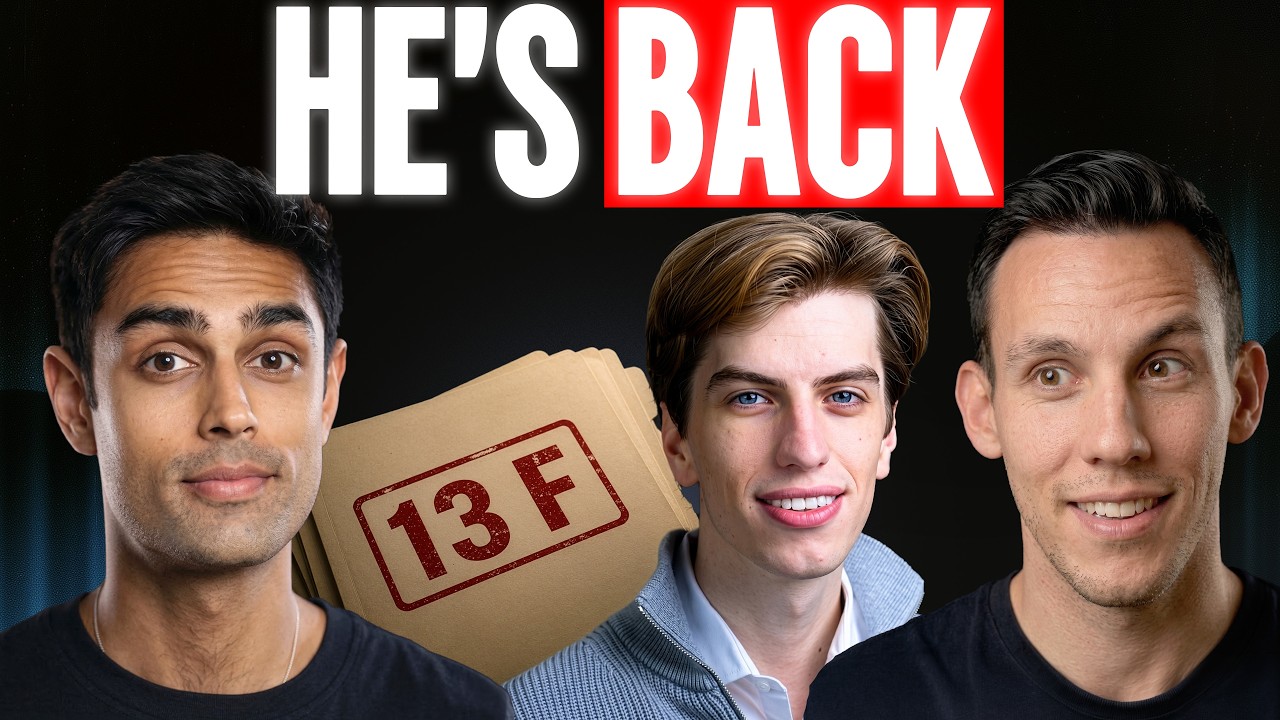
Hosts: Josh, EJ
Original Title: The Best AI Investor Just Shorted the Entire Market
Podcast Source: Limitless (an AI investment podcast)
Air Date: May 19, 2026
Editor’s Note
Leopold Aschenbrenner—the Wall Street’s most prominent AI bull, former OpenAI researcher, and founder of Situational Awareness Fund—has just filed his latest 13F with the SEC. The market’s most unexpected signal has emerged: He has established $8 billion in short positions across the entire semiconductor supply chain—including NVIDIA, AMD, Broadcom, ASML, and Micron—representing 40x the fund’s total assets 18 months ago, and marking the first time the fund’s net short exposure has exceeded its long exposure since inception.
His new thesis can be distilled into one sentence: The bottleneck in AI investment is shifting from chips (the design layer) to power and memory (the infrastructure layer). On the long side, he continues to hold large positions in data center and power infrastructure newcomers such as CoreWeave and Bloom Energy, and has added new positions in Bitcoin miners with grid-access capabilities—including SanDisk, CleanSpark, Riot Platforms, Applied Digital, and IREN. This filing is a key document for understanding the narrative shift in AI investing in 2026.
Key Quotes
From Bullish on AI to Shorting Semiconductors
- “This is the first time in the fund’s history that short exposure has exceeded long exposure—$8 billion in shorts, 40x the fund’s net asset value 18 months ago. This isn’t hedging; it’s a directional bet.”
- “If you were merely hedging realized gains, you’d see small-scale hedges offsetting long book profits. But when total put notional exceeds long exposure, you’re betting the market will decline.”
Core Thesis: Bottleneck Has Shifted from Silicon to Electrons
- “The bottleneck has shifted from chips to electrons. Chips are actually sufficient—it’s about where to plug them in. Anthropic is willing to partner with competitor SpaceX for compute—not because chips are scarce, but because there’s insufficient infrastructure to deploy them at scale.”
- “Leopold understands data centers and GPUs better than anyone in this market—and he’s studied this longer than anyone. So he knows more clearly than anyone else where the next bottleneck lies: power and energy.”
- “I don’t think he’s truly bearish on GPUs. He simply views them as overcrowded in the near term—and believes allocating capital to power and memory delivers higher returns.”
On Neocloud and Power: A Win-Win Trade
- “Neoclouds like CoreWeave possess something NVIDIA lacks: grid interconnection rights. Betting on Neoclouds isn’t just about their ability to run GPUs—any well-capitalized data center can do that. It’s about their secured access permits and capacity within existing grid infrastructure.”
- “This is a win-win trade: Even if the semiconductor sector falls—and GPU valuations held by these companies decline—they still benefit from power premiums thanks to their secured capacity.”
- “U.S. Bitcoin miners are expected to bring ~30 GW of power capacity online this year. For context, that’s roughly equivalent to the combined data center power plans announced by Microsoft, Google, Amazon, and Meta. They already own power, land, and facilities—only needing to swap mining rigs for AI accelerators.”
Memory and the Infrastructure Layer
- “Memory prices are surging. Over the past nine months, average prices among major memory vendors have risen 300%–500%; looking at capacity, nearly all production is booked through end-2027.”
- “SanDisk has surged ~40,000% over the past year—by all logic, one of the most crowded trades—but Leopold remains bullish. Its core product is NAND flash, precisely the type of temporary storage AI models rely on for memory and context recall.”
NVIDIA: Largest Short, Yet Possibly the Greatest Misjudgment
- “Leopold holds ~$1.9 billion in short exposure to NVIDIA—including indirect shorts via the VanEck Semiconductor ETF (SMH), whose top holding is NVIDIA at ~20% weight.”
- “NVIDIA’s moat may be stronger than imagined. CUDA is a software lock-in platform—once built upon, users resist migration due to the immense complexity of rebuilding custom infrastructure for new chips.”
- “Six-to-eight-year-old NVIDIA GPUs now command higher secondary-market lease rates than two years ago—and contracts must be signed a full year in advance.”
Practical Advice for Retail Investors
- “If you’re a retail investor entering this space solely based on Leopold’s 13F, proceed conservatively. This isn’t the moment to go all-in on a single stock. Over the past two years, S&P 500 gains have been driven overwhelmingly by the ‘Magnificent Seven,’ with capital cascading down to the very companies we’ve just discussed. That may represent an overcrowded trade—so caution is warranted.”
- “Two things I personally favor long-term: First, energy—everyone faces power shortages. Second, physical-world manufacturing and construction capability—any company with near-monopoly advantages in building factories or securing grid interconnection rights possesses a durable moat and merits long-term investment.”
- “NVIDIA reports earnings on May 20. If its guidance for next quarter exceeds $78 billion, these put positions will likely be reversed.”
The King of AI Bulls Turns Bearish
Josh: Wall Street’s most prominent AI bull has just declared a top for the entire AI market. Leopold Aschenbrenner—the 24-year-old former OpenAI researcher who founded his own fund after being fired—grew $250 million into $13.7 billion in under two years (“America’s version of ‘Zi’”). And his latest portfolio isn’t what you’d expect. He’s turned bearish on the broader equity market and established $8 billion in short exposure across AI’s largest names—including NVIDIA, AMD, Broadcom—and the entire semiconductor supply chain. But he’s not entirely pessimistic: He’s also revealed where his next biggest AI bet lies—power and memory—and doubled down on data centers and three newly added companies. We’ll break each down—but first, the biggest change.
EJ: The world’s most valuable company, the poster child of the AI revolution, and the engine behind countless fortunes—NVIDIA—is now squarely in his crosshairs. It’s Leopold’s largest short position—but you won’t spot it immediately on the filing. His top short is listed as the VanEck Semiconductor ETF (SMH), followed closely by NVIDIA itself. He currently holds $1.5 billion in direct put option exposure to NVIDIA. For those unfamiliar with puts: A put gives Leopold the *right*, not the obligation, to sell the underlying asset at a predetermined price. He’s bought the right to sell NVIDIA shares at a higher price if the stock falls below that level.
Josh: SMH is his #1 short, sized at ~$2 billion. I checked its holdings—NVIDIA is its largest single position, at ~20% weight. So combining his top two shorts, his effective NVIDIA short exposure is ~$1.9 billion. That’s likely a shock to those convinced NVIDIA can only rise. But Leopold clearly disagrees.
Beyond that, Broadcom, Oracle, AMD, Micron, ASML, Intel, and Corning are all new short positions. Recall Intel was once his breakout trade—the single largest profit in his fund’s history—and he’s now shorting it. Broadcom is the primary builder for OpenAI’s Project Stargate (a massive AI data center initiative co-led by SoftBank), so shorting Broadcom is effectively shorting OpenAI and Stargate. Corning, the optical fiber glass maker, also drew a large short. Altogether, this represents $8 billion in short exposure—equivalent to 40x the fund’s total assets 18 months ago. This is an extremely aggressive bet.
EJ: Extremely aggressive. Remember, his entire fund thesis rests on his 64-page paper “Situational Awareness,” whose central wager is that semiconductor compute FLOPs will grow by multiple orders of magnitude over the next decade. This $8 billion short is, in effect, a reversal of that thesis. So only two explanations exist: Either he sees current positioning as dangerously overcrowded—creating near-term volatility and downside pressure—or some core element of his original thesis has failed—and he hasn’t publicly specified which.
Long Side: Neocloud, Power, and Bitcoin Miners
EJ: He’s not fully bearish. Looking at the right-hand side of the chart—the long book—he maintains substantial equity stakes in many companies and has purchased call options. First, CoreWeave: He maintains his position. CoreWeave has been one of his largest data center / Neocloud investments since fund inception. His bets include private investments and acquisitions like Core Scientific—a Bitcoin mining/data center operator that helps run CoreWeave’s infrastructure. Simply put, Neoclouds are new cloud providers that procure, assemble, and rent out GPU clusters to top AI labs. CoreWeave has already signed multi-billion-dollar contracts with Meta and Anthropic.
Next is Bloom Energy—the fund’s largest new position last quarter. Bloom manufactures portable gas turbines that can be air-freighted directly beside any data center to power it. One of AI data centers’ biggest bottlenecks today is having stacks of GPUs—but no grid capacity to feed them. Hence, supplemental power solutions like Bloom’s are critical. Leopold didn’t exit—he reduced his position by $1 billion. That makes sense: This stake rose from ~$800 million to ~$2.5 billion in three months, so taking some profits off the top is rational. He still holds just over $1 billion in Bloom Energy.
Below that, he added positions in Bitcoin miners—CleanSpark, Riot Platforms, Applied Digital, and IREN. If those names sound familiar, it’s because they operate in the same Neocloud space as CoreWeave. So he’s deploying full firepower behind data centers and Neocloud. His observation: Anthropic and OpenAI keep releasing new models, and the scaling laws for compute demand continue expanding—so GPUs remain essential. But the current choke point is *delivery*. These companies solve delivery; GPU manufacturers themselves (NVIDIA, Broadcom, etc.) are precisely whom he chooses to short.
Josh: This is an emerging narrative trade—capital flowing away from semiconductors themselves and toward infrastructure, power, data centers, and memory. He’s doubling down on the direction we saw last quarter—but this time, simultaneously establishing shorts to bet against companies he believes won’t outperform.
A reminder: The 13F is a snapshot—reflecting trades made in the prior quarter (Jan 1–Mar 31). Leopold has been remarkably consistent—his fund size has grown from $220 million to a current $13.7 billion. But he could be wrong: His short on AMD, for example, surged 74% last month—perhaps he timed his short at the peak of the AI rotation. Is that a timing error—or a flawed thesis? Or take ASML: To my knowledge, ASML remains the world’s sole producer of EUV lithography machines—100% monopolistic—and he’s shorting it too. So his thesis clearly tilts toward memory, power, and infrastructure—not semiconductors per se.
Deconstructing the Thesis: What Is Leopold Really Betting On?
EJ: Rather than reviewing longs and shorts separately, let’s cut straight to the thesis behind each position. These positions are highly aggressive—$8 billion in shorts isn’t trivial—and many of the longs (Neoclouds, power companies) are unfamiliar to most investors. Are they good bets? In my view, he’s executing a directional two-sided trade: short silicon, long electricity. He sees GPU designers (NVIDIA, Broadcom) and foundry players (TSMC) as overcrowded trades. I don’t think he’s truly “bearish”—he thinks they’re overvalued. Conversely, he’s overweight power because he understands data centers and GPUs better than anyone—and he’s identified power and energy as the next bottleneck. He doesn’t believe sufficient energy exists—or sufficiently efficient ways to deliver it—to GPUs.
He’s also heavily overweight memory. SanDisk surged ~40,000% over the past year—by all logic, the most crowded trade imaginable—yet he remains bullish. SanDisk’s core product is NAND flash—the exact type of temporary storage AI models need to retain context during conversations. So I don’t think he’s deeply bearish on GPUs themselves—he just sees them as overcrowded near-term, with superior risk-adjusted returns available in power and memory.
Josh: This makes me wonder whether he’s bearish on the entire market. This is the first time in the fund’s history that short exposure has exceeded long exposure—for a fund historically known for being “long-only, always up.” That’s a striking pivot. My initial assessment was: Could this just be hedging? After all, he’s made enormous profits—maybe he’s locking in gains and protecting against downside. But pure hedging would involve smaller positions designed to *offset* long-book gains—not a directional bet where put notional exceeds long exposure. Last quarter, he did hold some hedge positions—but they were small and non-directional. This quarter, total put notional has surpassed long exposure—that’s a directional bet on market decline.
So he’s in a curious position: He appears to believe the overall AI market will fall—even while expecting memory, infrastructure, and energy to keep rising. That’s his bet.
EJ: What you’re describing is uncertainty. He himself isn’t fully certain either—evident in one detail: He paired several put positions with corresponding call positions. This structure is known in hedge funds as a “collar trade.” When you’re unsure whether markets will rise or fall, you hedge both sides—and profit from the spread between call and put premiums. He executed this strategy across four companies—the largest being Micron. If he’s truly bullish on memory players like SanDisk, he theoretically shouldn’t short Micron—the largest U.S. memory company—and Leopold is a staunch U.S.-equity purist, having earned his biggest wins on Intel longs, Bloom Energy, and NVIDIA. So Micron looks less like a thesis-driven short and more like a “market-neutral trade”: He’s uncertain on direction, so he hedges—and believes the market is overcrowded, though still positive long-term. That’s actually quite savvy.
Four Core Arguments
Josh: I’ve condensed his new thesis into four points. First: The bottleneck has shifted from chips to electrons. We know chips are plentiful—the issue is where to plug them in. Look at SpaceX and Anthropic’s recent partnership announcement: Anthropic is so starved for compute that it’s willing to collaborate with a rival. That’s not a chip shortage—it’s an infrastructure shortage for running chips at scale.
Second: Chip valuations are priced for a world that no longer exists. SMH is up 66% YTD, while Intel is up 200%. The market is pricing the entire semiconductor sector on the assumption that *every* chip company benefits equally from AI demand. Leopold is betting the opposite—that winners and losers will emerge, and early winners will continue winning, allowing him to capture further upside.
EJ: Looking at these long positions just now, I realized something: These Neocloud companies stand to benefit directly from his new thesis. When the semiconductor sector falls, their stocks should theoretically decline too—since they hold GPUs. But CoreWeave-like firms possess something NVIDIA lacks: grid interconnection rights. He’s investing in these Neoclouds not because they run GPUs—any well-funded data center can—but because they hold secured access permits and capacity within existing grid infrastructure. So through one company, he expresses *both* a long-power and short-semiconductor thesis—a two-for-one play.
Josh: Third, he’s buried a “Easter egg” in the question of *where to get power*: Bitcoin miners. We briefly touched on this last quarter—and he’s doubled down here. U.S. Bitcoin miners are projected to bring ~30 GW of power capacity online this year. For comparison, that’s roughly equal to the combined data center power plans announced by Microsoft, Google, Amazon, and Meta. They already own critical infrastructure—power, facilities, and scalable buildings—and need only swap mining rigs for AI accelerators. This is a perspective few have explored: Bitcoin pivoting to AI—purely following capital.
EJ: Finally, he’s doubling down on *physical infrastructure*. He doesn’t believe this layer will be commoditized—but he does believe the semiconductor “design layer” is overcrowded. Reminder: NVIDIA doesn’t fabricate chips—it designs them and sends blueprints to TSMC for manufacturing; Broadcom operates similarly. Intel and AMD design CPUs/GPUs—and Leopold shorted them all. They design chips but don’t manufacture them. Intel and AMD plan to build fabs—but lack current facilities or infrastructure. So his logic is: Chip design is overcrowded; hardware infrastructure is where capital flows—and power is the foundational substrate of that layer.
Where Could He Be Wrong? NVIDIA’s Moat
Josh: Let’s also examine where this trade could unravel. As noted, AMD surged 74% last month—while he’s short. That’s certainly painful. His total NVIDIA short exposure is ~$1.9 billion—and one potential failure point is NVIDIA’s moat proving stronger than he expects. He’s betting NVIDIA will become “commoditized,” as custom chips like Google’s TPU and Amazon’s Trainium gradually erode its monopoly. Reality may differ: Order books and 80% gross margins show demand still flooding toward NVIDIA—driven by CUDA, a highly customized, high-barrier software stack. Once built upon, migrating infrastructure is prohibitively complex. Is that true? Did Leopold misjudge? We don’t know.
Anthropic pursues a “lower-lock-in” path—partnering with Amazon on Trainium and Google on TPU—while still using NVIDIA. But xAI’s Colossus data center runs almost exclusively on NVIDIA GPUs—fully leveraging the latest Blackwell architecture (NVIDIA’s newest AI accelerator generation)—and betting hard on CUDA. So one thesis may prevail while another fails. Regardless, NVIDIA is the world’s most valuable company—its collapse wouldn’t be trivial.
Even more striking: NVIDIA GPUs shipped 6–8 years ago now command higher secondary-market lease rates than two years ago—and leases require signing a full year in advance. That means someone is willing to rent older GPUs at higher prices than their original list price.
EJ: Leopold’s style reminds me of Michael Burry—we discussed months ago how Burry loudly shorted NVIDIA near its peak, only to get burned badly. Let’s hope Leopold avoids the same fate. Two other potential risks or blind spots: Situational Awareness is a hedge fund—not a VC fund—so aggressively going “all-in on AI” is rare for a hedge fund. All these 13F positions reflect a quarterly snapshot—he must file every three months; as we speak, he may have already reversed these positions.
Another issue: When did he establish these puts? Likely early this year—when the fund may have faced headwinds. Of course, the counterpoint is clear: His fund size grew from $5.5 billion to $14 billion in three months—so he profited. Crucially, these puts and calls are leveraged: Behind $8 billion in notional shorts, he may have deployed only ~$1 billion in actual capital—plus ongoing premium and fee payments—making this a short-term trade.
So I must stress: He may have already exited some of these positions. If you’re watching this episode thinking, “Oh no—I need to overhaul my entire portfolio,” remember: Your trading approach isn’t his. You’re not trading short-term or high-frequency—you’re a long-term holder. That’s a completely different paradigm.
What Should Retail Investors Do? Polymarket Data and Personal Views
Josh: Some Polymarket data supports the idea that things aren’t as dire as they seem—because retail investors and Leopold play different games. If you interpret this 13F as signaling an AI bubble burst, consider this: Per Polymarket, the probability of an AI bubble bursting by December 31, 2026, stands at just 24%. I checked another market: Polymarket shows a 93% probability that NVIDIA remains the world’s most valuable company for the rest of this month. This suggests volatility may be less extreme than implied by this 13F. Again, this is last quarter’s news—the tide has turned; we don’t know how he’s traded over the past few months. Indeed, things aren’t that bleak—he’s merely switched strategies. EJ, how would you adjust your own portfolio as a retail investor?
EJ: Two answers. If you’re new—and planning to trade solely based on Leopold’s 13F—be conservative. This isn’t the time to bet on a single stock, and I never recommend doing so. Leopold’s caution has rationale: Over the past two years, markets rose hundreds of percent—a massive move for normal equities; S&P 500 gains came overwhelmingly from the Magnificent Seven, with capital trickling down to all the companies we just discussed. He’s likely just saying: This is an overcrowded trade—proceed with caution.
But Josh, I always maintain a bullish ceiling—and my strongest conviction today is in power and energy. I agree with Leopold on Bloom Energy and the data center theme. One insight from this research excites me deeply: Investing in top-tier Neoclouds expresses *both* a long-power and short-semiconductor thesis. They’ve signed multi-billion-dollar contracts with Anthropic and Meta—and even if semiconductors fall, they retain secured power capacity. That’s a trade I might place.
But I’m skeptical of his shorts on Corning and other optical fiber bottlenecks. NVIDIA just signed a multi-billion-dollar deal with Corning—and he’s shorting it. He’s picking which bottlenecks to bet on. I agree he picked power correctly—but I’m unsure about fiber. Josh, your view?
Josh: For me personally, the two most critical elements in AI investing are energy—and the “movement of atoms in the physical world.” The physical world is hard, complex, and far slower than the software world. Any company with near-monopoly advantages in manufacturing, construction, or securing grid interconnection rights possesses massive structural advantages.
Second is energy—everyone faces power shortages, yet nobody wants to be the “bad guy” who builds data centers next to cities and siphons electricity from households—pushing up residential rates. Everyone wants cheap, easy, fast, efficient power generation—and abundant energy. Any company with near-monopoly advantages in these areas deserves investment—because it’s durable.
As for the chip layer? Competition is fierce. Amazon’s Trainium, Google’s TPU, Cerebras (which just IPO’d with a brand-new architecture)—competition here may compress margins. Profits remain extremely high today—but there’s room for compression.
Key upcoming checkpoints: NVIDIA’s May 20 earnings—if next-quarter guidance exceeds $78 billion, these puts will likely be reversed; AMD’s 2026 Analyst Day; Bloom Energy’s key deployment milestones. These are concrete reference points to validate Leopold’s positions. But at the thematic level, energy and infrastructure remain unambiguous directions.
Conclusion: Think, Compare, Don’t Follow Blindly
EJ: Roughly one to two weeks ago, we did an episode on where future AI investment capital will flow. We walked down the AI infrastructure stack—from model labs, to hyperscalers (like the Magnificent Seven’s in-house massive clouds), to AI platforms, to GPUs/semiconductors—and concluded capital would flow *down* from NVIDIA, AMD, and Broadcom toward memory/storage layers, and power/infrastructure layers. That’s precisely the direction of Leopold’s latest 13F—shorts + longs. We may have anticipated this.
Crucially, AI isn’t a “one-to-one” trade. You can certainly buy and hold NVIDIA long-term—and directionally, that may be correct for the next decade. But assuming safety by placing money in just one segment of the stack is a grave mistake. Capital flows across the entire value chain. AI is like a car: It consumes fuel (capital), burns it across the full infrastructure stack, and expels exhaust at the other end. We may now be at the two-thirds mark along that chain.
This isn’t speculation—it’s grounded in data. Memory prices have surged 300%–500% across all major vendors over the past nine months; their capacity is booked solid through end-2027—roughly 18 months of orders. Will more supply arrive? Will power magically appear? We don’t know—but directionally, Leopold’s bet aligns with our analysis.
Josh: We’ll keep tracking: Cerebras, Leopold’s next 13F, upcoming earnings—all rich with news. There are also some hilarious memes: Nick Carter drew Leopold as “I don’t want to play with you anymore”—abandoning the AI industry. And “The last look before Intel investors panic-sell”—he went long billions on Intel, then hit the sell button: “I’m done.”
EJ, before we go—what would you like listeners to do? How should they adjust their portfolios based on Leopold?
EJ: My final thought: I’m Leopold’s #1 fan—but I think he may be wrong in places. I invite you to comment: Which part of his thesis do you disagree with—and why? I won’t speak for Leopold—but I feel uneasy myself. I’m not sure he fully knows what he’s doing. In fact, judging from the bilateral structure he’s laid out, he’s not certain either—he’s playing it safe.
Josh: If you had to pick just *one* thing he might be wrong about?
EJ: NVIDIA. I bet you’d say the same?
Josh: Yes. If NVIDIA falls, everything falls. That’s how I see it.
$1.9 billion shorting NVIDIA—I’m puzzled. With such high margins, everyone demanding Blackwell, and us only just receiving the earliest Blackwell models—the first called Mythos—NVIDIA’s infrastructure stack and software hold immense value. It’s a one-way-up, world’s most valuable company. Not continuing to back the winner sounds like a loser’s strategy. That said, we’ll keep tracking—and keep you updated daily on frontier AI investing developments.
Thanks for watching. If you enjoyed this episode, please share it with friends, leave a comment, like, and give us five stars. That’s all for today. This does not constitute investment advice.
Join TechFlow official community to stay tuned
Telegram:https://t.me/TechFlowDaily
X (Twitter):https://x.com/TechFlowPost
X (Twitter) EN:https://x.com/BlockFlow_News
 深潮TechFlow