








Modular Blockchains: Ethereum's Engineering Path to Becoming the "World Computer"
TechFlow Selected TechFlow Selected
Modular Blockchains: Ethereum's Engineering Path to Becoming the "World Computer"
Looking at the development trends of crypto in 2022, launching a new Layer 1 blockchain at this point seems somewhat unconvincing. The narrative around modular blockchains cannot be ignored.
 Navigating Web3 tides with focused insights
Author: 0x1
The Trend Toward Modular Blockchains
Looking at the development trends of crypto in 2022, launching a new Layer 1 blockchain at this point would seem somewhat forced. The narrative around modular blockchains is impossible to ignore.
After The Merge, Ethereum’s roadmap is increasingly leaning toward the direction of modular blockchains.
The key difference between modular and monolithic blockchains lies in how functions are structured: monolithic blockchains implement execution, settlement, consensus, and data availability all within a single base layer, whereas modular blockchains split these functions across multiple specialized layers.
In fact, Ethereum isn’t the only network planning for a modular architecture:
- The earliest proponent of modular blockchain design, Celestia, is building a data availability layer for rollups based on the Cosmos ecosystem;
- Tezos is also embracing a rollup-centric roadmap;
- NEAR is actively designing data availability sharding.
This article primarily discusses Ethereum's trend toward modularity.
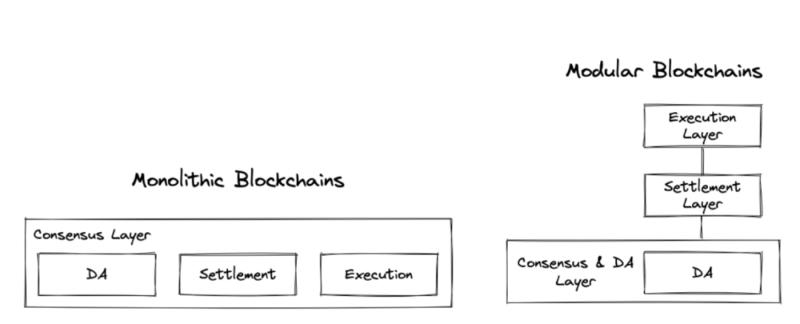
Ethereum’s current congestion highlights the drawbacks of monolithic blockchains—poor scalability, lack of customization, and high fees.
The problem with monolithic blockchains is that the consensus layer must handle many different tasks simultaneously, and optimizing for just one function does not effectively improve overall performance.
To use an analogy, a monolithic blockchain is like a wooden barrel made of four staves—the barrel’s capacity (performance) depends on the shortest stave. Any weakness in one attribute limits the whole system, and the so-called “blockchain trilemma” makes it impossible to maximize all attributes at once. Therefore, scaling solutions based purely on the monolithic blockchain model cannot resolve Ethereum’s challenges.
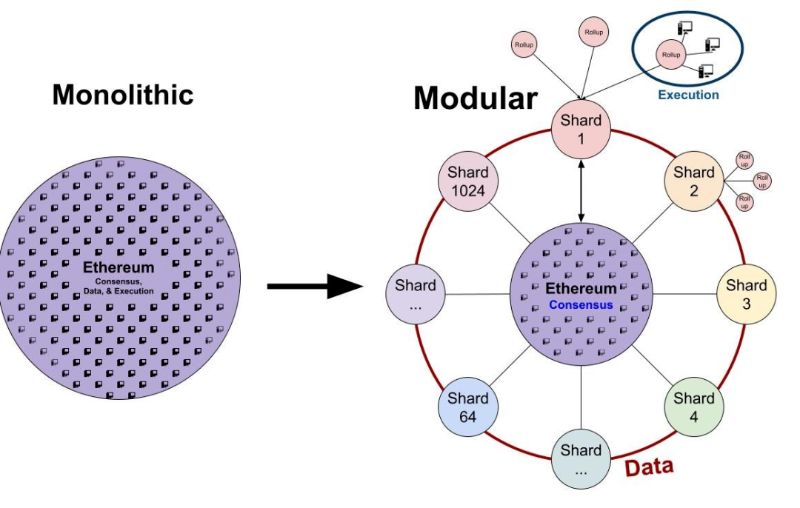
Modular hybrid scaling: layer1 (data sharding) + layer2 (rollups)
In essence, modular blockchains represent a hybrid scaling approach. At the sixth Blockchain Global Summit, Vitalik’s presentation was titled “The Rise of Ethereum’s Layer 2 Ecosystem,” where he emphasized that Ethereum’s scaling strategy isn't limited to either Layer 1 or Layer 2 alone, but rather combines both approaches.
The nature of modular blockchains closely resembles this hybrid Layer 1 and Layer 2 scaling model.
Ethereum’s Modular Architecture
Ethereum’s modular architecture is primarily divided into four layers: Execution Layer, Settlement Layer, Consensus Layer, and Data Availability Layer.
Currently, within the industry, the Execution and Settlement layers are often collectively referred to as the Execution Layer, while the Consensus and Data Availability layers are grouped together as the Consensus Layer.
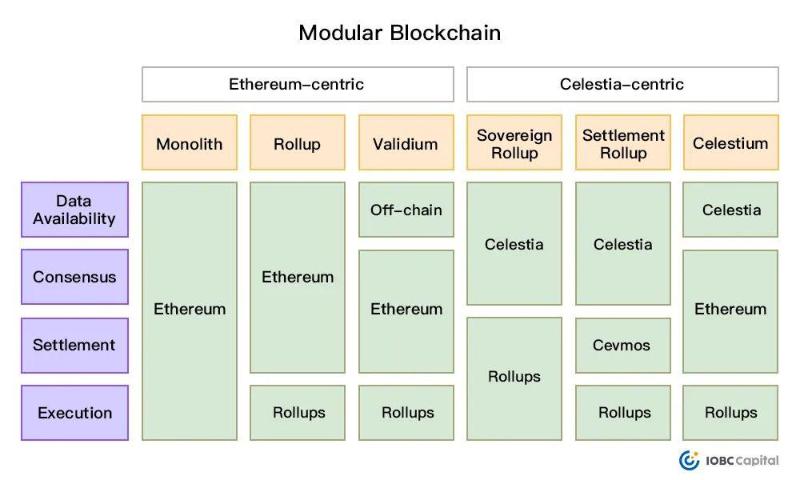
Execution Layer: Handles transaction processing, order execution, and validation of transfers and smart contract operations, primarily through rollups. In the mature phase of modular blockchains, users typically interact with the blockchain via the Execution Layer—signing transactions, deploying smart contracts, and transferring assets. This layer addresses scalability.
Settlement Layer: Validates the results from rollups and other execution layers, resolves disputes, and finalizes state commitments.
Consensus Layer: Full nodes download and execute block contents, reaching consensus on the validity of state transitions, providing ordering and finality, and validating block production via PoS.
Data Availability Layer: Ensures transaction data is usable (stored, verifiable, and accessible). It publishes and stores the data required to verify state transition validity. If malicious block proposers withhold transaction data, this layer provides the necessary data for verification.
In the foreseeable short- to mid-term after The Merge, Ethereum’s Settlement, Consensus, and Data Availability layers remain unified.
Future Danksharding will transform Ethereum L1’s data sharding into a data availability engine, with the beacon chain serving as the consensus layer, and the original Ethereum mainnet becoming an execution layer, while additional execution layers will be L2 rollups.
Moreover, beyond current L2s, the industry has already begun exploring customized L3s as further extensions of the execution layer.
If today’s Ethereum is still a theoretical “world computer,” then modular blockchains represent the engineering blueprint for turning Ethereum into a true “world computer.”
Ethereum’s Future Roadmap
As widely known, The Merge refers to the transition from PoW to PoS, merging the Beacon Chain with the original Ethereum mainnet.
Beyond The Merge, Ethereum is concurrently advancing The Surge, The Verge, The Purge, and The Splurge.
The rollout sequence of these upgrades is uncertain because they are independent and progressing in parallel.
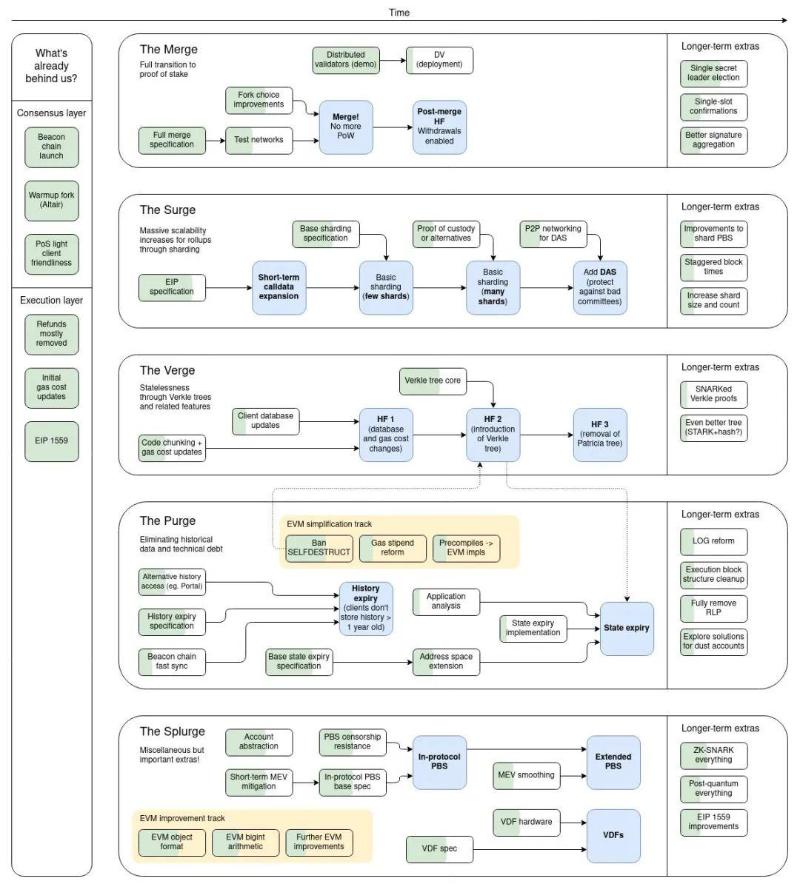
- The Surge focuses on introducing sharding, enabling massive scalability by allowing the Ethereum network to process more transactions in parallel.
- The Verge involves Verkle Trees, aimed at optimizing storage and reducing node size. This upgrade will leverage Verkle Trees—a mathematical construct and an evolution of Merkle Trees—to minimize the amount of data validators need to store locally. Smaller node requirements will allow more users to become validators, further decentralizing the network and enhancing security.
- The Purge reduces the disk space required by validators by eliminating historical data and technical debt. This simplifies storage and helps reduce network congestion.
- The Splurge consists of various minor optimizations and adjustments to fine-tune the Ethereum network, making it smoother and more efficient.
Vitalik has stated that after completing these five major phases, Ethereum could achieve 100,000 TPS, finally realizing his original vision of a “world computer.”
Although the names of these five parallel phases rhyme, they may still make Ethereum’s multi-year roadmap difficult to grasp. To better understand Ethereum’s modular trajectory, it helps to focus on the most critical and concrete upgrade milestones:
1. Proto-danksharding (EIP-4844)
Proto-danksharding is a proposal that implements much of the logic and foundational rules (e.g., transaction format, validation rules) needed for full Danksharding, though without actual sharding yet. At this stage, all validators and users still directly verify complete data availability.
The key feature introduced by proto-danksharding is a new transaction type called “blob-carrying transactions.” These resemble regular transactions but include an additional piece of data called a blob. Each blob is about 128KB and significantly cheaper than equivalent calldata. However, blob data is inaccessible to EVM execution; the EVM can only see commitments to the blobs.
Currently, Ethereum block size is determined by gas limits. After EIP-4844 is implemented, the number of blobs will become another dimension determining block size. Blobs are binary data structures of approximately 128KB. Ethereum limits the number of blobs per block—targeting 8, with a maximum of 16—adding 1–2MB (128*8 to 128*16) of extra storage per block.
Blobs are primarily used to store Layer 2 data, which previously relied on calldata. Introducing blobs greatly increases available storage within blocks. However, due to their large size, if each block adds 1MB of blob data, Ethereum would accumulate several terabytes of data per month. To address rapid data growth, blob data will be stored off-chain and automatically deleted after 30 days.
Since blob data does not compete with existing Ethereum transactions for gas usage, significant scaling benefits are still achieved. A simple way to understand the EIP-4844 proposal under proto-danksharding is: Ethereum L1 maintains its ~1MB block size while adding temporary, off-chain blob storage to hold L2 data, thereby achieving substantial scalability improvements.
2. Danksharding
Danksharding is a new sharding design proposed for Ethereum. Earlier plans involved state sharding, but after committing to a rollup-centric roadmap and adopting a modular hybrid scaling model (L1 data sharding + L2 rollups), the focus shifted to data sharding. Data sharding embodies the modular blockchain philosophy: splitting Ethereum into multiple data shards, each connected to one or more rollups. Rollups act as execution layers, while Ethereum serves as the consensus and data availability layer.
The core mechanisms introduced by Danksharding are PBS and DAS.
PBS (Proposer-Builder Separation) separates the roles of block proposer and block builder during block construction. The proposer selects the block, while builders bid for transaction ordering rights and compute the block header. The proposer then packages transactions based on the builder’s computation and writes the header into the block. Before PBS, proposers (miners pre-Merge, validators post-Merge) could inspect the mempool and strategically extract MEV to maximize revenue. With PBS, this role separation combined with competitive bidding for ordering rights mitigates MEV extraction, effectively distributing MEV rewards across the validator set. Additionally, PBS helps address synchronization issues between shards and the beacon chain, as well as censorship resistance.
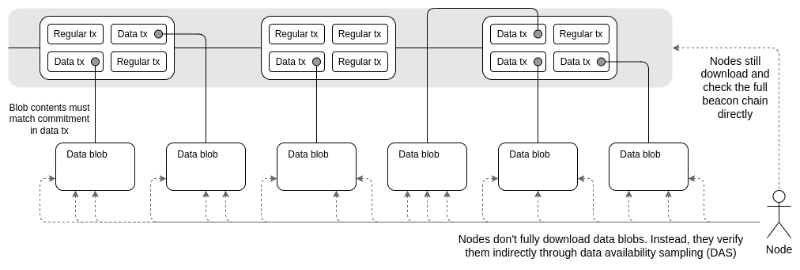
DAS (Data Availability Sampling) is an effective solution to blockchain state bloat. It enables lightweight clients to verify whether a block has been published by randomly sampling small portions of the block data. Because DAS allows parallelized verification of block data, even with a large number of data shards, the load on individual validators won’t increase. This encourages more participants to run validators, maintaining strong decentralization.
Ultimately, Danksharding enables centralized block production via PBS and decentralized validation via DAS, along with improved censorship resistance. This ensures Ethereum evolves into a scalable consensus and data availability layer capable of supporting a growing number of rollups on the execution layer. (Note: Centralized block production with decentralized validation aligns with Vitalik’s vision outlined in his “Endgame” post.)
Conclusion
I’ve always believed that Ethereum’s founding team is deeply principled, and many details suggest they remain committed to their original vision and continue moving forward steadily.
Among Ethereum’s numerous upgrades, three stand out to me: the Byzantium hard fork at block 4.37 million, the Constantinople hard fork at block 7.28 million, and the Istanbul network upgrade at block 9.069 million.
Interestingly, Byzantium, Constantinople, and Istanbul refer to the same city—one spanning Europe and Asia, bordered by the Golden Horn to the north, the Sea of Marmara to the south, and facing the Anatolian Peninsula across the water, connected to the mainland only on its western side. Napoleon once declared of this city: “If the world were a nation, its capital would surely be Istanbul.” This ancient city has formed a subtle connection with the blockchain world through Ethereum, and the naming of these three upgrades sends a clear message—Ethereum remains consistent and unwavering.
Perhaps Ethereum’s path toward modular blockchains won’t move quickly, but one thing is certain: whether it’s the overarching themes of The Merge, The Surge, The Verge, The Purge, and The Splurge—all aiming for 100,000 TPS—or specific key upgrades like Proto-danksharding and Danksharding—the ultimate goal remains the same: to fulfill Ethereum’s original ambition of becoming the “world computer.”
Join TechFlow official community to stay tuned
Telegram:https://t.me/TechFlowDaily
X (Twitter):https://x.com/TechFlowPost
X (Twitter) EN:https://x.com/BlockFlow_News






