








Insight into the Future: Celestia and Modular Blockchains
TechFlow Selected TechFlow Selected
Insight into the Future: Celestia and Modular Blockchains
A modular blockchain is a blockchain that separates the components of execution, consensus, and data availability.
 Navigating Web3 tides with focused insights
Author: RainandCoffee
Translation: 0xbread, TechFlow
Modular Protocols vs. Modular Software
Before diving into modular application-specific blockchains, it's essential to distinguish between modular protocols and modular software.
First, understand that a blockchain built using modular software is not necessarily a modular blockchain protocol. Blockchains constructed with modular software may still perform consensus, data availability (DA), and execution independently—meaning the protocol remains monolithic despite being built from modular components.
Examples of such chains include those built on the Cosmos SDK/Tendermint stack (e.g., Cosmos, Osmosis). While they are application-specific, they are not modular. Another example is the AVAX C-Chain, which handles all three layers—consensus, DA, and execution—on its own. So what makes a protocol modular rather than just an individual chain built with modular software?
Celestia addresses this issue by offering a truly modular protocol that only handles data availability (DA). Celestia’s design allows execution and settlement layers to securely anchor to its DA layer.
Are there other examples of modular protocols besides Celestia? Yes. Sidechains like Arbitrum and ZKSync are also modular protocols because they handle only execution and rely on another chain—Ethereum in these cases—for consensus, DA, and settlement.
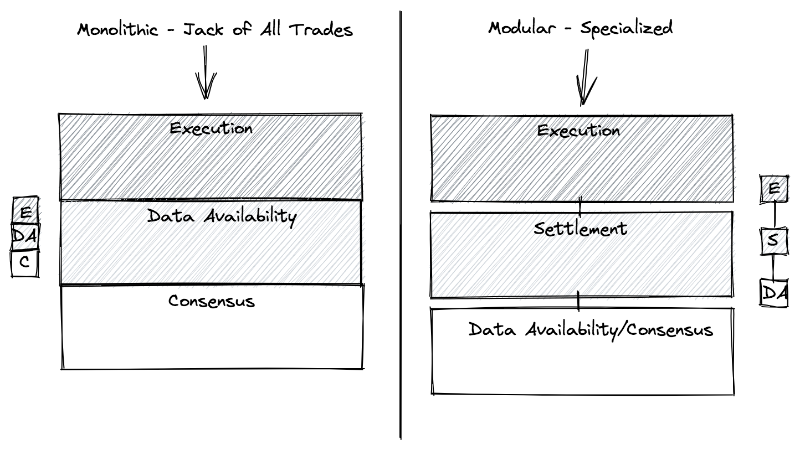
Monolithic vs. Modular Architectures
Today’s “modular-monolithic” chains divide the blockchain software stack into modular parts, while modular chains split the blockchain protocol stack into distinct, specialized layers. The reason for this shift is that growth becomes increasingly difficult in monolithic architectures as they become larger and more complex over time.
Modular Application-Specific Chains
To explain what a modular application-specific chain is, we’ll first examine how most existing blockchains operate, then look at how Cosmos enables building applications as sovereign chains, and finally explore the framework Celestia is developing for modular application chains.
Currently, most decentralized applications (dApps) are built atop existing blockchains like Ethereum using virtual machines such as the EVM. Until recently, this was the most practical approach. However, with the release of the Cosmos SDK and its consensus engine Tendermint, a new method emerged: sovereign application-specific chains.
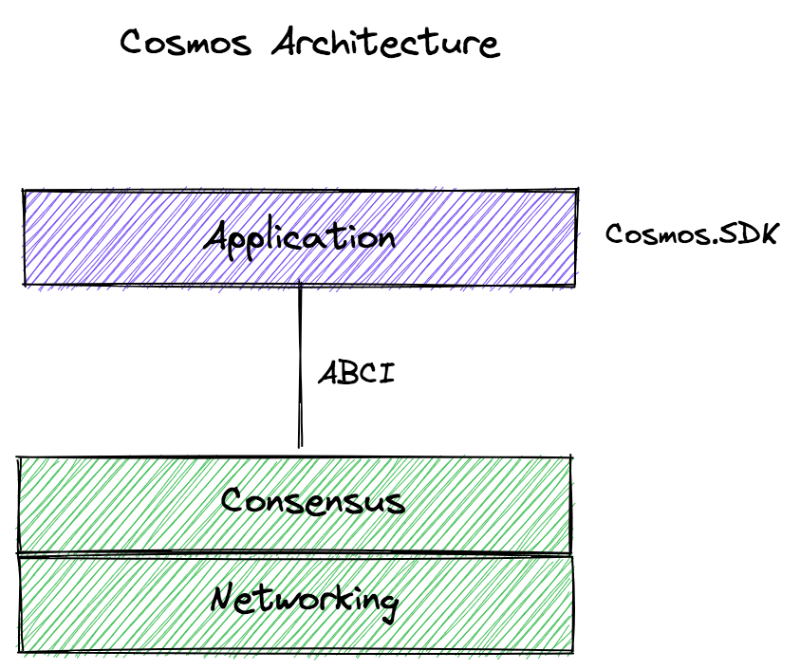
Cosmos Architecture
In Cosmos, instead of having a virtual machine where dApps are built on top, the application layer itself becomes part of the blockchain. This allows dApps to be developed directly as blockchains—what we call application-specific blockchains. By building your dApp as a sovereign blockchain, you define only the transaction types and state transition logic required for your specific use case. This ensures consistent finality across nodes, significantly improving speed and scalability.
Now, what advantage does Celestia offer? Celestia goes further by enabling modular application-specific chains. How do they achieve this? Celestia provides a dedicated data availability (DA) layer—including for rollups. It functions as a consensus and DA layer separate from execution, without offering on-chain smart contract environments like Ethereum. This means Celestia handles only consensus and data availability, while others can build their execution and smart contract layers on top. All upper layers must verify that their blocks are included in the Celestia DA chain, enabling high security with minimal trust assumptions.
Thus, we can conclude that modular blockchains result from separating the core components of a single blockchain—execution, consensus, and data availability—and running them on independent layers sharing a common DA layer.
Layering
Data Availability Layer
Data availability (DA) enables us to verify with high probability that all block data has been published by downloading only a small portion of it. A DA layer is necessary both to detect fraud and to reconstruct the entire chain history. Why is the DA layer important?
Because rollups depend on data availability for security. Similarly, cross-chain interoperability relies on light clients, which are typically insecure due to majority assumptions. However, Celestia’s DA light clients do not require such assumptions—they don’t validate transactions but only check whether each block has achieved consensus and whether data is available to the network—enabling secure cross-chain communication. The base layer (DA layer) guarantees message availability, not settlement or execution.
Settlement/Execution Layer (Rollups on Rollups)
The settlement layer for rollups is a chain where rollups have a trust-minimized two-way bridge via contracts on the settlement layer—similar to how rollups currently operate on Ethereum. This enables trust-minimized token transfers between a rollup and the settlement layer, or between rollups via the settlement layer.
As noted, most rollups today use Ethereum’s mainnet for settlement. However, Ethereum is not an ideal settlement layer for rollups because it shares resources with non-rollup applications executing smart contracts. Compared to a dedicated settlement layer, Ethereum is less specialized and has limited capacity. An ideal rollup-dedicated settlement layer would allow only its own smart contracts, simple bridging between rollups, and force non-rollup applications to run on execution layers.
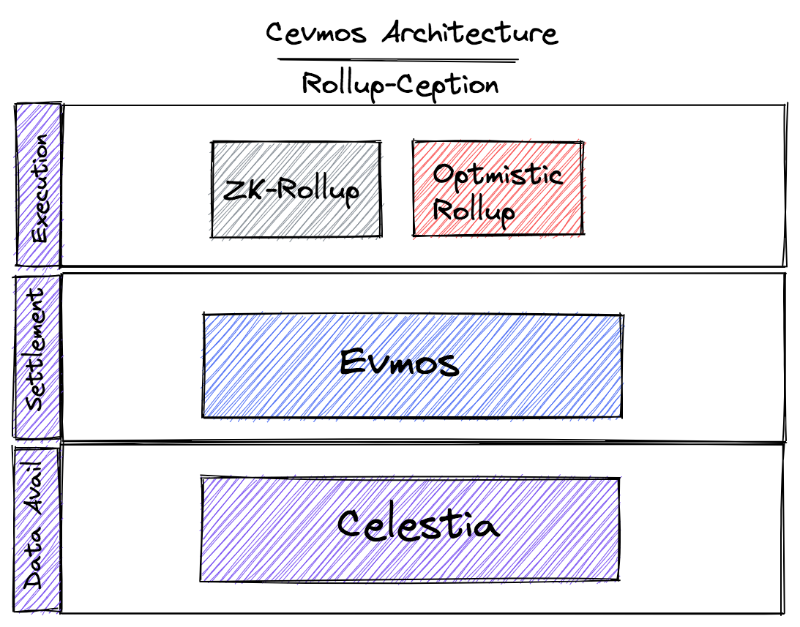
A settlement rollup would provide a low-overhead solution for execution rollups to bootstrap their networks, given the significant operational overhead involved in launching and managing rollups today. Transactions are executed by applications built on top, making them highly scalable—meaning the middle layer (settlement) could itself be a rollup hosting its own rollups.
In traditional blockchains, the consensus and execution layers reside on the same level and are handled by the same set of validators. In contrast, Celestia separates consensus and execution, allowing developers to deploy their execution layers atop Celestia’s data availability layer.
The execution layer will exist as independent blockchains, where teams can decide what to specialize and optimize for.
The execution layer will consist of various execution chains, whether EVM-based (on CEVMOS) or Cosmos SDK rollups. Rollups offer scalability for developers and users since protocols execute at Layer 1 scale.
Regarding Ethereum rollups, currently all rollups on Ethereum run contracts on Ethereum, where assets are settled at the settlement layer. Most rollups prefer this model if launching on another protocol. Cevmos (Celestia + EVMos + CosmOS) aims to enable exactly this.
Sovereignty
Another major advantage of modular blockchains is multi-sovereignty. With modular blockchains, governance can be isolated within your application and does not overlap with others. If your application encounters issues, governance can fix them without disrupting other applications in the cluster. Previously, if a decentralized application built on Ethereum was hacked and funds were stolen, recovery was impossible unless governance agreed. Fixing it required a hard fork of the entire chain. Hard forking away from Ethereum meant doing so permissionlessly, but users might avoid your fork due to lower security compared to the original. Forking the EVM also implies forking the consensus layer.
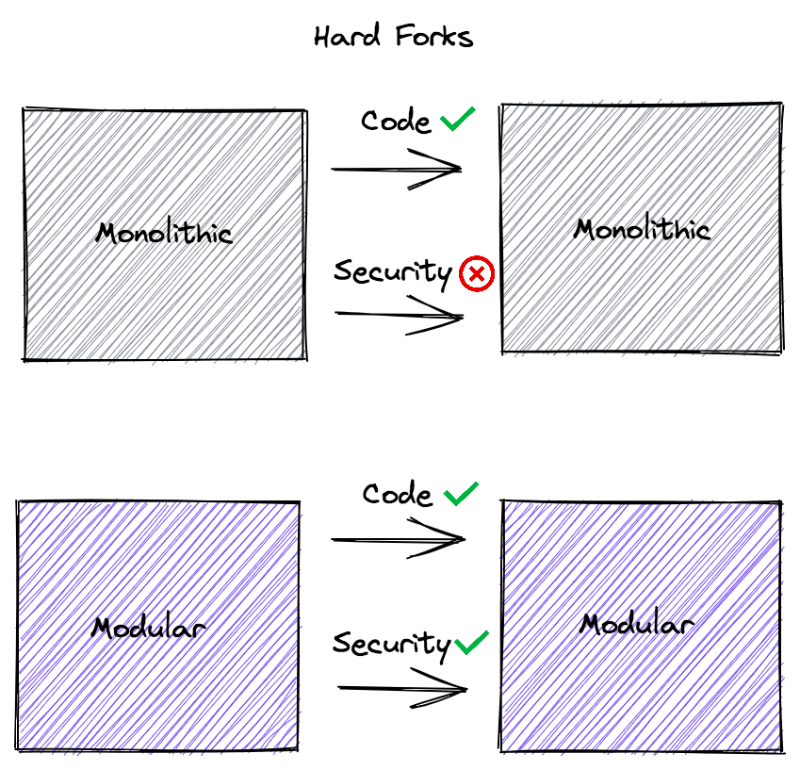
Hard Forking on Monolithic Chains vs. Modular Chains Without Forking Consensus
With Celestia, however, you can fork the rollup built on top. On Ethereum, you cannot fork a rollup unless the entire Ethereum chain is forked, because rollups use Ethereum as their settlement layer. On Celestia, rollups do not use Celestia for settlement, so multiple forks can coexist—encouraging experimentation and paving the way for new ideas.
Comparison
How do modular blockchains compare to monolithic ones? Consider non-modular blockchains built with modular software, such as Avalanche. In Avalanche’s case, subnets are independent chains without shared security—a new subnet must bootstrap its own consensus network.
All Avalanche subnets handle consensus, data availability, and execution independently, making them monolithic entities. True modularity comes from splitting functionality into separate layers.
Therefore, we can conclude that current chains built using certain modular software are not truly modular protocols but rather prototypes (Ethereum with rollups) or pseudo-modular systems (AVAX).
Conclusion
We can define modular blockchains as those that separate the components of execution, consensus, and data availability, whereas monolithic blockchains handle all three themselves. This means Celestia is a modular blockchain because it only handles DA, while rollups built on top manage execution and settlement. As a result, true modular chains enable:
-
Shared security
-
Launching new chains without bootstrapping a new consensus network
-
Scaling without increasing node requirements
Join TechFlow official community to stay tuned
Telegram:https://t.me/TechFlowDaily
X (Twitter):https://x.com/TechFlowPost
X (Twitter) EN:https://x.com/BlockFlow_News






