Gala Games: A New Web3 Gaming Aggregator Platform – How Traditional Game Developers Are Shaping a Steam for Blockchain Games?
TechFlow Selected TechFlow Selected
Gala Games: A New Web3 Gaming Aggregator Platform – How Traditional Game Developers Are Shaping a Steam for Blockchain Games?
Gala Games: The Steam Platform in the Web3 World.
 Navigating Web3 tides with focused insights
When it comes to blockchain gaming, Gala Games is undoubtedly a project we cannot overlook. Over the past few years, Gala Games has already delivered numerous surprises.
How Does Gala Games Work?
Gala Games is a blockchain gaming aggregation platform where games and in-game assets (NFTs) are issued on Ethereum. In the future, Gala Games plans to launch a dedicated public chain optimized for both game developers and players. Many compare it directly to Steam in the Web3 world.
According to OKLink data, thanks to the explosive growth of the Play-to-Earn model, the GameFi market saw a surge in daily active users in 2021. Riding this wave, Gala Games achieved significant progress during that year.
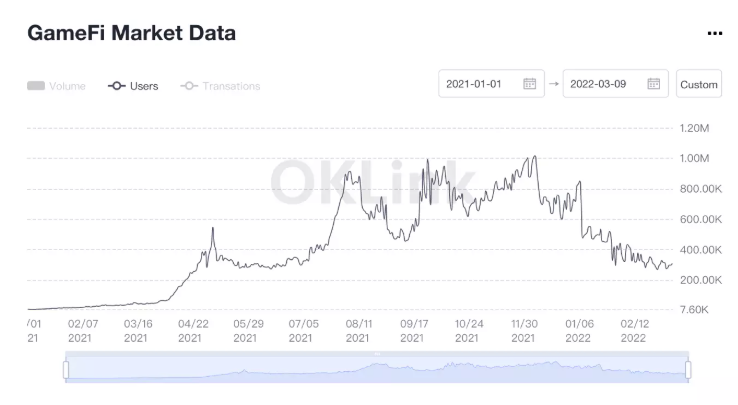
Official data from Gala Games shows that its monthly active users have exceeded 1.3 million, with over 26,000 NFTs sold. However, as the GameFi market cooled down, after reaching new highs, the GALA token price began a steady decline starting November 2021. Although GALA’s price performance appears strongly correlated with the broader GameFi market, Gala Games itself does not heavily emphasize P2E mechanics. As stated on their official website, Gala Games prioritizes “Fun First.”
They believe: "We believe the blockchain should be invisible in our games. We use simple game mechanics that all players can enjoy, whether or not they consider themselves to be blockchain pros." — meaning blockchain integration should enhance rather than dominate the gameplay experience.
Currently, Gala Games has confirmed eight upcoming games: Legends Reborn, Spider Tanks, Town Star, The Walking Dead: Empires, Mirandus, Legacy, Last Expedition, Echoes of Empire, and Fortified. These titles span multiple genres including card games, strategy, RPG, MMORPG, fighting, simulation, FPS, and tower defense (TD). Themes range from space and medieval fantasy to zombies, cyberpunk, adventure, casual farming, and more. Among them, the simulation game Town Star is already live via web browser. The remaining seven are in various stages of development, testing, or awaiting node voting approval.
This article will analyze Gala Games’ fundamentals and future potential through key aspects such as nodes, the GALA token, game content, team, competitors, and risks.
Nodes
The decentralized node network forms the foundation of Gala Games. Through Founder Nodes, users vote on which games should be launched on the platform. For individual games, Gala also implements specific game nodes—such as those for Town Star—to reduce server load.
The total number of Gala Games Founder Nodes is capped at 50,000. According to official figures, over 16,000 founder nodes operated by players are currently supporting the ecosystem's growth.
In essence, Gala Games acts as a central entity using distributed nodes to decentralize the entire gaming network. The core Gala Games team provides operational support, curation, marketing, maintenance, and development services—including updates to the Gala Games Network software—working alongside the community to drive long-term evolution.
As explained officially, the Gala Games node ecosystem consists of five components: the Gala Games entity, in-game NFTs, random allocation algorithms, public databases, and nodes.
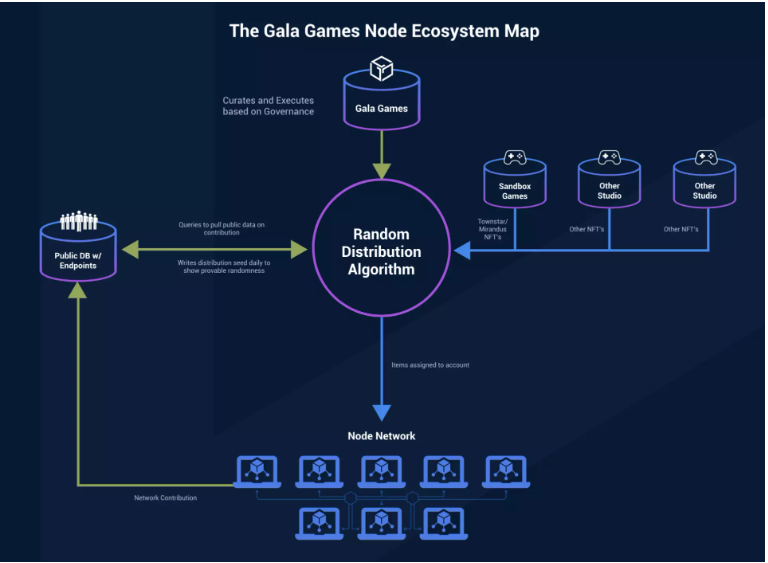
Gala Games Entity
The Gala Games entity oversees planning and execution related to game governance—such as deciding which games go live. Additionally, Gala Games aims to provide toolkits for studios to create and publish NFTs, fostering an open ecosystem welcoming more game developers. As per the official statement: “Gala Games aims to make it easy and fast for any company to add their game to the Gala Games ecosystem, using toolkits to generate standardized crypto packages, NFT libraries, and wallets integrated into their games.” The number of participating game studios thus becomes a critical indicator of Gala Games’ future growth potential.
Public Database
The Gala Games community has established a public database via GALABASE.io—an equivalent of a blockchain explorer. This database enables easier access for developer communities looking to participate in the Gala Games ecosystem, with game studios forming the primary segment of these developers.
Additionally, the public database supports the random distribution algorithm. Users can also check how different nodes contribute to the Gala Games ecosystem. However, testing reveals that GALABASE mainly functions for NFT queries, while information about node contributions remains relatively unclear.
Founder Nodes and NFTs
Benefits of becoming a Gala Founder Node include:
-
1. Voting rights on which games are launched on the platform;
-
2. Revenue sharing from Gala Games operations and specific games like Town Star;
Moreover, under the random allocation algorithm, new game NFTs are airdropped to founder nodes. These NFTs are provided by game studios and traded within the Gala Games store.
Besides voting rights, although running a Gala node requires hardware like computers, the actual required contributions remain vague, with limited transparency. Also, the last update on active node data in the database was three months ago.
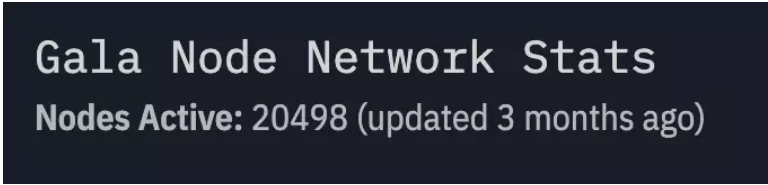
It may only be when more games launch that the full functionality of Gala founder nodes becomes evident.
A node owner known as @Alchemist noted: “Node sales are essentially a disguised fundraising method. The project team admitted selling nodes helps avoid U.S. regulatory scrutiny. With around 10,000 nodes still unsold, how much could they raise? Approximately $750 million.”
GALA Token
GALA is the native utility token of the Gala Games ecosystem, initially built as an ERC-20 token but now cross-chain compatible with BSC. Total supply is capped at 50 billion, with approximately 6.98 billion currently circulating. As of now, GALA has a market cap of $1.7 billion, ranking #63 globally.
Notably, GALA did not conduct an ICO and is listed on major exchanges including Binance, Coinbase, Crypto.com, OKX, Kucoin, Gate.io, and Uniswap, offering trading pairs such as GALA/BNB, GALA/USD, GALA/USDT, and GALA/ETH.
Node operators earn daily points by running their node for at least six hours, which can then be redeemed for GALA token rewards. The more points accumulated, the larger the share of daily GALA distributions. Additional points are awarded for inviting new users to join or operate nodes for over six hours.
Every July 21st, the amount of GALA distributed is halved—reducing inflation over time but increasing payback periods for new node investors. Importantly, Gala Games has raised no external funding; instead, founder nodes effectively act as early investors. Through node sales, Gala Games has already secured sufficient capital for long-term sustainability. According to TokenUniverse, as of January 11, node sales generated $510 million plus 8,681.8 ETH in revenue.
Another revenue stream comes from Gold Membership subscriptions. Gold Members receive benefits such as priority information access, exclusive NFT drops, and early entry into game tests.
GALA serves as the primary payment medium across the Gala Games ecosystem—for node purchases, Gold Memberships, and NFT transactions in the marketplace. This gives GALA strong real-world utility. In the future, once Project GYRI (Gala’s own blockchain initiative) launches, GALA may also serve as gas for transactions.
Beyond being a transactional currency, GALA tokens represent a key mechanism for early investors—especially founder node holders—to recoup their initial investment.
If GALA fails to meet price expectations, return-on-investment timelines lengthen, discouraging new participants from purchasing nodes, ultimately threatening Gala Games’ ability to fund ongoing operations. That said, current finances remain healthy. On February 8, Gala Games announced plans to allocate $5 billion over the next year toward expanding its NFT offerings: $200 million for gaming NFTs, $1 billion for music NFTs via studio partnerships, $1 billion for film NFTs, and $1 billion for Gala Theme Park NFTs.
Node growth will remain a crucial KPI. Only by continuously growing its internal ecosystem and boosting investor confidence in GALA’s value can Gala attract more nodes and players—a virtuous cycle.
Games
Town Star
Currently, Town Star is the only fully launched game on Gala Games (Spider Tanks remains in testing). Town Star is a web-based Play-to-Earn blockchain game.
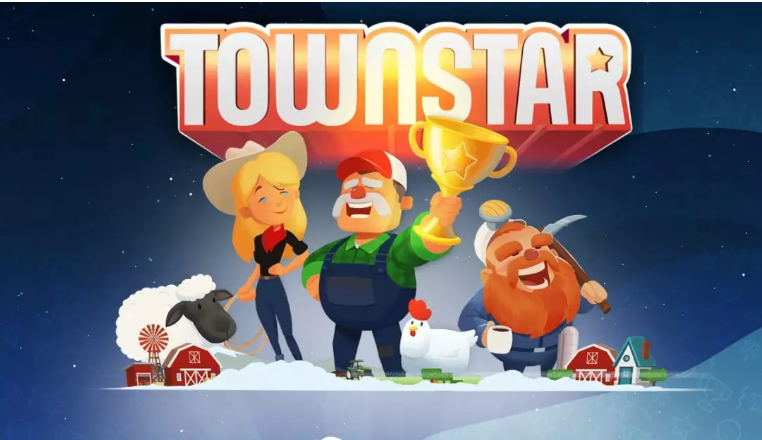
It’s a simulation management game where players build farms, ranches, lumber mills, factories, hire workers, process goods, and sell resources to grow a dynamic town. Despite being browser-based, the game features deep mechanics and allows free access without entry barriers.
For typical GameFi players, Town Star presents a steep learning curve. While less complex than traditional simulators, mastering workflows demands time and effort.
Players must first understand worker roles, material costs, and infrastructure needs, balancing expansion until resources support oil refinery operations. Gasoline is the most critical resource, needed to power vehicles that transport goods for profit. It cannot be bought—it must be produced in refineries. If gasoline runs out and production halts, the game enters a death spiral—forcing a restart.
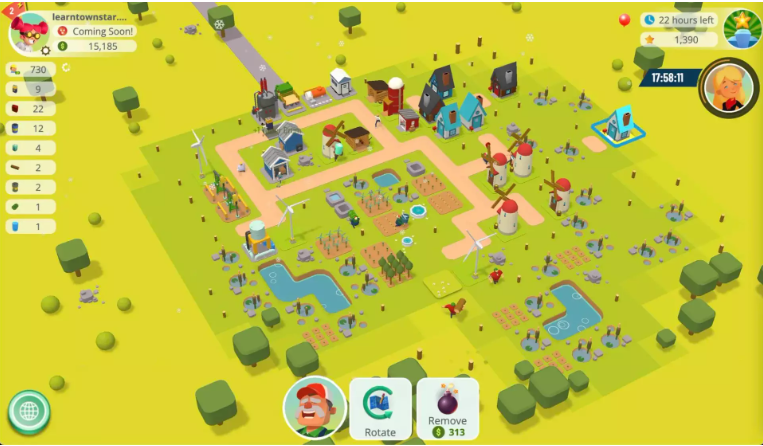
Town Star’s Play-to-Earn model differs from conventional GameFi designs rooted in gamified DeFi. Traditional GameFi blends NFTs and fungible tokens (FTs), often prioritizing financial incentives over gameplay. In contrast, Town Star embodies Gala Games’ “Fun First” philosophy, emphasizing player enjoyment—even if immediate profits are limited.
Key P2E elements in Town Star include:
-
Daily Challenges: Complete tasks to earn token rewards;
-
Gala Power: Encourages holding both GALA and TOWN tokens—the more held, the higher the Gala Power level, leading to more NFTs earned in Town Coin;
-
Season Pass: Players complete missions within a timeframe to earn TOWN token rewards.
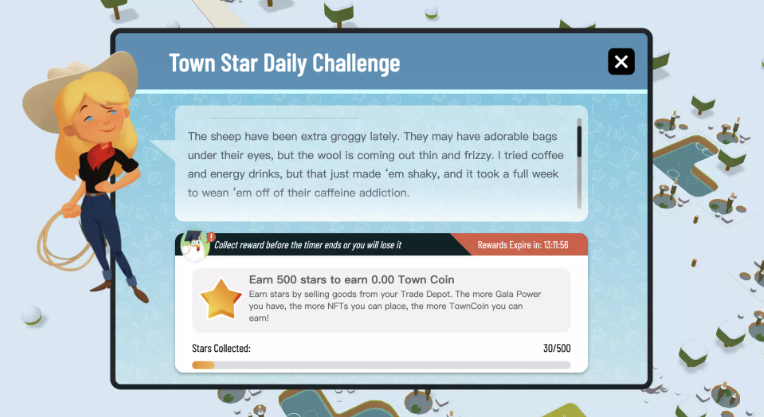
Additionally, paid NFTs boost earning efficiency and are freely tradable in the marketplace. Players can buy rarer NFTs in the Gala Games store—the rarer the NFT, the higher the TOWN generation rate.
TOWN tokens, earned either through gameplay or third-party exchanges, serve three main purposes:
-
Purchase exclusive NFT items in TownCoin;
-
Upgrade in-game perks and features;
-
Holding TOWN increases your Gala Power level.
Aside from playing the game, another way to obtain TOWN tokens is by operating a Town Star node. Node operators receive TOWN as a reward for maintaining the network.
From Town Star, we see Gala Games’ vision for its game ecosystem: moving toward a model where “casual players enjoy the game, professional players earn bounties”—closer to Contest-to-Earn than pure Play-to-Earn.
This further explains why Gala Games is seen as a Web2.5 product. A fun game appeals beyond crypto natives, drawing in mainstream players—bridging Web2 and Web3. Moreover, non-crypto users can register via email to create a wallet (still requiring seed phrase backup), eliminating the need to download MetaMask or similar tools—lowering the barrier to blockchain adoption.
Gala Games Ecosystem NFT: VOX
VOX NFT is an ecosystem-wide NFT on Gala Games, with an initial mint of 8,888 units. VOX NFTs can be used across Gala Games titles—for example, staking in Town Star yields TOWN token rewards.

Following the MMORPG-inspired Mirandus, the second series of VOX Collectibles: Mirandus has already been released.

In the future, upon launching the Gala Games Metaverse, VOX NFTs will function as avatars. Metaverse participants will also earn VOX Coin through VOX NFTs, usable within the metaverse or exchangeable for other cryptocurrencies.
Founders and Team
According to Gala Games’ Medium introduction, the company was founded by Eric Schiermeyer (co-founder of Zynga), Wright Thurston (an early cryptocurrency miner and holder of multiple blockchain patents), and Michael McCarthy (creative director behind hits like Farmville 2).
Eric Schiermeyer serves as CEO. Before founding Gala Games, he co-founded Zynga, which released popular web and mobile games such as Farmville, Farmville 2, and Zynga Poker.

To simplify, think of Farmville as Facebook’s version of the once-popular QQ Farm in China. Farmville 2 is the 3D sequel. Zynga Poker is a mobile poker game based on Texas Hold’em.
While Eric lacks experience in developing large-scale AAA games, his strength lies in marketing—evident from Farmville’s success. Given that blockchain gaming is still in its infancy, lightweight games like these have room to thrive before heavier AAA titles adapt successfully.
Other key members include John Osvald, Head of Game Development, who previously worked at Zynga and EA, focusing primarily on mobile game design. T. Elliot Cannon served as Director for Town Star, bringing 27 years of industry experience designing major titles like Unreal Engine, Unreal Tournament, Crysis, and Doom. As of February this year, he has begun working on Gala Games’ next title.

Additional Information
Gala Music
Gala Music aims to build a decentralized music network better suited for artists and fans. It will expand its reach through node sales, allowing node operators to stream song NFTs. Listeners, node operators, NFT owners, and artists all earn rewards—essentially creating a Listen-to-Earn model. Project GYRI will play a vital role in supporting this initiative.
Gala Music has already partnered with Snoop Dogg.
Recent Gala News
-
Project GYRI, Gala’s ecosystem blockchain, will launch in the coming weeks;
-
Gala Games is collaborating with the GRIT team to release GRIT: A Wild West Royale, a Western-themed battle royale game.
Social Media Metrics
-
Twitter Followers: 328.2K
-
Discord Members: 148.8K
Short-Term Growth Catalysts
-
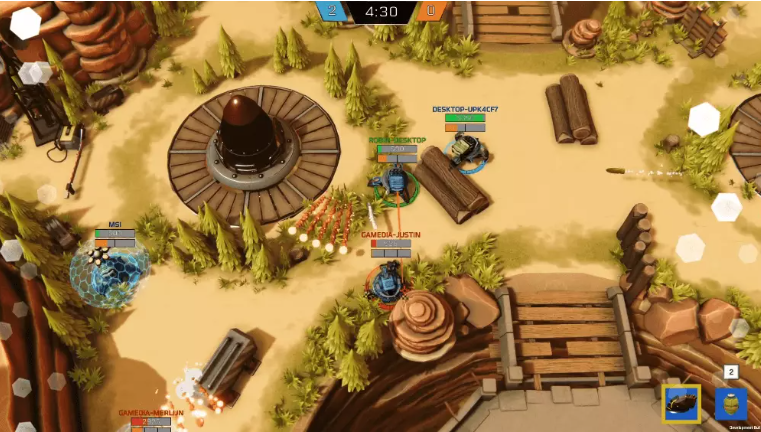
Launch of Spider Tanks
-
Launch of Project GYRI blockchain
Competitive Landscape
As a gaming aggregation platform, Gala Games faces several competitors—most notably Axie Infinity, which pioneered the GameFi Play-to-Earn trend, and Immutable X, focused on building NFT Layer2 infrastructure.
Comparison with Axie Infinity
To address Ethereum’s scalability issues and high fees, Axie Infinity built Ronin, a sidechain for gamers. Beyond solving Ethereum’s limitations, Ronin integrates fiat gateways for seamless deposits and withdrawals. Thus, Ronin is foundational to Axie Infinity’s success.
As Play-to-Earn momentum faded, Axie Infinity shifted focus toward Ronin’s development rather than exploring new game mechanics. With the launch of Katana, a decentralized exchange on Ronin, investor attention moved from GameFi to DeFi. Katana added utility to SLP (Axie’s reward token)—by providing liquidity (SLP/ETH), users could mine RON, Ronin’s native token. On December 3, 2021, Ronin reached a record $1.5 billion in TVL.
However, under Proof-of-Authority (PoA), Ronin remains relatively centralized. Sky Mavis intends to introduce more games only after Ronin matures further.
Unlike Axie, Gala Games’ upcoming Project GYRI is designed specifically for game developers’ unique needs. As the team states: “We’ve never wavered from our stance: ‘Games first, blockchain second.’”
Furthermore, with eight games in parallel development, Gala Games’ ecosystem is poised to become highly competitive. Quantity breeds quality—and one of these projects might rise from obscurity to challenge Axie Infinity’s dominance.
Comparison with Immutable X
Like Project GYRI, Immutable X is a Layer2 solution tailored for games and NFTs.
Immutable X targets major pain points in today’s Ethereum NFT ecosystem:
-
Scalability;
-
Long confirmation times (transactions take minutes);
-
Gas fees;
-
Liquidity (most NFTs never trade);
-
Developer experience (teams spend too much time on tech instead of innovation);
-
Environmental impact (a barrier to mainstream adoption).
These are pressing needs in the current NFT market. To address them, Immutable X partners with StarkWare, leveraging ZK-Rollup technology to build an NFT-friendly Layer2.
While Immutable X aims to inherit Ethereum’s NFT ecosystem, reality dictates that only substantial incentives attract lasting liquidity. Early growth relies heavily on foundation grants. Only when top-tier blockchain games emerge on Immutable X will it achieve sustainable development.
This highlights a key difference in strategy. Gala Games resembles a Web2.5 product—a hybrid of centralized control and decentralized nodes, grounded in gaming, evolving tools and infrastructure for developers.
Compared to Immutable X, it’s hard to declare a clear winner—but from a gaming perspective, Gala Games’ operational and marketing approach has clearly succeeded. Meanwhile, Immutable X must wait for organic growth after launching its infrastructure.
Risks
First, unlike many Web3 projects, Gala Games has not open-sourced its codebase or whitepaper. It operates more like a Web2 company, where opacity and semi-centralization may dampen enthusiasm among crypto-native investors.
Second, current Gala Games titles fail to satisfy crypto players’ income expectations. Take Town Star: while other GameFi games offer ROI within days, weeks, or months, Town Star’s payback period exceeds one year. Small-scale games struggle to maintain immersion, making long-term engagement difficult. Future titles may resolve this issue.
Third, there’s uncertainty around whether Project GYRI will meet developer expectations. If Project GYRI underperforms, it could deter future developers—posing a serious threat to ecosystem growth.
Conclusion
At its core, Gala Games’ success stems directly from its founders’ extensive experience in game development and marketing, which has profoundly influenced node sales and game operations.
Users drawn by Gala Games’ titles tend to stay engaged within its community and social platforms, ensuring rapid user acquisition for new game launches. As the primary transactional token within the ecosystem, GALA benefits from diverse use cases—from node purchases to NFT trading—gaining solid support from active users. Furthermore, Gala NFTs exhibit stronger liquidity compared to others, as they’re interoperable across multiple games within the ecosystem.
Join TechFlow official community to stay tuned
Telegram:https://t.me/TechFlowDaily
X (Twitter):https://x.com/TechFlowPost
X (Twitter) EN:https://x.com/BlockFlow_News