BAC Games: An Initial Exploration of Social Gaming Products Tailored for Web3 Users
TechFlow Selected TechFlow Selected
BAC Games: An Initial Exploration of Social Gaming Products Tailored for Web3 Users
It's not that AAA games are unaffordable—it's just that social games offer better value for money.
 Navigating Web3 tides with focused insights
Authors: Xingye, Gua Ge, Guatian Lab
Preface
With the official U.S. approval of spot Bitcoin ETFs, the crypto market has rebounded over the past four months, driving BTC from 16,000 USD at the beginning of the year to around 40,000 USD today. A new bull market is now widely accepted. During this period, three major drivers have led the current bull run: inscriptions, the Bitcoin ecosystem, and blockchain gaming.
What new narratives and opportunities will blockchain gaming (or Web3 gaming) bring in this bull cycle?
I. Three Years of Blockchain Gaming
The story of blockchain gaming may begin in early 2021. Today’s experts generally agree that DeFi was extremely hot back then, attracting significant external capital. For non-professional users outside the crypto space, games appeared to be a more accessible entry point. Thus, early blockchain games were essentially DeFi wrapped in game-like interfaces—DeFi economic models enhanced with "metaverse" storytelling.
Perhaps coinciding with the previous bull market frenzy, blockchain gaming sparked a wave of excitement across the entire crypto community. Users rushed to join new games as quickly as possible. Never played before? Not interested in games? None of that mattered—the gameplay often involved just clicking a few buttons daily while generating substantial profits.
During the bull market, almost any economic model seemed viable. However, pure Ponzi schemes inevitably spiral into collapse. The two black swan events of 2022—Luna and FTX—delivered harsh lessons to newcomers. Even when projects continued using similar strategies, without the bull market's momentum, most products saw drastically shortened lifespans.
As a result, project teams began trying to win back crypto users through improved game quality and playability. "Our game quality far exceeds Axie Infinity, so we’ll definitely outperform them and earn even more," confidently claimed many project founders in 2022 who came from traditional Web2 gaming backgrounds. They hoped superior game design would deliver a decisive blow to GameFi 1.0 projects. Yet, up to now, no Web3 game has surpassed Axie or StepN in popularity. Perhaps the perfect alignment of timing, conditions, and opportunity hasn’t occurred yet—the next breakthrough might come during the 2024–2025 bull market.
To players’ relief, in 2023, well-funded and experienced traditional Web2 studios finally entered the space. These teams brought not only high-quality games under major IPs but also represented established game industry players testing the waters in blockchain gaming. Notable examples include Matr1x, Seraph, Metalist, Metacene, Crystal Fun (Outer), among others.
Industry insiders refer to these projects—backed by both capital and professional expertise—as Web2.5 blockchain games. Unlike purely Ponzi-based GameFi 1.0 projects, Web2.5 games represent a leap forward in gameplay quality and production value. Their strategic, long-term NFT asset management has also strengthened consensus among Web3 users.
II. Is Matching Traditional 3A “High Playability” the Only Way Forward?
Undeniably, improving product quality is an inevitable evolution for the blockchain gaming sector, given how low the actual playability was in earlier iterations. Without profit incentives, neither gamers nor Web3 users would likely experience dopamine spikes playing those GameFi 1.0 products.
But is aiming for traditional 3A-level playability the only viable path forward for blockchain gaming today? Will current Web3 gaming users embrace it?
Let’s first profile who currently plays Web3 games—understanding user characteristics is essential before developing any product. Only someone like Steve Jobs at Apple could confidently assume they can shape user desires regardless of current preferences.
After two long years of bear market, those still active in Web3 gaming are mostly seasoned veterans ("old degens"). If you tell them to spend countless hours grinding a blockchain game with no profit potential, they’d respond: “Why should I play? If it’s about fun, I’d rather play Genshin Impact or Palworld.” To these veterans, a high-quality blockchain game doesn’t primarily mean better gameplay—gameplay is just the surface. What truly matters is that such a project implies strong funding, capable teams, and technical competence—a signal of “value investment” in the blockchain gaming space.
Most users don’t necessarily believe big-budget productions will attract large numbers of outsiders. Instead, they think: a high-budget team must have invested heavily, so they probably aren’t just after my small stake. This indirectly suggests that because significant resources have already been spent on development, the likelihood of the team abandoning the project is lower.
The vast majority of veteran users are here to make money.
What about new users? Since the bull market has just started, there hasn't been a massive influx of new entrants yet—hard to define precisely.
Another unresolved issue: large institutional players ("crypto whales") won’t spend much time actually playing games. As a result, big capital can only participate via asset purchases, unable to engage deeply in game mechanics. Wealthy investors prefer staking their funds in DeFi protocols rather than immersing themselves in gameplay. Most in-game activity thus revolves around small-scale PVE farming or peer-to-peer competition, limiting each game’s sustainability to factors like new user acquisition speed, project treasury size, and ability to attract external capital.
Therefore, we must acknowledge: current Web3 gaming user demographics largely overlap with general crypto users—all primarily motivated by profit, not genuine gaming interest. Hence, increasing playability may not directly satisfy existing Web3 gaming users’ needs. Their logic goes: high playability → strong project backing → early participants are likely to profit.
Moreover, enhancing playability sounds simple but requires massive spending—teams of dozens plus extensive outsourcing lead to huge upfront costs. More awkwardly, since most Web3 gaming users aren’t true gamers, they may not appreciate millions spent on UI or artwork. Project teams hope polished production signals “this is a value investment,” but users lack the judgment to recognize it! When creators and consumers operate on different wavelengths, it creates an awkward mismatch—like a man who escorts a woman home, and when she invites him in for tea, he declines, saying, “No thanks, I’ve had too much tea already…”
Are there alternative paths beyond playability improvements to capture both veteran and new users? Yes—socialization! In 2024, the casual game series BAC Games arrives with the philosophy: “Playing Web3 games means playing socially.”
III. “Strong External Socialization” as the Breakout Path
Socialization in gaming differs from traditional social concepts. In games, socialization means bringing people together through game mechanics. Early collaboration on shared tasks builds chemistry; conversations expand beyond the game; emotional connections form—eventually reaching a state where “the game may no longer be fun, but the friends still are.” The game becomes the medium connecting these individuals.
Web3 games have unique advantages in fostering socialization. Most Web3 users work remotely, often isolated in rooms, interacting mainly with delivery riders—psychologically craving social connection.
So what happens when deep social interaction is integrated into blockchain games—multiple players discussing, deciding, celebrating, and fighting together in nation-wide battles?
-
First, rational, profit-focused blockchain gamers gradually transform into emotionally driven participants. “Our alliance got attacked—let’s upgrade gear and fight back together!” At this point, who cares if the payback period slows down?
-
Second, interpersonal conflicts and disagreements within groups create friction in output, thereby extending token sell pressure timelines.
Are there such games already?
IV. BAC’s Innovative Social Gameplay
BAC, a blockchain game centered on social interaction—specifically “strong external socialization”—is built around a core model called “Group to Earn.” Just as the protagonist in *Ready Player One* couldn’t succeed without his loyal teammates risking everything, BAC embodies the motto: “No brothers, no glory.” Based on available information, here’s how BAC implements its social concept:
Tightly integrated with Blast, an EVM Layer-2 chain (https://blast.io/, founded by the Blur team and funded by Paradigm), the name itself is a clever double entendre: “Blast Auto Clubs,” Chinese name “Kuangbiao Automobile Club,” but could also be interpreted as “Automobile Club on Blast.”
Blast’s team clearly understands social dynamics. Their innovation of “group staking ETH for airdrops” directly addresses a key pain point. Since November last year, when Blast launched staking, recruitment for staking groups spread everywhere.
BAC Games is a collection of casual games, with the first titled simply BAC. Its economic model is uniquely designed as “Group to Earn”: users must join an automobile club to share profits, with clubs functioning similarly to alliances in traditional online games.
The integration strategy is clever: BAC directly airdrops VeTokens to users who have staked ETH on Blast. These VeTokens can be used in-game to upgrade character NFTs and establish clubs. This grants liquidity to otherwise idle ETH locked in Blast: “You’re getting free tokens anyway—why not play?” Since Blast already has staking groups, why not bring your group members along?
In a prior English AMA, the team emphasized: “Early users must profit—that’s how we generate initial traction. Social features cannot thrive without sufficient user base.”
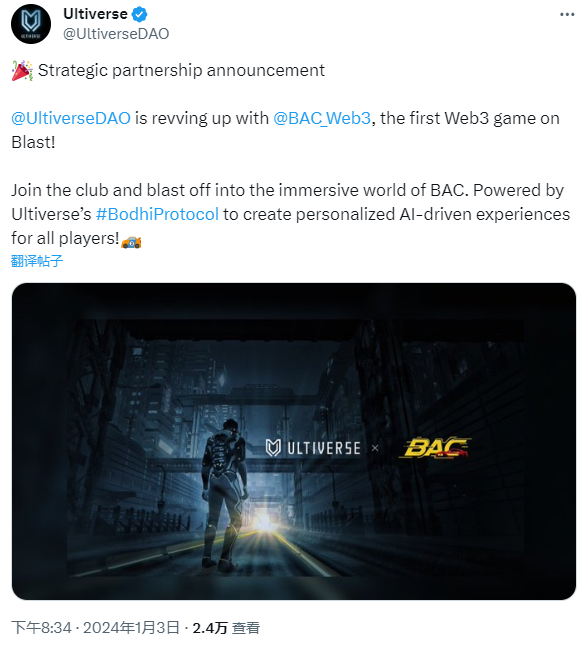
From a joint tweet released on January 3, 2024 by Ultiverse and BAC Games, it’s clear BAC Games is a flagship project promoted by Ultiverse. Well-known to many, Ultiverse has raised $9.5 million from top-tier institutions including Binance and Sequoia Capital. With recent expectations of token listings and airdrops, its Electric Sheep NFTs have performed exceptionally well, surging in price. Moonlight, Ultiverse’s community lead and a gold-medal host on Binance Live, is one of crypto’s top KOLs. In a recent BAC AMA, it was revealed that Moonlight has become an ambassador for BAC Games, actively promoting it across Chinese and English AMAs.
To date, no official statements have disclosed the relationship between BAC Games and the Blast team. Official updates are expected later. However, BAC Games’ launch timing closely aligns with Blast’s mainnet release, making it highly likely that BAC will be Blast’s first blockchain game.
Now let’s examine the publicly available V1 version economic model:
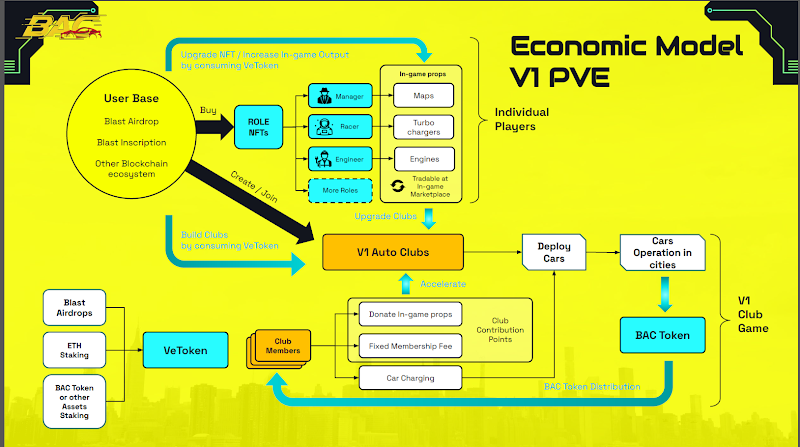
The above illustrates the game’s V1 (PVE) version. The main flow involves users purchasing mystery boxes to randomly obtain one of three types of character NFTs, each producing different materials. Users then join an automobile club, contributing their generated materials to build cars. Once produced, these vehicles are deployed to various cities as Uber drivers, generating revenue (BAC tokens) for the entire club. BAC tokens are automatically distributed to members based on individual contribution scores.
Notably, the aforementioned VeToken is used for building clubs and upgrading character NFTs. Initially, only users who staked ETH on Blast will hold VeTokens. Reportedly, over $1.3 billion worth of ETH is already staked on Blast, meaning the game empowers this substantial user base. Consequently, BAC starts with a vast built-in audience from Blast.
V1 is expected to launch alongside Blast’s mainnet in February–March 2024. Prior to that, a 300-player closed beta test will occur. Currently, BAC’s Discord community is intensely competing for beta whitelist spots, which will convert into guaranteed minting rights for genesis character NFTs.
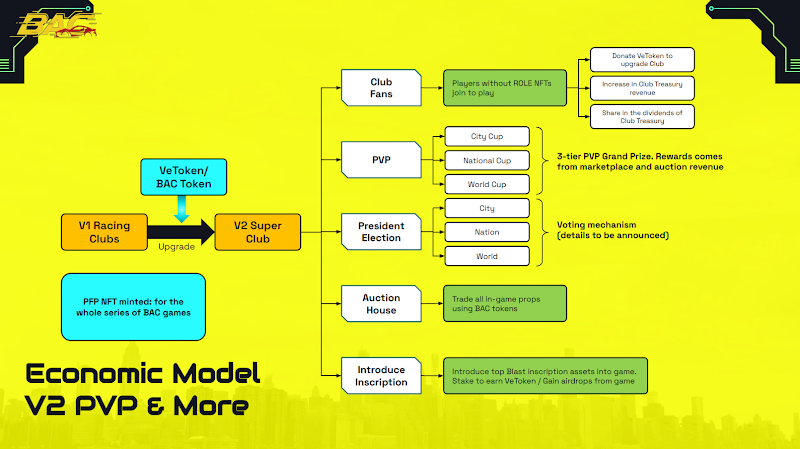
The image above outlines BAC’s V2 version, adding fan engagement, elections, auctions, and even inscription assets on top of three layers of PvP gameplay. V2 is scheduled for Q2 rollout. Blue boxes in the diagram indicate future avatar NFT releases, representing the highest tier of utility across the entire BAC Games series.
V. Blockchain Gaming Tailored for Web3 Users
Through conversations with the project team, it’s evident that BAC Games has a clear vision:
- First: the majority of current Web3 gaming users are best suited for light, casual games;
- Second: quickly引导 users into social scenarios to build community consensus.
Accordingly, BAC’s economic model features two striking innovations: a bridging model + “Group to Earn”—a user-acquisition approach reminiscent of Blast’s own “carpool staking” mechanism, both solving real pain points effectively.
“It’s not that 3A games are unaffordable—it’s that social games offer better ROI.” In 2024, the blockchain gaming landscape is blossoming. While leading projects compete on game quality and playability, lighter alternatives like BAC Games—with nimble mechanics focused on casual competition and social elements—may forge their own distinct path. We shall see.
Join TechFlow official community to stay tuned
Telegram:https://t.me/TechFlowDaily
X (Twitter):https://x.com/TechFlowPost
X (Twitter) EN:https://x.com/BlockFlow_News
 瓜田实验室W Labs