Web3 Social, Still Dominated by Chinese
TechFlow Selected TechFlow Selected
Web3 Social, Still Dominated by Chinese
Decentralized social media has a new dominant player, and they all speak Chinese.
 Navigating Web3 tides with focused insights
Author: David, TechFlow
Within two days, two decentralized social protocols changed hands.
On January 20, Lens Protocol announced it would be taken over by Mask Network. On January 21, Farcaster announced it had been acquired by Neynar, one of its clients.
Together, these two protocols have raised over $200 million. Farcaster was valued at $1 billion last year, backed by investors including a16z and Paradigm. Lens is supported by DeFi giant Aave.
Now, both founding teams have “stepped back from day-to-day operations to work on new projects.”
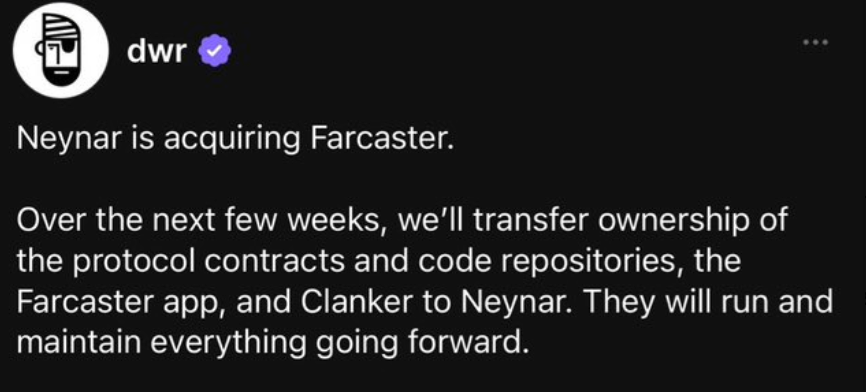
Adding Steem—an earlier notable project acquired by Tron in 2020—two out of the three most prominent decentralized social protocols have now been taken over by Chinese teams.
You may have forgotten Steem—it launched in 2016 as the pioneer of "writing-to-mine," once the benchmark project in the Web3 social space. After being acquired by Justin Sun, the community forked and left entirely. More on that later.
Mask Network, which took over Lens, was founded by Suji Yan, a Chinese entrepreneur who dropped out of UIUC at age 20 to start up. He previously wrote for Caixin and Jiemian.
He founded Mask in 2017 with the goal of adding Web3 features on top of traditional social platforms like Twitter.
In recent years, Mask has been on an acquisition spree: in 2022 it acquired two large Japanese Mastodon instances, last year it bought Orb—the most active client on Lens—and now it has taken over Lens itself.
Suji Yan describes his mission as building “Tencent of Web3.”
As for Farcaster, the acquiring company Neynar was founded by two Indian-American former Coinbase employees. Still, the fact remains: two out of the three major decentralized social protocols are now under Chinese leadership.
Why Chinese teams?
One possible explanation is capability. The two countries with the most successful track records in social products are the United States and China. WeChat, TikTok, Xiaohongshu—Chinese teams have proven they can build social apps that reach billions of users.
But this reasoning has flaws. Building consumer products isn't the same as acquiring protocols. Protocols are infrastructure—they don’t directly serve users. You can build products on top of them, but the protocol itself doesn’t deliver user experience.
A more plausible explanation is price.
Look at Justin Sun’s acquisition history: $140 million for BitTorrent in 2018, Poloniex in 2019, Steemit in 2020, HTX in 2022.
These targets share one thing in common:
They were once great, but already declining. BitTorrent pioneered P2P file sharing, Poloniex was once a leading U.S. exchange, HTX was once among China’s top three exchanges.
Justin Sun didn’t buy the best—he bought good assets at rock-bottom prices.
Farcaster is now valued at $1 billion, yet monthly revenue has fallen to just $10,000—down over 95% year-on-year. Founder Dan Romero recently admitted, after four and a half years of trying a “social-first” approach, “it didn’t work.”
Lens has only 50,000 monthly active users. The Aave team wants to offload it to focus on their core DeFi business.
Their peak value is behind them—but the technical foundation and brand equity remain. In A-share market terms:
They’ve fallen into value territory.
There's also a subtler mindset difference: in the West, decentralized social is ideology; in China, it's business.
Western founders in this space carry idealism. Users should own their data. Social graphs should be portable. Platforms shouldn’t have censorship power... Farcaster’s slogan is “able decentralized,” Lens calls itself “user-owned social.”
After five years, users don’t care.
Ordinary people don’t care who owns their data or whether their social graph is portable. They care whether there are people to talk to, interesting content, and assets that might skyrocket.
Chinese buyers stepping in marks a shift—from idealists to pragmatists.
Suji Yan says Mask’s goal is to “bring decentralized social from the lab into daily life.” In other words:
Stop talking about ideals—first make people actually want to use it.
Of course, the last time a Chinese team acquired a decentralized social protocol, it didn’t end well.
In 2020, Justin Sun acquired Steem. After completing the purchase, he teamed up with exchanges to seize control of Steem’s governance. The original community responded by forking the chain into Hive, using code to blacklist Justin Sun’s wallet.
Forking is the most extreme form of protest in blockchain: we’re not playing with you anymore—we’ll copy everything and leave.
Steemit still runs today, but most active users long ago migrated to Hive.
So the question arises: will this time be different?
Mask’s takeover of Lens is officially framed as “stewardship”—positioning itself as a caretaker rather than an acquirer. Founders will remain as advisors, and the protocol will stay open.
But the very fact that a “decentralized protocol” can be taken over reveals something. Contracts can be transferred. Code repositories can be handed over. Apps can change ownership. Where, then, is decentralization?
Once demystified, decentralization is just a technical architecture—not a business model. Technically decentralized doesn’t mean no one controls things commercially.
After Lens changed leadership, Vitalik posted a message. He noted that every piece of content he published in 2026 was sent via Firefly—the multi-platform client under Mask Network.
He added: “If we want a better society, we need better tools for mass communication.”
That’s true. But decentralization doesn’t answer who builds these tools, who operates them, or who decides what they become.
Right now, the answer might be: Chinese teams.
Then again, maybe nothing will happen. After all, active users are already few.
Join TechFlow official community to stay tuned
Telegram:https://t.me/TechFlowDaily
X (Twitter):https://x.com/TechFlowPost
X (Twitter) EN:https://x.com/BlockFlow_News
 深潮TechFlow